IOM 2019, Теория — Задача 3. «Monopoles and Dyons»
The 4th International Olympiad of Metropolises. Problem 3: «Monopoles and Dyons» · 42 т.
Условие
As early as in the 18th century Charles Coulomb established experimentally that the laws of interaction of electric charges and poles of a magnet are identical. After that many researches tried to separate two poles of magnet to obtain a «single» magnetic charge which was named «magnetic monopole». However, any known magnet ranging from a macroscopic size to elementary particle turns out to be magnetic dipole, i.e. it always has the both magnetic poles. In the 19th century Andre-Marie Ampere showed that the field of magnetic dipole was generated by a small loop of electric current, therefore, it was not necessary to assume existence of magnetic charges in order to describe the observed phenomena. In the 20th century Paul Dirac proposed an idea of how to make an «artificial» magnetic monopole: one should take very thin and very long (of a length l and a cross-section S, so that ) flexible solenoid, which winding consists of N turns and carries a steady current I. The magnetic flux flowing inside the solenoid spreads out of its end radially in all directions. Therefore, the magnetic field near the solenoid end (everywhere except on the solenoid itself) is identical with the field of a magnetic monopole of magnetic charge . The magnetic induction of the monopole equals , where is the magnetic constant. Later this idea was implemented experimentally: with a vortex in a quantum liquid or gas serving as a solenoid. Two «ends» of such a solenoid are far away and move almost independently, thereby creating «illusion» of two monopoles resided in the system. Lines of magnetic induction go from the solenoid ends radially and spread spherically symmetrically as the lines of electric field of a point-like electric charge.
In 1974 Alexander Polyakov and Gerard t’Hooft discovered that «real» magnetic monopoles with a nonzero magnetic charge must exist in some realistic theories of elementary particles. Therefore, the active experimental search for such particles continues even in the 21st century.
Part I: Detection of Passage of Magnetic Monopole.
One of several methods of magnetic monopole detection is to register an electric current induced by monopole passing through an conductive loop. Currently the monopole detectors use superconductor loops (aka SQUID – Superconducting Quantum Interference Device).
1.1. A magnetic monopole travels at a large speed along the axis of a thin superconducting ring and passes through the ring. Plot the dependence of an induction current I on time t in Figure 1. Let the positive direction of the current correspond to monopole approaching the ring. Assume that at t = 0 the monopole is at the ring plane. Your sketch must explicitly show all important features. [1 т.]
Let a magnetic charge of the monopole be and its mass be m = 1 µg, the ring radius be a = 1 m, and assume the ring to be made of a wire of radius r = 0,5 mm. The ring inductance is well approximated by Grover’s formula: .
1.2. Assume that monopole velocity at a large distance () from the ring is km/s. Let x be a current distance between the monopole and the ring. The whole setup is in vacuum and the monopole travels along the ring axis. Determine the induction current I(x) at this moment. What is the maximum value of the induction current? Neglect electromagnetic radiation emitted by the system and determine the maximum variation of monopole velocity () during the motion. Your answer must include an equation for I, an equation and the numerical value for (in mA), and an equation and the numerical value for the velocity variation (in m/s). [5 т.]
Mathematical hint: The solid angle subtended by a cone with the apex angle 2α equals .
Then you should study how electrical resistivity of the ring would affect a shape of the pulse of induction current and the monopole motion.
1.3. Assume that the magnetic monopole travels at a large velocity along the axis of a thin conducting ring and passes through the ring.
A) Plot the dependence of induction current I through the ring on time t in Figure 2. An electrical resistance of the ring is large: .
B) Plot the dependence I(t) for the same monopole motion and a «medium» ring resistivity, , in Figure 3.
C) For comparison, plot in Figure 4 the dependence of I(t) for the case of a thin linear cylindrical magnet passing through the ring with a large electrical resistance (the magnetic axis of the magnet is aligned with the ring axis).
In all cases the positive direction of induction current corresponds to an object approaching the ring. Assume that a monopole (or the center of the cylindrical magnet) is at the ring plane at t = 0. Draw qualitative graphs which exhibit all important features of a plotted dependence. [4 т.]
Consider a situation described in 1.2, but for a ring with an electrical resistivity (and the same the numerical values of , and ).
1.4. At some moment the monopole is at a distance from the ring center and travels at a speed . What is the value of induction current I(x) at this moment? Neglect emission of electromagnetic waves and estimate the change of monopole velocity after the monopole has passed through the ring (i.e. when the monopole is already far away from the ring). Your answer must include the equation for I and the numerical value of the velocity change in m/s. [5 т.]
Part II: Dyon and Circular Orbits.
In addition to monopoles, many theories of high energy physics predict hypothetic particles carrying both electric and magnetic charges (aka dyons).
Suppose that a light charged particle of a mass m and an electric charge q travels in the field of a very heavy dyon with an electric charge Q > 0 and a magnetic charge M > 0. Recall that the vacuum permittivity in Coulomb’s law is related to the magnetic constant as , where m/s is the velocity of light in vacuum.
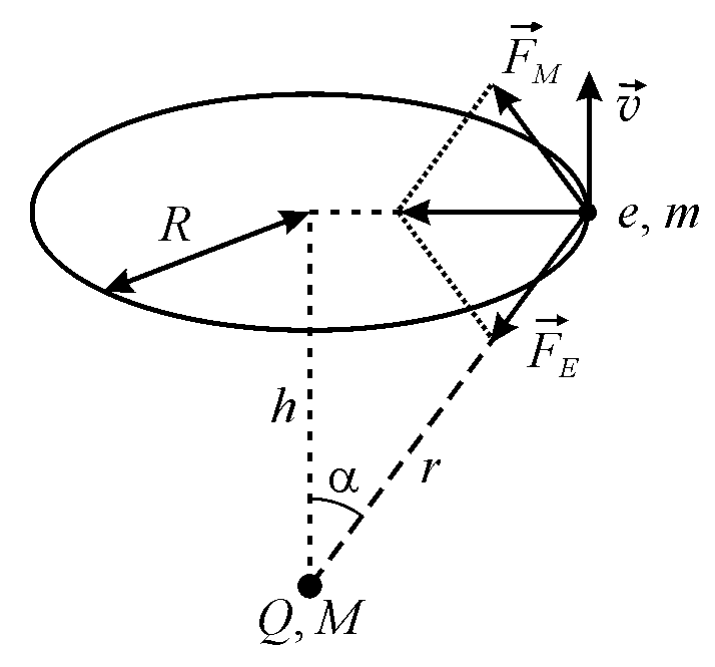
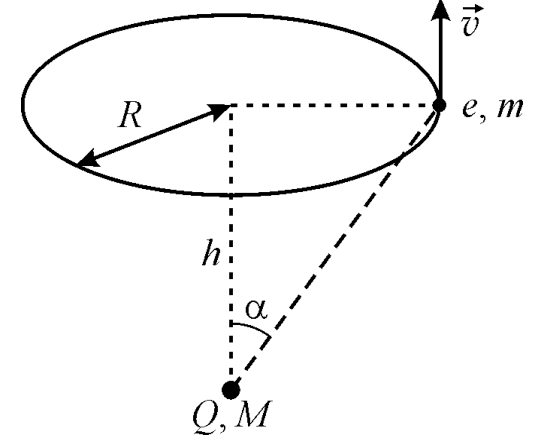
2.1. The particle is set into motion so that it travels in the field of the dyon in a circular orbit at a constant velocity (emission of electromagnetic waves at such a velocity is negligible). Determine a possible radius of the orbit. The answer must be represented by a formula. Sketch the dyon, the particle, and its orbit. [3 т.]
2.2. Show the orbit location relative to the dyon (determine all necessary geometrical parameters and write down the corresponding formulae). Indicate these parameters on the plot sketched in 2.1. [2 т.]
2.3. Determine two integrals of motion (a scalar and a vector) which remain constant during the motion of electric particle in the dyon field. Express these integrals via a particle coordinate and a velocity (these formulae must also include the parameters of the system). Derive the formulae for the integrals of motion for the circular orbit studied above (the answer must be given as an equation which includes the system parameters and ). [9 т.]
Hint. The vector integral at M = 0 must become angular momentum of the particle which is obviously conserved during the particle motion in the field of a point-like electric charge. When M ≠ 0 the vector integral equals the net angular momentum of the system consisting of the dyon, the particle, and their electromagnetic field.
Mathematical hint. The following identity can be helpful: .
Part III: Magnetic Monopole and Quantization of Electric Charges.
Consider a particle of mass m and electric charge q traveling in the field of an immobile monopole with a magnetic charge M. Let the particle start its motion far away from the monopole at a velocity , and an impact parameter b (this is the perpendicular distance between the monopole and the particle extrapolated path, see the Figure). It turns out that the value of b was such that after the particle has passed by the monopole and moved far away from it, it travels in a plane parallel to the plane of the Figure at a distance d.
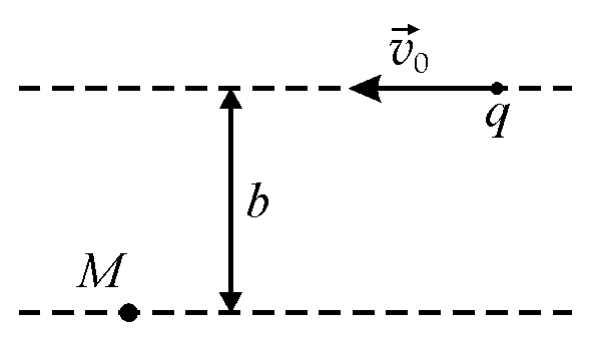
3.1. Determine a particle velocity after it was scattered on the monopole (i.e. when the particle was far away from the monopole). The answer must be given as a formula including the quantities introduced above. [1 т.]
3.2. Determine all possible values of the scattering angle (the angle between and ). The answer must be given as a formula including the quantities introduced above. [4 т.]
3.3. Determine the perpendicular distance between the monopole and the particle path after the scattering. The answer must be given as a formula including the quantities introduced above. [4 т.]
In classical physics magnetic and electric charges can take arbitrary values, however, in quantum theory this is no longer true. The point is that in quantum theory the angular momentum of a particle (aka orbital angular momentum) and the angular momentum of electromagnetic field obey the rule of quantization of angular momentum: any vector component of angular momentum must be a multiple integer of , where J·s is the fundamental Planck constant.
3.4. Consider a particle with an electric charge q moving in the field of magnetic charge M and use the law of quantization of angular momentum. Determine the condition relating q and M, such that the conservation laws specific for this problem and the law of quantization of angular momentum do not disagree. Determine a value of magnetic charge for which any electric charge is a multiple of the elementary charge C. The answer must be a formula which relates magnetic and electric charges and the numerical value of M in C·m/s. [4 т.]
Отговори
1.1. Graph (Fig. 1 of the official solution): , a monotonic increase of current reaching a constant positive value as .
1.2. 2 mA
Table of answers: mA and m/s. The text of the official solution instead prints mA and m/s; both are kept as printed.
1.3. Qualitative graphs, Fig. 2, Fig. 3 (or Fig. 3') and Fig. 4 of the official solution.
1.4. 0.000006 m/s
; m/s.
2.1.
2.2.
2.3.
3.1.
3.2.
3.3.
The table of answers prints ; the solution text derives and (hence ).
3.4. C·m/s
( an integer); C·m/s.
Решение
Proposed Solution
Part I
1.1. There are two possible methods of solution.
Method 1: Magnetic charges must be introduced into electrodynamics so that the "symmetry" of the electrodynamic equations is preserved when replacing a magnetic charge with an electric one and at the same time a magnetic field with an electric one (as can be seen from the task, the magnetic field of a stationary magnetic charge fully coincides with the electric field of a stationary electric charge if necessary replacements are made: , and ). As you know, moving electric charges create magnetic fields. The electric field of a point electric charge is , where vector connects the point of charge location and the observation point P, that is, (here is the radius vector that sets the position of the charge relative to the origin of the coordinate system). The magnetic field of a moving charge can be determined from the Bio-Savard-Laplace law: (taking into account that ). Thus, for a point charge moving at a speed , . Keeping in mind dimensional considerations and the mentioned symmetry we can conclude that a moving magnetic charge creates an electric field . We emphasize that this is a total field created by a uniformly moving charge (at variable speed, radiation also emerge).
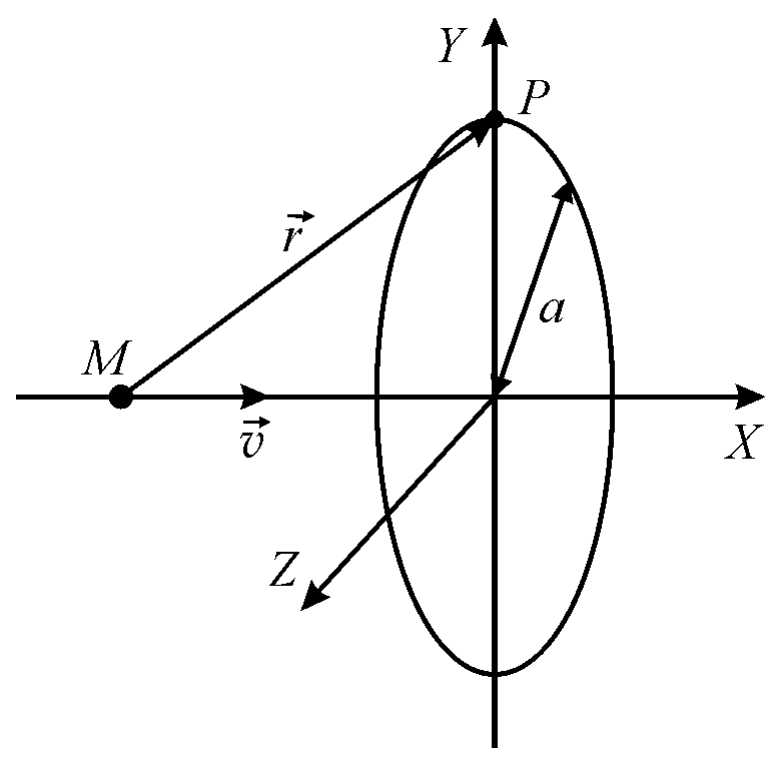
Now consider the passage of a monopole through a superconducting ring. We introduce the coordinate system shown in the figure: origin is in the center of the ring, the X axis is along the symmetry axis of the ring, the Y axis is directed to the selected element P of the ring. The monopole velocity , the law of its motion , and . The electric field created by the monopole at point P is . Since this field is symmetric about the axis, the monopole field in the ring creates an emf equal to . The emf created in the superconducting ring should remain zero for any finite current. The emf in the ring is composed of the “external” EMF created by external fields, and the self-induction emf . The expression for the EMF of the electric field of the monopole obtained above can be written in the form of the time derivative: . Therefore, the condition that the total emf is equal to zero leads to the relation
The constant is calculated as . Thus, . The graph of this function is shown in the figure .
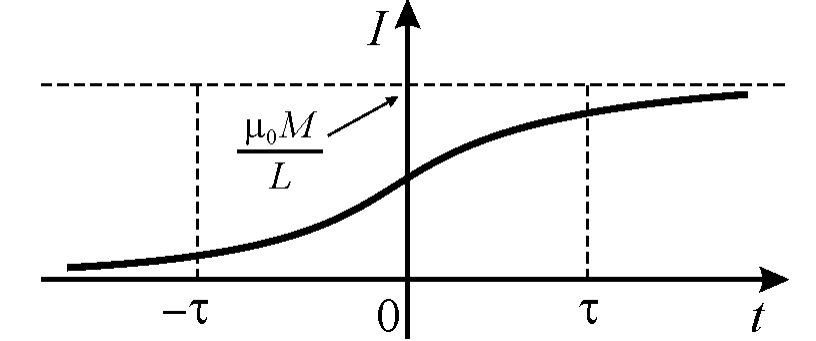
The correctness of plot is determined by the following features: a monotonic increase of current , reaching a constant positive value as .
Method 2: Another method is based on the Faraday's law of induction and the law of total current. In this case, it is important to take into account that the electric field of the moving monopole, which we calculated above, can be represented as the sum of the vortex induction field (which creates the induction emf ) and the field magnetic current. We start with calculating , the flux from the magnetic field of the monopole through the loop. Since the magnetic field of a monopole is similar to the electric field of a point electric charge, this magnetic flux is . Here, is the solid angle enclosed by the cone at which the vertex is at the monopole location and the base is the area of the ring. The half-angle α of this cone is determined from the relation . The value of the solid angle (according to the mathematical hint)
Therefore:
To take into account the contribution from the magnetic current, we use the total current law, according to which the circulation of the magnetic induction vector along an arbitrary circuit in vacuum is equal to the total electric current penetrating this circuit times . Note that the circulation of vector is calculated as follows: the contour is divided into infinitesimal elements and scalar products are calculated. The sum of these scalar products is circulation. In fact, such an operation (summation of an infinitely large number of infinitesimal contributions) is integration along a closed circuit, therefore it is denoted by the symbol , thus, the law of the total current can be written as follows: . The circulation of the electric field is the EMF. Therefore, the contribution to the emf of the magnetic field can be written as . The EMF is proportional to the rate of change of the magnetic charge passed through the circuit at time . In case of the magnetic monopole passage , the law of change of the magnetic charge is , and this expression can also be written in the following form . Thus, the condition that the total EMF is equal to zero leads to the relation , and taking into account the fact that as , all three terms in brackets are equal to zero, we obtain: . Substituting here the expression for , we finally find: . We got the same expression as in the first method.
1.2. The expression for the current in the ring obtained in the previous paragraph can be written as a function depending on if we assume that the monopole velocity changes very insignificantly (). In fact, we have already used this approximation, since we used the formula for the field of a uniformly moving charge, so in the end its applicability will need to be checked. If it is valid, . The maximum current is achieved at , that is, mA (the inductance is determined by the Grover formula: H).
In the process of movement, the monopole expends its kinetic energy to increase the energy of the magnetic field of the ring. The minimum speed corresponds to the position of the monopole at which the current is maximum, i.e.
Even very rough numerical estimates show that , that is, the decrease in the kinetic energy of the monopole is really very small and its speed changes insignificantly (we can assume that ). Therefore, m / s.
Note: since taking the magnetic current field into account is a rather non-trivial part of the problem, at the Olympiad a positive mark for points 1.1 and 1.2 was put up for participants who, without making other errors, got the result using a model that does not take this contribution into account.
1.3. A) For a large resistance any effect of the EMF due to self-induction is small and the induction current is proportional to the EMF of «external» induction which, in turn, is proportional to the rate of magnetic flux variation. During the magnetic monopole passage the flux increases at first, then drops «abruptly» reversing the sign, then leaps upward and reverses the sign again, and finally returns to the initial zero value. The induction current is shown in Fig.2. Notice that this plot is similar to the derivative of the function in Fig.1.
B) If , the EMF of self-induction is negligible only «far outside» from the time interval (t = 0 is the moment of passage through the ring) when the monopole is far away from the ring. Within the time interval the EMF of self-induction is, on the contrary, very large thereby opposing a change of induction current in the ring. Therefore, the maximum current attained when the monopole was approaching the ring remains approximately constant when the monopole passes through the ring. After the monopole leaves this interval, the current returns to the «quasi-stationary» dependence in a time which is small compared to (see Fig.3).
C) A thin linear cylindric magnet is a magnetic dipole. The lines of magnetic induction of such a magnet come out of one pole and enter the other one. When the dipole passes through the ring the magnetic flux grows at first, then rapidly drops, and then changes smoothly near the minimum (goes through 0 when the magnet middle point coincides with the ring plane). Then the flux reaches the maximum again and after that slowly decays. A time dependence at a large resistance corresponds to the rate of change of magnetic flux (see Fig.4).
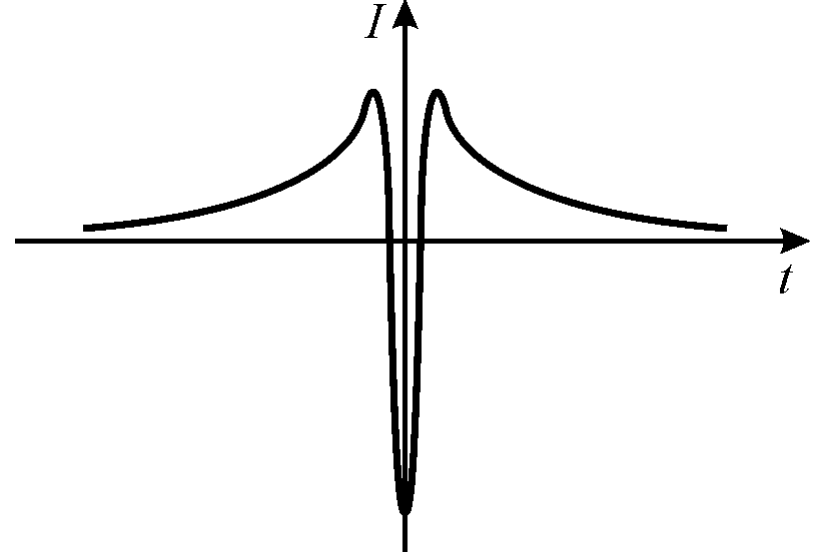
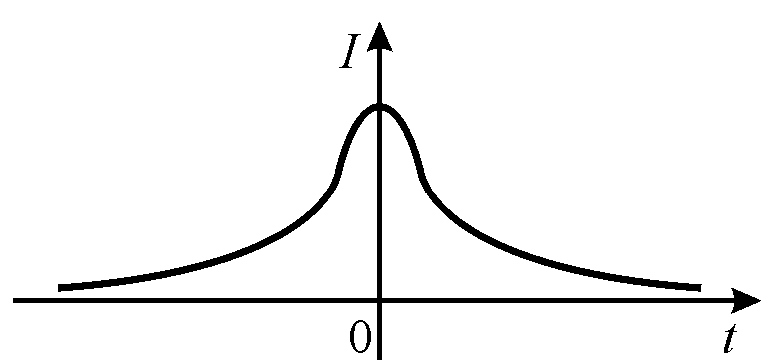
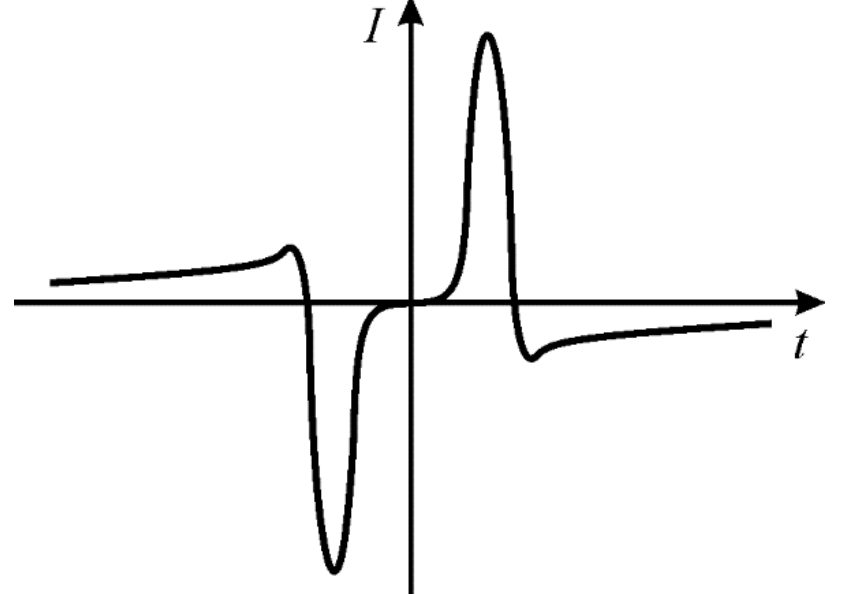
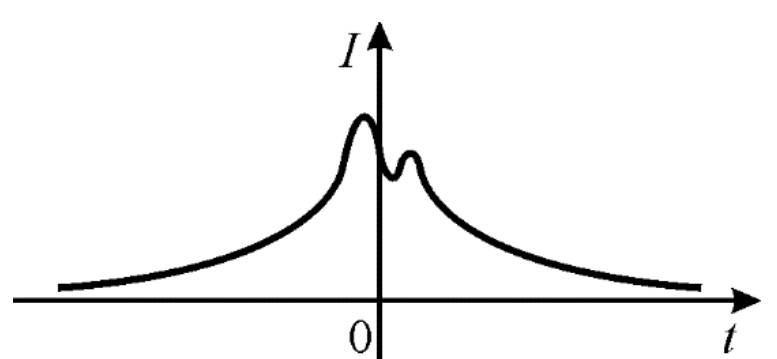
Correctness of a plot should be judged according to the following criteria: the number of «outbursts», their «polarity», symmetry or antisymmetry. The plot in Fig.3 can be «distorted» near the maximum: it can be «cut off» or exhibit a small variation of the current as in Fig.3'.
1.4. First, notice that the kinetic energy of monopole partially converts into the energy of magnetic field of the induction current () and into the heat released in the conducting ring (). The ring inductance in our case is H and the electrical resistance equals Ω. For the induction losses are negligible compared to the thermal ones. The former are significant only for where the flux changes rapidly, so a calculation which does not take into account the induction losses results in a current exceeding , which is obviously impossible (electrical resistance of the ring cannot increase the current). The “external” EMF (see 1.1) is determined by the expression . Thus, the magnitude of the induction current at the time when the monopole is at a distance from the circuit (we assume that when approaching the ring and after flying through it) and moves with speed is equal to . For the given ring dimensions , therefore it is reasonable to consider that . Hence, the plot in Fig.3 approximately corresponds to the time dependence of induction current and we can use the obtained expression for the current as a reasonable approximation for any moment of time. In this approximation the instantaneous power of heat losses becomes . It is also clear that in the case at hand monopole acceleration is very small like in the previous cases (see 1.2). Therefore, a net heat released in the ring is approximately equal to . Since , we have , and
Now, using the law of conservation of energy one can write:
Since the change of velocity is small, we obtain m/s. Note that in questions 1.3 and 1.4, the absence of taking into account the contribution of the magnetic current field does not lead to a significant distortion of the results. Therefore, in these questions for solutions without taking into account the specified contribution, a full score was marked.
Part II
2.1. Notice that motion of a charged particle with a mass m and a charge q in the field of a heavy dyon conserves the sum of the particle kinetic energy and the potential energy of its interaction with the electric field of the dyon. The work done by the magnetic component of the Lorentz force is identically zero and the work of the electrical component can be computed as a difference of potential energy (r is a distance between the particle and the dyon). Thus, . Therefore, if the particle velocity is constant, the distance to the dyon must be constant as well. This implies that the dyon must reside at the axis of symmetry of a particle circular orbit (the axis passes through the orbit center perpendicular to the orbit plane, see the Figure). The force exerted on the particle, , must be directed at the orbit center. Recall that magnetic induction of the dyon points in the radial direction from it. By now it should be clear that such a motion is possible only for providing the magnetic and electric components of the Lorentz force balance each other in the direction perpendicular to the orbit plane:
The radius r can be determined from the equation of centripetal acceleration,
yielding . It is interesting that this formula does not include M: the distance to the points of the circular orbit of a charged particle in the electromagnetic field of the dion coincides with the radius of its circular orbit in the field of only the electric charge of the dion. However, the magnetic field of the dyon displaces the particle orbital plane so that the dyon is not at this plane anymore.
2.2. According to the above analysis, the orbit of a radius is at the plane separated from the dyon by a distance where the dyon is at the orbit symmetry axis. The orbit subtends an angle from the dyon location. Obviously, any two of these three quantities completely determine the orbit.
2.3. Now it should be clear that the scalar integral of motion is given by the total mechanical energy of the particle: . The vector integral of motion must be related to the angular momentum which is obviously conserved in the field of an immobile electric charge if M = 0. The rate of change of the particle angular momentum during motion in a circular orbit is only due to the magnetic component of the Lorentz force (the torque of the electric force vanishes):
Since and , we obtain
Thus, ! A vector quantity is conserved for a charged particle traveling in the dyon field. Evaluating and (from symmetry considerations is directed along the orbit axis) by means of the derived expressions for and yields: and , where the unit vector points from the dyon to the center of particle orbit.
Comments. Electromagnetic field is an independent type of matter which carries energy, momentum (its energy flux and momentum flux are related by the Pointing vector ), and, accordingly, angular momentum. Angular momentum of an isolated system must be conserved, in our case this conserved angular momentum equals to the sum of angular momenta of the particle and electromagnetic field in the reference frame of the dyon (one can see that for our system !). Therefore, the second term in is the angular momentum of electromagnetic field and is the net angular momentum of the system consisting of a dyon, a charged particle, and electromagnetic field.
Part III:
3.1. According to 2.3, motion of a charged particle in the field of magnetic monopole conserves the particle kinetic energy and the vector .
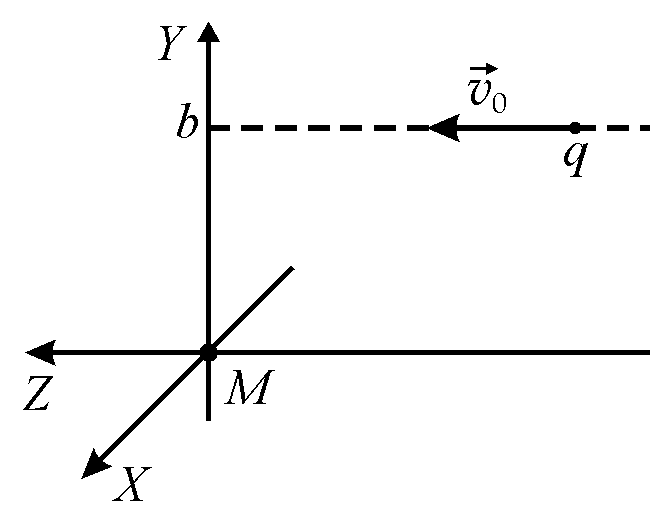
Let us introduce the reference frame shown in the Figure. When the particle is far away from the monopole, , , , and , where . Then
After scattering on the monopole (and very far from it) the particle will travel along a straight line at a velocity . Clearly, because is conserved.
3.2. Let be a unit vector in the direction of and be a vector pointing from the monopole to the closest point at the line of particle motion after the scattering. Then the position vector of the particle, when it is at a distance r from the monopole, equals . According to the frame choice, vector is parallel to (yz), i.e. one can write , where is the angle between and . It is also evident that . Using the conservation laws, we obtain:
To simplify derivation, we introduce the notation and evaluate the cross product of the above equation with , which gives: . Substituting the expression for in this formula, we obtain: . Hence, the distance to the plane of particle motion after the scattering is . Therefore, there are two possible values of the scattering angle: and . One can see that the problem is well posed only for (all allowed values of d fall into this range).
3.3. It follows from the equation for that its absolute value is . In addition, when raising the equality scalar squared, we find, taking into account the perpendicularity of the vectors and , as well as the vectors and such that . Since and are also perpendicular, then . It follows that ! This means that the restriction on is even more strong: from the two relations obtained it follows that . At the same time, obviously, , i.e., or . In fact, the case is realized only as the limit for very large and . As can be seen, when a charge is scattered by a monopole, in which the charge after scattering moves parallel to the original plane of motion, the charge actually moves in this plane!
3.4. One can argue that the component of the angular momentum of electromagnetic field in the system «magnetic monopole + particle + field» in the direction of must be a multiple of . This implies the relation , where is an integer. Therefore, in a self-consistent theory a charge of any particle must be a multiple of the elementary charge provided C·m/s.
TABLE OF ANSWERS AND EVALUATION CRITERIA
| № | ANSWER | Maximum score |
|---|---|---|
| 1.1. | Fig. 1. | 1 |
| 1.2. | ; | 2 |
| mA, the value must be correct upon rounding to the nearest integer of mA; | 0,75 + 0,25 = 1 | |
| m/s, the value must be correct upon rounding to an integer multiplied by m/s. | 1,5 + 0,5 = 2 | |
| 1.3. | Fig. 2. Fig. 3. Fig. 4. | 1 + 2 + 1 = 4 (two points for the plot in Fig.3) |
| 1.4. | ; | 2 |
| m/s, if a value falls in the interval of a «double» width, the score is 1 point. | 3 | |
| 2.1. | (Any two of these three quantities: R, h, or α must be indicated.) | 2 + 1 = 3 |
| 2.2. | Orbit of radius lies in a plane at from the dyon, the radius subtends an angle from the dyon location (any two of these three quantities must be indicated on the diagram). | 1 + 1 = 2 |
| 2.3. | ; | 1 |
| . | 4 | |
| On the specified orbit . | 1 | |
| On the specified orbit , where the unit vector points from the dyon location to the orbit center. | 3 | |
| 3.1. | 1 | |
| 3.2. | or . OR and | 2×2=4 |
| 3.3. | . | 4 |
| 3.4. | , where k is an integer | 3 |
| 1 | ||
| TOTAL | 42 |
Оригинал в Архива: phys-theory3-2019-en.pdf · официални решения: phys-theory3-solutions-2019-en.pdf