IOM 2020, Експеримент — Задача 14
Answer Sheet
Внимание: Бележка към темата
The source is the experimental-round answer sheet with the official answers overlaid in red; the task description with the experiment setup (videos) is not in the archive, and the answer-sheet pictures are available only with the answers drawn on them.
Условие
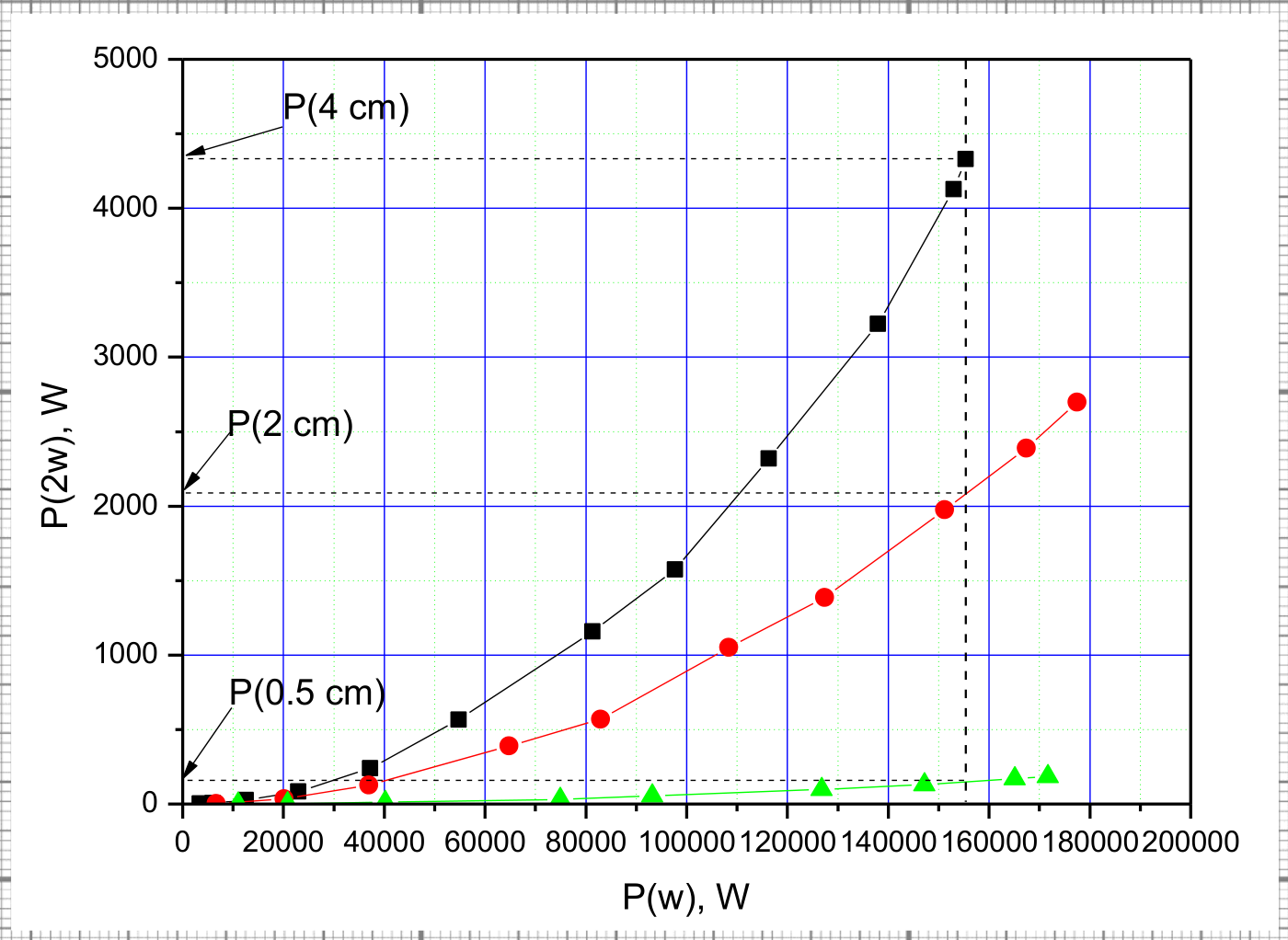
Q.14 a) Using the experimental data on the dependence of the second harmonic power on the first harmonic power for all crystals, plot the dependence of the second harmonic power on the crystal length for the same maximum possible power of the first harmonic.
Q.14 b) Can this dependence of the second harmonic power on the crystal length be expressed in terms of a power function? If possible, indicate the degree.
Q.14 c) Briefly describe the reason why the experimental dependence of the second harmonic power on the crystal length differs from the theoretical one. Write down the answer in English.
Отговори
- Q.14 b) No
- Q.14 c) This is due to the laser beam divergence.
Решение
Answer 14 a)
You need to plot somewhere all three graphs P (2w) versus P (w). Understand that you need to take the power P (2w) with the same power and maximum possible power P (w).
Plot the dependence of P (w) on L. And it is best on a double logarithmic scale.
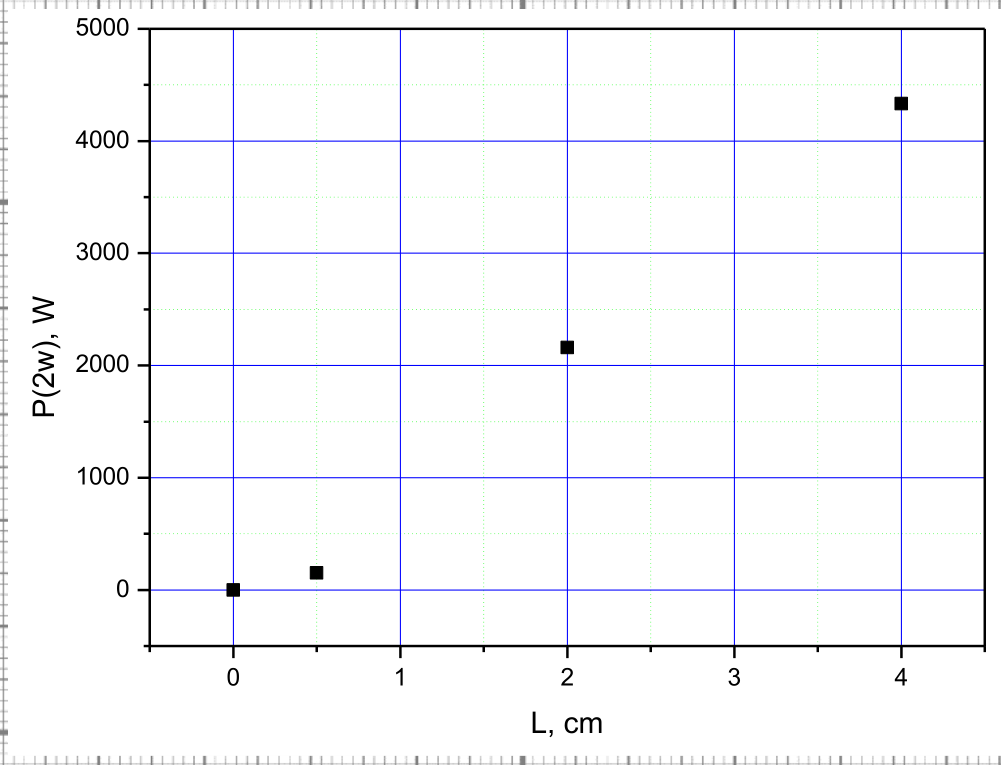
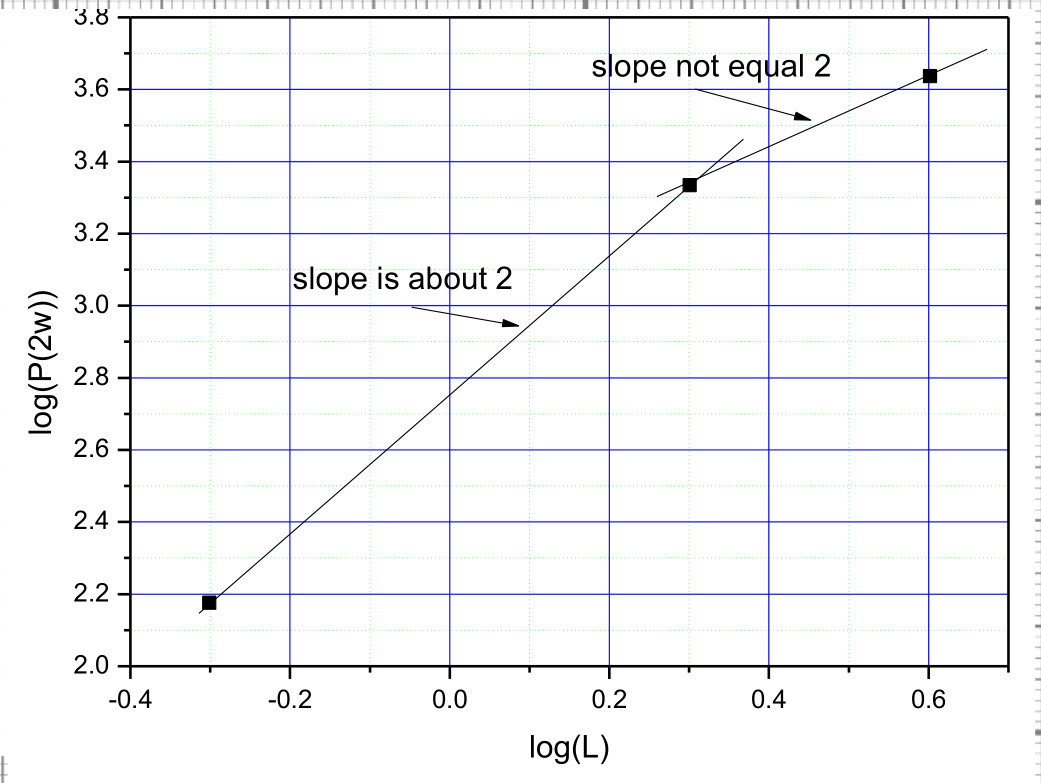
There is also a point (0, 0) on the linear scale. There are only three crystals (0.5, 2 and 4 cm), but nobody canceled zero. It can be seen that this is not a power dependence.
On a logarithmic scale (even if there is no zero point), it is obvious that this is not a power dependence.
Answer 14 b) No
From the previous logarithmic graph, you can see that it is impossible.
Answer 14 c) This is due to the laser beam divergence. The divergence width of the laser beam is comparable to the phase matching width for crystals of 2 and 4 cm. Therefore, not all of the beam energy is converted equally effectively into SH. Theory is for plane waves. The longer the crystal, the more it differs from theory.
Experimental data for second harmonic generation.
| KDP 0.5 cm | KDP 2.0 cm | KDP 4.0 cm | |||
|---|---|---|---|---|---|
| First harmonic Power, Watts | Second harmonic Power, Watts | First harmonic Power, Watts | Second harmonic Power, Watts | First harmonic Power, Watts | Second harmonic Power, Watts |
| 11040 | 0.801 | 6662 | 3.725 | 3413 | 1.902 |
| 20850 | 2.517 | 20170 | 35.31 | 5990 | 5.867 |
| 40230 | 10.111 | 36980 | 126.1 | 12580 | 26.88 |
| 74900 | 32.14 | 64740 | 390.2 | 22940 | 84.08 |
| 93200 | 54.09 | 82900 | 569 | 37210 | 240.2 |
| 126800 | 97.89 | 108400 | 1050 | 54780 | 565.9 |
| 147200 | 131.1 | 127400 | 1387 | 81350 | 1157 |
| 165100 | 169.7 | 151200 | 1977 | 97730 | 1574 |
| 171700 | 184.2 | 167400 | 2388 | 116300 | 2319 |
| 177500 | 2697 | 138000 | 3224 | ||
| 153000 | 4127 | ||||
| 155400 | 4331 |
Experimental data for third harmonic generation.
| First harmonic Power, Watts | Third harmonic Power, Watts | Second harmonic Power, Watts | Third harmonic Power, Watts |
|---|---|---|---|
| 7768 | 0.4 | 147 | 9.01 |
| 12950 | 1.5 | 432.8 | 30.13 |
| 26010 | 9.2 | 667.8 | 51.41 |
| 40890 | 30.77 | 1384 | 123.9 |
| 58310 | 70.1 | 2182 | 217.3 |
| 76790 | 110.9 | 3000 | 318.9 |
| 98830 | 210 | 4546 | 557 |
| 117900 | 265.5 | 4913 | 577.8 |
| 137000 | 412.9 | 5550 | 678.3 |
| 154600 | 502.8 | ||
| 162900 | 685.1 | ||
| 166200 | 676.7 |
Оригинал в Архива: exp.pdf