IPhO 1967, Теория и експеримент — Задача 3
Problems of the 1st International Physics Olympiad (Warsaw, 1967) · 10 т.
Source history and reconstruction
Problems of the 1st International Physics Olympiad1
(Warsaw, 1967)
Waldemar Gorzkowski
Institute of Physics, Polish Academy of Sciences, Warsaw, Poland2
Abstract
The article contains the competition problems given at he 1st International Physics Olympiad (Warsaw, 1967) and their solutions. Additionally it contains comments of historical character.
Introduction
One of the most important points when preparing the students to the International Physics Olympiads is solving and analysis of the competition problems given in the past. Unfortunately, it is very difficult to find appropriate materials. The proceedings of the subsequent Olympiads are published starting from the XV IPhO in Sigtuna (Sweden, 1984). It is true that some of very old problems were published (not always in English) in different books or articles, but they are practically unavailable. Moreover, sometimes they are more or less substantially changed.
The original English versions of the problems of the 1st IPhO have not been conserved. The permanent Secretariat of the IPhOs was created in 1983. Until this year the Olympic materials were collected by different persons in their private archives. These archives as a rule were of amateur character and practically no one of them was complete. This article is based on the books by R. Kunfalvi [1], Tadeusz Pniewski [2] and Waldemar Gorzkowski [3]. Tadeusz Pniewski was one of the members of the Organizing Committee of the Polish Physics Olympiad when the 1st IPhO took place, while R. Kunfalvi was one of the members of the International Board at the 1st IPhO. For that it seems that credibility of these materials is very high. The differences between versions presented by R. Kunfalvi and T. Pniewski are rather very small (although the book by Pniewski is richer, especially with respect to the solution to the experimental problem).
As regards the competition problems given in Sigtuna (1984) or later, they are available, in principle, in appropriate proceedings. “In principle” as the proceedings usually were published in a small number of copies, not enough to satisfy present needs of people interested in our competition. It is true that every year the organizers provide the permanent Secretariat with a number of copies of the proceedings for free dissemination. But the needs are continually growing up and we have disseminated practically all what we had.
The competition problems were commonly available (at least for some time) just only from the XXVI IPhO in Canberra (Australia) as from that time the organizers started putting the problems on their home pages. The Olympic home page www.jyu.fi/ipho contains the problems starting from the XXVIII IPhO in Sudbury (Canada). Unfortunately, the problems given in Canberra (XXVI IPhO) and in Oslo (XXVII IPhO) are not present there.
The net result is such that finding the competition problems of the Olympiads organized prior to Sudbury is very difficult. It seems that the best way of improving the situation is publishing the competition problems of the older Olympiads in our journal. The
1 This is somewhat extended version of the article sent for publication in Physics Competitions in July 2003. 2 e-mail: gorzk@ifpan.edu.pl
question arises, however, who should do it. According to the Statutes the problems are created by the local organizing committees. It is true that the texts are improved and accepted by the International Board, but always the organizers bear the main responsibility for the topics of the problems, their structure and quality. On the other hand, the glory resulting of high level problems goes to them. For the above it is absolutely clear to me that they should have an absolute priority with respect to any form of publication. So, the best way would be to publish the problems of the older Olympiads by representatives of the organizers from different countries.
Poland organized the IPhOs for thee times: I IPhO (1967), VII IPhO (1974) and XX IPhO (1989). So, I have decided to give a good example and present the competition problems of these Olympiads in three subsequent articles. At the same time I ask our Colleagues and Friends from other countries for doing the same with respect to the Olympiads organized in their countries prior to the XXVIII IPhO (Sudbury).
I IPhO (Warsaw 1967)
The problems were created by the Organizing Committee. At present we are not able to recover the names of the authors of the problems.
Editorial source note: this is Waldemar Gorzkowski’s extended 2003 historical reconstruction, including worked solutions. It explicitly states that the original English versions were not conserved. The five tasks below preserve this edition; they are not presented as surviving original 1967 English sheets.
Условие
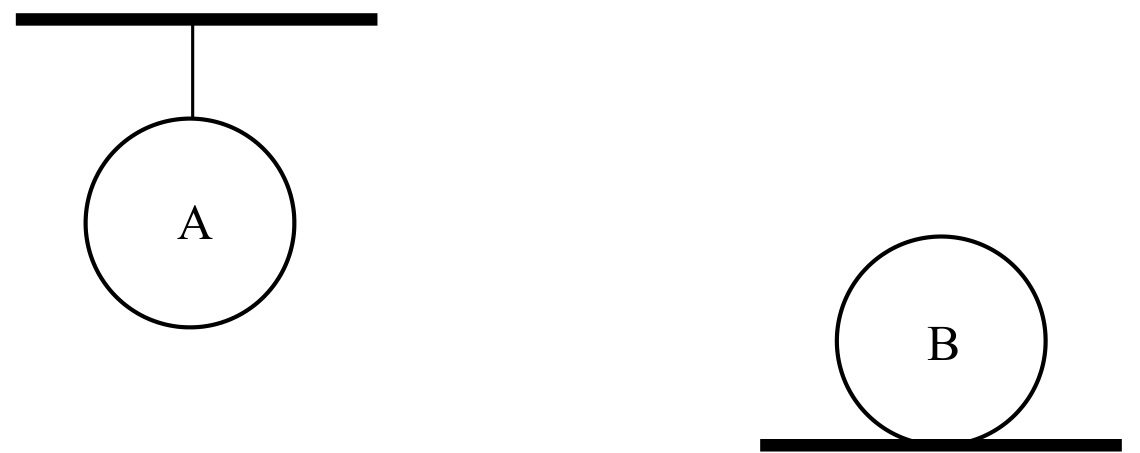
Consider two identical homogeneous balls, A and B, with the same initial temperatures. One of them is at rest on a horizontal plane, while the second one hangs on a thread (Fig. 6). The same quantities of heat have been supplied to both balls. Are the final temperatures of the balls the same or not? Justify your answer. (All kinds of heat losses are negligible.)
Решение
As regards the text of the problem, the sentence “The same quantities of heat have been supplied to both balls.” is not too clear. We will follow intuitive understanding of this sentence, i.e. we will assume that both systems (A – the hanging ball and B – the ball resting on the plane) received the same portion of energy from outside. One should realize, however, that it is not the only possible interpretation.
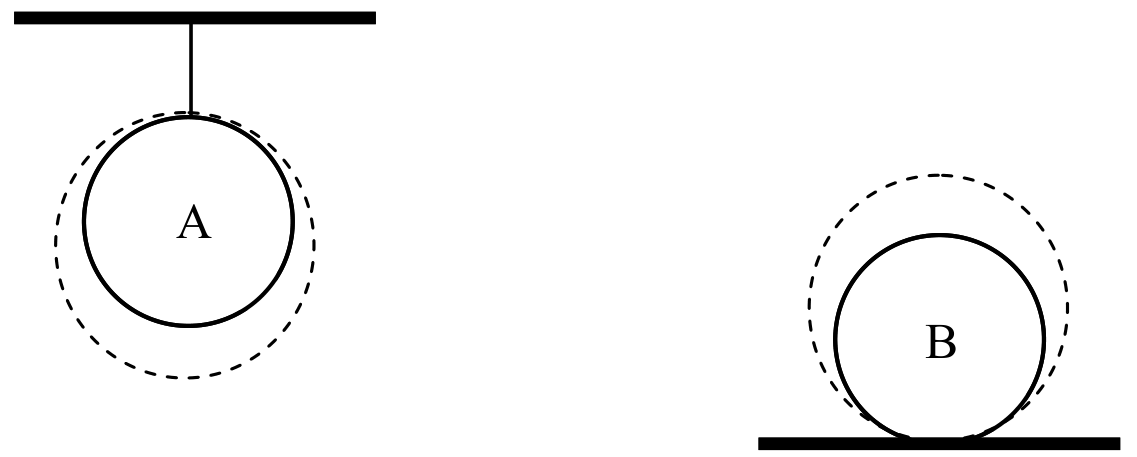
When the balls are warmed up, their mass centers are moving as the radii of the balls are changing. The mass center of the ball A goes down, while the mass center of the ball B goes up. It is shown in Fig. 7 (scale is not conserved).
Displacement of the mass center corresponds to a change of the potential energy of the ball in the gravitational field.
In case of the ball A the potential energy decreases. From the 1st principle of thermodynamics it corresponds to additional heating of the ball.
In case of the ball B the potential energy increases. From the 1st principle of thermodynamics it corresponds to some “losses of the heat provided” for performing a mechanical work necessary to rise the ball. The net result is that the final temperature of the ball B should be lower than the final temperature of the ball A.
The above effect is very small. For example, one may find (see later) that for balls made of lead, with radius 10 cm, and portion of heat equal to 50 kcal, the difference of the final temperatures of the balls is of order K. For spatial and time fluctuations such small quantity practically cannot be measured.
Calculation of the difference of the final temperatures was not required from the participants. Nevertheless, we present it here as an element of discussion.
We may assume that the work against the atmospheric pressure can be neglected. It is obvious that this work is small. Moreover, it is almost the same for both balls. So, it should not affect the difference of the temperatures substantially. We will assume that such quantities as specific heat of lead and coefficient of thermal expansion of lead are constant (i.e. do not depend on temperature).
The heat used for changing the temperatures of balls may be written as
Here: denotes the mass of ball, - the specific heat of lead and - the change of the temperature of ball.
The changes of the potential energy of the balls are (neglecting signs):
Here: denotes the gravitational acceleration, - initial radius of the ball, - coefficient of thermal expansion of lead. We assume here that the thread does not change its length.
Taking into account conditions described in the text of the problem and the interpretation mentioned at the beginning of the solution, we may write:
denotes the thermal equivalent of work: . In fact, is only a conversion ratio between calories and joules. If you use a system of units in which calories are not present, you may omit at all.
Thus
and
Finally we get
(We neglected the term with as the coefficient is very small.)
Now we may put the numerical values: kcal, cal/J, m/s, kg (mass of the lead ball with radius equal to 10 cm), m, cal/(g·K), K. After calculations we get K.
Marks and references
No marking schemes are present in my archive materials. Only the mean scores are available. They are:
| Problem | Mean score |
|---|---|
| Problem # 1 | 7.6 points |
| Problem # 2 | 7.8 points (without the Romanian students) |
| Problem # 3 | 5.9 points |
| Experimental problem | 7.7 points |
Thanks
The author would like to express deep thanks to Prof. Jan Mostowski and Dr. Yohanes Surya for reviewing the text and for valuable comments and remarks.
Literature
[1] R. Kunfalvi, Collection of Competition Tasks from the Ist trough XVth International Physics Olympiads, 1967 – 1984, Roland Eötvös Physical Society and UNESCO, Budapest 1985
[2] Tadeusz Pniewski, Olimpiady Fizyczne: XV i XVI, PZWS, Warszawa 1969
[3] Waldemar Gorzkowski, Zadania z fizyki z całego świata (z rozwiązaniami) - 20 lat Międzynarodowych Olimpiad Fizycznych, WNT, Warszawa 1994 [ISBN 83-204-1698-1]
Оригинал в Архива: ipho67.pdf