Problems of the 2nd International Physics Olympiads (Budapest, Hungary, 1968)
Условие
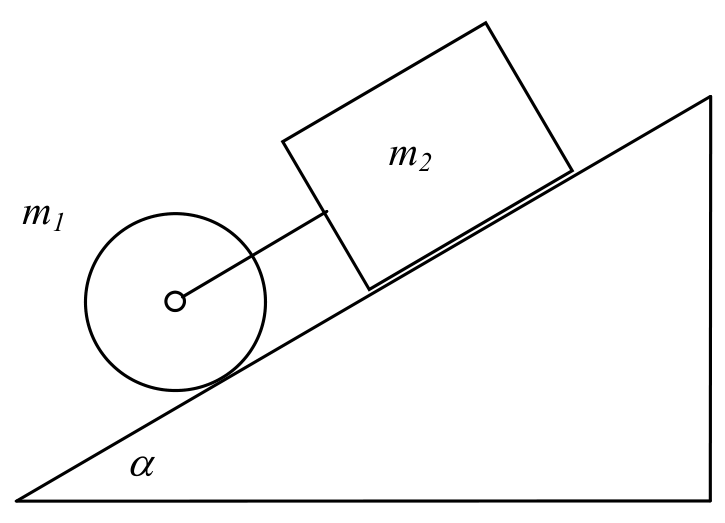
On an inclined plane of 30° a block, mass m2=4kg, is joined by a light cord to a solid cylinder, mass m1=8kg, radius r=5cm (Fig. 1). Find the acceleration if the bodies are released. The coefficient of friction between the block and the inclined plane μ=0.2. Friction at the bearing and rolling friction are negligible.
Figure 1
Отговори
3.25 m/s²
Решение
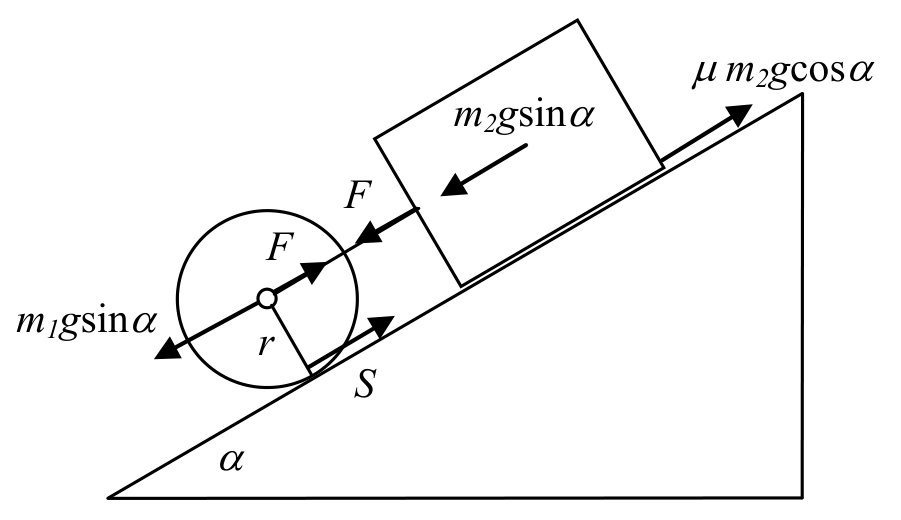
Figure 2
If the cord is stressed the cylinder and the block are moving with the same acceleration a. Let F be the tension in the cord, S the frictional force between the cylinder and the inclined plane (Fig. 2). The angular acceleration of the cylinder is a/r. The net force causing the acceleration of the block:
m2a=m2gsinα−μm2gcosα+F,
and the net force causing the acceleration of the cylinder:
m1a=m1gsinα−S−F.
The equation of motion for the rotation of the cylinder:
Sr=ra⋅I.
(I is the moment of inertia of the cylinder, S⋅r is the torque of the frictional force.)
Solving the system of equations we get:
a=g⋅m1+m2+r2I(m1+m2)sinα−μm2cosα,(1)
S=r2I⋅g⋅m1+m2+r2I(m1+m2)sinα−μm2cosα,(2)
F=m2g⋅m1+m2+r2Iμ(m1+r2I)cosα−r2Isinα.(3)
The moment of inertia of a solid cylinder is I=2m1r2. Using the given numerical values:
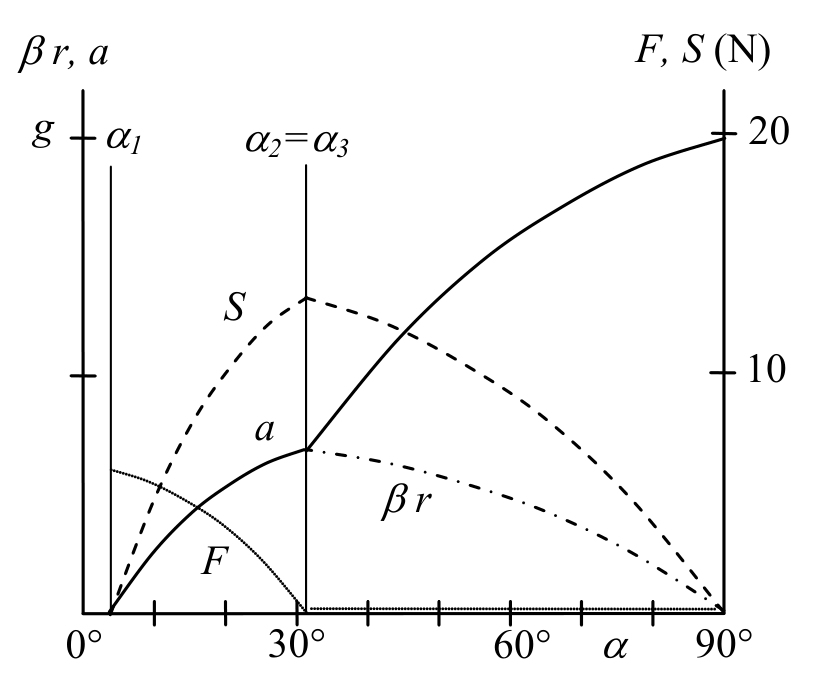
The condition for the system to start moving is a>0. Inserting a=0 into (1) we obtain the limit for angle α1:
tanα1=μ⋅m1+m2m2=3μ=0.0667,α1=3.81∘.
For the cylinder separately α1=0, and for the block separately α1=tan−1μ=11.31∘.
If the cord is not stretched the bodies move separately. We obtain the limit by inserting F=0 into (3):
tanα2=μ⋅(1+Im1r2)=3μ=0.6,α2=30.96∘.
The condition for the cylinder to slip is that the value of S (calculated from (2) taking the same coefficient of friction) exceeds the value of μm1gcosα. This gives the same value for α3 as we had for α2. The acceleration of the centers of the cylinder and the block is the same: g(sinα−μcosα), the frictional force at the bottom of the cylinder is μm1gcosα, the peripheral acceleration of the cylinder is μ⋅Im1r2⋅gcosα.