IPhO 1969, Теория — Задача 4
3rd International Physics Olympiad 1969, Brno, Czechoslovakia
Условие
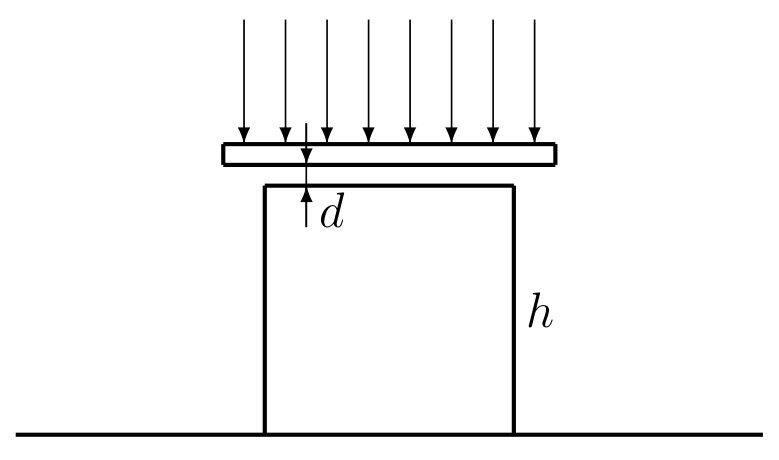
A glass plate is placed above a glass cube of 2 cm edges in such a way that there remains a thin air layer between them, see Figure 5. Electromagnetic radiation of wavelength between 400 nm and 1150 nm (for which the plate is penetrable) incident perpendicular to the plate from above is reflected from both air surfaces and interferes. In this range only two wavelengths give maximum reinforcements, one of them is . Find the second wavelength. Determine how it is necessary to warm up the cube so as it would touch the plate. The coefficient of linear thermal expansion is , the refractive index of the air . The distance of the bottom of the cube from the plate does not change during warming up.
Отговори
- The second wavelength is 666.7 nm; the cube must be warmed up by 3.1 °C.
Решение
Condition for the maximum reinforcement can be written as
i.e.
with being thickness of the layer, the refractive index and maximum order. Let us denote . Since for the condition for maximum is satisfied by the assumption, let us denote , where is an unknown integer identifying the maximum order, for which
holds true. The equation (13) yields that for fixed the wavelength increases with decreasing maximum order and vise versa. According to the assumption,
i.e.
Substituting to the last inequalities for using (14) one gets
Let us first investigate the first inequality, straightforward calculations give us gradually
i.e.
Similarly, from the second inequality we have
i.e.
The only integer satisfying both (15) and (16) is .
Let us now find the thickness of the air layer:
Substituting to the equation (13) we can calculate , i.e. :
Introducing the particular values we obtain
Finally, let us determine temperature growth . Generally, holds true. Denoting the cube edge by we arrive at . Hence
Оригинал в Архива: ipho69.pdf