IPhO 1970, Теория и експеримент — Задача 1. Problem 1.
Problems of the IV International Olympiad, Moscow, 1970
The publication is prepared by Prof. S. Kozel & Prof. V.Orlov (Moscow Institute of Physics and Technology)
The IV International Olympiad in Physics for schoolchildren took place in Moscow (USSR) in July 1970 on the basis of Moscow State University. Teams from 8 countries participated in the competition, namely Bulgaria, Hungary, Poland, Romania, Czechoslovakia, the DDR, the SFR Yugoslavia, the USSR. The problems for the theoretical competition have been prepared by the group from Moscow University stuff headed by professor V.Zubov. The problem for the experimental competition has been worked out by B. Zvorikin from the Academy of Pedagogical Sciences.
It is pity that marking schemes were not preserved.
Условие
A long bar with the mass is placed on a smooth horizontal surface of a table where it can move frictionless. A carriage equipped with a motor can slide along the upper horizontal panel of the bar, the mass of the carriage is . The friction coefficient of the carriage is . The motor is winding a thread around a shaft at a constant speed . The other end of the thread is tied up to a rather distant stationary support in one case (Fig.1, a), whereas in the other case it is attached to a picket at the edge of the bar (Fig.1, b). While holding the bar fixed one allows the carriage to start moving at the velocity then the bar is let loose.
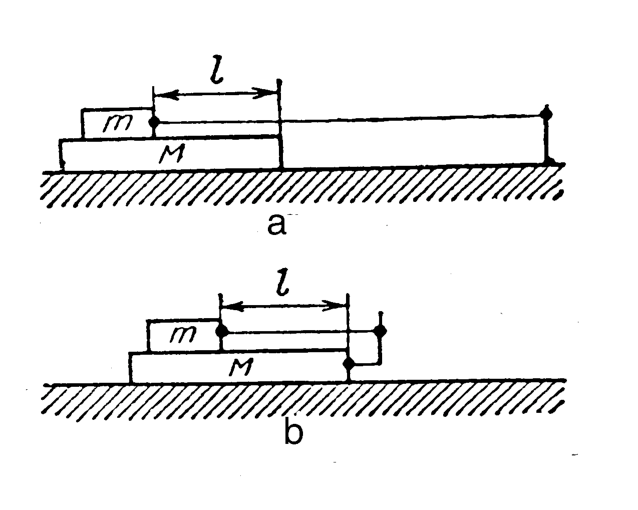
By the moment the bar is released the front edge of the carriage is at the distance from the front edge of the bar. For both cases find the laws of movement of both the bar and the carriage and the time during which the carriage will reach the front edge of the bar.
Отговори
a) The carriage moves uniformly at v0 = 0.1 m/s; the bar accelerates at a = 0.02 m/s² for the first 5 s, then moves together with the carriage (S = 0.25 m < l, so the time cannot be calculated). b) The bar remains fixed; the carriage reaches the edge in t = l/v0 = 5 s.
Summary of the official solution; the solution prints the unit of acceleration as m/s.
Решение
a) By the moment of releasing the bar the carriage has a velocity relative to the table and continues to move at the same velocity.
The bar, influenced by the friction force from the carriage, gets an acceleration ; , while the velocity of the bar changes with time according to the law .
Since the bar can not move faster than the carriage then at a moment of time its sliding will stop, that is . Let us determine this moment of time:
By that moment the displacement of the Sb bar and the carriage Sc relative to the table will be equal to
The displacement of the carriage relative to the bar is equal to
Since , the carriage will not reach the edge of the bar until the bar is stopped by an immovable support. The distance to the support is not indicated in the problem condition so we can not calculate this time. Thus, the carriage is moving evenly at the velocity , whereas the bar is moving for the first 5 sec uniformly accelerated with an acceleration and then the bar is moving with constant velocity together with the carriage.
b) Since there is no friction between the bar and the table surface the system of the bodies “bar-carriage” is a closed one. For this system one can apply the law of conservation of momentum:
where and are projections of velocities of the carriage and the bar relative to the table onto the horizontal axis directed along the vector of the velocity . The velocity of the thread winding is equal to the velocity of the carriage relative to the bar (), that is
Solving the system of equations (1) and (2) we obtain:
Thus, being released the bar remains fixed relative to the table, whereas the carriage will be moving with the same velocity and will reach the edge of the bar within the time equal to
Acknowledgement
The authors would like to thank Professor Waldemar Gorzkowski (Poland) and Professor Ivo Volf (Czech Republic) for their providing the materials of the IV IPhO in the Polish and Czech languages.
References:
- O.Kabardin, V.Orlov, International Physics Olympiads for Pupils, Nauka, Moskva 1985
- W.Gorzkowski, Zadania z fiziki z calego swiata – 20 lat. Miedzyna – rodowych Olimpiad Fizycznych, WNT, Warszawa 1994
- V.Urumov, Prosventno Delo, Skopje 1999
- D.Kluvanec, I.Volf, Mezinarodni Fysikalni Olympiady (metodycky material), MaFy, Hradec Kralowe 1993
Оригинал в Архива: ipho70.pdf