IPhO 1971, Теория и експеримент — Задача 2. Question 2.
V International Physics Olympiad, 1971. Sofia, Bulgaria
Внимание: Бележка към темата
Решенията са архивна адаптация на Victor Ivanov, както е посочено в оригинала. Формули (1.13), (1.17) и (4.6), както и повтореното означение P₂ в числените резултати на задача 2, са запазени според източника. Добавеният множител g в краткия отговор на задача 1 е отделно обозначена редакционна поправка; текстът на архивното решение остава непроменен.
Source
The problems and the solutions are adapted by Victor Ivanov University of Sofia, Faculty of Physics, 5 James Bourchier Blvd., 1164 Sofia, Bulgaria
Reference: O. F. Kabardin, V. A. Orlov, in “International Physics Olympiads for High School Students”, eds. V. G. Razumovski, Moscow, Nauka, 1985. (In Russian).
Theoretical problems
Solutions — source
Solutions to the problems of the 5-th International Physics Olympiad, 1971, Sofia, Bulgaria
The problems and the solutions are adapted by Victor Ivanov Sofia State University, Faculty of Physics, 5 James Bourcier Blvd., 1164 Sofia, Bulgaria
Reference: O. F. Kabardin, V. A. Orlov, in “International Physics Olympiads for High School Students”, eds. V. G. Razumovski, Moscow, Nauka, 1985. (In Russian).
Theoretical problems
Условие
A vertical glass tube of cross section contains unknown amount of hydrogen. The upper end of the tube is closed. The other end is opened and is immersed in a pan filled with mercury. The tube and the pan are placed in a sealed chamber containing air at temperature and pressure . Under these conditions the height of mercury column in the tube above the mercury level in the pan is .
One of the walls of the chamber is a piston, which expands the air isothermally to a pressure of . As a result the height of the mercury column in the tube decreases to . Then the chamber is heated up at a constant volume to some temperature until the mercury column rises to . Finally, the air in the chamber is expanded at constant pressure and the mercury level in the tube settles at above the mercury level in the pan.
Provided that the system is in mechanical and thermal equilibrium during all the processes calculate the mass of the hydrogen, the intermediate temperature , and the pressure in the final state.
The density of mercury at temperature is , the coefficient of expansion for mercury , and the gas constant . The thermal expansion of the glass tube and the variations of the mercury level in the pan are not considered.
Hint. If is the interval of temperature variations of the system then In that case you can use the approximation: .
Отговори
m ≈ 2.11×10⁻⁶ kg; T2 ≈ 364 K; P ≈ 4.8×10⁴ Pa (also H ≈ 1.3 m, P2 ≈ 1.067×10⁵ Pa, T3 ≈ 546 K)
The archived list labels the final pressure „P2 ≈ 4.8×10⁴ Pa“ (the same symbol as the earlier P2 ≈ 1.067×10⁵ Pa); it is the final pressure P asked for in the problem.
Решение
We will denote by ( = const) the height of the tube above the mercury level in the pan, and the height of the mercury column in the tube by . Under conditions of mechanical equilibrium the hydrogen pressure in the tube is:
(2.1) ,
where is the density of mercury at temperature :
(2.2)
The index enumerates different stages undergone by the system, is the density of mercury at , or , and its coefficient of expansion. The volume of the hydrogen is given by:
(2.3) .
Now we can write down the equations of state for hydrogen at points 0, 1, 2, and 3 of the diagram (see Fig. 2):
(2.4)
(2.5)
(2.6)
where , since the process 1–3 is isochoric, and:
(2.7)
where , for the isobaric process 2–3.
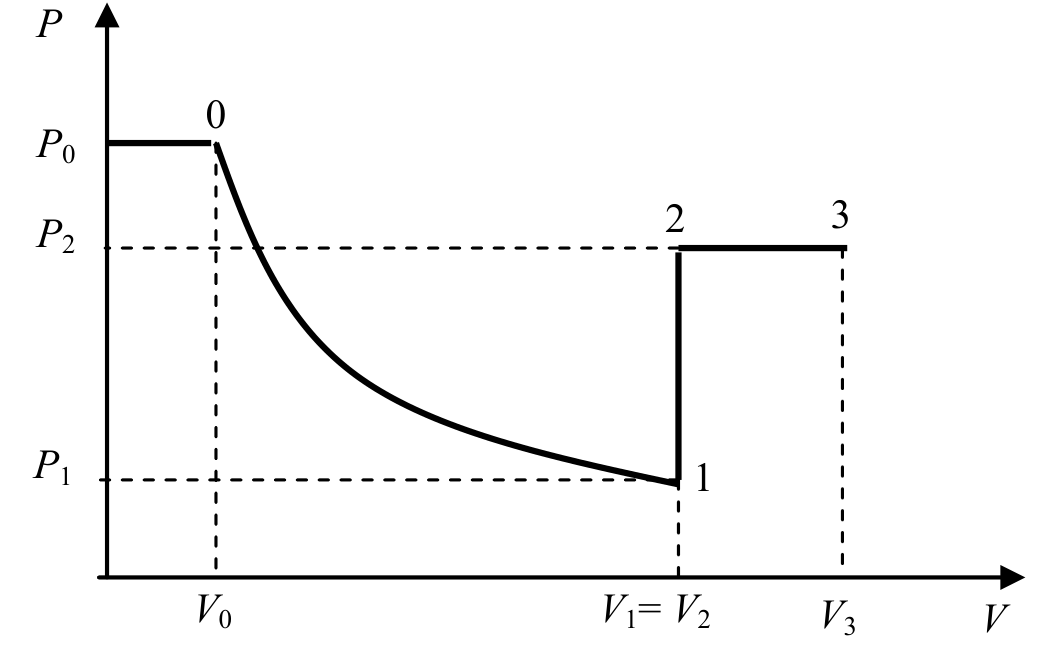
After a good deal of algebra the above system of equations can be solved for the unknown quantities, an exercise, which is left to the reader. The numerical answers, however, will be given for reference:
;
;
;
;
;
.
Оригинал в Архива: ipho71_problems.pdf · решение от архива: ipho71_solutions.pdf · допълнителни данни: 1971_Sofia_Problems.pdf · допълнителни данни: 1971_Sofia_Solutions.pdf