IPhO 1972, Теория и експеримент — Задача 2. Problem 2 (Molecular Physics)
Problems of the 6th International Physics Olympiad (Bucharest, 1972) · 10 т.
Romulus Pop, Civil Engineering University, Physics Department, Bucharest, Romania
The sixth IPhO was held in Bucharest and the participants were: Bulgaria, Czechoslovakia, Cuba, France, German Democratic Republic, Hungary, Poland, Romania, and Soviet Union. It was an important event because it was the first time when a non-European country and a western country participated (Cuba), and Sweden sent one observer.
The International Board selected four theoretical problems and an experimental problem. Each theoretical problem was scored from 0 to 10 and the maximum score for the experimental problem was 20. The highest score corresponding to actual marking system was 47,5 points. Each team consisted in six students. Four students obtained the first prize, seven students obtained the second prize, ten students obtained the third prize, thirteen students had got honorable mentions, and two special prizes were awarded too.
The article contains the competition problems given at the 6th International Physics Olympiad (Bucharest, 1972) and their solutions. The problems were translated from the book published in Romania concerning the first nine International Physics Olympiads², because I couldn’t find the original English version.
¹ E-mail: popr@tvet.ro
² Marius Gall and Anatolie Hristev, Probleme date la Olimpiadele de Fizica, Editura Didactica si Pedagogica – Bucuresti, 1978
Условие
Two cylinders A and B, with equal diameters have inside two pistons with negligible mass connected by a rigid rod. The pistons can move freely. The rod is a short tube with a valve. The valve is initially closed (fig. 2.1).
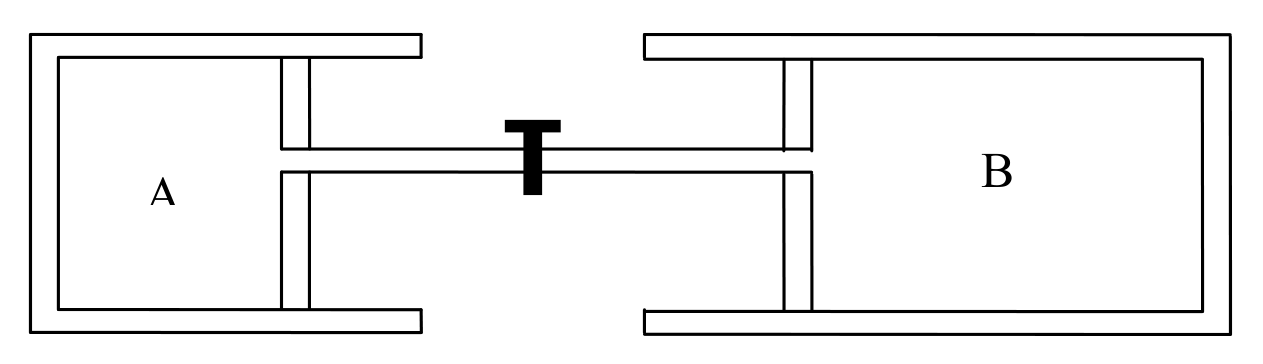
The cylinder A and his piston is adiabatically insulated and the cylinder B is in thermal contact with a thermostat which has the temperature .
Initially the piston of the cylinder A is fixed and inside there is a mass m= 32 kg of argon at a pressure higher than the atmospheric pressure. Inside the cylinder B there is a mass of oxygen at the normal atmospheric pressure.
Liberating the piston of the cylinder A, it moves slowly enough (quasi-static) and at equilibrium the volume of the gas is eight times higher, and in the cylinder B de oxygen’s density increased two times. Knowing that the thermostat received the heat , determine:
a) Establish on the base of the kinetic theory of the gases, studying the elastic collisions of the molecules with the piston, that the thermal equation of the process taking place in the cylinder A is = constant.
b) Calculate the parameters p, V, and T of argon in the initial and final states.
c) Opening the valve which separates the two cylinders, calculate the final pressure of the mixture of the gases.
The kilo-molar mass of argon is μ = 40 kg/kmol.
Отговори
b) T1 = 1000 K, T1' = 250 K, p1 = 64 atm, p1' = 2 atm, V1 = 1,02 m³, V1' = 8,16 m³
c) 2.2 atm
Printed: p = 2,2 atm = 2,23·10⁵ N/m².
Решение
a) We consider argon an ideal mono-atomic gas and the collisions of the atoms with the piston perfect elastic. In such a collision with a fix wall the speed of the particle changes only the direction so that the speed and the speed after collision there are in the same plane with the normal and the incident and reflection angle are equal.
In the problem the wall moves with the speed perpendicular on the wall. The relative speed of the particle with respect the wall is . Choosing the Oz axis perpendicular on the wall in the sense of , the conditions of the elastic collision give:
The increase of the kinetic energy of the particle with mass after collision is:
because u is much smaller than .
If is the number of molecules from unit volume with the speed component , then the number of molecules with this component which collide in the time dt the area dS of the piston is:
These molecules will have a change of the kinetic energy:
where is the increase of the volume of gas.
The change of the kinetic energy of the gas corresponding to the increase of volume dV is:
and:
Integrating equation (7) results:
The internal energy of the ideal mono-atomic gas is proportional with the absolute temperature T and the equation (8) can be written:
b) The oxygen is in contact with a thermostat and will suffer an isothermal process. The internal energy will be modified only by the adiabatic process suffered by argon gas:
where is the number of kilomoles. For argon .
For the entire system L=0 and .
We will use indices 1, respectively 2, for the measures corresponding to argon from cylinder A, respectively oxygen from the cylinder B:
From equation (11) results:
For the isothermal process suffered by oxygen:
From the equilibrium condition:
For argon:
c) When the valve is opened the gases intermix and at thermal equilibrium the final pressure will be and the temperature T. The total number of kilomoles is constant:
The total volume of the system is constant:
From equation (18) results the final pressure:
Оригинал в Архива: ipho72.pdf