IPhO 1979, Теория и експеримент — Задача 1
Problems of the XI International Olympiad, Moscow, 1979
Problems of the XI International Olympiad, Moscow, 1979
The publication has been prepared by Prof. S. Kozel and Prof. V.Orlov (Moscow Institute of Physics and Technology)
The XI International Olympiad in Physics for students took place in Moscow, USSR, in July 1979 on the basis of Moscow Institute of Physics and Technology (MIPT). Teams from 11 countries participated in the competition, namely Bulgaria, Finland, Germany, Hungary, Poland, Romania, Sweden, Czechoslovakia, the DDR, the SFR Yugoslavia, the USSR. The problems for the theoretical competition have been prepared by professors of MIPT (V.Belonuchkin, I.Slobodetsky, S.Kozel). The problem for the experimental competition has been worked out by O.Kabardin from the Academy of Pedagogical Sciences.
It is pity that marking schemes were not preserved.
Условие
A space rocket with mass =12t is moving around the Moon along the circular orbit at the height of =100 km. The engine is activated for a short time to pass at the lunar landing orbit. The velocity of the ejected gases u = m/s. The Moon radius km, the acceleration of gravity near the Moon surface = 1.7 m/s
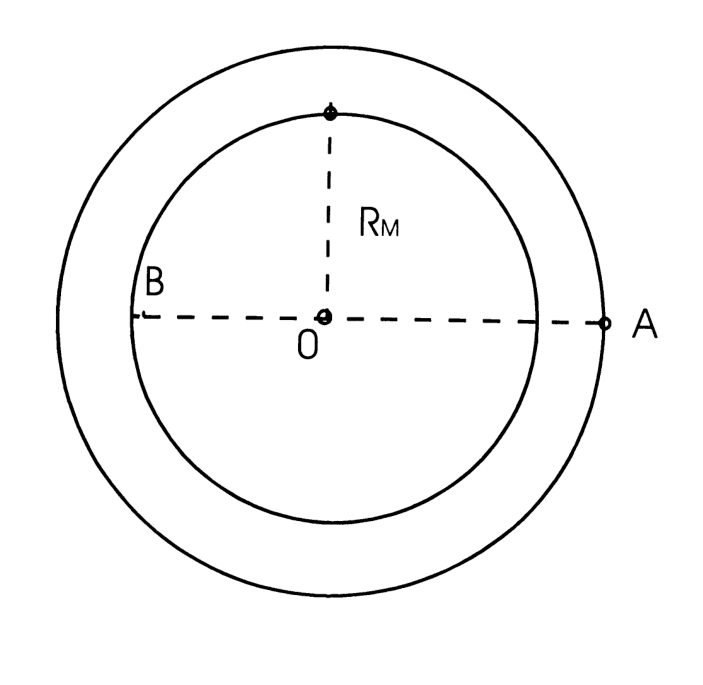
1). What amount of fuel should be spent so that when activating the braking engine at point A of the trajectory, the rocket would land on the Moon at point B (Fig.1)?
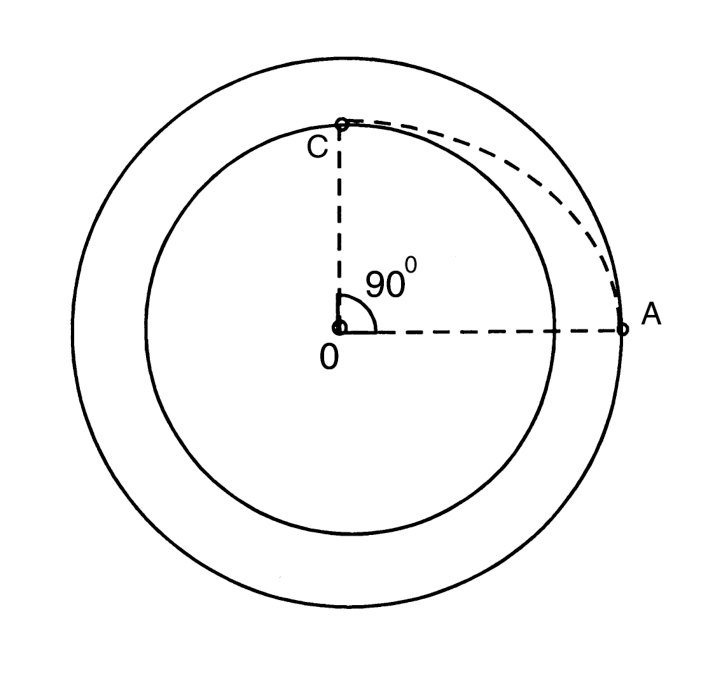
2). In the second scenario of landing, at point A the rocket is given an impulse directed towards the center of the Moon, to put the rocket to the orbit meeting the Moon surface at point C (Fig.2). What amount of fuel is needed in this case?
Отговори
- 1). 29 kg
- 2). 116 kg
Решение
- During the rocket moving along the circular orbit its centripetal acceleration is created by moon gravity force:
where is the primary orbit radius, -the rocket velocity on the circular orbit:
Since it yields
The rocket velocity will remain perpendicular to the radius-vector OA after the braking engine sends tangential momentum to the rocket (Fig.1). The rocket should then move along the elliptical trajectory with the focus in the Moon’s center.
Denoting the rocket velocity at points A and B as and we can write the equations for energy and momentum conservation as follows:
Solving equations (2) and (3) jointly we find
Taking (1) into account, we get
Thus the rocket velocity change at point A must be
Since the engine switches on for a short time the momentum conservation low in the system “rocket-fuel” can be written in the form
where is the burnt fuel mass.
This yields
Allow for we find
- In the second case the vector is directed perpendicular to the vector thus giving
Based on the energy conservation law in this case the equation can be written as
and from the momentum conservation law
Solving equations (4) and (5) jointly and taking into account (1) we find
Using the momentum conservation law we obtain
Acknowledgement
The authors would like to express their thanks and gratitude to Professor Waldemar Gorzkowski and Professor Ivo Volf for supplying the materials for the XI IphO in the Polish, Hungarian and Czech languages that have been of great help to the authors in their work at the problems of the Olympiad.
References:
- O.Kabardin, V.Orlov, International Physics Olympiads for Pupuls, Nauka, Moskva 1985.
- W.Gorzkowski, A.Kotlicki, Olimpiady Fizyczne XXVII i XXVIII, WsiP, Warszawa 1983
- R.Kunfalvi, Collection of Competition Tasks from the 1 trough XV International Physics Olympiads, 1867-1984, Roland Eotvos Physical Society an UNESCO, Budapest 1985
- V.Urumov, Megjunadodni Olimpijadi po Fisika, Prosvento Delo, Skopje 1999
- D.Kluvanec, I.Volf, Mezinarodni Fysikalni Olympiady, MaFy, Hradec Kralowe 1993
Оригинал в Архива: ipho79.pdf