IPhO 1979, Теория и експеримент — Задача 4. Experimental Problem
Problems of the XI International Olympiad, Moscow, 1979
Problems of the XI International Olympiad, Moscow, 1979
The publication has been prepared by Prof. S. Kozel and Prof. V.Orlov (Moscow Institute of Physics and Technology)
The XI International Olympiad in Physics for students took place in Moscow, USSR, in July 1979 on the basis of Moscow Institute of Physics and Technology (MIPT). Teams from 11 countries participated in the competition, namely Bulgaria, Finland, Germany, Hungary, Poland, Romania, Sweden, Czechoslovakia, the DDR, the SFR Yugoslavia, the USSR. The problems for the theoretical competition have been prepared by professors of MIPT (V.Belonuchkin, I.Slobodetsky, S.Kozel). The problem for the experimental competition has been worked out by O.Kabardin from the Academy of Pedagogical Sciences.
It is pity that marking schemes were not preserved.
Условие
Define the electrical circuit scheme in a “black box” and determine the parameters of its elements.
List of instruments: A DC source with tension 4.5 V, an AC source with 50 Hz frequency and output voltage up to 30 V, two multimeters for measuring AC/DC current and voltage, variable resistor, connection wires.
Решение
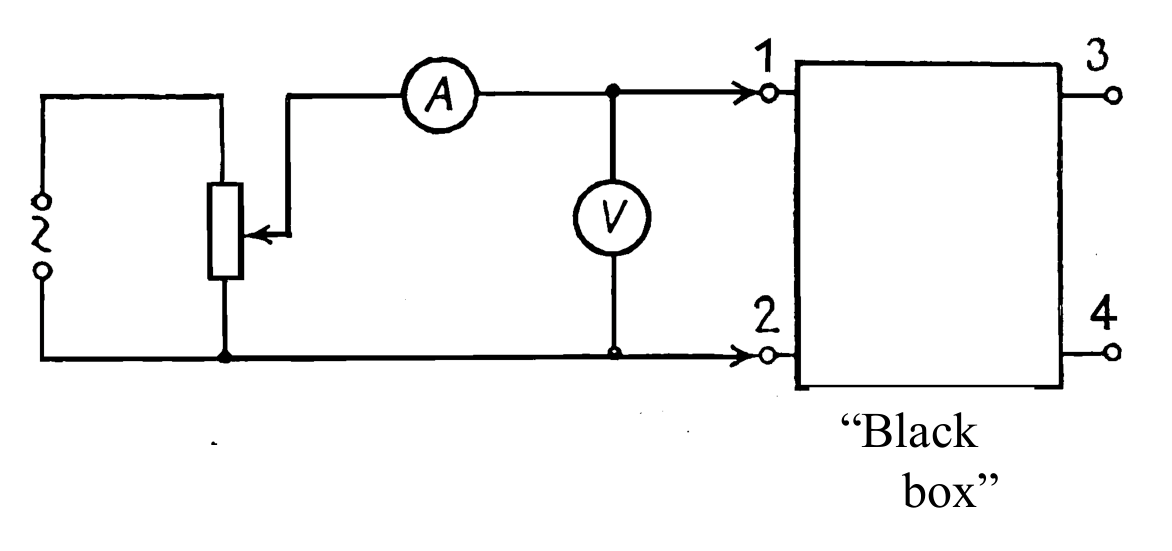
A transformer is built-in in a “black box”. The black box has 4 terminals. To be able to determine the equivalent circuit and the parameters of its elements one may first carry out measurements of the direct current. The most expedient is to mount the circuit according to the layout in Fig.3 and to build volt-ampere characteristics for various terminals of the “box”. This enables one to make sure rightway that there were no e.m.f. sources in the “box” (the plot goes through the origin of the coordinates), no diodes (the current strength does not depend on the polarity of the current’s external source), by the inclination angle of the plot one may define the resistances between different terminals of the “box”. The tests allowed for some estimations of values and . The ammeter did not register any current between the other terminals. This means that between these terminals there might be some other resistors with resistances larger than :
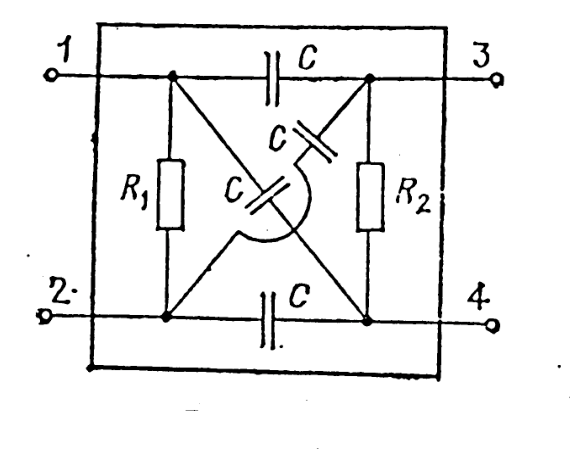
where - the minimum value of the strength of the current which the instrument would have registered. Probably there might be some capacitors between terminals 1-3, 1-4, 2-3, 2-4 (Fig.4).
Then, one can carry out analogous measurements of an alternative current. The taken volt-ampere characteristics enabled one to find full resistances on the alternative current of sections 1-2 and 3-4: and and to compare them to the values and . It turned out, that and .
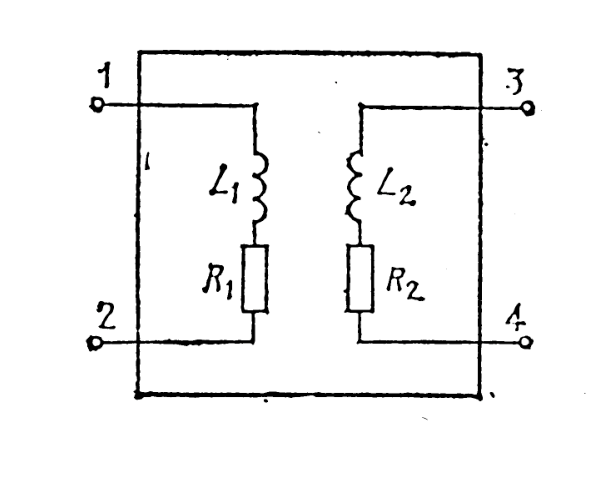
This fact allows one to conclude that in the “black box” the coils are connected to terminals 1-2 and 3-4 (Fig.5). Inductances of coils and can be determined by the formulas
After that the dependences , are to be investigated. The character of the found dependences enabled one to draw a conclusion about the presence of ferromagnetic cores in the coils. Judging by the results of the measurements on the alternative current one could identify the upper limit of capacitance of the capacitors which could be placed between terminals 1-3, 1-4, 2-3, 2-4:
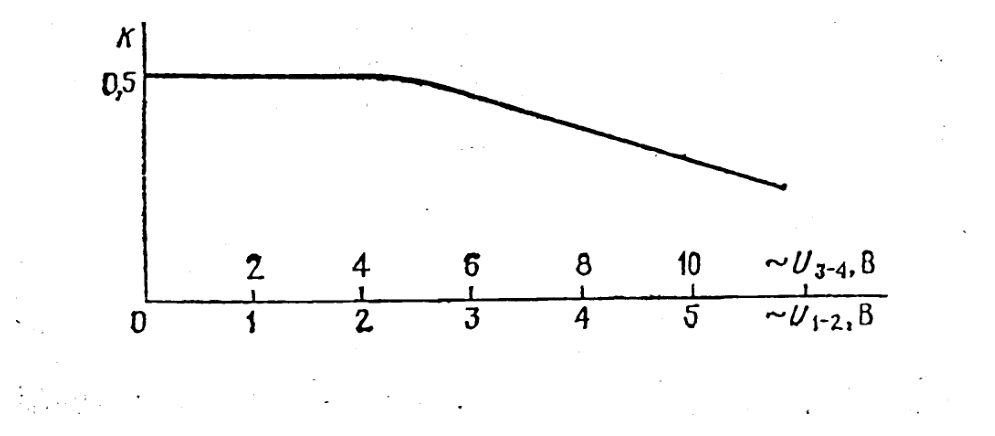
Then one could check the availability of inductive coupling between circuits 1-2 and 3-4. The plot of dependence of voltage versus voltage (Fig. 6) allows one to find both the transformation coefficient
and the maximum operational voltages on coils and , when the transformation coefficient has not changed yet, i.e. before saturation of the core.
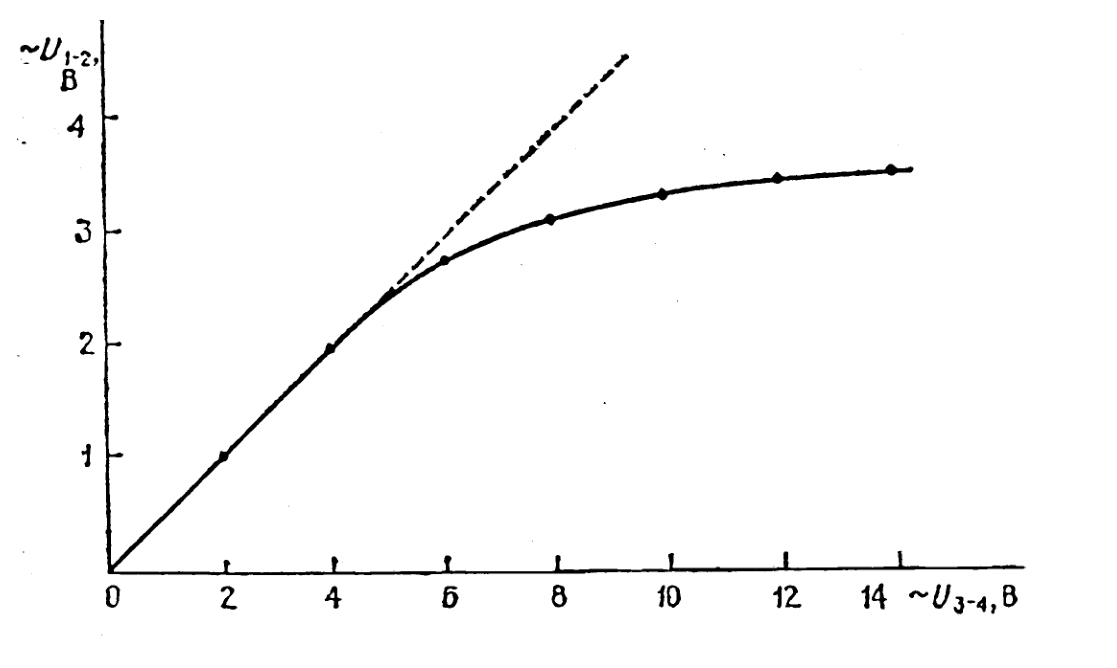
=2.5 V, = 5 V.
One could build either plot or (Fig. 7).
Note: It was also possible to define the “box” circuit after tests of the direct current. To do that one had to find the presence of induction coupling between terminals 1-2 and 3-4, that is the appearance of e.m.f. of induction in circuit 3-4, when closing and breaking circuits 1-2 and vice-versa. When comparing the direction of the pointer’s rejection of the voltmeters connected to terminals 1-2 and 3-4 one could identify directions of the transformer’s windings.
Acknowledgement
The authors would like to express their thanks and gratitude to Professor Waldemar Gorzkowski and Professor Ivo Volf for supplying the materials for the XI IphO in the Polish, Hungarian and Czech languages that have been of great help to the authors in their work at the problems of the Olympiad.
References:
- O.Kabardin, V.Orlov, International Physics Olympiads for Pupuls, Nauka, Moskva 1985.
- W.Gorzkowski, A.Kotlicki, Olimpiady Fizyczne XXVII i XXVIII, WsiP, Warszawa 1983
- R.Kunfalvi, Collection of Competition Tasks from the 1 trough XV International Physics Olympiads, 1867-1984, Roland Eotvos Physical Society an UNESCO, Budapest 1985
- V.Urumov, Megjunadodni Olimpijadi po Fisika, Prosvento Delo, Skopje 1999
- D.Kluvanec, I.Volf, Mezinarodni Fysikalni Olympiady, MaFy, Hradec Kralowe 1993
Оригинал в Архива: ipho79.pdf