IPhO 1982, Теория и експеримент — Задача 2. Oscillating coat hanger
Problems of the 13th International Physics Olympiad (Malente, 1982) · 10 т.
Abstract
The 13th International Physics Olympiad took place in 1982 in the Federal Republic of Germany. This article contains the competition problems, their solutions and a grading scheme.
Увод
In 1982 the Federal Republic of Germany was the first host of the Physics Olympiad outside the so-called Eastern bloc. The 13th International Physics Olympiad took place in Malente, Schleswig-Holstein. The competition was funded by the German Federal Ministry of Science and Education. The organisational guidelines were laid down by the work group “Olympiads for pupils” of the conference of ministers of education of the German federal states. The Institute for Science Education (IPN) at the University of Kiel was responsible for the realisation of the event. A commission of professors, whose chairman was appointed by the German Physical Society, were concerned with the formulation of the competition problems. All other members of the commission came from physics department of the university of Kiel or from the college of education at Kiel.
The problems as usual covered different fields of classical physics. In 1982 the pupils had to deal with three theoretical and two experimental problems, whereas at the previous Olympiads only one experimental task was given. However, it seemed to be reasonable to put more stress on experimental work. The degree of difficulty was well balanced. One of the theoretical problems could be considered as quite simple (problem 3: “hot-air balloon”). Another theoretical problem (problem 1: “fluorescent lamp”) had a mean degree of difficulty and the distribution of the points was a normal distribution with only a few excellent and only a few unsatisfying solutions. The third problem (problem 2: “oscillation coat hanger”) turned out to be the most difficult problem. This problem was generally considered as quite interesting because different ways of solving were possible. About one third of the pupils did not find an adequate start to the problem, but nearly one third of the pupils was able to solve the substantial part of the problem. That means, this problem polarized between the pupils. The two experimental tasks were quite different in respect of the input for the experimental setup and the time required for dealing with the problems, whereas they were quite similar in the degree of difficulty. Both required demandingly theoretical considerations and experimental skills. Both experimental problems turned out to be rather difficult. The tasks were composed in a way that on the one hand almost every pupil had the possibility to come to certain partial results and that there were some difficulties on the other hand which could only be solved by very few pupils. The difficulty in the second experimental problem (problem5: “motion of a rolling cylinder”) was the explanation of the experimental results, which were initially quite surprising. The difficulty in the other task (problem 4: “lens experiment") was the revealing of an observation method with a high accuracy (parallax). The five hours provided for solving the two experimental problems were slightly too short. According to that, in both experiments only a few pupils came up with excellent solutions. In problem 5 nobody got the full points.
The problems presented here are based on the original German and English versions of the competition problems. The solutions are complete but in some parts condensed to the essentials. Almost all of the original hand-made figures are published here.
Contact: Leibniz-Institute for Science Education (IPN) at the University of Kiel, Olshausenstrasse 62, 24098 Kiel, Germany, ipho@ipn.uni-kiel.de
Условие
A (suitably made) wire coat hanger can perform small amplitude oscillations in the plane of the figure around the equilibrium positions shown. In positions a) and b) the long side is horizontal. The other two sides have equal length. The period of oscillation is the same in all cases.
What is the location of the center of mass, and how long is the period?
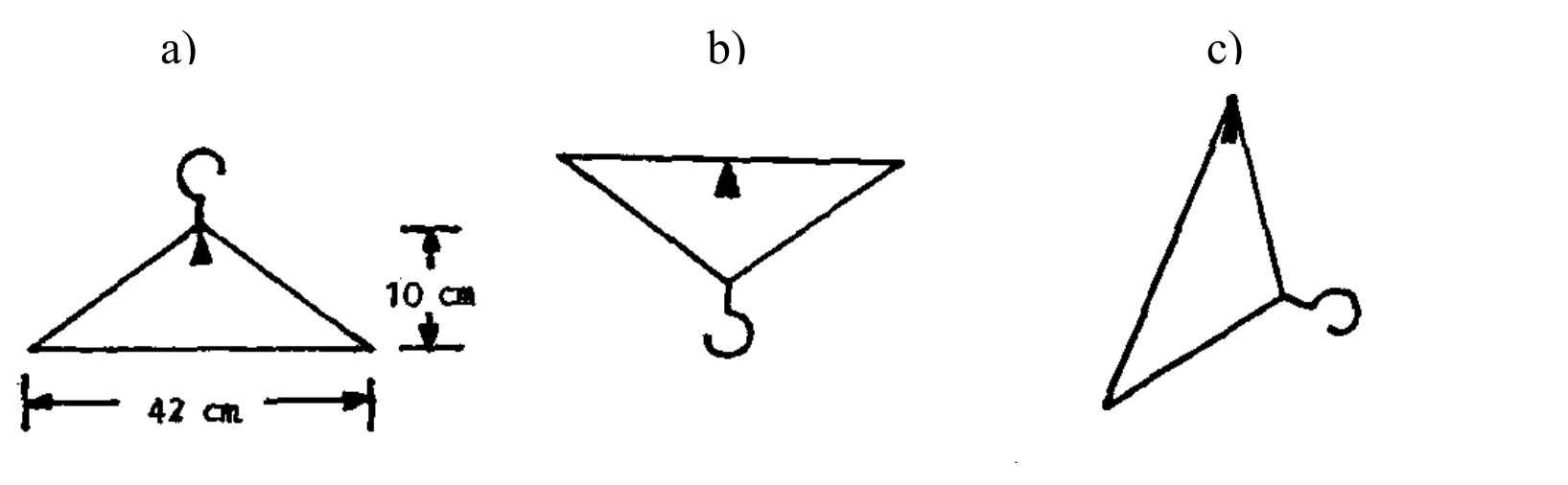
The figure does not contain any information beyond the dimensions given. Nothing is known, e.g., concerning the detailed distribution of mass.
Отговори
- The center of mass lies on the perpendicular bisector of the long side, 5 cm above it (half the height); T = 1.03 s.
Решение
First method:
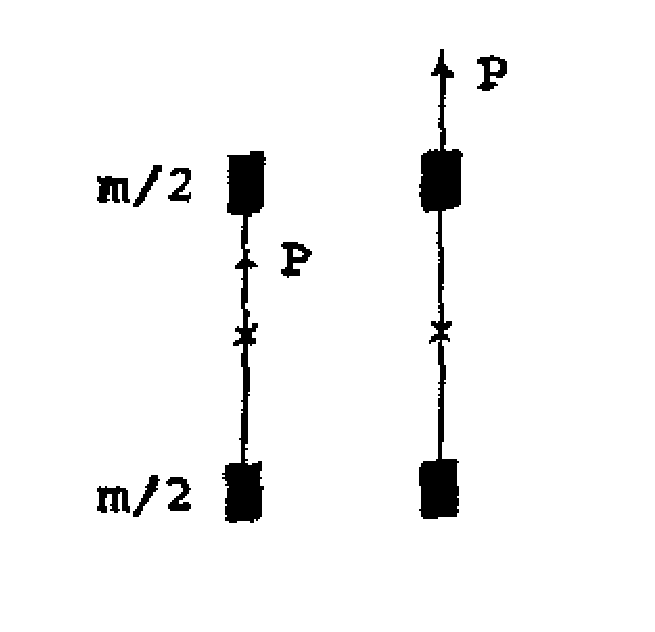
The motions of a rigid body in a plane correspond to the motion of two equal point masses connected by a rigid massless rod. The moment of inertia then determines their distance. Because of the equilibrium position a) the center of mass is on the perpendicular bipartition of the long side of the coat hanger. If one imagines the equivalent masses and the supporting point P being arranged in a straight line in each case, only two positions of P yield the same period of oscillation (see sketch). One can understand this by considering the limiting cases: 1. both supporting points in the upper mass and 2. one point in the center of mass and the other infinitely high above. Between these extremes the period of oscillation grows continuously. The supporting point placed in the corner of the long side c) has the largest distance from the center of mass, and therefore this point lies outside the two point masses. The two other supporting points a), b) then have to be placed symmetrically to the center of mass between the two point masses, i.e., the center of mass bisects the perpendicular bipartition. One knows of the reversible pendulum that for every supporting point of the physical pendulum it generally has a second supporting point of the pendulum rotated by , with the same period of oscillation but at a different distance from the center of mass. The section between the two supporting points equals the length of the corresponding mathematical pendulum. Therefore the period of oscillation is obtained through the corresponding length of the pendulum , where and , to be .
Second method:
Let denote the distance between the supporting point and the center of mass, the mass itself and the moment of inertia referring to the supporting point. Then we have the period of oscillation :
where is the acceleration of gravity, . Here can be obtained from the moment of inertia related to the center of mass:
Because of the symmetrical position in case a) the center of mass is to be found on the perpendicular bisection above the long side. Now (1) and (2) yield
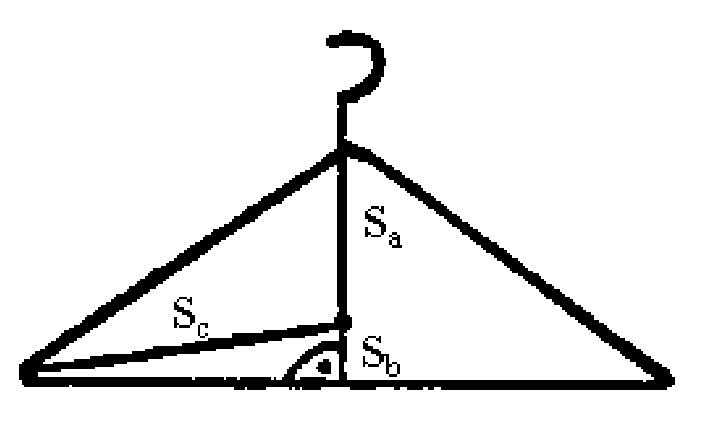
because all periods of oscillation are the same. This quadratic equation has only two different solutions at most. Therefore at least two of the three distances are equal. Because of , only and can equal each other. Thus we have
The moment of inertia is eliminated through (3):
and we have
with the numerical value ,
which has been rounded off after two decimals because of the accuracy of .
Third method:
This solution is identical to the previous one up to equation (2).
From (1) and (2) we generally have for equal periods of oscillation :
and therefore
or
The solution of (6) includes two possibilities: or
Let be the length of the long side and the height of the coat hanger. Because of we then have either or , where ,
which excludes the first possibility. Thus
For the case is excluded because of eq. (7), for we have
Hence ,
and
The numerical calculation yields the value .
Grading schemes
| Problem 2: Oscillating coat hanger | pts. |
|---|---|
| equation (1) | 1,5 |
| equation (2) | 1,5 |
| equation (4) | 3 |
| equation (5) | 2 |
| numerical value for T | 1 |
| 10 |
Оригинал в Архива: ipho82.pdf