IPhO 1983, Теория — Задача 4. Atomics - Problem IV: Compton scattering
IPhO 1983 Theoretical Questions · 7 т.
Условие
A photon of wavelength is scattered by a moving, free electron. As a result the electron stops and the resulting photon of wavelength scattered at an angle with respect to the direction of the incident photon, is again scattered by a second free electron at rest. In this second scattering process a photon with wavelength of emerges at an angle with respect to the direction of the photon of wavelength . Find the de Broglie wavelength for the first electron before the interaction. The following constants are known:
- Planck’s constant
- mass oh the electron
- speed of light in vacuum
The purpose of the problem is to calculate the values of the speed, momentum and wavelength of the first electron.
To characterize the photons the following notation are used:
Table 4.1
| initial photon | photon – after the first scattering | final photon | |
|---|---|---|---|
| momentum | |||
| energy | |||
| wavelength |
To characterize the electrons one uses
Table 4.2
| first electron before collision | first electron after collision | second electron before collision | Second electron after collision | |
|---|---|---|---|---|
| momentum | 0 | 0 | ||
| energy | ||||
| speed | 0 | 0 |
Решение
Problem III - Solution
The purpose of the problem is to calculate the values of the speed, momentum and wavelength of the first electron.
To characterize the photons the following notation are used:
Table 4.1
| initial photon | photon – after the first scattering | final photon | |
|---|---|---|---|
| momentum | |||
| energy | |||
| wavelength |
To characterize the electrons one uses
Table 4.2
| first electron before collision | first electron after collision | second electron before collision | Second electron after collision | |
|---|---|---|---|---|
| momentum | ||||
| energy | ||||
| speed |
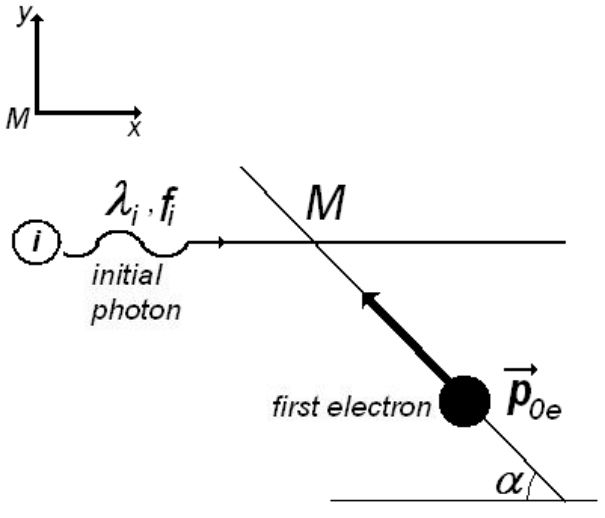
The image in figure 4.1 presents the situation before the first scattering of photon.
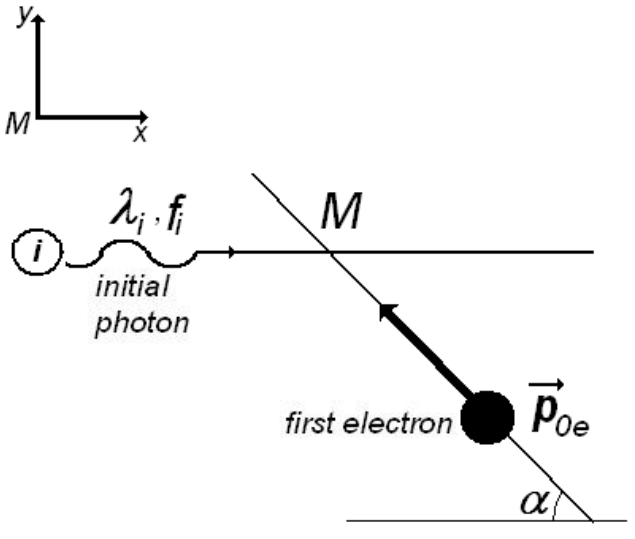
To characterize the initial photon we will use his momentum and his energy
is the frequency of initial photon.
For initial, free electron in motion the momentum and the energy are
where is the rest mass of electron and is the mass of moving electron. As usual, .
De Broglie wavelength of the first electron is
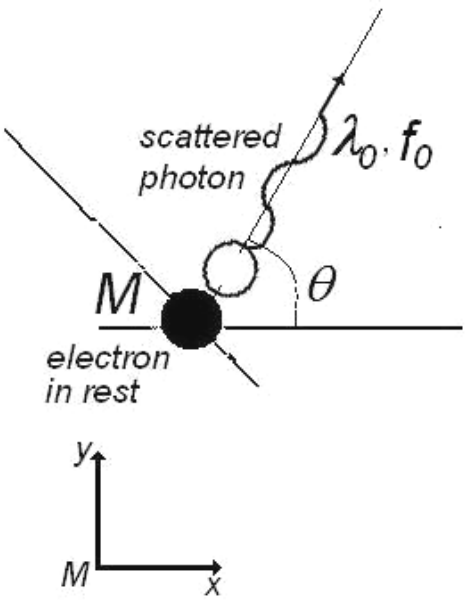
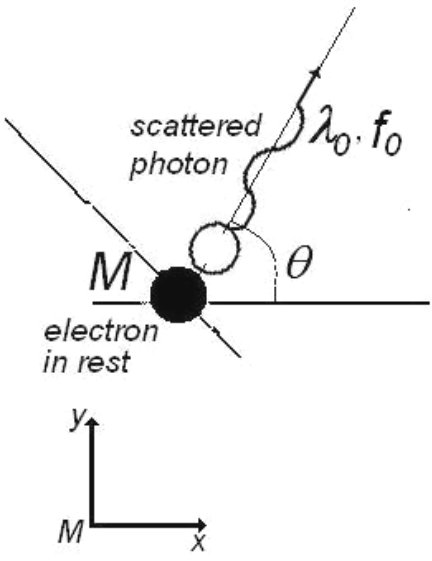
The situation after the scattering of photon is described in the figure 4.2. To characterize the scattered photon we will use his momentum and his energy
where
is the frequency of scattered photon.
The magnitude of momentum of the electron (that remains in rest) after the scattering is zero; his energy is . The mass of electron after collision is - the rest mass of electron at rest. So,
To determine the moment of the first moving electron, one can write the principles of conservation of moments and energy. That is
and
The conservation of moment on direction is written as
and the conservation of moment on is
To eliminate , the last two equation must be written again as
and then added. The result is
or
The conservation of energy (4.7) can be written again as
or
Squaring the last relation results
Subtracting (4.12) from (4.15) the result is
or
Using
the relation (4.17) becomes
The wavelength of scattered photon is
shorter than the wavelength of initial photon and consequently the energy of scattered photon is greater that the energy of initial photon.
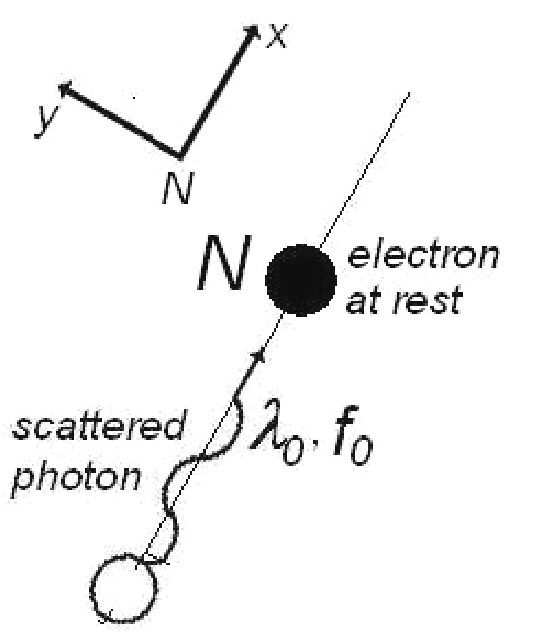
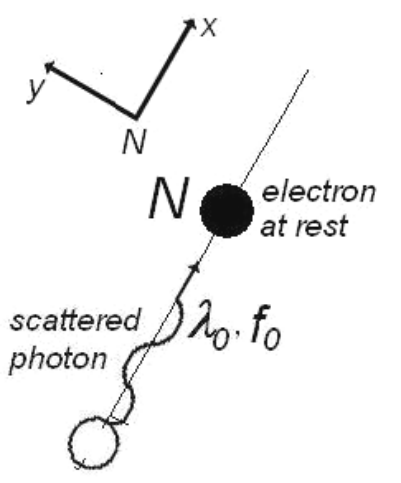
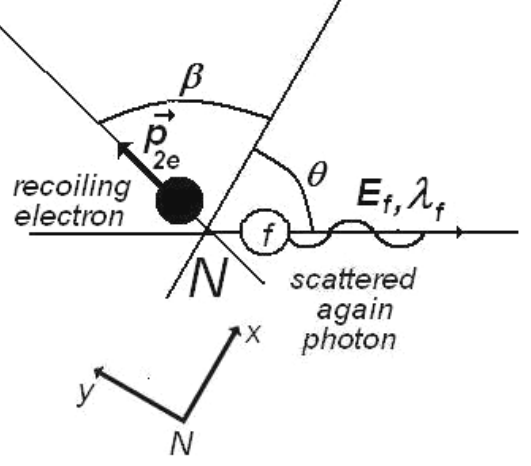
Let's analyze now the second collision process that occurs in point . To study that, let's consider a new referential having direction on the direction of the photon scattered after the first collision.
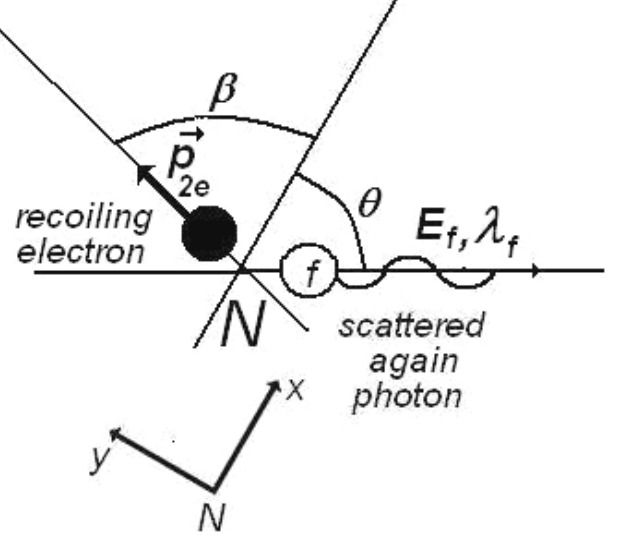
The figure 4.3 presents the situation before the second collision and the figure 4.4 presents the situation after this scattering process. The conservation principle for moment in the scattering process gives
To eliminate the unknown angle must square and then add the equations (4.22)
That is
or
The conservation principle of energy in the second scattering process gives
(4.24) and (4.25) gives
and
Subtracting (4.26) from (1.27), one obtain
That is
Because the value of is known and can be calculate as
the value of wavelength of photon before the second scattering is
Comparing (4.28) written as:
and (4.20) written as
clearly results
The energy of the double scattered photon is the same as the energy of initial photon. The direction of “final photon” is the same as the direction of “initial” photon. Concluding, the final photon is identical with the initial photon. The result is expected because of the symmetry of the processes.
Extending the symmetry analyze on electrons, the first moving electron that collides the initial photon and after that remains at rest must have the same momentum and energy as the second electron after the collision – because this second electron is at rest before the collision.
That is
Taking into account (4.24), the moment of final electron is
The de Broglie wavelength of second electron after scattering (and of first electron before scattering) is
Numerical value of this wavelength is
Professor Delia DAVIDESCU, National Department of Evaluation and Examination–Ministry of Education and Research- Bucharest, Romania
Professor Adrian S. DAFINEI, PhD, Faculty of Physics – University of Bucharest, Romania
Marking scheme — Question 4
IV. — 7.0 points
For: the situation before the first scattering of photon
| Marking scheme — The theoretical question IV — Compton scattering | Score |
|---|---|
| The momentum and the energy of the initial photon: , | 0.3 |
| The frequency of initial photon | 0.1 |
| The momentum and the energy of initial, free electron in motion: ; | 0.3 |
| De Broglie wavelength of the first electron | 0.2 |
The situation after the scattering of photon
| Marking scheme | Score |
|---|---|
| The momentum and the energy of the scattered photon: ; | 0.3 |
| The frequency of scattered photon | 0.1 |
| The principles of conservation of moments and energy: ; | 0.3 |
| The conservation of moment on direction: | 0.3 |
| The conservation of moment on : | 0.3 |
| 0.4 | |
| The conservation of energy | 0.3 |
| Or | 0.2 |
| 0.2 | |
| 0.2 | |
| 0.2 | |
| The wavelength of scattered photon | 0.3 |
| ; | 0.1 |
The situation before the second collision
The situation after this scattering process
| Marking scheme | Score |
|---|---|
| The conservation principle for moment in the scattering process: ; | 0.3 |
| 0.3 | |
| ; | 0.5 |
| ; | 0.1 |
| ; | 0.2 |
| The value of wavelength of photon before the second scattering | 0.1 |
| 0.3 | |
| ; | 0.2 |
| The moment of final electron, below | 0.4 |
The de Broglie wavelength of second electron after scattering (and of first electron before scattering)
| Marking scheme | Score |
|---|---|
| De Broglie wavelength expression above | 0.3 |
| Final result: | 0.2 |
| Total score theoretical question IV | 7.0 points |
Оригинал в Архива: 13th_IPhO_1983_Theoretical Questions.pdf · официални решения: 13th_IPhO_1983_Theo_I_Mechanics_Solution.pdf · допълнителни данни: 13th_IPhO_1983_MarkingScheme_ ThQ_III_ Optics.pdf · допълнителни данни: 13th_IPhO_1983_MarkingScheme_ ThQ_II_ Electricity.pdf · допълнителни данни: 13th_IPhO_1983_MarkingScheme_ ThQ_IV_ Atomics.pdf · допълнителни данни: 13th_IPhO_1983_MarkingScheme_ ThQ_I_ Mechanics.pdf · допълнителни данни: 13th_IPhO_1983_Theo_III_0ptics_Solution.pdf · допълнителни данни: 13th_IPhO_1983_Theo_II_Electricity_Solution.pdf · допълнителни данни: 13th_IPhO_1983_Theo_IV_Atomics_Solution.pdf · допълнителни данни: 13th_IPhO_1983_Theo_V_IPhO's Logo_Solution.pdf