IPhO 1989, Теория и експеримент — Задача 1. Problem 1
Problems of the 20th International Physics Olympiad (Warsaw, 1989) · 16 юли 1989 г.
Abstract
The article contains problems given at the 20th International Physics Olympiad (1989) and their solutions. The 20th IPhO was the third IPhO organized in Warsaw, Poland.
¹ This article has been sent for publication in Physics Competitions in October 2003
² e-mail: gorzk@ifpan.edu.pl
Logo
The emblem of the XX International Physics Olympiad contains a picture that is a historical record of the first hypernuclear event observed and interpreted in Warsaw by M. Danysz and J. Pniewski. The collision of a high-energy particle with a heavy nucleus was registered in nuclear emulsion. Tracks of the secondary particles emitted in the event, seen in the picture (upper star), consist of tracks due to fast pions (“thin tracks”) and to much slower fragments of the target nucleus (“black tracks”). The “black track” connecting the upper star (greater) with the lower star (smaller) in the figure is due to a hypernuclear fragment, in this case due to a part of the primary nucleus containing an unstable hyperon Λ instead of a nucleon. Hyperfragments (hypernuclei) are a new kind of matter in which the nuclei contain not only protons and neutrons but also some other heavy particles.
In the event observed above the hyperon Λ, bound with nucleon, decays like a free particle through a week (slow) process only. This fact strongly suggested the existence of a new quantum number that could explain suppression of the decay, even in presence of nucleons. Indeed, this was one of the observations that, 30 months later, led to the concept of strangeness.
M. Danysz and J. Pniewski, Bull. Acad. Polon. Sci., 3(1) 42 (1952) and Phil. Mag., 44, 348 (1953). Later the same physicists, Danysz and Pniewski, discovered the first case of a nucleus with two hyperons (double hyperfragment).
Увод
Theoretical problems (including solutions and marking schemes) were prepared especially for the 20th IPhO by Waldemar Gorzkowski. The experimental problem (including the solution and marking scheme) was prepared especially for this Olympiad by Andrzej Kotlicki. The problems were refereed independently (and many times) by at least two persons after any change was made in the text to avoid unexpected difficulties at the competition. This work was done by:
First Problem:
Andrzej Szadkowski, Andrzej Szymacha, Włodzimierz Ungier
Second Problem:
Andrzej Szadkowski, Andrzej Szymacha, Włodzimierz Ungier, Stanisław Woronowicz
Third Problem:
Andrzej Rajca, Andrzej Szymacha, Włodzimierz Ungier
Experimental Problem:
Krzysztof Korona, Anna Lipniacka, Jerzy Łusakowski, Bruno Sikora
Several English versions of the texts of the problems were given to the English-speaking students. As far as I know it happened for the first time (at present it is typical). The original English version was accepted (as a version for the students) by the leaders of the Australian delegation only. The other English-speaking delegations translated the English originals into English used in their countries. The net result was that there were at least four English versions. Of course, physics contained in them was exactly the same, while wording and spelling were somewhat different (the difference, however, were not too great).
This article is based on the materials quoted at the end of the article and on personal notes of the author.
Условие
Consider two liquids A and B insoluble in each other. The pressures ( = A or B) of their saturated vapors obey, to a good approximation, the formula:
where denotes the normal atmospheric pressure, – the absolute temperature of the vapor, and and ( = A or B) – certain constants depending on the liquid. (The symbol ln denotes the natural logarithm, i.e. logarithm with base = 2.7182818…)
The values of the ratio for the liquids A and B at the temperature 40°C and 90°C are given in Tab. 1.1.
Table 1.1
| [°C] | , = A | , = B |
|---|---|---|
| 40 | 0.284 | 0.07278 |
| 90 | 1.476 | 0.6918 |
The errors of these values are negligible.
A. Determine the boiling temperatures of the liquids A and B under the pressure .
B. The liquids A and B were poured into a vessel in which the layers shown in Fig. 1.1 were formed. The surface of the liquid B has been covered with a thin layer of a non-volatile liquid C, which is insoluble in the liquids A and B and vice versa, thereby preventing any free evaporation from the upper surface of the liquid B, The ratio of molecular masses of the liquids A and B (in the gaseous phase) is:
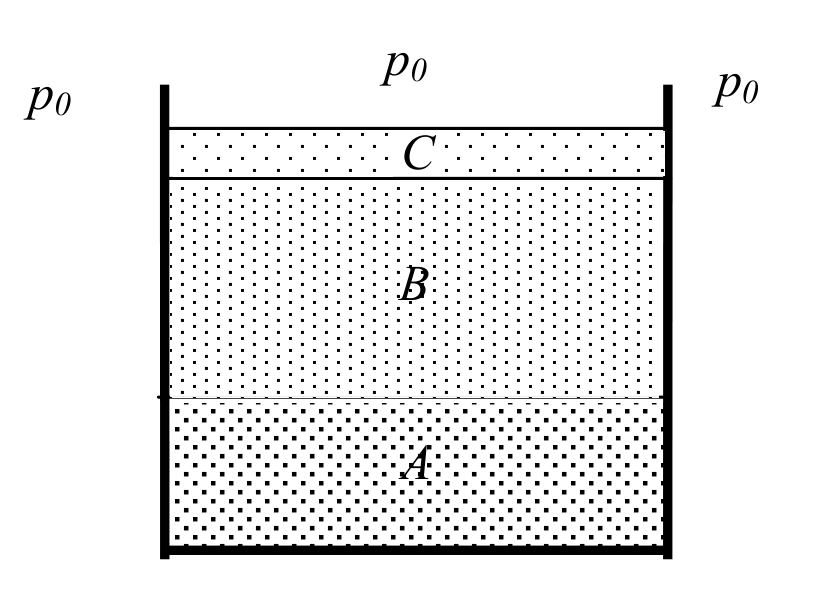
The masses of the liquids A and B were initially the same, each equal to = 100g. The heights of the layers of the liquids in the vessel and the densities of the liquids are small enough to make the assumption that the pressure in any point in the vessel is practically equal to the normal atmospheric pressure .
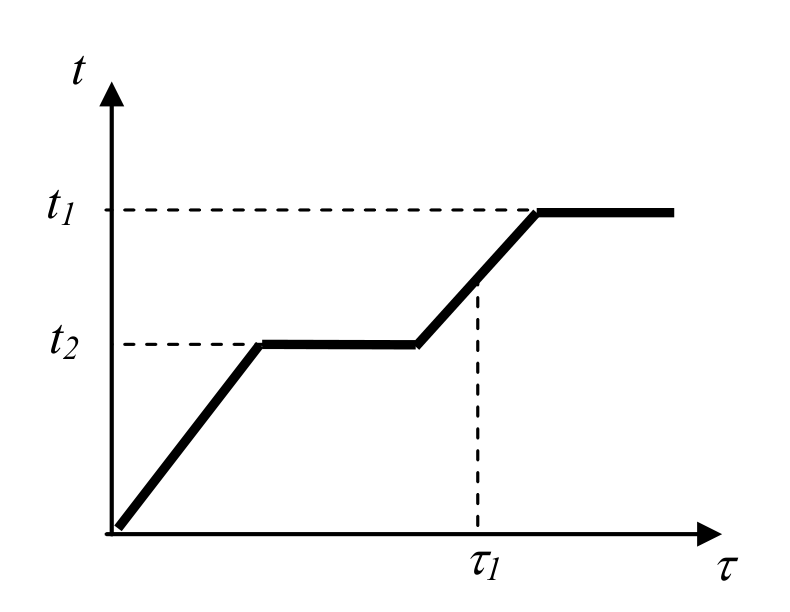
The system of liquids in the vessel is slowly, but continuously and uniformly, heated. It was established that the temperature of the liquids changed with time as shown schematically in the Fig. 1.2.
Determine the temperatures and corresponding to the horizontal parts of the diagram and the masses of the liquids A and B at the time . The temperatures should be rounded to the nearest degree (in °C) and the masses of the liquids should be determined to one-tenth of gram.
REMARK: Assume that the vapors of the liquids, to a good approximation,
(1) obey the Dalton law stating that the pressure of a mixture of gases is equal to the sum of the partial pressures of the gases forming the mixture and
(2) can be treated as perfect gases up to the pressures corresponding to the saturated vapors.
Отговори
A. tbA ≈ 77°C, tbB ≈ 100°C
From the official solution: TbA ≈ 349.95 K (76.80°C), tbB ≈ 99.74°C.
B. t1 ≈ 67°C, t2 = 100°C; at the time τ1 the vessel contains 95.5 g of the liquid B and no liquid A
Official solution: mA/mB ≈ 22.0 in the bubbles, so 100 g / 22 ≈ 4.5 g of B evaporates with all of A.
Решение
PART A
The liquid boils when the pressure of its saturated vapor is equal to the external pressure. Thus, in order to find the boiling temperature of the liquid ( - A or B), one should determine such a temperature (or ) for which .
Then , and we have:
The coefficients and are not given explicitly. However, they can be calculated from the formula given in the text of the problem. For this purpose one should make use of the numerical data given in the Tab. 1.1.
For the liquid A, we have:
After subtraction of these equations, we get:
Hence,
Thus, the boiling temperature of the liquid A is equal to
In the Celsius scale the boiling temperature of the liquid A is
For the liquid B, in the same way, we obtain:
PART B
As the liquids are in thermal contact with each other, their temperatures increase in time in the same way.
At the beginning of the heating, what corresponds to the left sloped part of the diagram, no evaporation can occur. The free evaporation from the upper surface of the liquid B cannot occur - it is impossible due to the layer of the non-volatile liquid C. The evaporation from the inside of the system is considered below.
Let us consider a bubble formed in the liquid A or in the liquid B or on the surface that separates these liquids. Such a bubble can be formed due to fluctuations or for many other reasons, which will not be analyzed here.
The bubble can get out of the system only when the pressure inside it equals to the external pressure (or when it is a little bit higher than ). Otherwise, the bubble will collapse.
The pressure inside the bubble formed in the volume of the liquid A or in the volume of the liquid B equals to the pressure of the saturated vapor of the liquid A or B, respectively. However, the pressure inside the bubble formed on the surface separating the liquids A and B is equal to the sum of the pressures of the saturated vapors of both these liquids, as then the bubble is in a contact with the liquids A and B at the same time. In the case considered the pressure inside the bubble is greater than the pressures of the saturated vapors of each of the liquids A and B (at the same temperature).
Therefore, when the system is heated, the pressure is reached first in the bubbles that were formed on the surface separating the liquids. Thus, the temperature corresponds to a kind of common boiling of both liquids that occurs in the region of their direct contact. The temperature is for sure lower than the boiling temperatures of the liquids A and B as then the pressures of the saturated vapors of the liquids A and B are less then (their sum equals to and each of them is greater than zero).
In order to determine the value of with required accuracy, we can calculate the values of the sum of the saturated vapors of the liquids A and B for several values of the temperature and look when one gets the value .
From the formula given in the text of the problem, we have:
equals to if
Thus, we have to calculate the values of the following function:
(where °C) and to determine the temperature , at which equals to 1. When calculating the values of the function we can divide the intervals of the temperatures by 2 (approximately) and look whether the results are greater or less than 1.
We have:
Table 1.2
| 40°C | (see Tab. 1.1) |
| 77°C | (as is less than ) |
| 59°C | |
| 70°C | |
| 66°C | |
| 67°C | |
| 66.5°C |
Therefore, C (with required accuracy).
Now we calculate the pressures of the saturated vapors of the liquids A and B at the temperature °C, i.e. the pressures of the saturated vapors of the liquids A and B in each bubble formed on the surface separating the liquids. From the equations (1) and (2), we get:
These pressures depend only on the temperature and, therefore, they remain constant during the motion of the bubbles through the liquid B. The volume of the bubbles during this motion also cannot be changed without violation of the relation . It follows from the above remarks that the mass ratio of the saturated vapors of the liquids A and B in each bubble is the same. This conclusion remains valid as long as both liquids are in the system. After total evaporation of one of the liquids the temperature of the system will increase again (second sloped part of the diagram). Then, however, the mass of the system remains constant until the temperature reaches the value at which the boiling of the liquid (remained in the vessel) starts. Therefore, the temperature (the higher horizontal part of the diagram) corresponds to the boiling of the liquid remained in the vessel.
The mass ratio of the saturated vapors of the liquids A and B in each bubble leaving the system at the temperature is equal to the ratio of the densities of these vapors . According to the assumption 2, stating that the vapors can be treated as ideal gases, the last ratio equals to the ratio of the products of the pressures of the saturated vapors by the molecular masses:
Thus,
We see that the liquid A evaporates 22 times faster than the liquid B. The evaporation of 100 g of the liquid A during the “surface boiling” at the temperature is associated with the evaporation of 100 g / 22 4.5 g of the liquid B. Thus, at the time the vessel contains 95.5 g of the liquid B (and no liquid A). The temperature is equal to the boiling temperature of the liquid B: °C.
Marking Scheme
- physical condition for boiling — 1 point
- boiling temperature of the liquid A (numerical value) — 1 point
- boiling temperature of the liquid B (numerical value) — 1 point
- analysis of the phenomena at the temperature — 3 points
- numerical value of — 1 point
- numerical value of the mass ratio of the saturated vapors in the bubble — 1 point
- masses of the liquids at the time — 1 point
- determination of the temperature — 1 point
REMARK: As the sum of the logarithms is not equal to the logarithm of the sum, the formula given in the text of the problem should not be applied to the mixture of the saturated vapors in the bubbles formed on the surface separating the liquids. However, the numerical data have been chosen in such a way that even such incorrect solution of the problem gives the correct value of the temperature (within required accuracy). The purpose of that was to allow the pupils to solve the part B of the problem even if they determined the temperature in a wrong way. Of course, one cannot receive any points for an incorrect determination of the temperature even if its numerical value is correct.
Typical mistakes in the pupils' solutions
Nobody has received the maximum possible number of points for this problem, although several solutions came close. Only two participants tried to analyze proportion of pressures of the vapors during the upward movement of the bubble trough the liquid B. Part of the students confused Celsius degrees with Kelvins. Many participants did not take into account the boiling on the surface separating the liquids A and B, although this effect was the essence of the problem. Part of the students, who did notice this effect, assumed a priori that the liquid with lower boiling temperature "must" be the first to evaporate. In general, this need not be true: if were, for example, 1/8 instead 8, then liquid A rather than B would remain in the vessel. As regards the boiling temperatures, practically nobody had any essential difficulties.
Acknowledgement
I would like to thank very warmly to Prof. Jan Mostowski and Dr. Andrzej Wysmołek for reading the text of this article and for valuable critical remarks. I express special thanks to Dr. Andrzej Kotlicki for critical reviewing the experimental part of the article and for a number of very important improvements.
Literature
[1] Waldemar Gorzkowski and Andrzej Kotlicki, XX Międzynarodowa Olimpiada Fizyczna - cz. I, Fizyka w Szkole nr 1/90, pp. 34 - 39
[2] Waldemar Gorzkowski, XX Międzynarodowa Olimpiada Fizyczna - cz. II, Fizyka w Szkole nr 2/3-90, pp. 23 - 32
[3] XX International Physics Olympiad - Proceedings of the XX International Physics Olympiad, Warsaw (Poland), July 16 - 24, 1989, ed. by W. Gorzkowski, World Scientific Publishing Company, Singapore 1990 [ISBN 981-02-0084-6]
Оригинал в Архива: ipho89.pdf