IPhO 1989, Теория и експеримент — Задача 4. Experimental Problem
Problems of the 20th International Physics Olympiad (Warsaw, 1989) · 16 юли 1989 г.
Abstract
The article contains problems given at the 20th International Physics Olympiad (1989) and their solutions. The 20th IPhO was the third IPhO organized in Warsaw, Poland.
¹ This article has been sent for publication in Physics Competitions in October 2003
² e-mail: gorzk@ifpan.edu.pl
Logo
The emblem of the XX International Physics Olympiad contains a picture that is a historical record of the first hypernuclear event observed and interpreted in Warsaw by M. Danysz and J. Pniewski. The collision of a high-energy particle with a heavy nucleus was registered in nuclear emulsion. Tracks of the secondary particles emitted in the event, seen in the picture (upper star), consist of tracks due to fast pions (“thin tracks”) and to much slower fragments of the target nucleus (“black tracks”). The “black track” connecting the upper star (greater) with the lower star (smaller) in the figure is due to a hypernuclear fragment, in this case due to a part of the primary nucleus containing an unstable hyperon Λ instead of a nucleon. Hyperfragments (hypernuclei) are a new kind of matter in which the nuclei contain not only protons and neutrons but also some other heavy particles.
In the event observed above the hyperon Λ, bound with nucleon, decays like a free particle through a week (slow) process only. This fact strongly suggested the existence of a new quantum number that could explain suppression of the decay, even in presence of nucleons. Indeed, this was one of the observations that, 30 months later, led to the concept of strangeness.
M. Danysz and J. Pniewski, Bull. Acad. Polon. Sci., 3(1) 42 (1952) and Phil. Mag., 44, 348 (1953). Later the same physicists, Danysz and Pniewski, discovered the first case of a nucleus with two hyperons (double hyperfragment).
Увод
Theoretical problems (including solutions and marking schemes) were prepared especially for the 20th IPhO by Waldemar Gorzkowski. The experimental problem (including the solution and marking scheme) was prepared especially for this Olympiad by Andrzej Kotlicki. The problems were refereed independently (and many times) by at least two persons after any change was made in the text to avoid unexpected difficulties at the competition. This work was done by:
First Problem:
Andrzej Szadkowski, Andrzej Szymacha, Włodzimierz Ungier
Second Problem:
Andrzej Szadkowski, Andrzej Szymacha, Włodzimierz Ungier, Stanisław Woronowicz
Third Problem:
Andrzej Rajca, Andrzej Szymacha, Włodzimierz Ungier
Experimental Problem:
Krzysztof Korona, Anna Lipniacka, Jerzy Łusakowski, Bruno Sikora
Several English versions of the texts of the problems were given to the English-speaking students. As far as I know it happened for the first time (at present it is typical). The original English version was accepted (as a version for the students) by the leaders of the Australian delegation only. The other English-speaking delegations translated the English originals into English used in their countries. The net result was that there were at least four English versions. Of course, physics contained in them was exactly the same, while wording and spelling were somewhat different (the difference, however, were not too great).
This article is based on the materials quoted at the end of the article and on personal notes of the author.
Условие
The following equipment is provided:
- Two piezoelectric discs of thickness 10 mm with evaporated electrodes (Fig. 4.1) fixed in holders on the jaws of the calipers;
- The calibrated sine wave oscillator with a photograph of the control panel, explaining the functions of the switches and regulators;
- A double channel oscilloscope with a photograph of the control panel, explaining the functions of the switches and regulators;
- Two closed plastic bags containing liquids;
- A beaker with glycerin (for wetting the discs surfaces to allow better mechanical coupling);
- Cables and a three way connector;
- A stand for support the bags with the liquids;
- Support and calipers.
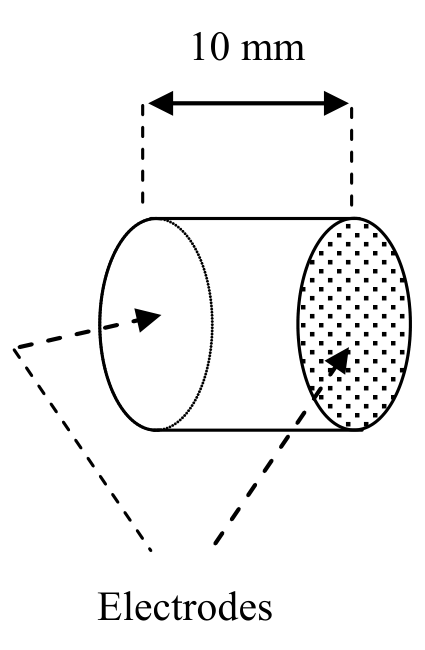
A piezoelectric material changes its linear dimensions under the influence of an electric field and vice-versa, the distortion of a piezoelectric material induces an electrical field. Therefore, it is possible to excite the mechanical vibrations in a piezoelectric material by applying an alternating electric field, and also to induce an alternating electric field by mechanical vibrations.
¹ The Organizing Committee planned to give another experimental problem: a problem on high superconductivity. Unfortunately, the samples of superconductors, prepared that time by a factory, were of very poor quality. Moreover, they were provided after a long delay. Because of that the organizers decided to use this problem, which was also prepared, but considered as a second choice.
A. Knowing that the velocity of longitudinal ultrasonic waves in the material of the disc is about m/s, estimate roughly the resonant frequency of the mechanical vibrations parallel to the disc axis. Assume that the disc holders do no restrict the vibrations. (Note that other types of resonant vibrations with lower or higher frequencies may occur in the discs.)
Using your estimation, determine experimentally the frequency for which the piezoelectric discs work best as a transmitter-receiver set for ultrasound in the liquid. Wetting surfaces of the discs before putting them against the bags improves penetration of the liquid in the bag by ultrasound.
B. Determine the velocity of ultrasound for both liquids without opening the bags and estimate the error.
C. Determine the ratio of the ultrasound velocities for both liquids and its error.
Complete carefully the synopsis sheet. Your report should, apart from the synopsis sheet, contain the descriptions of:
- method of resonant frequency estimation;
- methods of measurements;
- methods of estimating errors of the measured quantities and of final results.
Remember to define all the used quantities and to explain the symbols.
Synopsis Sheet¹
| Synopsis Sheet | ||||
|---|---|---|---|---|
| A | Formula for estimating the resonant frequency: | Results (with units): | ||
| A | Measured best transmitter frequency (with units): | Error: | ||
| B | Definition of measured quantity: | Symbol: | Results: | Error: |
| B | Final formula for ultrasound velocity in liquid: | |||
| B | Velocity of ultrasound (with units): | Error: | ||
| B | Liquid A | |||
| B | Liquid B | |||
| Ratio of velocities: | Error: |
¹ In the real Synopsis Sheet the students had more space for filling.
Отговори
A. Estimate f = v/2l = 2·10⁵ Hz = 200 kHz; measured strong resonance at f ≈ 220 kHz (accuracy 10 kHz).
B. vwater = (1.50 ± 0.10)·10³ m/s; vglycerin = (1.96 ± 0.10)·10³ m/s
Values received by the author of the problem in the standard solution.
C. 1.31
The official solution gives the ratio 1.31 ± 0.15.
Решение
***Solution (draft)***¹
¹ This draft solution is based on the camera-ready text of the more detailed solution prepared by Dr. Andrzej Kotlicki and published in the proceedings [3]
A. As the holders do not affect vibrations of the disc we may expect antinodes on the flat surfaces of the discs (Fig. 4.2; geometric proportions not conserved). One of the frequencies is expected for
where denotes the velocity of longitudinal ultrasonic wave (its value is given in the text of the problem), - the frequency and - the thickness of the disc. Thus:
Numerically Hz = 200 kHz.
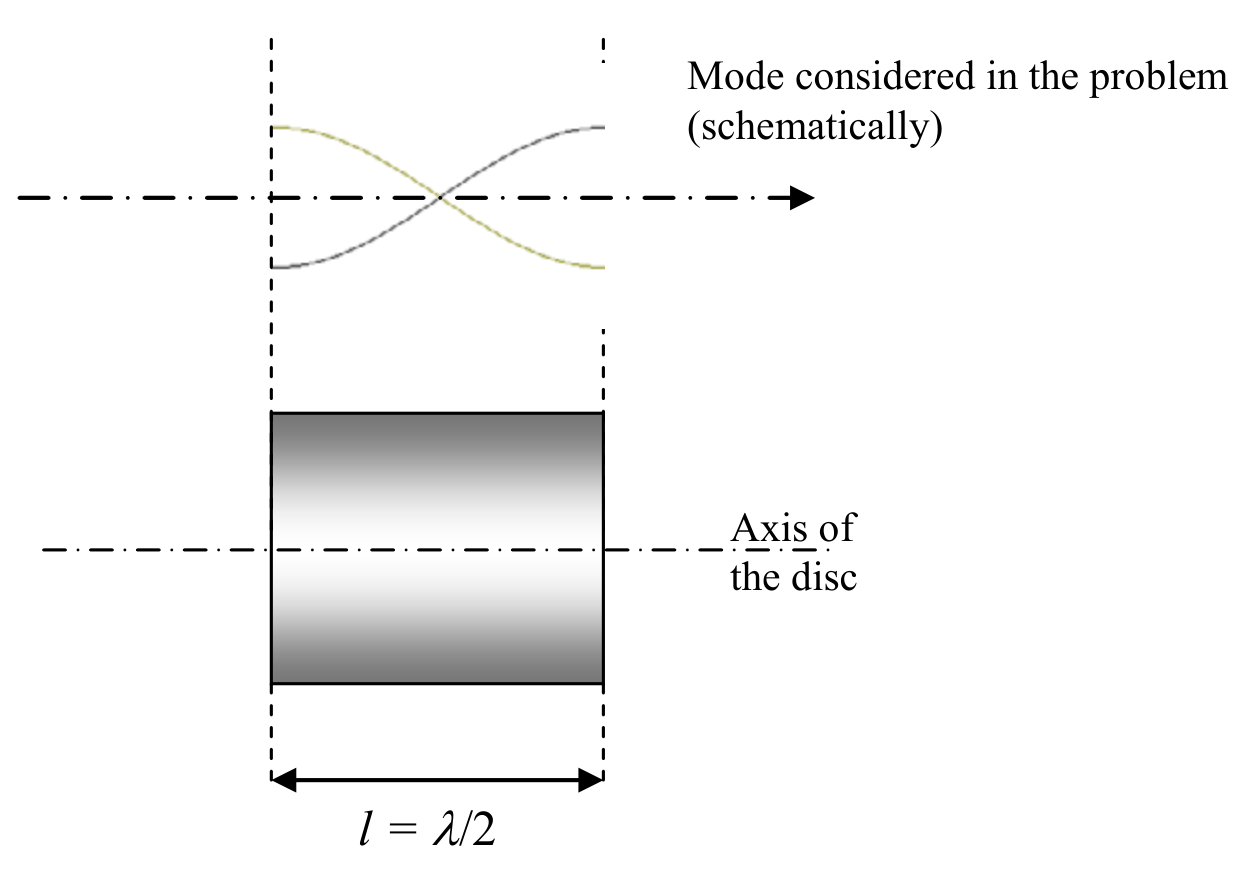
One should stress out that different modes of vibrations can be excited in the disc with height comparable to its diameter. We confine our considerations to the modes related to longitudinal waves moving along the axis of the disc as the sound waves in liquids are longitudinal. We neglect coupling between different modes and require antinodes exactly at the flat parts of the disc. We assume also that the piezoelectric effect does not affect velocity of ultrasound. For these reasons the frequency just determined should be treated as only a rough approximation. However, it indicates that one should look for the resonance in vicinity of 200 kHz.
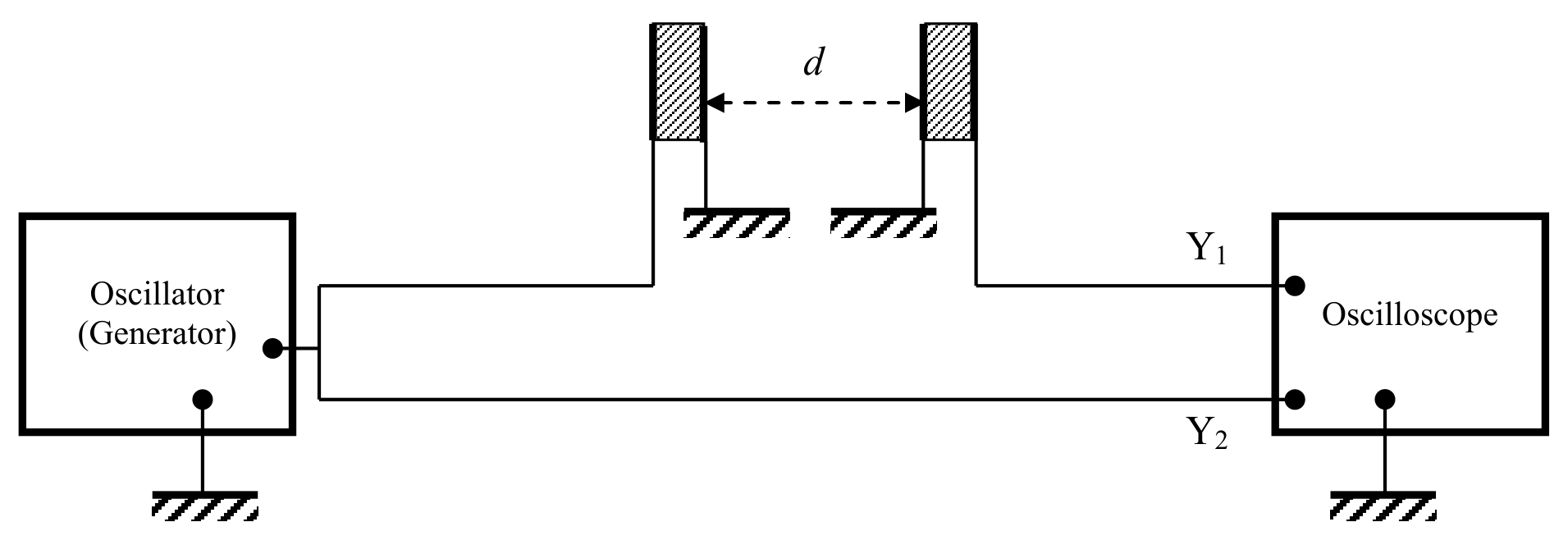
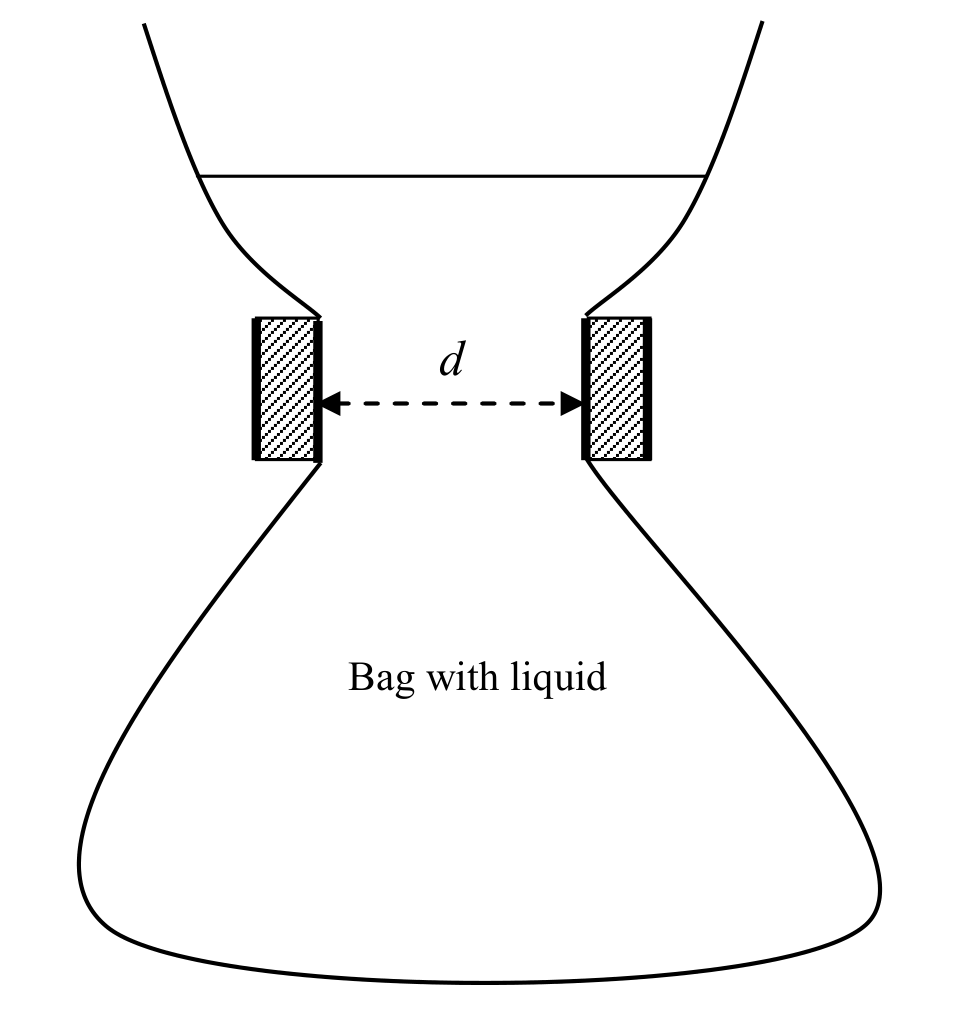
The experimental set-up is shown in Fig. 4.3. The oscillator (generator) is connected to one of the discs that works as a transmitter and to one channel of the oscilloscope. The second disc is connected to the second channel of the oscilloscope and works as a receiver. Both discs are placed against one of the bags with liquid (Fig. 4.4). The distance can be varied.
One searches for the resonance by slowly changing the frequency of the oscillator in the range 100 – 1000 kHz and watching the signal on the oscilloscope. In this way the students could find a strong resonance at frequency kHz. Other resonance peaks could be found at about 110 kHz and 670 kHz. They should have been neglected as they are substantially weaker. (They correspond to some other modes of vibrations.) Accuracy of these measurements was 10 kHz (due to the width of the resonance and the accuracy of the scale on the generator).
B. The ultrasonic waves pass through the liquid and generate an electric signal in the receiver. Using the same set-up (Fig. 4.3 and 4.4) we can measure dependence of the phase shift between the signals at Y₁ and Y₂ vs. distance between the piezoelectric discs at the constant frequency found in point A. This phase shift is , where denotes velocity of ultrasound in the liquid. denotes a constant phase shift occurring when ultrasound passes trough the bag walls (possibly zero). The graph representing dependence should be a straight line. Its slope allows to determine and its error. In general, the measurements of are difficult for many reflections in the bag, which perturb the signal. One of the best ways is to measure only for ( - integer) as such points can be found rather easy. Many technical details concerning measurements can be found in [3] (pp. 37 and 38).
The liquids given to the students were water and glycerin. In the standard solution the author of the problem received the following values:
The ratio of these values was .
The ultrasonic waves are partly reflected or scattered by the walls of the bag. This effect somewhat affects measurements of the phase shift. To minimize its role one can measure the phase shift (for a given distance) or distance (at the same phase shift) several times, each time changing the shape of the bag. As regards errors in determination of velocities it is worth to mention that the most important factor affecting them was the error in determination of the frequency. This error, however, practically does not affect the ratio of velocities.
Marking Scheme
Frequency estimation
- Formula — 1 point
- Result (with units) — 1 point
- Method of experimental determining the resonance frequency — 1 point
- Result (if within 5% of standard value) — 2 points
- Error — 1 point
Measurements of velocities
- Explanation of the method — 2 points
- Proper number of measurements in each series — 3 points
- Result for velocity in the first liquid (if within 5% of standard value) — 2 points
- Error of the above — 1 point
- Result for velocity in the second liquid (if within 5% of standard value) — 2 points
- Error of the above — 1 point
Ratio of velocities
- Result (if within 3% of standard value) — 2 points
- Error of the above — 1 point
Typical mistakes
The results of this problem were very good (more than a half of competitors obtained more than 15 points). Nevertheless, many students encountered some difficulties in estimation of the frequency. Some of them assumed presence of nodes at the flat surfaces of the discs (this assumption is not adequate to the situation, but accidentally gives proper formula). In part B some students tried to find distances between nodes and antinodes for ultrasonic standing wave in the liquid. This approach gave false results as the pattern of standing waves in the bag is very complicated and changes when the shape of the bag is changed.
Acknowledgement
I would like to thank very warmly to Prof. Jan Mostowski and Dr. Andrzej Wysmołek for reading the text of this article and for valuable critical remarks. I express special thanks to Dr. Andrzej Kotlicki for critical reviewing the experimental part of the article and for a number of very important improvements.
Literature
[1] Waldemar Gorzkowski and Andrzej Kotlicki, XX Międzynarodowa Olimpiada Fizyczna - cz. I, Fizyka w Szkole nr 1/90, pp. 34 - 39
[2] Waldemar Gorzkowski, XX Międzynarodowa Olimpiada Fizyczna - cz. II, Fizyka w Szkole nr 2/3-90, pp. 23 - 32
[3] XX International Physics Olympiad - Proceedings of the XX International Physics Olympiad, Warsaw (Poland), July 16 - 24, 1989, ed. by W. Gorzkowski, World Scientific Publishing Company, Singapore 1990 [ISBN 981-02-0084-6]
Оригинал в Архива: ipho89.pdf