IPhO 1990, Теория и експеримент — Задача 1. X-ray Diffraction from a crystal.
THE 21st INTERNATIONAL PHYSICS OLYMPIAD - 1990 · 10 т.
Внимание: Бележка към темата
Complete combined archive booklet, attributed to Hans Jordens, contains three theory questions and two experiments with keys. Printed errors and gaps are preserved: the neutron-star key changes the flattening denominator and uses a square-law radius inference; the LED key references missing graphs, has printed inconsistent table values and one unassigned final value; magnet-speed tables print m/s but their values match cm/s. Native source values and all grading remain unchanged.
Условие
We wish to study X-ray diffraction by a cubic crystal lattice. To do this we start with the diffraction of a plane, monochromatic wave that falls perpendicularly on a 2-dimensional grid that consists of slits with separations and . The diffraction pattern is observed on a screen at a distance from the grid. The screen is parallel to the grid and is much larger than and .
a- Determine the positions and widths of the principal maximum on the screen.
The width is defined as the distance between the minima on either side of the maxima. [4 т.]
We consider now a cubic crystal, with lattice spacing and size . is much smaller than . The crystal is placed in a parallel X-ray beam along the z-axis at an angle (see Fig. 1). The diffraction pattern is again observed on a screen at a great distance from the crystal.
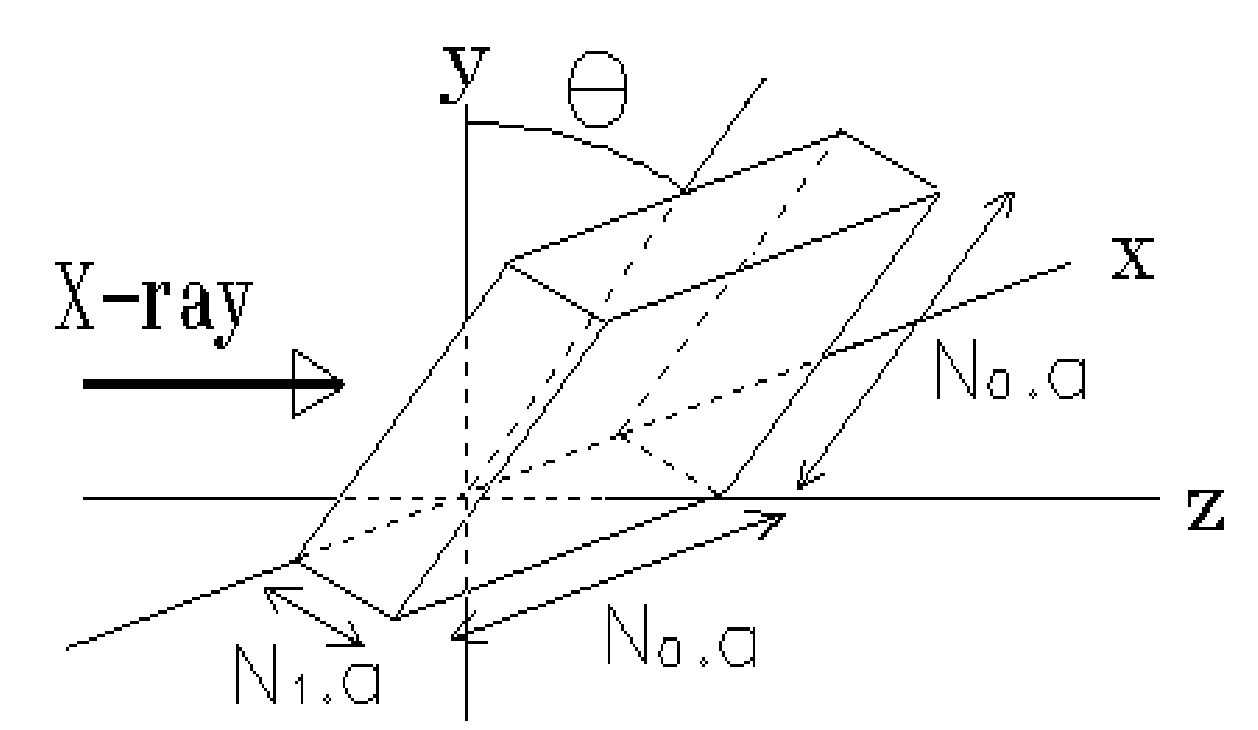
b- Calculate the position and width of the maxima as a function of the angle (for small ).
- What in particular are the consequences of the fact that . [3 т.]
The diffraction pattern can also be derived by means of Bragg's theory, in which it is assumed that the X-rays are reflected from atomic planes in the lattice. The diffraction pattern then arises from interference of these reflected rays with each other.
c- Show that this so-called Bragg reflection yields the same conditions for the maxima as those that you found in b. [2 т.]
In some measurements the so-called powder method is employed. A beam of X-rays is scattered by a powder of very many, small crystals. (Of course the sizes of the crystals are much larger than the lattice spacing, ).
Scattering of X-rays of wavelength by Potassium Chloride [KCl] (which has a cubic lattice, see Fig.2) results in the production of concentric dark circles on a photographic plate. The distance between the crystals and the plate is , and the radius of the smallest circle is (see Fig. 3). and ions have almost the same size, and they may be treated as identical scattering centres.
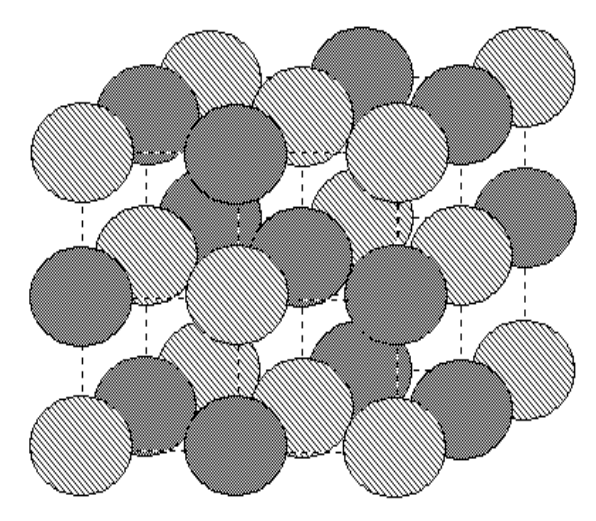
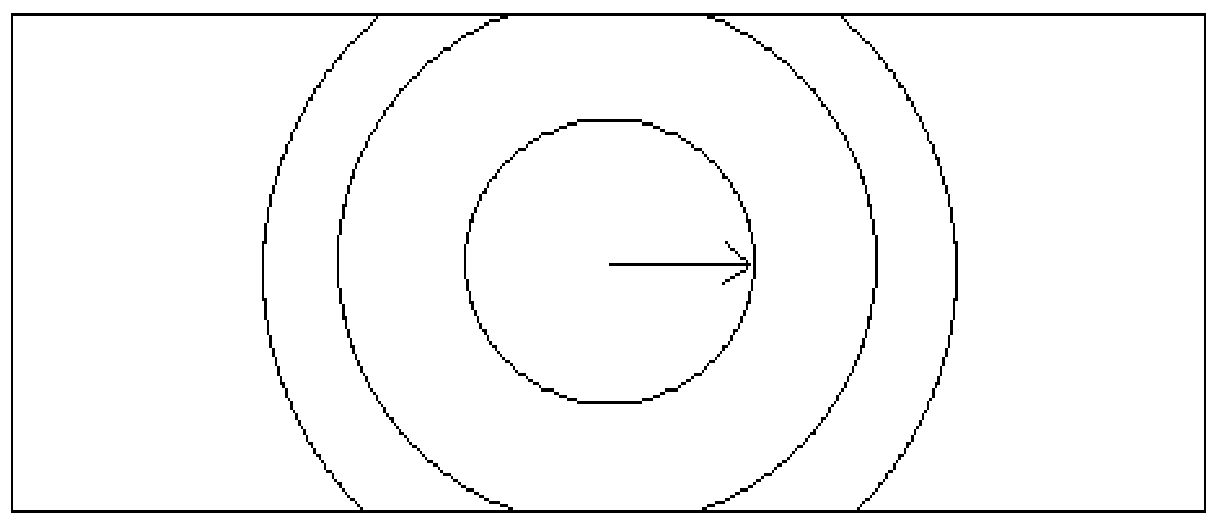
d- Calculate the distance between two neighbouring K ions in the crystal. [1 т.]
Решение
a-
Consider first the x-direction. If waves coming from neighbouring slits (with separation ) traverse paths of lengths that differ by:
where is an integer, then a principal maximum occurs. The position on the screen (in the x-direction) is:
since .
The path difference between the middle slit and one of the slits at the edge is then:
If on the other hand this path difference is:
then the first minimum, next to the principal maximum, occurs. The position of this minimum on the screen is given by:
The width of the principal maximum is accordingly:
A similar treatment can be made for the y-direction, in which there are slits with separation . The positions and widths of the principal maximal are:
An alternative method of solution is to calculate the intensity for the 2-dimensional grid as a function of the angle that the beam makes with the screen.
b-
In the x-direction the beam 'sees' a grid with spacing , so that in this direction we have:
In the y-direction, the beam 'sees' a grid with effective spacing . Analogously, we obtain:
In the z-direction, the beam 'sees' a grid with effective spacing . This gives rise to principal maxima with position and width:
This pattern is superimposed on the previous one. Since is very small, only the zeroth-order pattern will be seen, and it is very broad, since . The diffraction pattern from a plane wave falling on a thin plate of a cubic crystal, at a small angle of incidence to the normal, will be almost identical to that from a two-dimensional grid.
c-
In Bragg reflection, the path difference for constructive interference between neighbouring planes:
Here is the angle of diffraction.
This is the same condition for a maximum as in section b.
d-
For the distance, , between neighbouring K ions we have:
Marking Breakdown
| Part | Criterion | Marks |
|---|---|---|
| a | position of principal maxima | 1 |
| a | width of principal maxima | 3 |
| b | lattice constants | 1 |
| b | effect of thickness | 2 |
| c | Bragg reflection | 2 |
| d | Calculation of K-K spacing | 1 |
Оригинал в Архива: ipho90.pdf · решение от архива: ipho90.pdf