IPhO 1999, Теория — Задача 2. Magnetic field with a V-shaped wire
Problem 2 — Magnetic field with a V-shaped wire · 18 юли 1999 г. · 10 т.
Условие
Among the first successes of the interpretation by Ampère of magnetic phenomena, we have the computation of the magnetic field B generated by wires carrying an electric current, as compared to early assumptions originally made by Biot and Savart.
A particularly interesting case is that of a very long thin wire, carrying a constant current , made out of two rectilinear sections and bent in the form of a "V", with angular half-span (see figure). According to Ampère's computations, the magnitude of the magnetic field in a given point P lying on the axis of the "V", outside of it and at a distance from its vertex, is proportional to . Ampère's work was later embodied in Maxwell's electromagnetic theory, and is universally accepted.
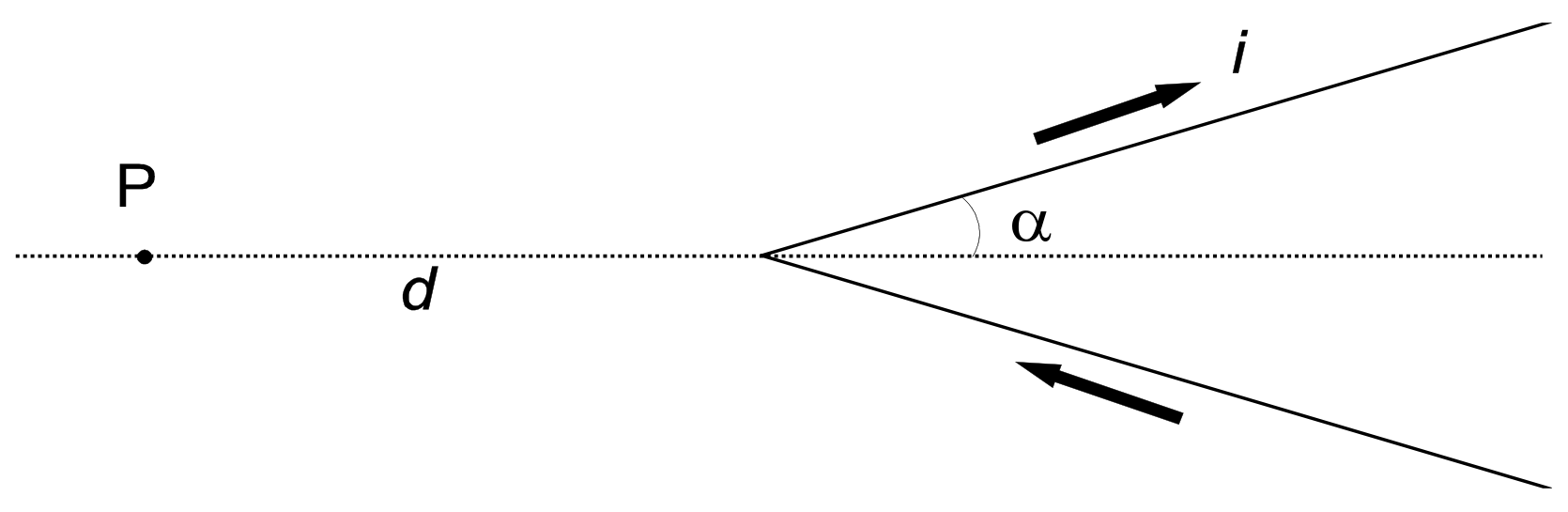
Using our contemporary knowledge of electromagnetism,
Throughout this problem is expressed in radians
1. Find the direction of the field B in P. [1 т.]
2. Knowing that the field is proportional to , find the proportionality factor in . [1,5 т.]
3. Compute the field B in a point P symmetric to P with respect to the vertex, i.e. along the axis and at the same distance , but inside the "V" (see figure). [2 т.]
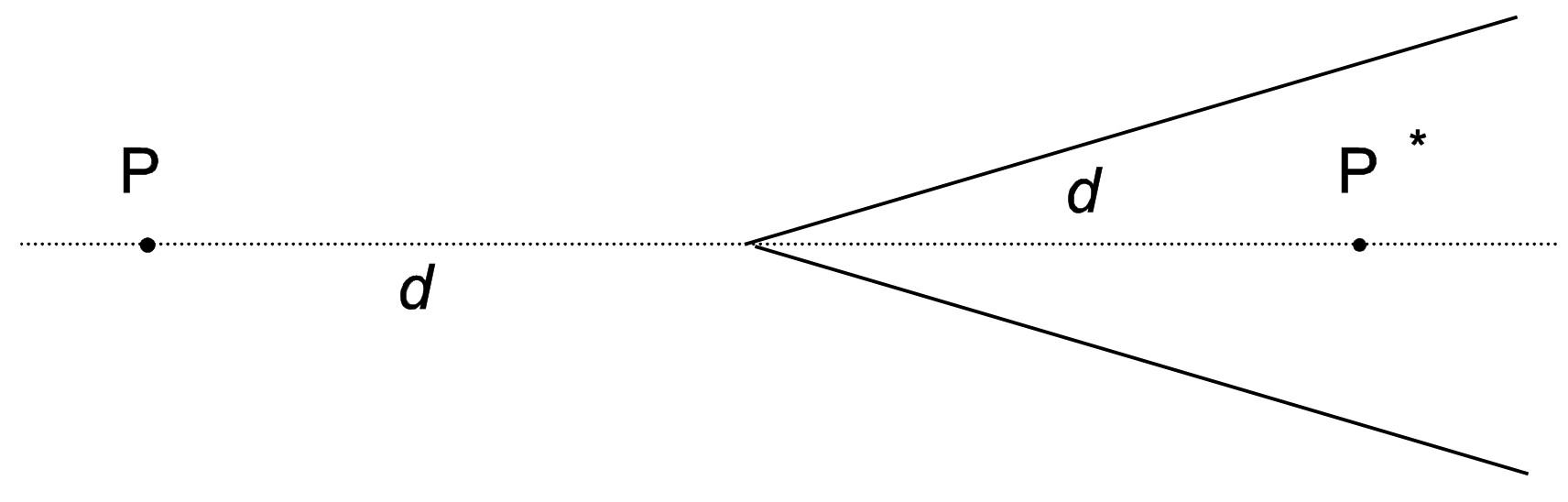
4. In order to measure the magnetic field, we place in P a small magnetic needle with moment of inertia and magnetic dipole moment ; it oscillates around a fixed point in a plane containing the direction of B. Compute the period of small oscillations of this needle as a function of . [2,5 т.]
In the same conditions Biot and Savart had instead assumed that the magnetic field in P might have been (we use here the modern notation) , where is the magnetic permeability of vacuum. In fact they attempted to decide with an experiment between the two interpretations (Ampère's and Biot and Savart's) by measuring the oscillation period of the magnetic needle as a function of the "V" span. For some values, however, the differences are too small to be easily measurable.
5. If, in order to distinguish experimentally between the two predictions for the magnetic needle oscillation period in P, we need a difference by at least 10%, namely ( being the Ampere prediction and the Biot-Savart prediction) state in which range, approximately, we must choose the "V" half-span for being able to decide between the two interpretations. [3 т.]
Hint
Depending on which path you follow in your solution, the following trigonometric equation might be useful:
Answer sheet
In this problem write the requested results as analytic expressions, not as numerical values and units, unless explicitly indicated.
1. Using the following sketch draw the direction of the B field (the length of the vector is not important). The sketch is a spatial perspective view.
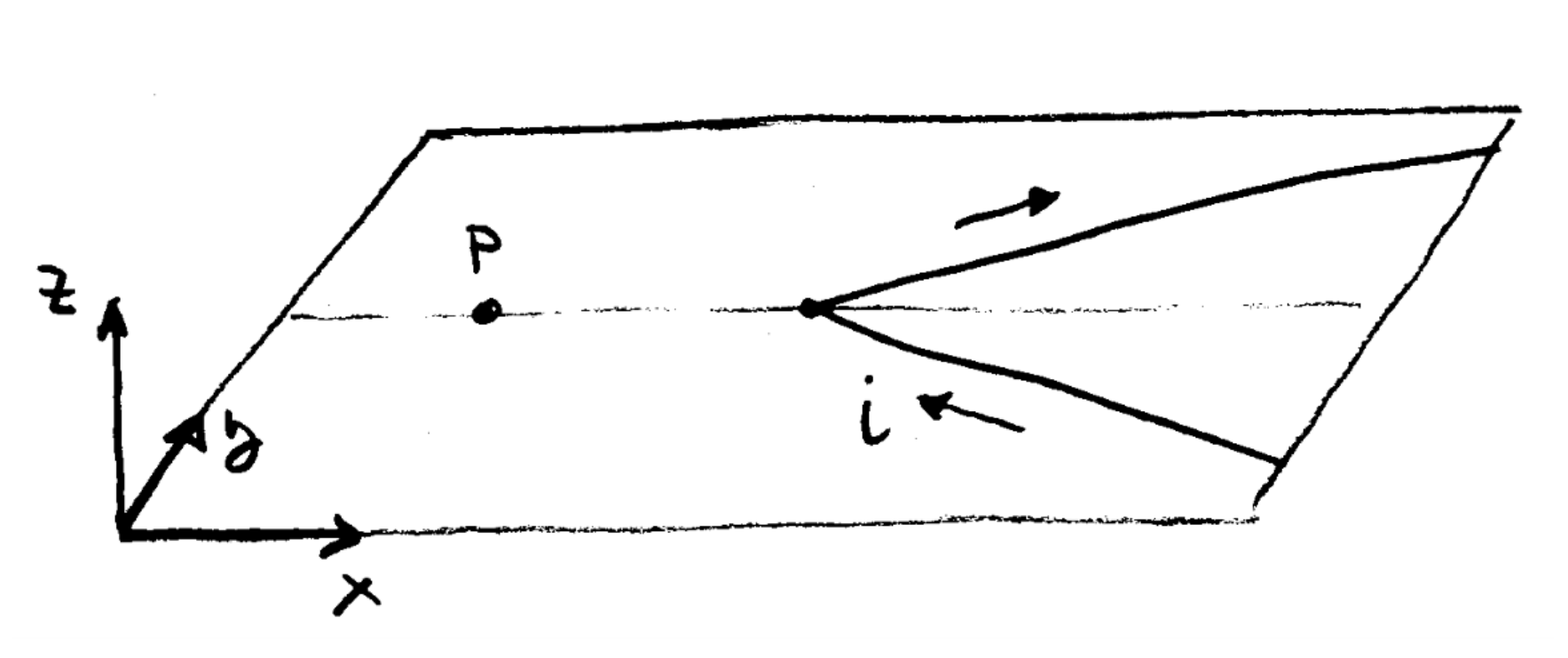
2. Proportionality factor ……………………….
3. Absolute value of the magnetic field intensity at the point P, as described in the text……………………...………………
Draw the direction of the B field in the above sketch
4. Period of the small angle oscillations of the magnet ……………………………
5. Write for which range of values (indicating here the numerical values of the range limits) the ratio between the oscillation periods, as predicted by Ampère and by Biot and Savart, is larger than 1.10:
……………………. ……………………….
Отговори
1. Orthogonal to the plane of the wire: along the positive axis (right-handed frame with the wire in the - plane, as in the solution figure).
2.
3.
The field is along the negative z axis.
4.
5. smaller than (the limit is where ).
Решение
Solution
1. The contribution to B given by each leg of the "V" has the same direction as that of a corresponding infinite wire and therefore - if the current proceeds as indicated by the arrow - the magnetic field is orthogonal to the wire plane taken as the x-y plane. If we use a right-handed reference frame as indicated in the figure, B(P) is along the positive axis.
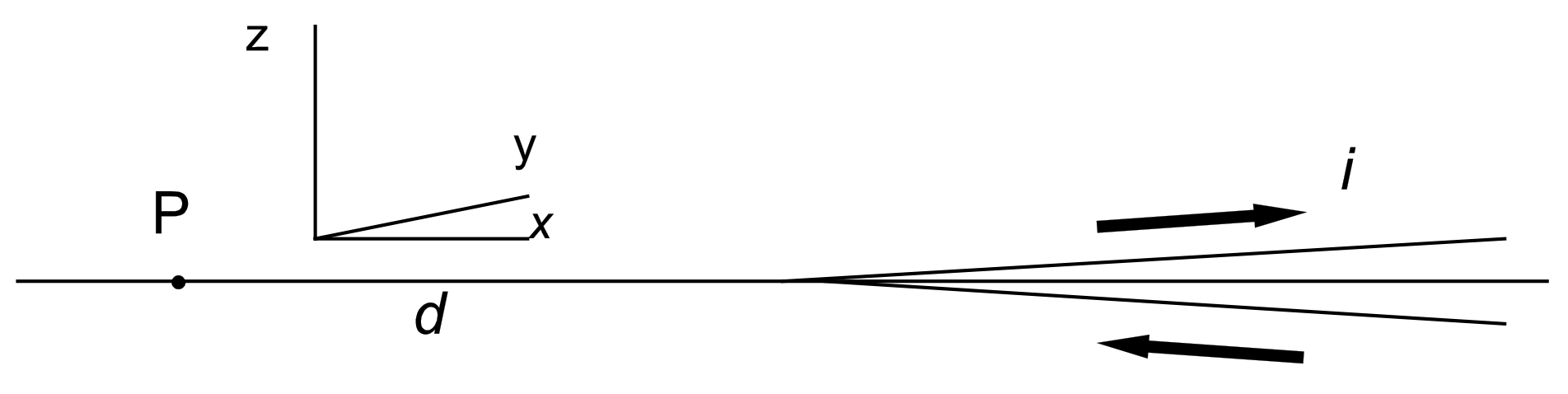
For symmetry reasons, the total field is twice that generated by each leg and has still the same direction.
2A. When the "V" becomes a straight infinite wire. In this case the magnitude of the field is known to be , and since , the factor is .
The following solution is equally acceptable:
2B. If the student is aware of the equation for a finite stretch of wire lying on a straight line at a distance from point P and whose ends are seen from P under the angles and , he can find that the two legs of the “V” both produce fields and therefore the total field is . This is a more complete solution since it also proves the angular dependence, but it is not required.
3A. In order to compute we may consider the "V" as equivalent to two crossed infinite wires ( and in the following figure) plus another "V", symmetrical to the first one, shown in the figure as V', carrying the same current , in opposite direction.
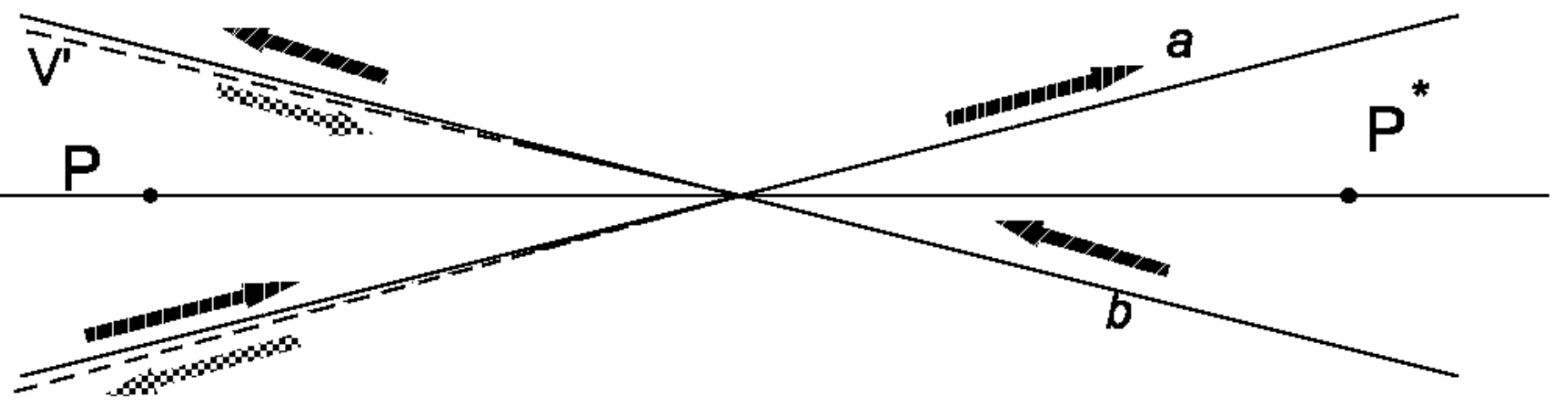
Then . The individual contributions are:
, along the negative axis;
, along the positive axis.
Therefore we have , and the field is along the negative axis.
The following solutions are equally acceptable:
3B. The point P inside a "V" with half-span can be treated as if it would be on the outside of a "V" with half-span carrying the same current but in an opposite way, therefore the field is ; the direction is still that of the axis but it is along the negative axis because the current flows in the opposite way as previously discussed.
3C. If the student follows the procedure outlined under 2B., he/she may also find the field value in P* by the same method.
4. The mechanical moment M acting on the magnetic needle placed in point P is given by (where the symbol is used for vector product). If the needle is displaced from its equilibrium position by an angle small enough to approximate with , the angular momentum theorem gives , where there is a minus sign because the mechanical momentum is always opposite to the displacement from equilibrium. The period of the small oscillations is therefore given by .
Writing the differential equation, however, is not required: the student should recognise the same situation as with a harmonic oscillator.
5. If we label with subscript A the computations based on Ampère's interpretation, and with subscript BS those based on the other hypothesis by Biot and Savart, we have
For (maximum possible value) ; and for . Since within this range is a monotonically growing function of , is a monotonically decreasing function of ; in an experiment it is therefore not possible to distinguish between the two interpretations if the value of is larger than the value for which (10% difference), namely when . By looking into the trigonometry tables or using a calculator we see that this condition is well approximated when rad; must therefore be smaller than 0.77 rad ≈ 44°.
A graphical solution of the equation for is acceptable but somewhat lengthy. A series development, on the contrary, is not acceptable.
Grading guidelines
1.
- 1 for recognising that each leg gives the same contribution
- 0.5 for a correct sketch
2.
- 0.5 for recognising that for a straight wire, or for knowledge of the equation given in 2B.
- 0.25 for correct field equation (infinite or finite)
- 0.25 for value of
3.
- 0.7 for recognising that the V is equivalent to two infinite wires plus another V
- 0.3 for correct field equation for an infinite wire
- 0.5 for correct result for the intensity of the required field
- 0.5 for correct field direction
alternatively
- 0.8 for describing the point as outside a V with half-amplitude and opposite current
- 0.7 for correct analytic result
- 0.5 for correct field direction
alternatively
- 0.5 for correctly using equation under 2B
- 1 for correct analytic result
- 0.5 for correct field direction
4.
- 0.5 for correct equation for mechanical moment M
- 0.5 for doing small angle approximation
- 1 for correct equation of motion, including sign, or for recognizing analogy with harmonic oscillator
- 0.5 for correct analytic result for
5.
- 0.3 for correct formulas of the two periods
- 0.3 for recognising the limiting values for
- 0.4 for correct ratio between the periods
- 1 for finding the relationship between and tangent
- 0.5 for suitable approximate value of
- 0.5 for final explicit limiting value of
For the numerical values a full score cannot be given if the number of digits is incorrect (more than one digit more or less than those given in the solution) or if the units are incorrect or missing