IPhO 1999, Теория — Задача 3. A space probe to Jupiter
Problem 3 — A space probe to Jupiter · 18 юли 1999 г. · 10 т.
Условие
We consider in this problem a method frequently used to accelerate space probes in the desired direction. The space probe flies by a planet, and can significantly increase its speed and modify considerably its flight direction, by taking away a very small amount of energy from the planet's orbital motion. We analyze here this effect for a space probe passing near Jupiter.
The planet Jupiter orbits around the Sun along an elliptical trajectory, that can be approximated by a circumference of average radius ; in order to proceed with the analysis of the physical situation we must first:
1. Find the speed of the planet along its orbit around the Sun. [1.5 points]
2. When the probe is between the Sun and Jupiter (on the segment Sun-Jupiter), find the distance from Jupiter where the Sun's gravitational attraction balances that by Jupiter. [1 point]
A space probe of mass flies by Jupiter. For simplicity assume that the trajectory of the space probe is entirely in the plane of Jupiter's orbit; in this way we neglect the important case in which the space probe is expelled from Jupiter’s orbital plane.
We only consider what happens in the region where Jupiter's attraction overwhelms all other gravitational forces.
In the reference frame of the Sun's center of mass the initial speed of the space probe is (along the positive direction) while Jupiter's speed is along the negative direction (see figure 1); by "initial speed" we mean the space probe speed when it's in the interplanetary space, still far from Jupiter but already in the region where the Sun's attraction is negligible with respect to Jupiter's. We assume that the encounter occurs in a sufficiently short time to allow neglecting the change of direction of Jupiter along its orbit around the Sun. We also assume that the probe passes behind Jupiter, i.e. the coordinate is greater for the probe than for Jupiter when the coordinate is the same.
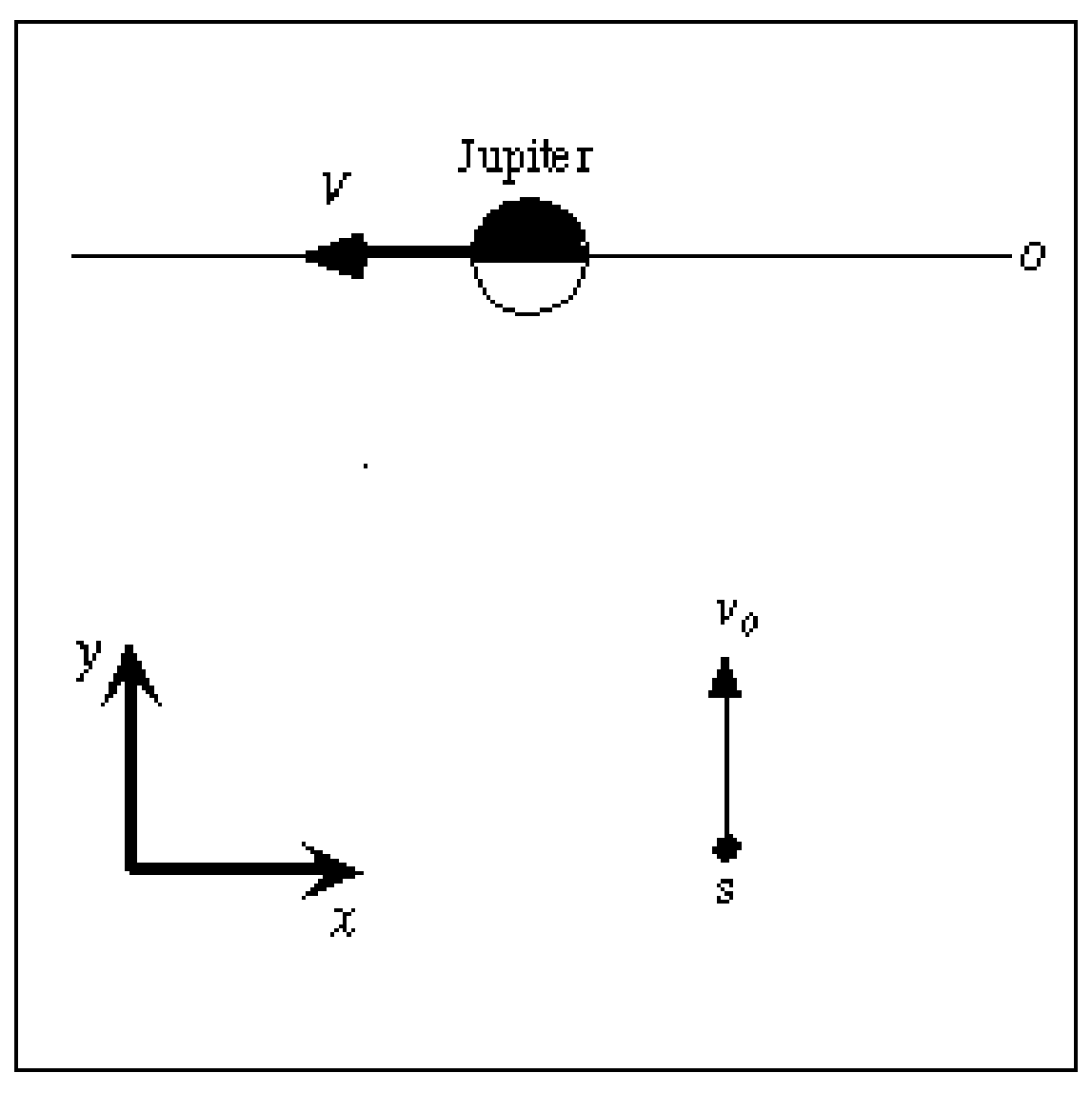
3. Find the space probe's direction of motion (as the angle between its direction and the axis) and its speed in Jupiter's reference frame, when it's still far away from Jupiter. [2 points]
4. Find the value of the space probe's total mechanical energy in Jupiter's reference frame, putting – as usual – equal to zero the value of its potential energy at a very large distance, in this case when it is far enough to move with almost constant velocity owing to the smallness of all gravitational interactions. [1 point]
The space probe's trajectory in the reference frame of Jupiter is a hyperbola and its equation in polar coordinates in this reference frame is
where is the distance between one of the asymptotes and Jupiter (the so called impact parameter), is the probe’s total mechanical energy in Jupiter’s reference frame, is the gravitational constant, is the mass of Jupiter, and are the polar coordinates (the radial distance and the polar angle).
Figure 2 shows the two branches of a hyperbola as described by equation (1); the asymptotes and the polar co-ordinates are also shown. Note that equation (1) has its origin in the "attractive focus" of the hyperbola. The space probe's trajectory is the attractive trajectory (the emphasized branch).
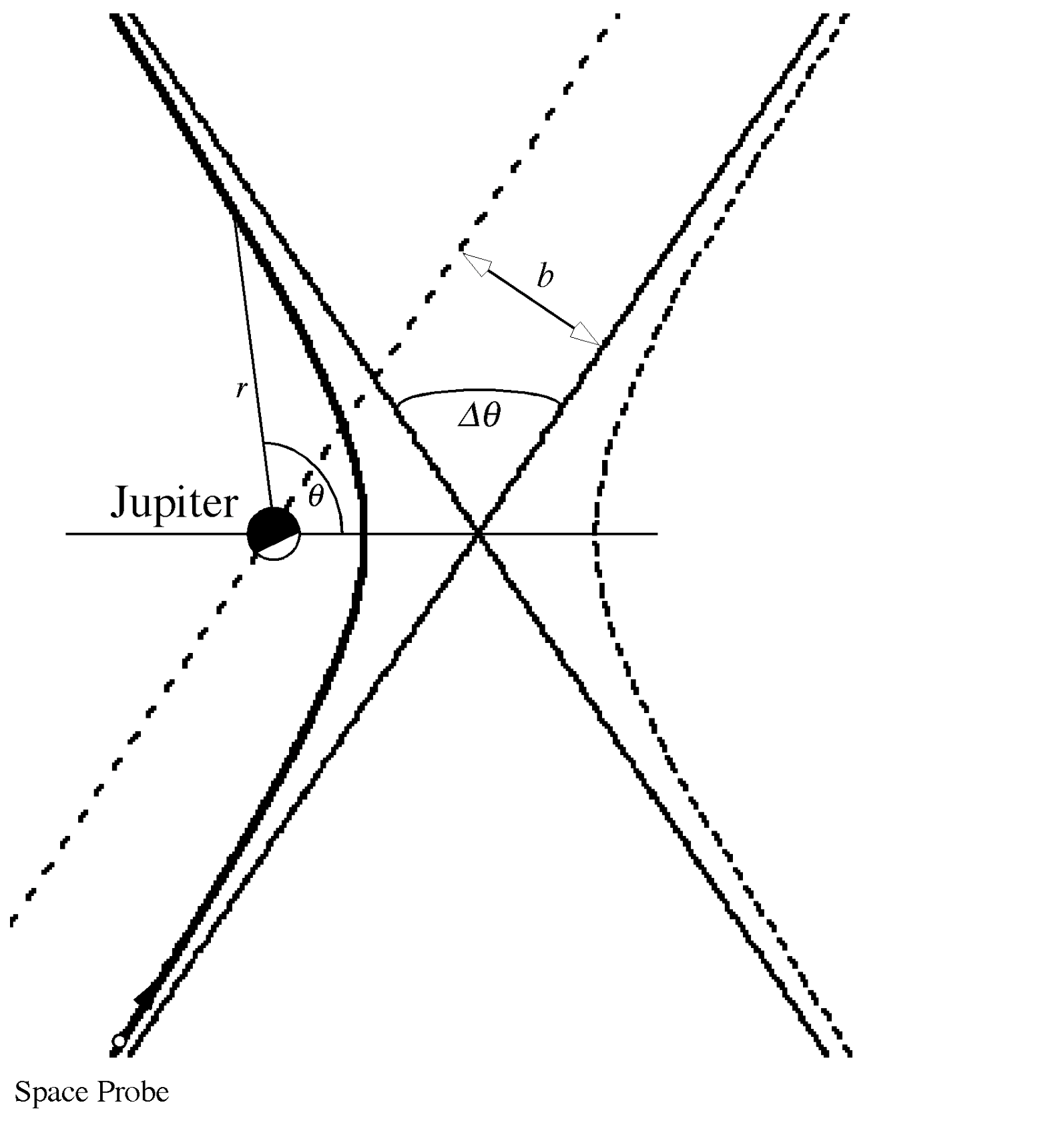
5. Using equation (1) describing the space probe's trajectory, find the total angular deviation in Jupiter’s reference frame (as shown in figure 2) and express it as a function of initial speed and impact parameter . [2 points]
6. Assume that the probe cannot pass Jupiter at a distance less than three Jupiter radii from the center of the planet; find the minimum possible impact parameter and the maximum possible angular deviation. [1 point]
7. Find an equation for the final speed of the probe in the Sun's reference frame as a function only of Jupiter’s speed , the probe’s initial speed and the deviation angle . [1 point]
8. Use the previous result to find the numerical value of the final speed in the Sun's reference frame when the angular deviation has its maximum possible value. [0.5 points]
Hint
Depending on which path you follow in your solution, the following trigonometric formulas might be useful:
Answer sheet
Unless explicitly requested to do otherwise, in this problem you are supposed to write your results both as analytic equations (first) and then as numerical results and units (e.g. ).
1. Speed of Jupiter along its orbit ……………………………
2. Distance from Jupiter where the two gravitational attractions balance each other …………………………………….
3. Initial speed of the space probe in Jupiter’s reference frame ………………………………...
and the angle its direction forms with the axis, as defined in figure 1, ………………….………
4. Total energy of the space probe in Jupiter’s reference frame …………………………………...
5. Write a formula linking the probe’s deviation in Jupiter’s reference frame to the impact parameter , the initial speed and other known or computed quantities ……………………………………………………………………………………………..
6. If the distance from Jupiter’s center can’t be less than three Jovian radii, write the minimum impact parameter and the maximum angular deviation: ……………………………………; ……………………………………………………..
7. Equation for the final probe speed in the Sun’s reference frame as a function of , and ……………………………………………………………………………
8. Numerical value of the final speed in the Sun’s reference frame when the angular deviation has its maximum value as computed in step 6 ………………………………………………………………
Отговори
1.
2.
3. and
The official solution calls the angle (the problem text calls it ).
4.
5.
6. and
7.
8. 26200 m/s
Решение
Solution
1A. Assuming – as outlined in the text – that the orbit is circular, and relating the radial acceleration to the gravitational field (where is the solar mass) we obtain Jupiter's orbital speed .
The following alternative solution is also acceptable:
1B. Since we treat Jupiter’s motion as circular and uniform, , where is the revolution period of Jupiter, which is given in the list of the general physical constants.
2. The two gravitational forces on the space probe are equal when
(where is the distance from Jupiter and is Jupiter’s mass), whence
and
and therefore the two gravitational attractions are equal at a distance of about 23.3 million kilometers from Jupiter (about 334 Jupiter radii).
3. With a simple Galilean transformation we find that the velocity components of the probe in Jupiter's reference frame are
and therefore - in Jupiter's reference frame – the probe travels with an angle with respect to the axis and its speed is (we also note that and ).
Using the given values we obtain and .
4. Since the probe trajectory can be described only approximately as the result of a two-body gravitational interaction (we should also take into account the interaction with the Sun and other planets) we assume a large but not infinite distance from Jupiter and we approximate the total energy in Jupiter's reference frame as the probe's kinetic energy at that distance:
The corresponding numerical value is .
5. Equation (1) shows that the radial distance becomes infinite, and its reciprocal equals zero, when
namely when
We should also note that the radial distance can't be negative, and therefore its acceptable values are those satisfying the equation
or
The solutions for the limiting case of eq. (10) (i.e. when the equal sign applies) are:
and therefore the angle (shown in figure 2) between the two hyperbola asymptotes is given by:
In the last line, we used the value of the total energy as computed in the previous section.
6. The angular deviation is a monotonically decreasing function of the impact parameter, whence the deviation has a maximum when the impact parameter has a minimum. From the discussion in the previous section we easily see that the point of nearest approach is when , and in this case the minimum distance between probe and planet center is easily obtained from eq. (1):
By inverting equation (13) we obtain the impact parameter
We may note that this result can alternatively be obtained by considering that, due to the conservation of angular momentum, we have
where we introduced the speed corresponding to the nearest approach. In addition, the conservation of energy gives
and by combining these two equations we obtain equation (14) again.
The impact parameter is an increasing function of the distance of nearest approach; therefore, if the probe cannot approach Jupiter's surface by less than two radii (and thus , where is Jupiter’s body radius), the minimum acceptable value of the impact parameter is
From this equation we finally obtain the maximum possible deviation:
and by using the numerical values we computed before we obtain:
and
7. The final direction of motion with respect to the axis in Jupiter’s reference frame is given by the initial angle plus the deviation angle, thus if the probe passes behind the planet. The final velocity components in Jupiter's reference frame are therefore:
whereas in the Sun reference frame they are
Therefore the final probe speed in the Sun reference frame is
8. Using the value of the maximum possible angular deviation, the numerical result is .
Grading guidelines
| 1. | 0.4 | Law of gravitation, or law of circular uniform motion |
| 0.4 | Correct approach | |
| 0.4+0.3 | Correct results for velocity of Jupiter | |
| 2. | 0.3 | Correct approach |
| 0.4+0.3 | Correct results for distance from Jupiter | |
| 3. | 1 | Correct transformation between reference frames |
| 0.3+0.2 | Correct results for probe speed in Jupiter reference frame | |
| 0.3+0.2 | Correct results for probe angle | |
| 4. | 0.8 | Understanding how to handle the potential energy at infinity |
| 0.2 | Numerical result for kinetic energy | |
| 5. | 0.6 | Correct approach |
| 0.6 | Equation for the orientation of the asymptotes | |
| 0.8 | Equation for the probe deflection angle | |
| 6. | 0.3+0.2 | Correct results for minimum impact parameter |
| 0.3+0.2 | Correct results for maximum deflection angle | |
| 7. | 0.5 | Equation for velocity components in the Sun reference frame |
| 0.5 | Equation for speed as a function of angular deflection | |
| 8. | 0.5 | Numerical result for final speed |
For “correct results” two possible marks are given: the first one is for the analytical equation and the second one for the numerical value.
For the numerical values a full score cannot be given if the number of digits is incorrect (more than one digit more or less than those given in the solution) or if the units are incorrect or missing.