IPhO 2000, Теория — Задача 1. Theoretical Problem 1
Theoretical Problem 1
Условие
A
A bungee jumper is attached to one end of a long elastic rope. The other end of the elastic rope is fixed to a high bridge. The jumper steps off the bridge and falls, from rest, towards the river below. He does not hit the water. The mass of the jumper is , the unstretched length of the rope is , the rope has a force constant (force to produce 1 m extension) of and the gravitational field strength is .
You may assume that
- the jumper can be regarded as a point mass attached to the end of the rope,
- the mass of the rope is negligible compared to ,
- the rope obeys Hooke’s law,
- air resistance can be ignored throughout the fall of the jumper.
Obtain expressions for the following and insert on the answer sheet:
(a) the distance dropped by the jumper before coming instantaneously to rest for the first time,
(b) the maximum speed attained by the jumper during this drop,
(c) the time taken during the drop before coming to rest for the first time.
B
A heat engine operates between two identical bodies at different temperatures and (), with each body having mass and constant specific heat capacity . The bodies remain at constant pressure and undergo no change of phase.
(a) Showing full working, obtain an expression for the final temperature attained by the two bodies A and B, if the heat engine extracts from the system the maximum amount of mechanical work that is theoretically possible.
Write your expression for the final temperature on the answer sheet.
(b) Hence, obtain and write on the answer sheet an expression for this maximum amount of work available.
The heat engine operates between two tanks of water each of volume 2.50 m. One tank is at 350 K and the other is at 300 K.
(c) Calculate the maximum amount of mechanical energy obtainable. Insert the value on the answer sheet.
Specific heat capacity of water =
Density of water =
C
It is assumed that when the earth was formed the isotopes and were present but not their decay products. The decays of and are used to establish the age of the earth, .
(a) The isotope decays with a half-life of years. The decay products in the resulting radioactive series have half-lives short compared to this; to a first approximation their existence can be ignored. The decay series terminates in the stable lead isotope .
Obtain and insert on the answer sheet an expression for the number of atoms, denoted , produced by radioactive decay with time , in terms of the present number of atoms, denoted , and the half-life time of . (You may find it helpful to work in units of years.)
(b) Similarly, decays with a half-life of years through a series of shorter half-life products to give the stable isotope .
Write down on the answer sheet an equation relating to and the half-life of .
(c) A uranium ore, mixed with a lead ore, is analysed with a mass spectrometer. The relative concentrations of the three lead isotopes , and are measured and the number of atoms are found to be in the ratios 1.00 : 29.6 : 22.6 respectively. The isotope is used for reference as it is not of radioactive origin. Analysing a pure lead ore gives ratios of 1.00 : 17.9 : 15.5.
Given that the ratio is 137 : 1, derive and insert on the answer sheet an equation involving .
(d) Assume that is much greater than the half lives of both uranium isotopes and hence obtain an approximate value for .
(e) This approximate value is clearly not significantly greater than the longer half life, but can be used to obtain a much more accurate value for . Hence, or otherwise, estimate a value for the age of the earth correct to within 2%.
D
Charge is uniformly distributed in vacuo throughout a spherical volume of radius .
(a) Derive expressions for the electric field strength at distance from the centre of the sphere for and .
(b) Obtain an expression for the total electric energy associated with this distribution of charge.
Insert your answers to (a) and (b) on the answer sheet.
E
A circular ring of thin copper wire is set rotating about a vertical diameter at a point within the Earth's magnetic field. The magnetic flux density of the Earth's magnetic field at this point is 44.5 μT directed at an angle of 64° below the horizontal. Given that the density of copper is and its resistivity is , calculate how long it will take for the angular velocity of the ring to halve. Show the steps of your working and insert the value of the time on the answer sheet. This time is much longer than the time for one revolution.
You may assume that the frictional effects of the supports and air are negligible, and for the purposes of this question you should ignore self-inductance effects, although these would not be negligible.
Решение
A Bungee Jumper
(a) Comes to rest when loss of gravitational potential energy = strain energy stored in rope.
Rearranging:
Quadratic solution:
Need positive root. This gives the lower rest position (other root after initial rise).
(b) Maximum speed when acceleration is zero, i.e. .
Kinetic energy = loss of potential energy − strain energy:
Putting ,
(c) Time to come to rest = time of free fall + time for SHM to stop stretching.
Free fall: , so .
The jumper enters the SHM with free fall velocity .
Period of SHM .
We represent a full SHM cycle by
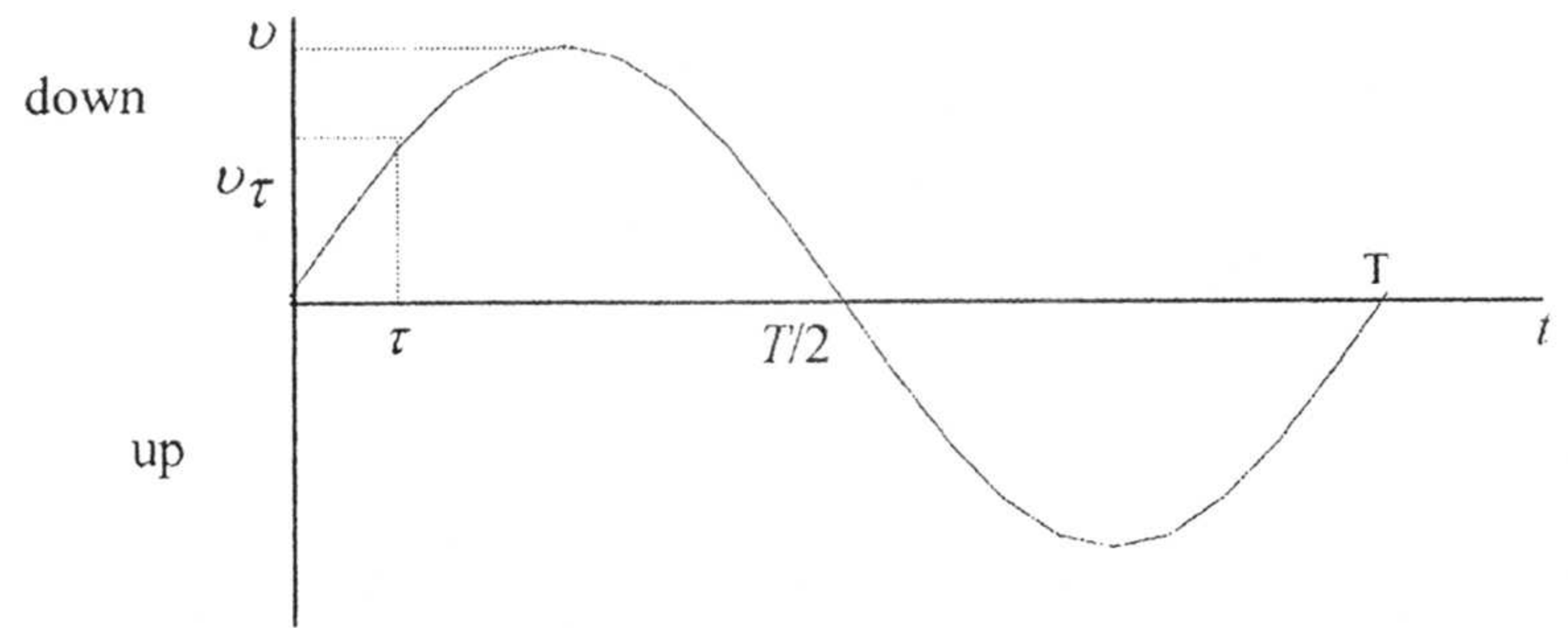
The jumper enters the SHM at time given by
Jumper comes to rest at one half cycle of the SHM at total time given by
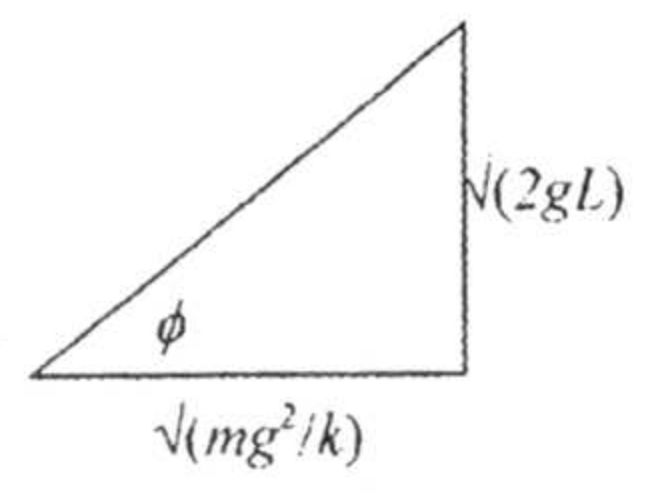
This is the same as
B Heat Engine Question
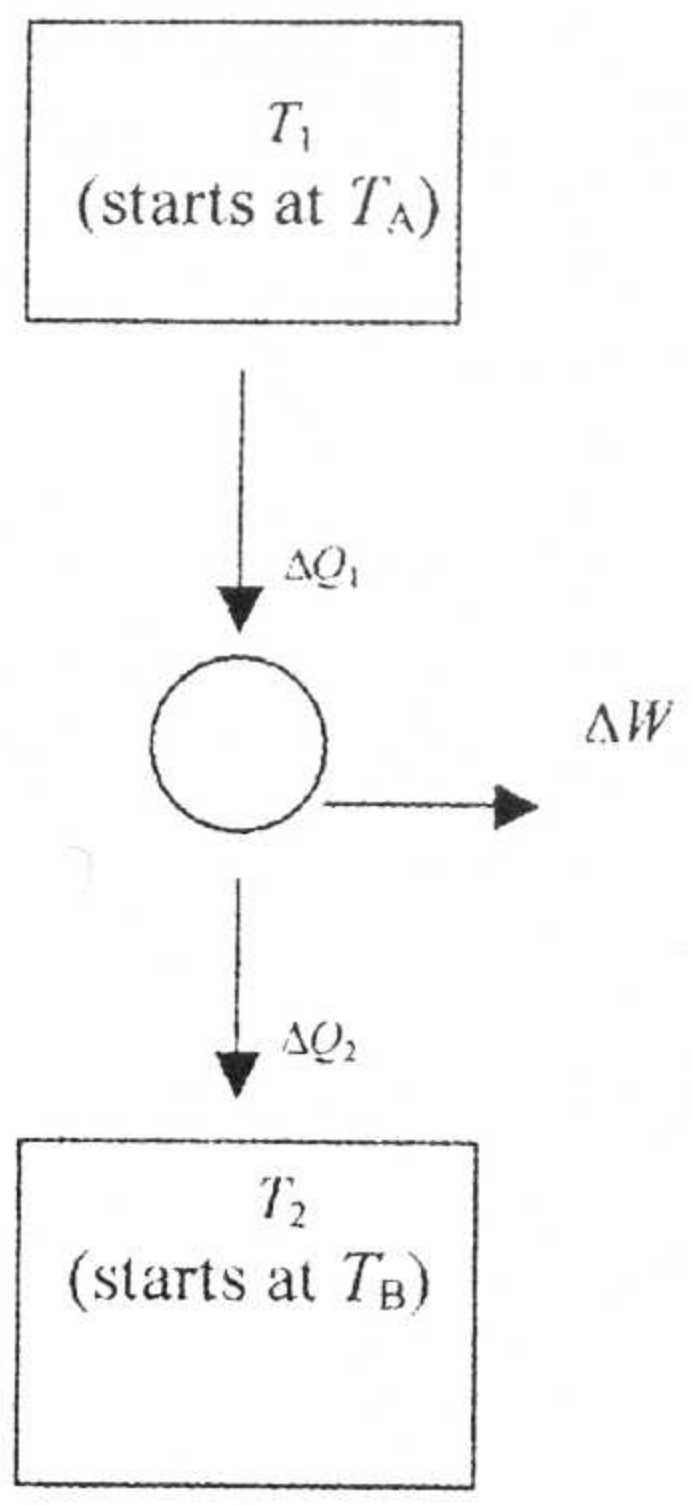
In calculating work obtainable, we assume no loss (friction etc.) in engine working.
energy from body A ( −ve).
( +ve).
(a) For maximum amount of mechanical energy assume Carnot engine.
throughout operation (second law).
But and .
or .
(d) Numerical example:
Mass = volume × density.
C Radioactivity and age of the Earth
(a) , original number.
Therefore
So where is half-life,
or as ,
where time is in years.
(b)
(c) In mixed uranium (i.e. containing Pb of both natural and radioactive origin)
| 204 : 206 : 207 | |
|---|---|
| Proportions | 1.00 : 29.6 : 22.6 |
| In pure lead (no radioactivity) | 1.00 : 17.9 : 15.5 |
Therefore for radioactively produced lead by subtraction
| 204 : 206 : 207 | |
|---|---|
| Proportions | 1.00 : 29.6 : 22.6 |
| In pure lead (no radioactivity) | 1.00 : 17.9 : 15.5 |
Therefore for radioactively produced lead by subtraction
Dividing equations from (a) and (b) gives
or
(d) Assume and ignore 1 in both brackets:
Or ,
(e) is not years but is years.
We can insert the approximate value for (call it years) in the term and obtain a better value by iteration (in the rapidly changing term). We now leave in the −1’s, although the −1 on the right-hand side has little effect and may be omitted.
Either
Put years
Further iteration gives 4.52.
So more accurate answer for to be in range years to years (either acceptable).
D Spherical charge
(a) Charge density
within sphere.
: Field at distance :
: Field at distance from the centre:
(b) Method 1
Energy density is .
: Energy in a thin shell of thickness at radius is given by
Energy within the spherical volume
: Energy within spherical shell
Energy within the spherical volume for
Total energy associated with the charge distribution
Method 2
A shell with charge moves from to the surface of a sphere radius where the electric potential is
and will therefore gain electrical potential energy
Total energy of complete sphere
Putting charge on sphere , ,
(c) Binding energy .
Binding energy is a negative energy.
Therefore MeV per nucleon.
MeV per nucleon.
Radius of cobalt nucleus is given by
E E.M. Induction
Method 1 Equating energy
Horizontal component of magnetic field inducing emf in ring:
Magnetic flux through ring at angle , where radius of ring.
Instantaneous emf
where angular velocity.
R.m.s. emf over 1 revolution .
Average resistive heating of ring .
Moment of inertia .
Rotational energy , where mass of ring.
Power producing change in
Equating:
If is time for angular velocity to halve,
But , where is cross-sectional area of copper ring;
( density).
Method 2 Back Torque
Horizontal component of magnetic field .
Cross-section of area of ring is . Radius of ring . Density of ring . Resistivity . angular velocity ( positive when clockwise).
Resistance .
Mass of ring .
Moment of inertia .
Magnetic flux through ring at angle .
Instantaneous emf
Induced current .
Torque opposing motion
Work done in small :
Average torque = (work done in revolution)/
This equals so that
Оригинал в Архива: T1.pdf · официални решения: 1_sol1.jpg · допълнителни данни: 1_sol2.jpg · допълнителни данни: 1_sol3.jpg · допълнителни данни: 1_sol4.jpg · допълнителни данни: 1_sol5.jpg · допълнителни данни: 1_sol6.jpg · допълнителни данни: 1_sol7.jpg · допълнителни данни: 1_sol8.jpg · допълнителни данни: 1_sol9.jpg · допълнителни данни: 1_sol10.jpg · допълнителни данни: 1_1.png · допълнителни данни: 1_2.png · допълнителни данни: 1_3.png · допълнителни данни: 1_4.png · допълнителни данни: 1_5.png