IPhO 2000, Теория — Задача 3. Gravitational waves and the effects of gravity on light
Theoretical Problem 3 — Gravitational waves and the effects of gravity on light.
Условие
Part A
This part is concerned with the difficulties of detecting gravitational waves generated by astronomical events. It should be realised that the explosion of a distant supernova may produce fluctuations in the gravitational field strength at the surface of the Earth of about .
A model for a gravitational wave detector (see figure 3.1) consists of two metal rods each 1m long, held at right angles to each other. One end of each rod is polished optically flat and the other end is held rigidly. The position of one rod is adjusted so there is a minimum signal received from the photocell (see figure 3.1).
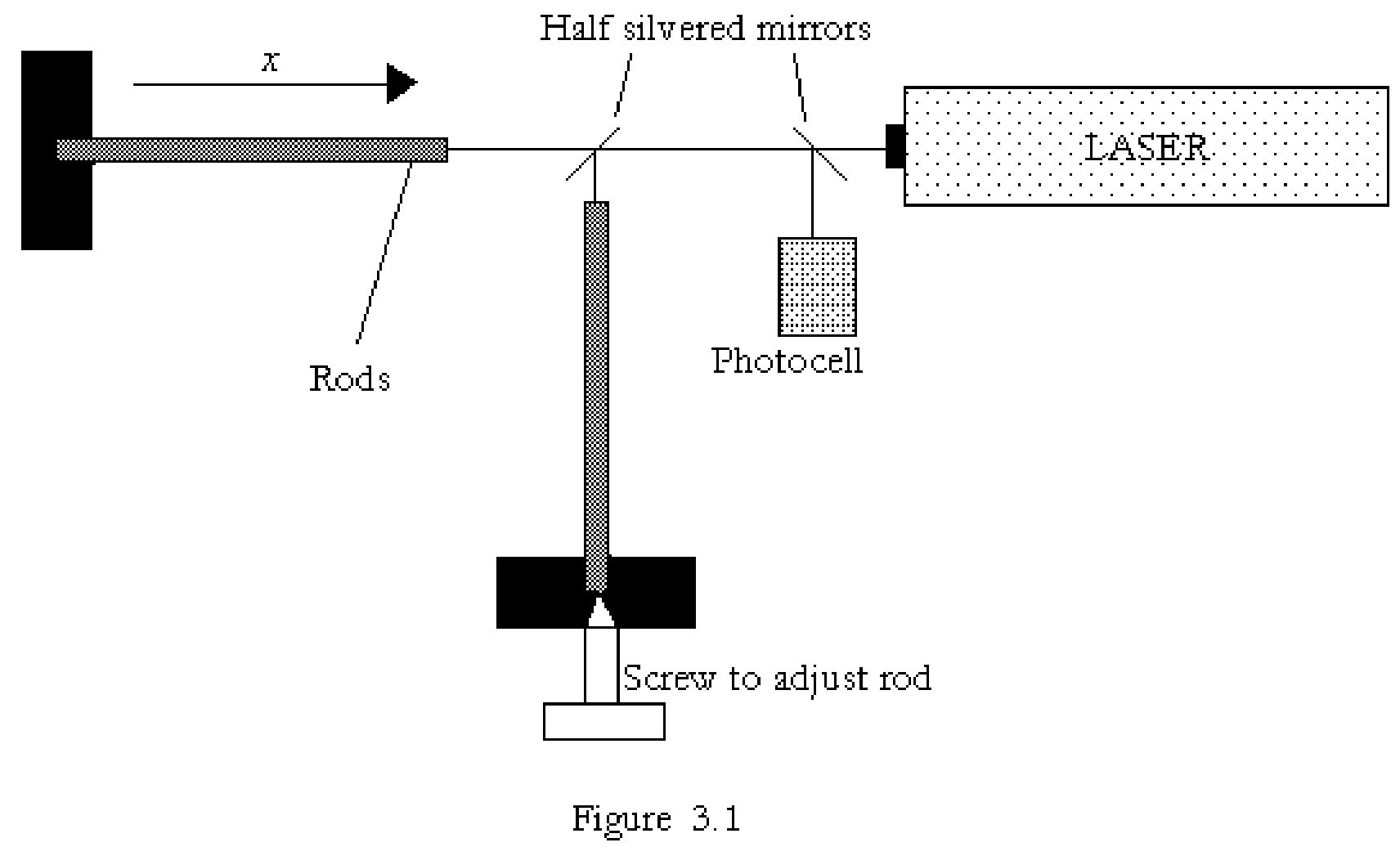
The rods are given a short sharp impulse by a piezoelectric device. As a result the free ends of the rods oscillate with a longitudinal displacement , where
and , , and are constants.
(a) If the amplitude of the motion is reduced by 20% during a 50s interval determine a value for .
(b) Determine also a value for given that the rods are made of aluminium with a density () of 2700 kg m and a Young modulus (E) of Pa.
(c) It is impossible to make the rods exactly the same length so the photocell signal has a beat frequency of 0.005 Hz. What is the difference in length of the rods?
(d) For the rod of length , derive an algebraic expression for the change in length, , due to a change, , in the gravitational field strength, , in terms of and other constants of the rod material.
(e) The light produced by the laser is monochromatic with a wavelength of 656nm. If the minimum fringe shift that can be detected is of the wavelength of the laser, what is the minimum value of necessary if such a system were to be capable of detecting variations in of ?
A non-directional form of gravitational wave detector consists of a sphere of copper-alloy of mass 1168 kg, suspended in a vacuum from a vibration-reducing assembly. Transducers, containing tuned circuits, are attached to the sphere to detect changes in its dimensions. The transducers will, however, pick up all spurious vibrations due to, for example, temperature effects and noise due to electric pick up.
(f) To reduce vibrations due to temperature effects the sphere is maintained at a temperature of 100 mK. By what factor will the amplitude of the atomic vibrations been reduced in cooling the assembly from 300 K?
(g) The sphere is initially cooled to 4.2 K using liquid nitrogen and liquid helium. The temperature, , is further reduced to 100 mK by a refrigeration process, which removes energy from the system at an average rate of 1 mW. Given that the specific thermal capacity, , of the copper-alloy varies directly as at these low temperatures, estimate the time taken for the system to cool from 4.2 K to 100 mK, given that at 4.2 K.
Part B
This part is concerned with the effect of a gravitational field on the propagation of light in space.
(a) A photon emitted from the surface of the Sun (mass , radius ) is red-shifted. By assuming a rest-mass equivalent for the photon energy, apply Newtonian gravitational theory to show that the effective (or measured) frequency of the photon at infinity is reduced (red-shifted) by the factor .
(b) A reduction of the photon's frequency is equivalent to an increase in its time period, or, using the photon as a standard clock, a dilation of time. In addition, it may be shown that a time dilation is always accompanied by a contraction in the unit of length by the same factor.
We will now try to study the effect that this has on the propagation of light near the Sun. Let us first define an effective refractive index at a point from the centre of the Sun. Let
where is the speed of light as measured by a co-ordinate system far away from the Sun's gravitational influence (), and is the speed of light as measured by a co-ordinate system at a distance from the centre of the Sun.
Show that may be approximated to:
for small , where is a constant that you determine.
(c) Using this expression for , calculate in radians the deflection of a light ray from its straight path as it passes the edge of the Sun.
Data
Gravitational constant, .
Mass of Sun, .
Radius of Sun, .
Velocity of light, .
You may also need the following integral:
Решение
Внимание: Непълно решение
The archived solution sheets cover Part A (a)–(e) and Part B (a)–(c). They do not contain solutions to Part A (f) and (g), which appear in T3.pdf but are absent from the photographed Part A sheet.
Part A
(a)
(b)
At fundamental m.
(c)
[0.6]
(d) Change in gravitational force on rod at a distance from the free end and , where is the cross-sectional area of the rod.
Change in stress .
Change in strain ;
that is,
(e) At fundamental ,
for .
[0.1]
Part B
(a)
[0.3]
(b)
(c)
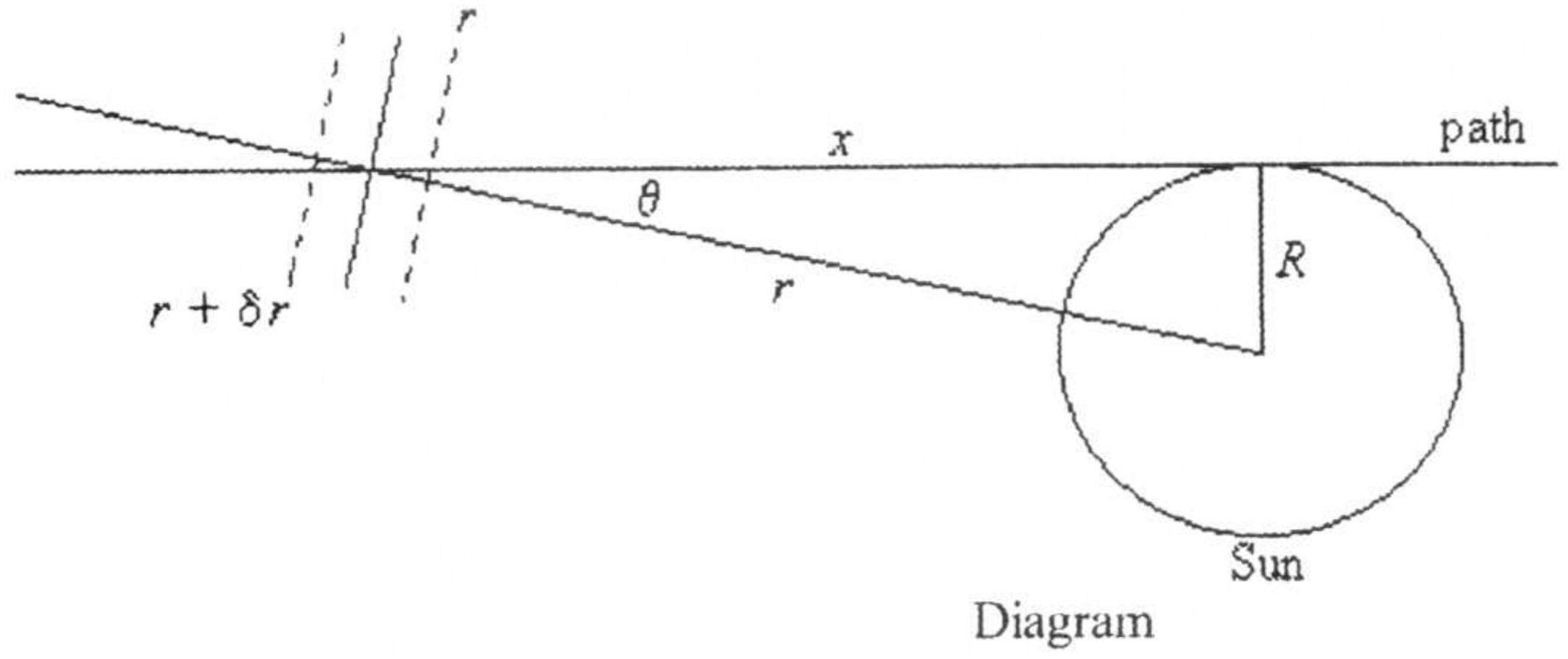
By Snell’s law:
Now , so ,
and .
Hence
Now , so :
Оригинал в Архива: T3.pdf · официални решения: 3_sol1.jpg · допълнителни данни: 3_sol2.jpg · допълнителни данни: 3_1.png · допълнителни данни: 3_2.png