IPhO 2002, Експеримент — Задача 2. II. OPTICAL BLACK BOX
IPhO2002 — II. OPTICAL BLACK BOX · 25 юли 2002 г. · 10 т.
Please read this first:
The time available is 5 hours for the experimental competition
Use only the pen provided
Use only the front side of the paper
Begin each part of the problem on a separate sheet
For each question, in addition to the answer sheets where you may write, there is an answer form where you must summarize the results you have obtained. Numerical results should be written with as many digits as are appropriate to the given data.
Write on the blank sheet of paper the results of all your measurements and whatever else you consider is required for the solution of question. Please use as little text as possible; express yourself primarily in equations, numbers, figures, and plots.
Fill in the boxes at the top of each sheet of paper used by writing your Country, your student number (Student No.), the number of the question (Question No.), the progressive number of each sheet (Page No.), and the total number of blank sheets used for each question (Total Pages). Write the question number and the section letter of the part you are answering at the top of each sheet. If you use some blank sheets of paper for notes that you do not wish to be marked, put a large X across the sheet and do not include it in your numbering.
At the end of the exam, arrange all sheets for each problem in the following order:
- Answer form
- Used sheets in order
- The sheets you do not wish to be marked
- Unused sheets and the printed question
Place the paper inside the envelope and leave everything on your desk.
You are not allowed to take any sheets of paper and any material used in experiment out of the room.
Note that all scales marked on the graph papers and the apparatus for the experiments (e.g. the test tube) are of the same scale unit, but not calibrated in milimeter.
EXPERIMENTAL COMPETITION — instructions continued
- Beware the time consuming process of electrolytic experiment. You are allowed to perform the two problems (problem I and problem II) in any order, even simultaneously.
Use the following symbols in your answer
| acceleration of gravity | absolute temperature | ||
| gas pressure | frequency | ||
| angular frequency | periodicity of oscilation | ||
| Height | velocity of light | ||
| wavelength | refractive index | ||
| Mass | gas constant | ||
| mechanical work | length | ||
| Diameter | electric current | ||
| electric charge | electron charge | ||
| Boltzmann constant | radius | ||
| volume of gas | voltage |
Условие
Description
In this problem, the students have to identify the unknown optical components inside the cubic box. The box is sealed and has only two narrow openings protected by red plastic covering. The components should be identified by means of optical phenomena observed in the experiment. Ignore the small thickness effect of the plastic covering layer.
A line going through the centers of the slits is defined as the axis of the box. Apart from the red plastic coverings, there are three (might be identical or different) elements from the following list:
- Mirror, either plane or spherical
- Lens, either positive or negative
- Transparent plate having parallel flat surfaces (so called plane-parallel plate)
- Prism
- Diffraction grating.
The transparent components are made of material with a refractive index of 1.47 at the wavelength used.
Apparatus available:
- A laser pointer with a wavelength of 670 nm. CAUTION: DO NOT LOOK DIRECTLY INTO THE LASER BEAM.
- An optical rail
- A platform for the cube, movable along the optical rail
- A screen which can be attached to the end of the rail, and detached from it for other measurements.
- A sheet of graph paper which can be pasted on the screen by cellotape.
- A vertical stand equipped with a universal clamp and a test tube with arbitrary scales, which are also used in the Problem I.
Note that all scales marked on the graph papers and the apparatus for the experiments are of the same scale unit, but not calibrated in millimeter.
The Problem
Identify each of the three components and give its respective specification:
| Possible type of component | Specification required |
|---|---|
| mirror | radius of curvature, angle between the mirror axis and the axis of the box |
| lens* | positive or negative, its focal length, and its position inside the box |
| plane-parallel plate | thickness, the angle between the plate and the axis of the box |
| prism | apex angle, the angle between one of its deflecting sides and the axis of the box |
| diffraction grating* | line spacing, direction of the lines, and its position inside the box |
- implies that its plane is at right angle to the axis of the box
Express your final answers for the specification parameters of each component (e.g. focal length, radius of curvature) in terms of millimeter, micrometer or the scale of graph paper.
You don’t have to determine the accuracy of the results.
ANSWER FORM
| Country | Student No. | Experiment No. | Page No. | Total Pages |
|---|---|---|---|---|
1. Write down the types of the optical components inside the box :
no.1. ………………………………………… [0.5 pts]
no.2.. ………………………………………… [0.5 pts]
no.3. ………………………………………… [0.5 pts] [1,5 т.]
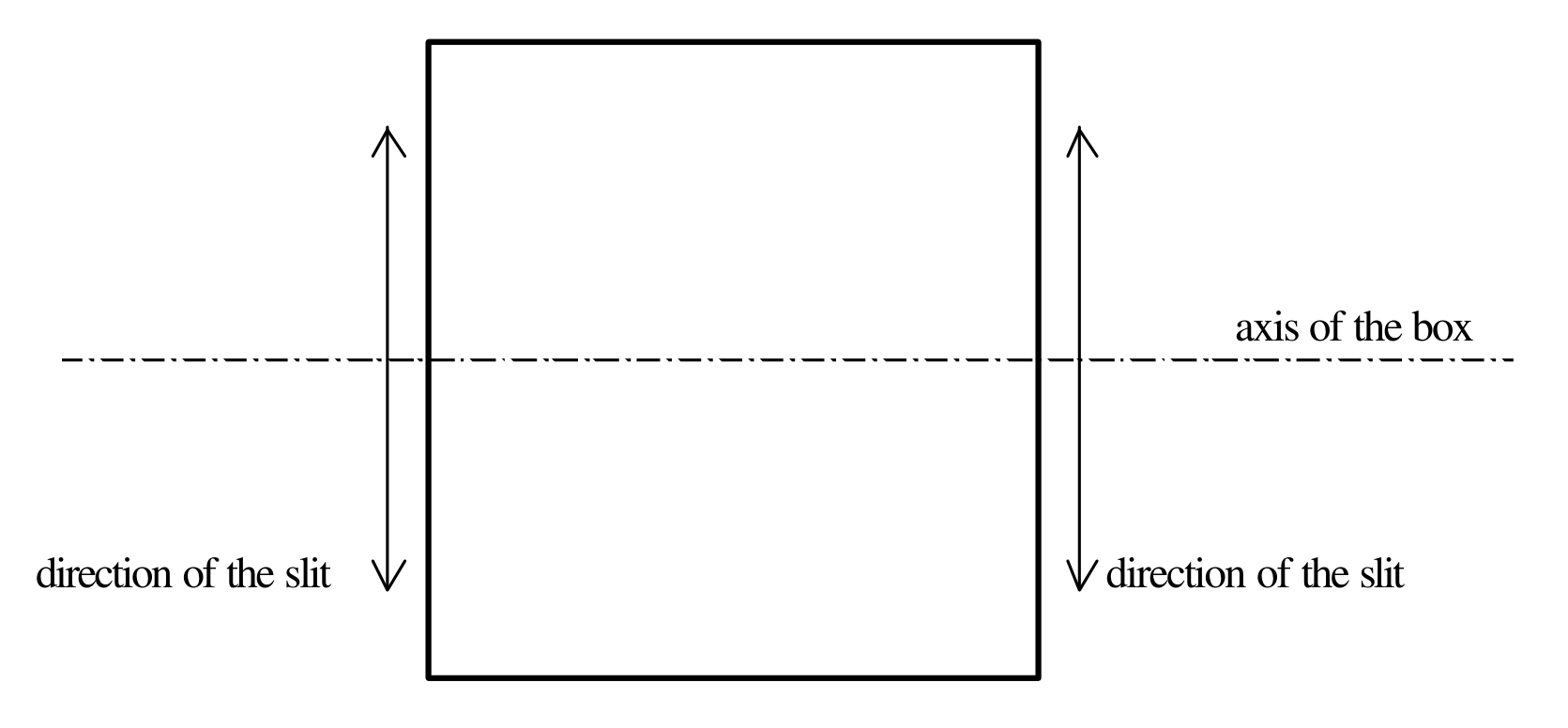
2. The cross section of the box is given in the figure below. Add a sketch in the figure to show how the three components are positioned inside the box. In your sketch, denote each component with its code number in answer 1. [0.5 pts for each correct position] [1,5 т.]
3. Add detailed information with additional sketches regarding arrangement of the optical components in answer 2, such as the angle, the distance of the component from the slit, and the orientation or direction of the components. [1.0 pts]
4. Summarize the observed data [0.5 pts], determine the specification of the optical component no.1 by deriving the appropriate formula with the help of drawing [1.0 pts], calculate the specifications in question and enter your answer in the box below [0.5 pts].
| Name of component no.1 | Specification |
|---|---|
[2 т.]
5. Summarize the observed data [0.5 pts], determine the specification of the optical component no.2 by deriving the appropriate formula with the help of drawing [1.0 pts], calculate the specifications in question and enter your answer in the box below [0.5 pts].
| Name of component no.2 | Specification |
|---|---|
[2 т.]
6. Summarize the observed data [0.5 pts], determine the specification of the optical component no.3 by deriving the appropriate formula with the help of drawing [1.0 pts], calculate the specifications in question and enter your answer in the box below [0.5 pts].
| Name of component no.3 | Specification |
|---|---|
[2 т.]
Отговори
- no.1 Diffraction grating; no.2 Diffraction grating; no.3 Plan-parallel plate.
Решение
SOLUTION OF EXPERIMENT PROBLEM 2
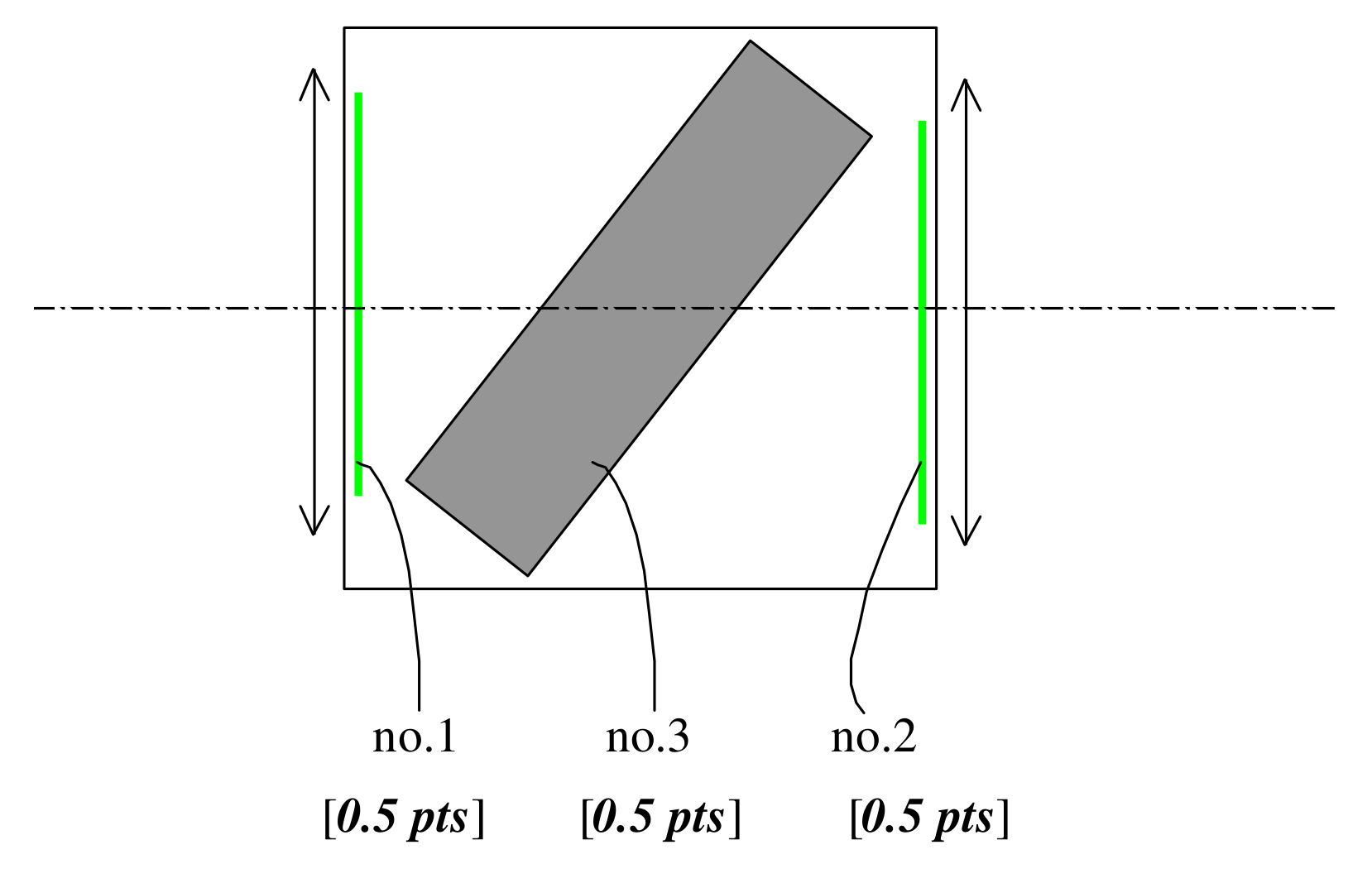
1. The optical components are [total 1.5 pts]:
no.1 Diffraction grating [0.5 pts]
no.2 Diffraction grating [0.5 pts]
no.3 Plan-parallel plate [0.5 pts]
2. Cross section of the box [total 1.5 pts]:
3. Additional information [total 1.0 pts]:
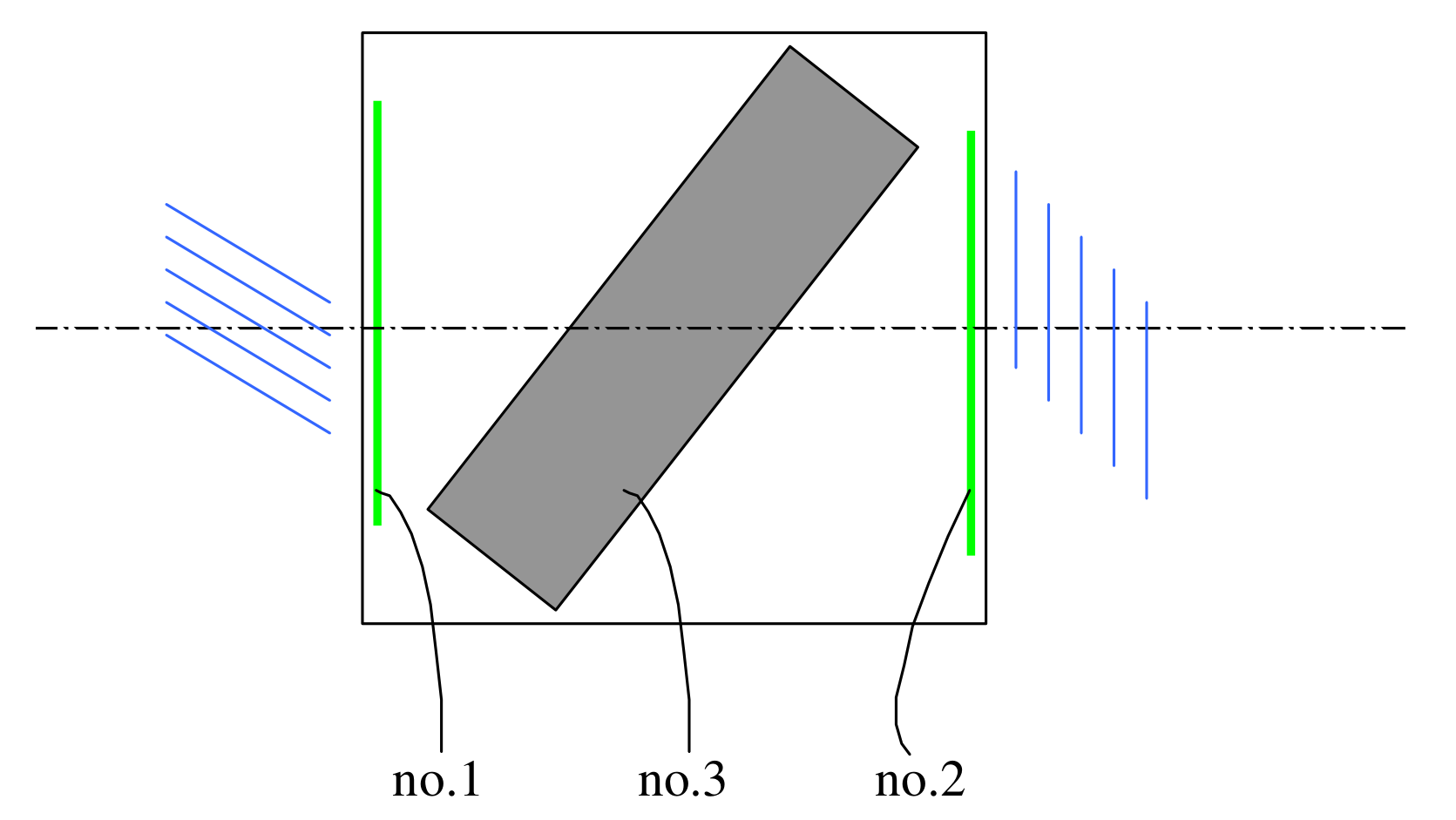
Distance of the grating (no.1) to the left wall is practically zero [0.2 pts].
Distance of the grating (no.2) to the right wall is practically zero [0.2 pts].
Lines of grating no.1 is at right angle to the slit [0.3 pts].
Lines of grating no. 2 is parallel to the slit [0.3 pts].
4. Diffraction grating [total 2.0 pts]:
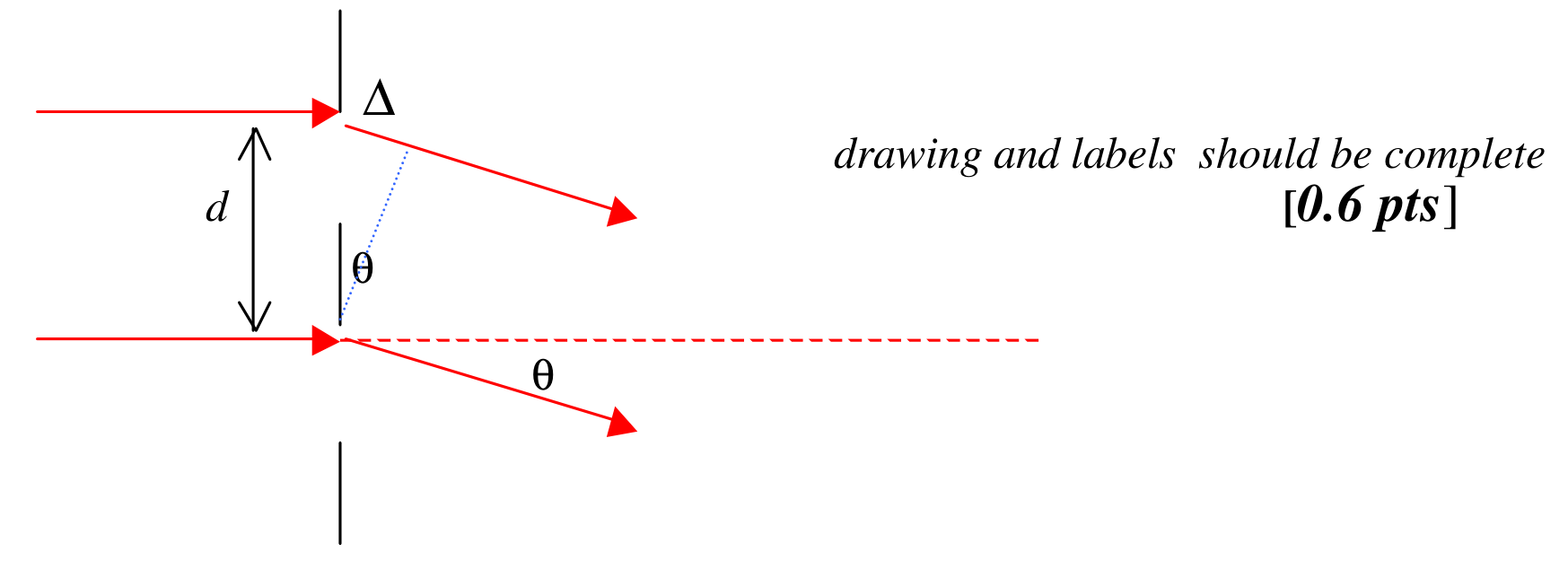
drawing and labels should be complete [0.6 pts]
Path length difference:
Diffraction order:
Hence, for the first order :
| 0.34 | 0.3219 | |
| 0.32 | 0.3048 | |
| 0.32 | 0.3048 |
number of data [0.5 pts]
| Name of component no.1 | Specification |
|---|---|
| Diffraction grating | Spacing = 2.16 µm [0.4 pts]; Lines at right angle to the slit [0.1 pts] |
Note: true value of grating spacing is 2.0 µm, deviation of the result
5. Diffraction grating [total 2.0 pts]:
For the derivation of the formula, see nr.4 above. [1.0 pts]
Observation data:| 1.04 | 0.7208 | |
| 0.96 | 0.6925 | |
| 1.08 | 0.7330 |
number of data [0.5 pts]
| Name of component no.2 | Specification |
|---|---|
| Diffraction grating | Spacing = 0.936 µm [0.4 pts]; Lines parallel to the slit [0.1 pts] |
Note: true value of grating spacing is 1.0 µm, deviation of the result
6. Plan-parallel plate [total 2.0 pts]:
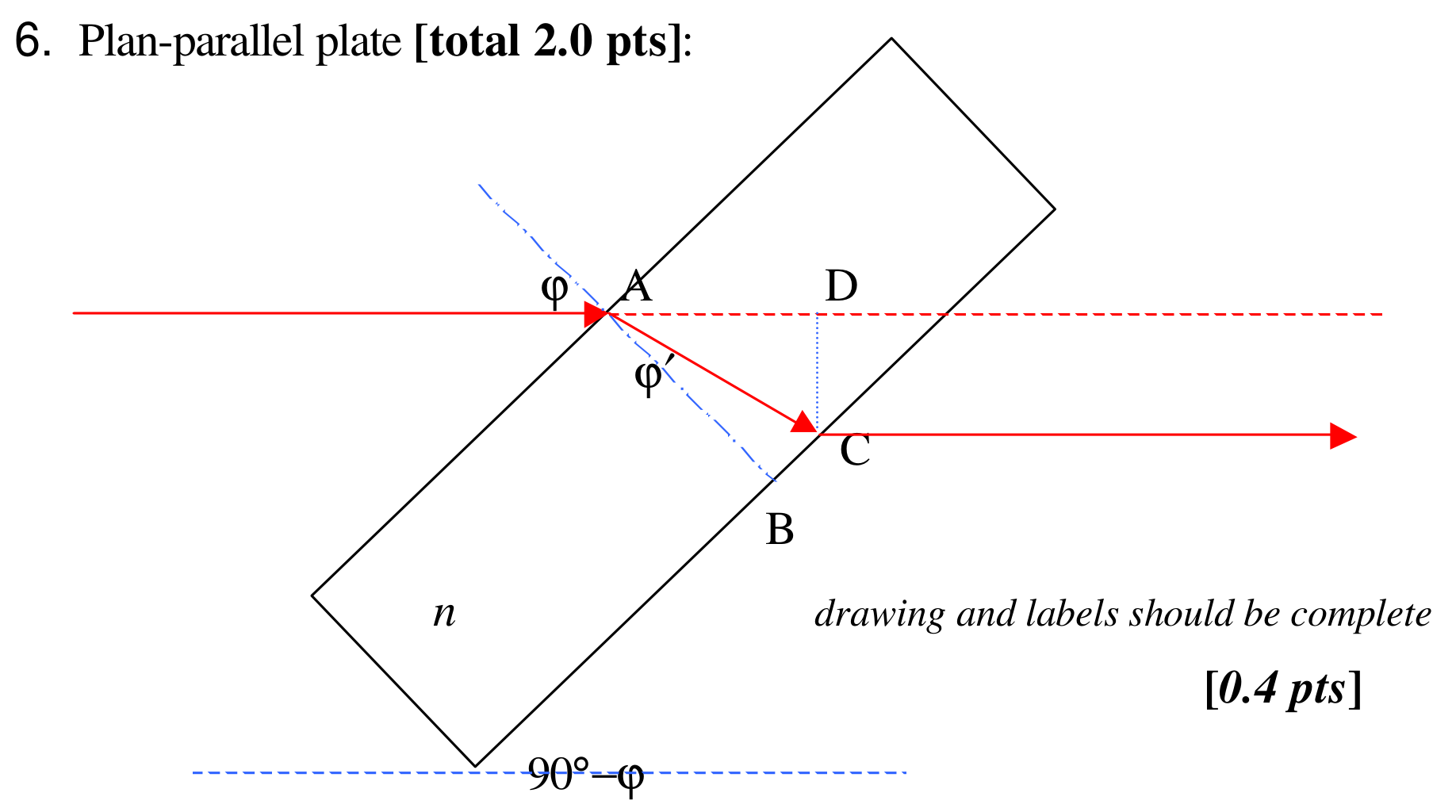
drawing and labels should be complete [0.4 pts]
Snell’s law:
Path length inside the plate:
Beam displacement:
Hence:
| 0 | 0 | (angle between beam and axis 49°) |
| 7.3 arbitrary scale | [0.5 pts] |
| Name of component no.3 | Specification |
|---|---|
| Plane-parallel plate | Thickness = 17.9 mm [0.2 pts]; Angle to the axis of the box 49° [0.3 pts] |
Note:
- true value of plate thickness is 20 mm
- true value of angle to the axis of the box is 52°
- deviation of the results .
Теми и трудност
Оценена трудност: 4/5.
Оптика · Дифракция и разделителна способност · Пречупване · Оптични уреди
Предпоставки: Гимназиална подготовка, Разширена олимпиадна подготовка
Оригинал в Архива: IPhO_2002_Experimental Question 2.pdf · официални решения: IPhO_2002_Experimental Solution 2.pdf · допълнителни данни: IPhO_2002_Experimental Question Cover.pdf