IPhO 2002, Експеримент — Задача 1. Determination of $e/k_B$ Through Electrolysis Process
IPhO2002 — I. Determination of e/kB Through Electrolysis Process
Внимание: Бележка към темата
The alternate archive question and solution editions contain the same complete Experiment I as the primary originals. The shared competition cover permits five hours for both independent experiments I and II together; no separate time limit is printed for this experiment. Both question editions print O² without a minus sign in the background reactions; that scientific notation is retained as printed. The worked key preserves its missing grouping in the pendulum subtraction formula, its I Δt (C) table values calculated from mA·s, its inconsistent second-row product and its two different reported e/kB results (1.28 × 10^4 from the graph; 1.07 × 10^4 with standard deviation 0.66 × 10^3 by the alternative method). The primary-slope result has no printed ±100 tolerance. Printed answer-form headers and all nine labelled items are included. The cover refers to additional blank answer sheets and graph papers, which are not included in these standalone PDFs; no absent forms or further marking scheme are invented. Red source correction text is retained in wording without colour.
Please read this first:
EXPERIMENTAL COMPETITION
Thursday, July 25th, 2002
The time available is 5 hours for the experimental competition
Use only the pen provided
Use only the front side of the paper
Begin each part of the problem on a separate sheet
For each question, in addition to the answer sheets where you may write, there is an answer form where you must summarize the results you have obtained. Numerical results should be written with as many digits as are appropriate to the given data.
Write on the blank sheet of paper the results of all your measurements and whatever else you consider is required for the solution of question. Please use as little text as possible; express yourself primarily in equations, numbers, figures, and plots.
Fill in the boxes at the top of each sheet of paper used by writing your Country, your student number (Student No.), the number of the question (Question No.), the progressive number of each sheet (Page No.), and the total number of blank sheets used for each question (Total Pages). Write the question number and the section letter of the part you are answering at the top of each sheet. If you use some blank sheets of paper for notes that you do not wish to be marked, put a large X across the sheet and do not include it in your numbering.
At the end of the exam, arrange all sheets for each problem in the following order:
- Answer form
- Used sheets in order
- The sheets you do not wish to be marked
- Unused sheets and the printed question
Place the paper inside the envelope and leave everything on your desk.
You are not allowed to take any sheets of paper and any material used in experiment out of the room.
Note that all scales marked on the graph papers and the apparatus for the experiments (e.g. the test tube) are of the same scale unit, but not calibrated in milimeter.
EXPERIMENTAL COMPETITION — instructions continued
- Beware the time consuming process of electrolytic experiment. You are allowed to perform the two problems (problem I and problem II) in any order, even simultaneously.
Use the following symbols in your answer
| acceleration of gravity | absolute temperature | ||
| gas pressure | frequency | ||
| angular frequency | periodicity of oscilation | ||
| Height | velocity of light | ||
| wavelength | refractive index | ||
| Mass | gas constant | ||
| mechanical work | length | ||
| Diameter | electric current | ||
| electric charge | electron charge | ||
| Boltzmann constant | radius | ||
| volume of gas | voltage |
Условие
Background Theory
The electrolysis of water is described by the reaction :
The reaction takes place when an electric current is supplied through a pair of electrodes immersed in the water. Assume that both gases produced in the reaction are ideal.
One of the gases produced by the reaction is kept in a test tube marked by arbitrary scale. By knowing the total charge transferred and the volume of the gas in the test tube the quantity can be determined, where is the charge of electron and is the Boltzmann constant.
For the purpose mentioned above, this experiment is divided into two parts.
Part A: Calibration of the arbitrary scale on the test tube by using a dynamic method. This result will be used for part B
Part B: Determination of the physical quantity by means of water electrolysis
You are not obliged to carry out the two experiments ( part A and part B ) in alphabetical order
The following physical quantities are assumed:
- Acceleration of gravity,
- Ratio of internal vs external diameters of the test tube,
The local values of temperature and pressure will be provided by the organizer.
List of tools and apparatus given for experiment (part A & B):
- Insulated copper wires of three different diameters:
- Brown of larger diameter
- Brown of smaller diameter
- Blue
- A regulated voltage source (0-60 V, max.1A)
- A plastic container and a bottle of water.
- A block of brass with plastic clamp to keep the electrode in place without damaging the insulation of the wire.
- A digital stopwatch.
- A multimeter (beware of its proper procedure).
- A wooden test tube holder designed to hold the tube vertically.
- A multipurpose pipette
- A vertical stand.
- A bottle of white correction fluid for marking.
- A cutter
- A pair of scissors
- A roll of cellotape
- A steel ball
- A piece of stainless steel plate to be used as electrode.
- A test tube with scales.
- Graph papers.
Note that all scales marked on the graph papers and the apparatus for the experiments (e.g. the test tube) are of the same scale unit, but not calibrated in millimeter.
EXPERIMENT
Part A: Calibration of the arbitrary scale on the test tube
- Determine a dynamic method capable of translating the arbitrary length scale to a known scale available.
- Write down an expression that relates the measurable quantities from your experiment in terms of the scale printed on the test tube, and sketch the experiment set up.
- Collect and analyze the data from your experiment for the determination and calibration of the unknown length scale.
Part B: Determination of physical quantity
- Set up the electrolysis experiment with a proper arrangement of the test tube in order to trap one of the gases produced during the reaction.
- Derive an equation relating the quantities: time , current I, and water level difference , measured in the experiment.
- Collect and analyze the data from your experiment. For simplicity, you may assume that the gas pressure inside the tube remains constant throughout the experiment.
- Determine the value of .
| Country | Student No. | Experiment No. | Page No. | Total Pages |
|---|---|---|---|---|
ANSWER FORM
PART A
A.1 State the method of your choice and sketch the experimental set up of the method: [0.5 pts]
A.2 Write down the expression relating the measurable quantities in your chosen method: [0.5 pts]. State all the approximations used in obtaining this expression [1.0 pts]. [1,5 т.]
A.3 Collect and organize the data in the following orders : physical quantities, values, units [1.0 pts]
A.4 Indicate the quality of the calibration by showing the plot relating two independently measured quantities and mark the range of validity. [0.5 pts]
A.5 Determine the smallest unit of the arbitrary scale in term of mm and its estimated error induced in the measurements. [1.5 pts]
| Country | Student No. | Experiment No. | Page No. | Total Pages |
|---|---|---|---|---|
PART B
B.1 Sketch of the experimental set up. [1.0 pts]
B.2 Derive the following expression:
[1,5 т.]
B.3 Collect and organize the data in the following format : physical quantities (value, units) [1.0 pts]
B.4 Determine the value of and its estimated error [1.5 pts]
Отговори
A.5 0.89 mm
Official sample result: mm, mm; other legitimate methods may be used.
B.4 12800 C·K/J
Official sample result from the slope of the plot: Coulomb K/J; the alternative per-point method gives an average of Coulomb K/J with standard deviation Coulomb K/J.
Решение
SOLUTION EXPERIMENT I
PART A
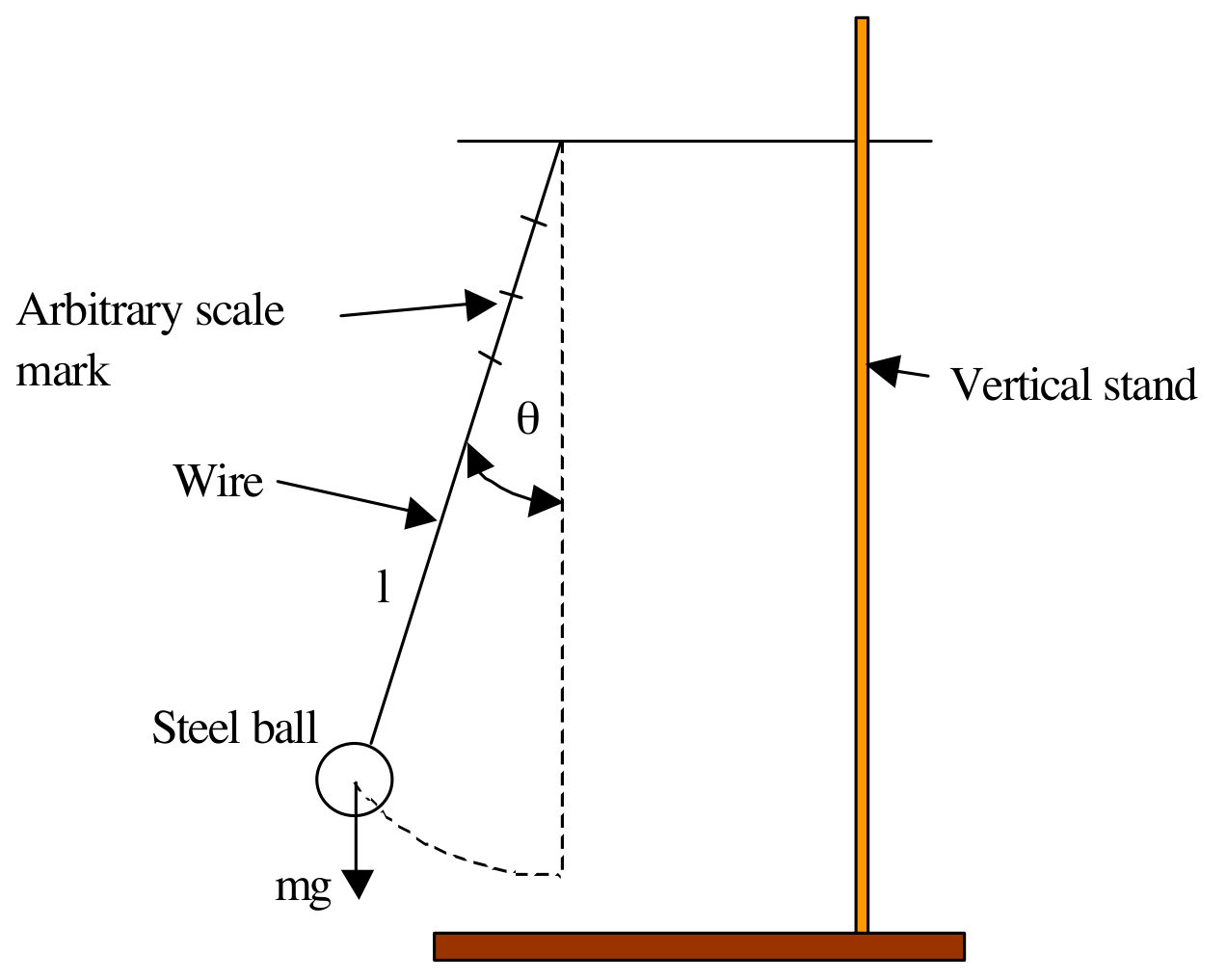
1. [Total 0.5 pts]
The experimental method chosen for the calibration of the arbitrary scale is a simple pendulum method [0.3 pts]
2. [Total 1.5 pts]
The expression relating the measurable quantities: [0.5 pts]
Approximations :
[0.5 pts]
mathematical pendulum (mass of the wire mass of the steel ball, the radius of the steel ball length of the wire [0.5 pts]
flexibility of the wire, air friction, etc [0.1 pts, only when one of the two major points above is not given]
3. [Total 1.0 pts] Data sample from simple pendulum experiment
# of cycle [0.2 pts.] , difference in T s [0.4 pts], # of data [0.4 pts]
| No. | t(s) for 50 cycles | Period, T (s) | Scale marked on the wire (arbitrary scale) |
|---|---|---|---|
| 1 | 91.47 | 1.83 | 200 |
| 2 | 89.09 | 1.78 | 150 |
| 3 | 86.45 | 1.73 | 100 |
| 4 | 83.8 | 1.68 | 50 |
4. [Total 0.5 pts]
| No. | Period, T (s) | Scale marked on the wire (arbitrary scale) | T(s) |
|---|---|---|---|
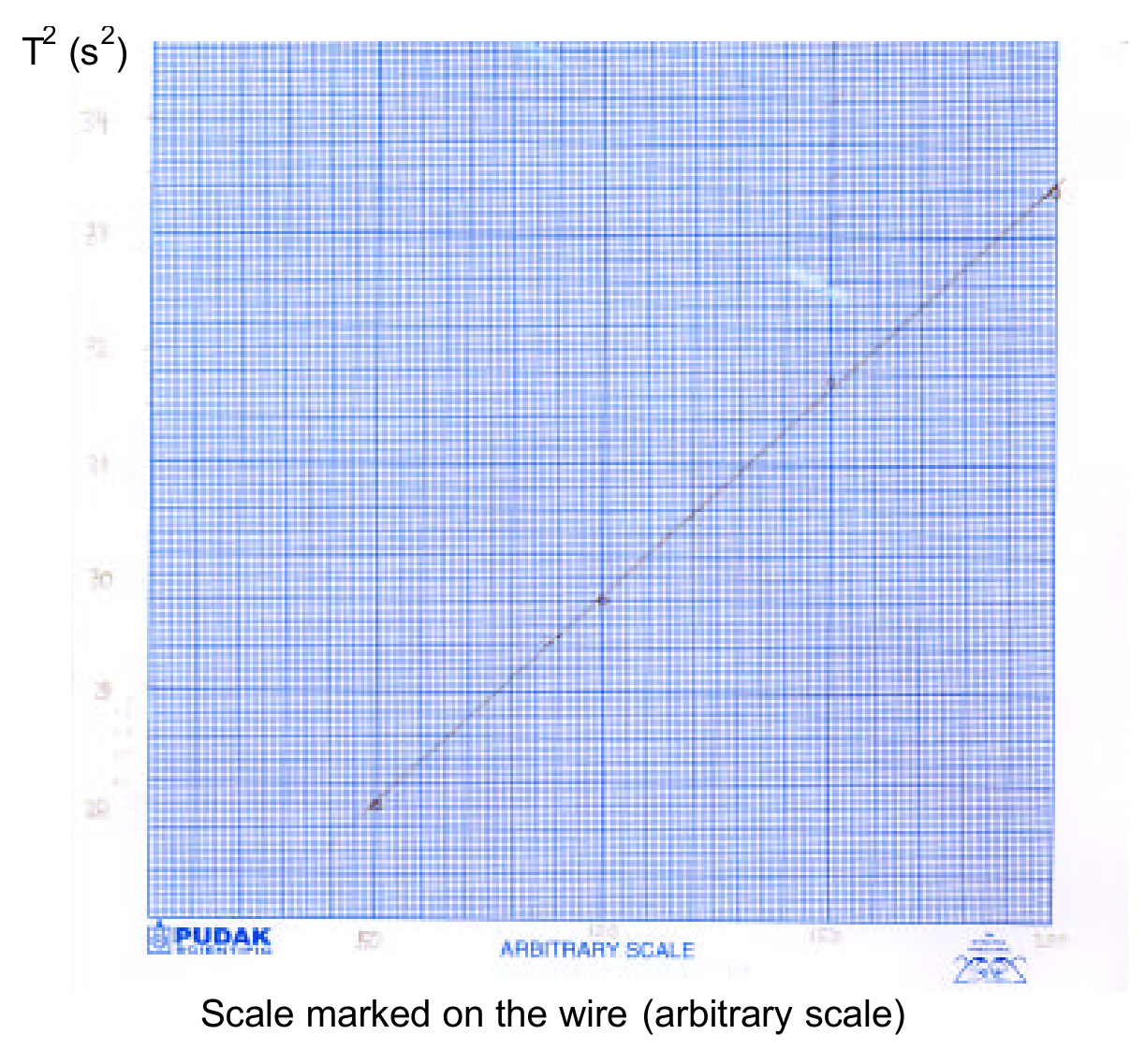
| 1 | 1.83 | 200 | 3.35 |
| 2 | 1.78 | 150 | 3.17 |
| 3 | 1.73 | 100 | 2.99 |
| 4 | 1.68 | 50 | 2.81 |
The plot of T vs scale marked on the wire:
5. Determination of the smallest unit of the arbitrary scale in term of mm [Total 1.5 pts]
or other equivalent expression [0.5 pts]
| No. | Calculated ΔL (m) | ΔL in arbitrary scale | Values of smallest unit of arbitrary scale (mm) | |
|---|---|---|---|---|
| 1. | - = 0.171893 s | 0.042626 | 50 | 0.85 |
| 2. | - =0.357263 s | 0.088595 | 100 | 0.89 |
| 3. | - =0.537728 s | 0.133347 | 150 | 0.89 |
| 4. | - =0.18537 s | 0.045968 | 50 | 0.92 |
| 5. | - =0.365835 s | 0.09072 | 100 | 0.91 |
| 6. | - =0.180465 s | 0.044752 | 50 | 0.90 |
The average value of smallest unit of arbitrary scale, = 0.89 mm [0.5 pts]
The estimated error induced by the measurement: [0.5 pts]
| No. | Values of smallest unit of arbitrary scale (mm) | ||
|---|---|---|---|
| 1. | 0.85 | -0.04 | 0.0016 |
| 2. | 0.89 | 0 | 0 |
| 3. | 0.89 | 0 | 0 |
| 4. | 0.92 | 0.03 | 0.0009 |
| 5. | 0.91 | 0.02 | 0.0004 |
| 6. | 0.90 | 0.01 | 0.0001 |
And the standard deviation is:
other legitimate methods may be used
PART B
1. The experimental set up:[Total 1.0 pts]
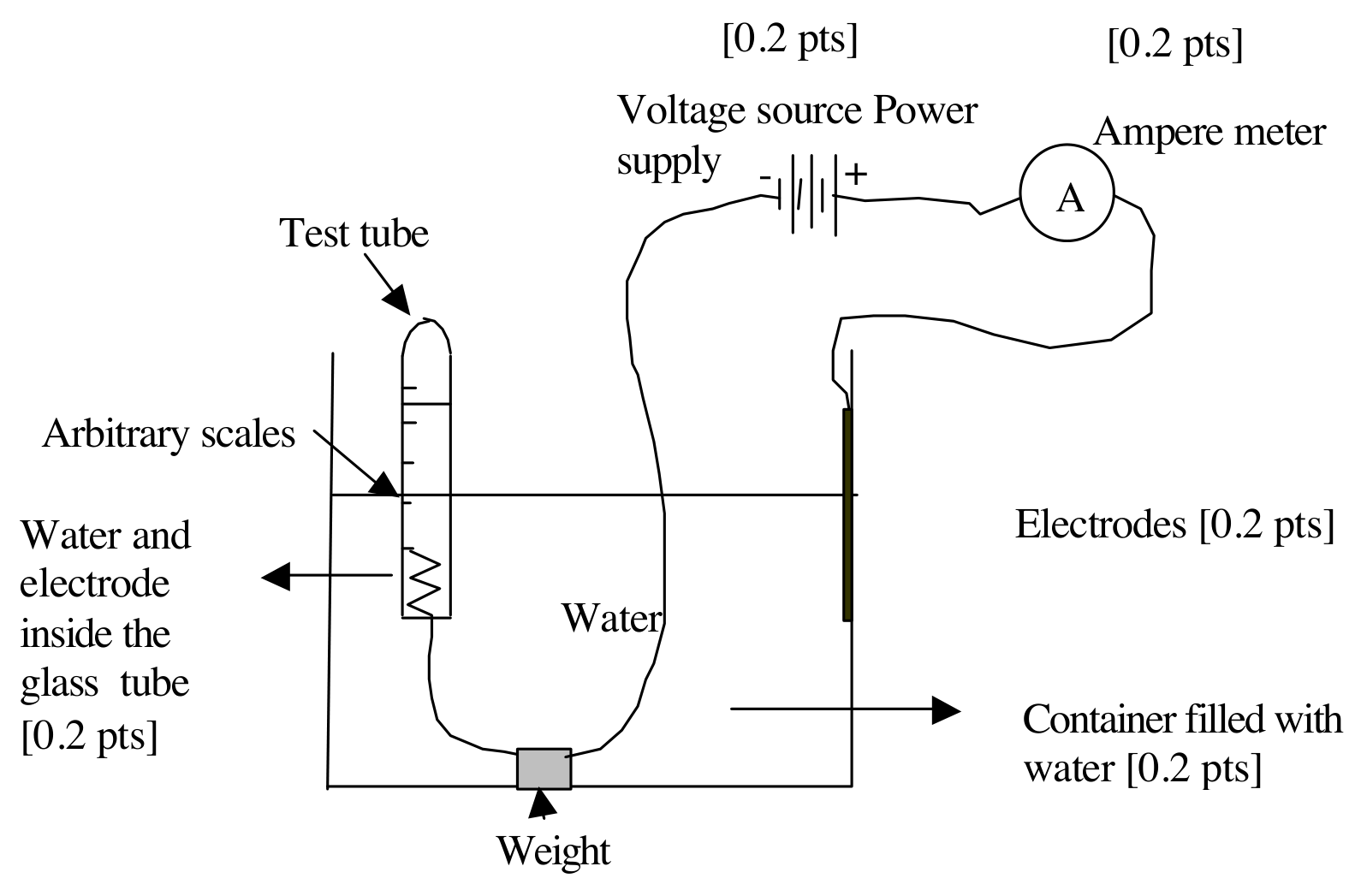
2. Derivation of equation relating the quantities time , current , and water level difference : :[Total 1.5 pts]
From the reaction: , the number of molecules produced in the process (ΔN) requires the transfer of electric change is ΔQ=2e ΔN : [0.2 pts]
3. The experimental data: [ Total 1.0 pts]
| No. | Δh (arbitrary scale) | I (mA) | Δt (s) |
|---|---|---|---|
| 1 | 12 | 4.00 | 1560.41 |
| 2 | 16 | 4.00 | 2280.61 |
| 3 | 20 | 4.00 | 2940.00 |
| 4 | 24 | 4.00 | 3600.13 |
- The circumference , of the test tube = 46 arbitrary scale [0.3 pts]
- The chosen values for ( scale unit) for acceptable error due to uncertainty of the water level reading and for ( mA) for acceptable disturbance [0.3 pts]
- # of data [0.4 pts]
The surrounding condition (,) in which the experimental data given above taken:
= 300 K
= 1.00 10 Pa
4. Determination the value of e/k [Total 1.5 pts]
| No. | Δh (arbitrary scale) | Δh (mm) | I (mA) | Δt (s) | I Δt ( C ) |
|---|---|---|---|---|---|
| 1 | 12 | 10.68 | 4.00 | 1560.41 | 6241.64 |
| 2 | 16 | 14.24 | 4.00 | 2280.61 | 9120.48 |
| 3 | 20 | 17.80 | 4.00 | 2940.00 | 11760.00 |
| 4 | 24 | 21.36 | 4.00 | 3600.13 | 14400.52 |
Plot of IΔt vs Δh from the data listed above
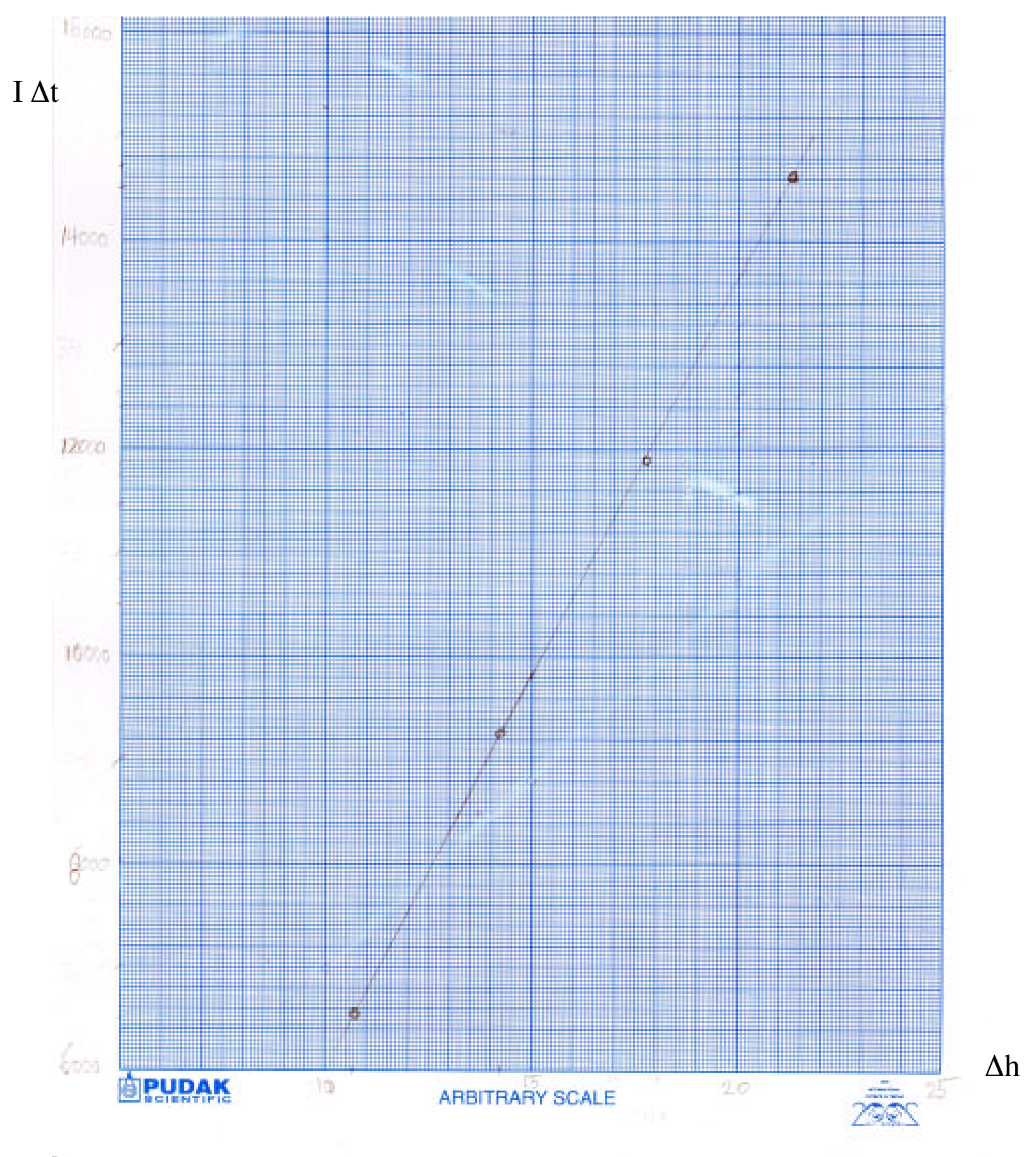
The slope obtained from the plot is 763.94;
[1.0 pts]
Alternatively [the same credit points]
| No. | Δh (mm) | I Δt ( C ) | Slope | e/k |
|---|---|---|---|---|
| 1 | 10.68 | 6241.64 | 584.4232 | 9774.74 |
| 2 | 14.24 | 9120.48 | 640.4831 | 10712.37 |
| 3 | 17.80 | 11760.00 | 660.6742 | 11050.07 |
| 4 | 21.36 | 14400.52 | 674.1816 | 11275.99 |
Average of e/k = 1.07 × 10 Coulomb K/J
[1.0 pts]
| No. | e/k | difference | Square difference |
|---|---|---|---|
| 1 | 9774.74 | -928.55 | 862205.5 |
| 2 | 10712.37 | 9.077117 | 82.39405 |
| 3 | 11050.07 | 346.7808 | 120256.9 |
| 4 | 11275.99 | 572.6996 | 327984.9 |
Estimated error [0.5 pts]
The standard deviation obtained is 0.66 × 10 Coulomb K/J,
Other legitimate measures of estimated error may be also used
Оригинал в Архива: exp1.pdf · официални решения: exp1_sol.pdf · допълнителни данни: IPhO_2002_Experimental Question 1.pdf · допълнителни данни: IPhO_2002_Experimental Solution 1.pdf · допълнителни данни: IPhO_2002_Experimental Question Cover.pdf