IPhO 2002, Теория — Задача 1. Ground-Penetrating Radar
IPhO2002 — I. Ground-Penetrating Radar
Внимание: Бележка към темата
The official solution prints an extra ω in the denominator of the intermediate speed formula in question 1; question 2 prints a Latin a in δ = 1/a; and question 4 places v inside the square root in one intermediate travel-time formula. These expressions are preserved as printed. The two archived English editions contain the same question and official solution.
Условие
Ground-penetrating radar (GPR) is used to detect and locate underground objects near the surface by means of transmitting electromagnetic waves into the ground and receiving the waves reflected from those objects. The antenna and the detector are directly on the ground and they are located at the same point.
A linearly polarized electromagnetic plane wave of angular frequency propagating in the z direction is represented by the following expression for its field:
where is constant, is the attenuation coefficient and is the wave number expressed respectively as follows
with , and denoting the magnetic permeability, the electrical permittivity, and the electrical conductivity respectively.
The signal becomes undetected when the amplitude of the radar signal arriving at the object drops below 1/e ( 37%) of its initial value. An electromagnetic wave of variable frequency (10 MHz – 1000 MHz) is usually used to allow adjustment of range and resolution of detection.
The performance of GPR depends on its resolution. The resolution is given by the minimum separation between the two adjacent reflectors to be detected. The minimum separation should give rise to a minimum phase difference of between the two reflected waves at the detector.
Questions
(Given : H/m and F/m )
1. Assume that the ground is non-magnetic () satisfying the condition . Derive the expression of propagation speed in terms of and , using equations (1) and (2). [1 т.]
2. Determine the maximum depth of detection of an object in the ground with conductivity of 1.0 mS/m and permittivity of , satisfying the condition , (S=ohm ; use ). [2 т.]
3. Consider two parallel conducting rods buried horizontally in the ground. The rods are 4 meter deep. The ground is known to have conductivity of 1.0 mS/m and permittivity of . Suppose the GPR measurement is carried out at a position approximately above one of the rod. Assume point detector is used. Determine the minimum frequency required to get a lateral resolution of 50 cm. [3,5 т.]
4. To determine the depth of a buried rod in the same ground, consider the measurements carried out along a line perpendicular to the rod. The result is described by the following figure:
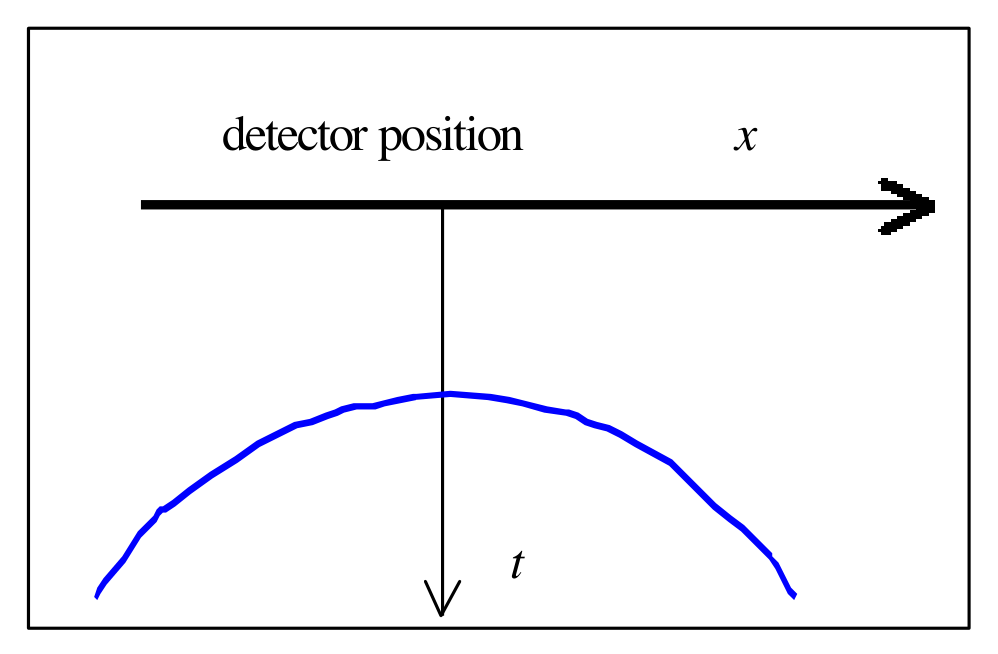
Derive as a function of and determine . [3,5 т.]
Отговори
- Questions, 1.
- Questions, 2. 15.93 m
- Questions, 3. 800 MHz
- Questions, 4. 5 m
Решение
1.
Speed of radar signal in the material :
constant -constant + (0.2 pts)
(0.4 pts)
(0.4 pts)
2.
The maximum depth of detection (skin depth, ) of an object in the ground is inversely proportional to the attenuation constant:
(0.5 pts) (0.3 pts) (0.2 pts)
Numerically m, where is in mS/m. (0.5 pts)
For a medium with conductivity of 1.0 mS/m and relative permittivity of 9, the skin depth
(0.3 pts) + (0.2 pts)
3.
Lateral resolution:
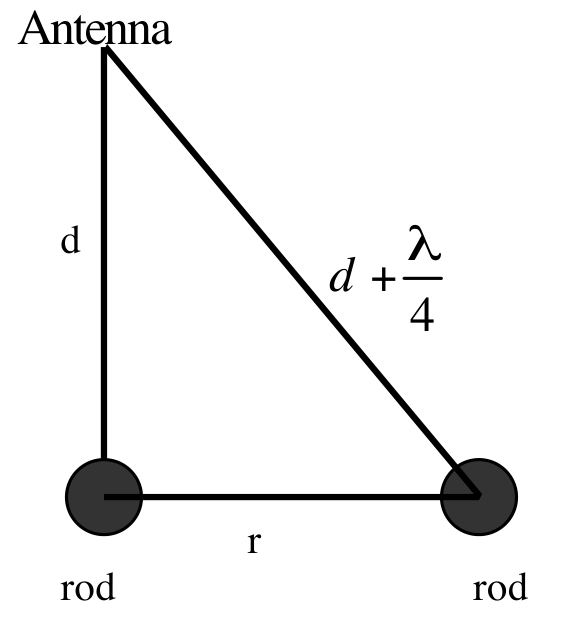
(1.0 pts)
r =0.5 m, d =4 m: , (0.5 pts)
The wavelength is =0.125 m. (0.3 pts) + (0.2 pts)
The propagation speed of the signal in medium is
m/ns , where and
m/ns m/s (0.5 pts)
The minimum frequency need to distinguish the two rods as two separate objects is
(0.5 pts)
(0.3 pts) + (0.20 pts)
4.
Path of EM waves for some positions on the ground surface
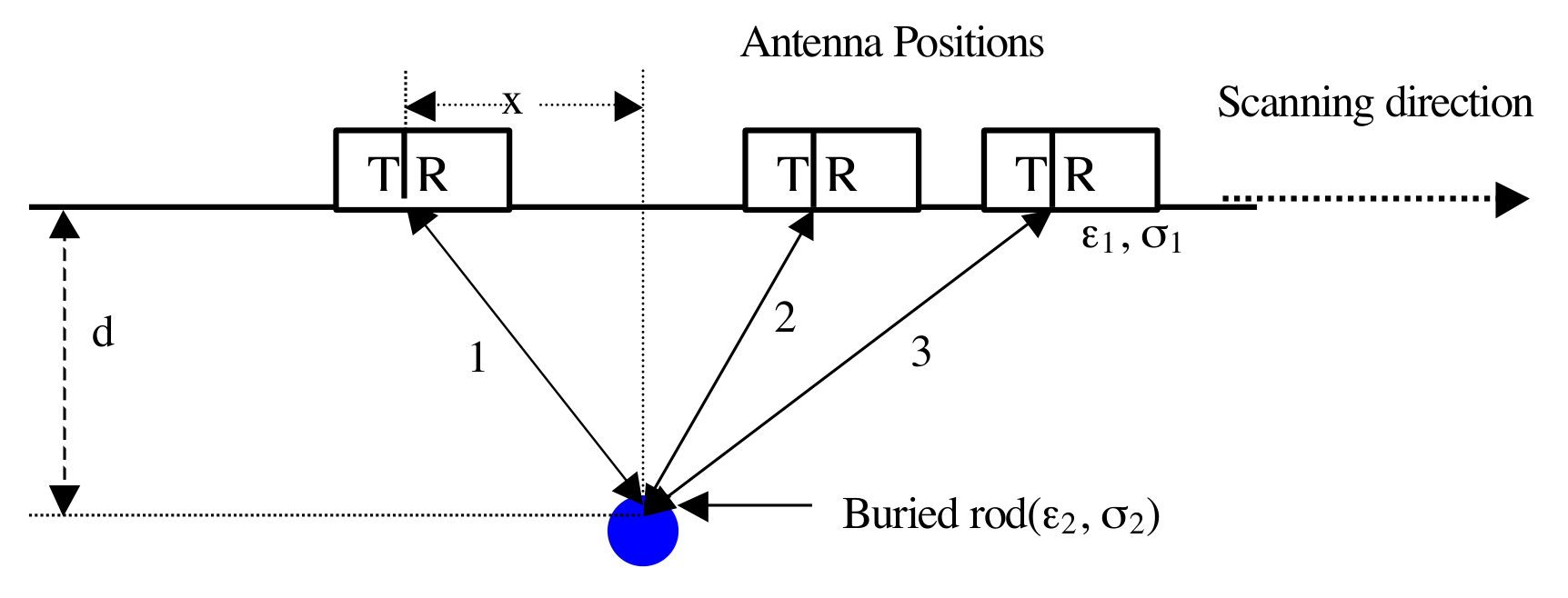
The traveltime as function of is
(1.0 pts)
(1.0 pts)
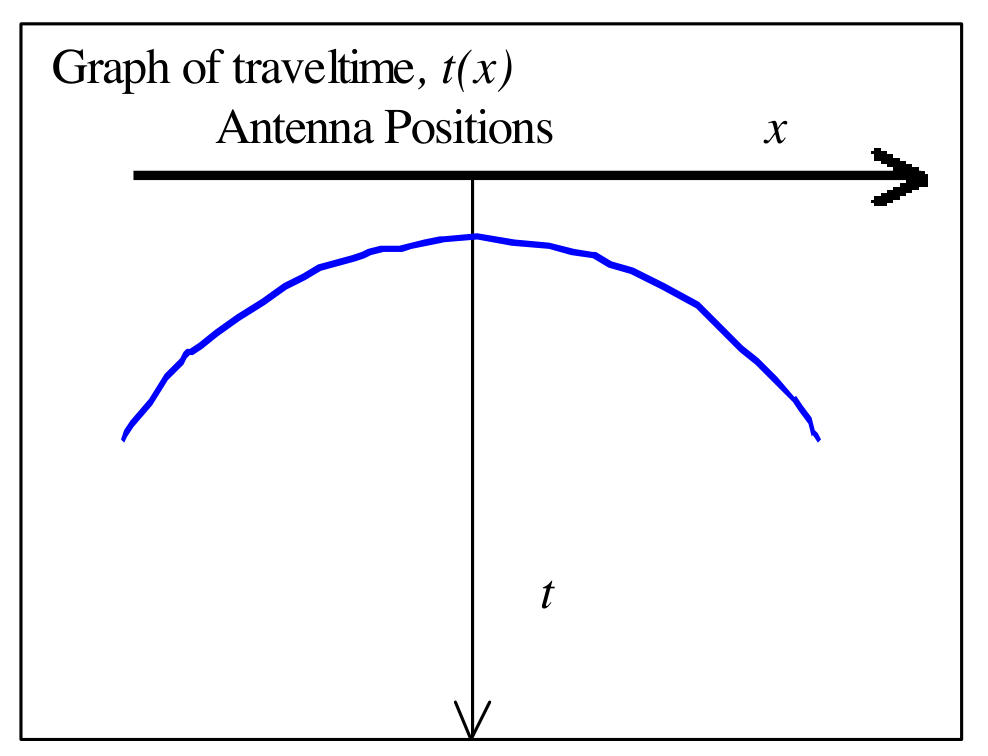
For =0 (1.0 pts)
100 = 2×(3/0.3)
= 5 m (0.5 pts)
Оригинал в Архива: 1.pdf · официални решения: 1_sol.pdf · допълнителни данни: IPhO_2002_Theoretical Question 1.pdf · допълнителни данни: IPhO_2002_Theoretical Solution 1.pdf