IPhO 2002, Теория — Задача 2. Sensing Electrical Signals
IPhO2002 — II. Sensing Electrical Signals · 23 юли 2002 г. · 10 т.
Условие
Some seawater animals have the ability to detect other creatures at some distance away due to electric currents produced by the creatures during the breathing processes or other processes involving muscular contraction. Some predators use this electrical signal to locate their preys, even when buried under the sands.
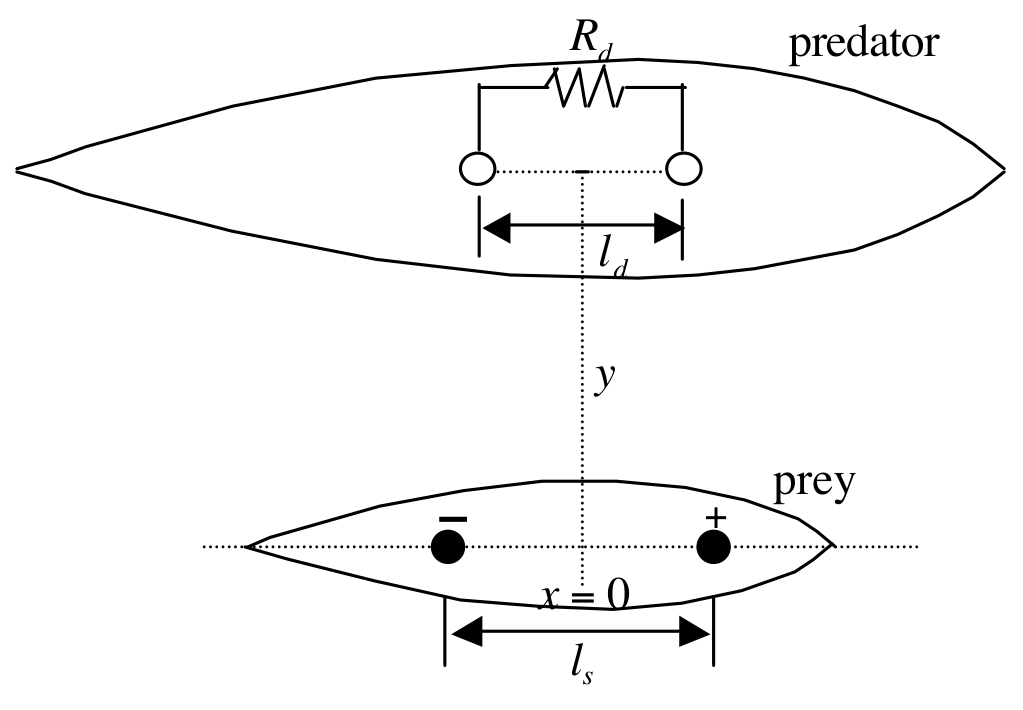
The physical mechanism underlying the current generation at the prey and its detection by the predator can be modeled as described by Figure II-1. The current generated by the prey flows between two spheres with positive and negative potential in the prey’s body. The distance between the centers of the two spheres is , each having a radius of , which is much smaller than . The seawater resistivity is . Assume that the resistivity of the prey’s body is the same as that of the surrounding seawater, implying that the boundary surrounding the prey in the figure can be ignored.
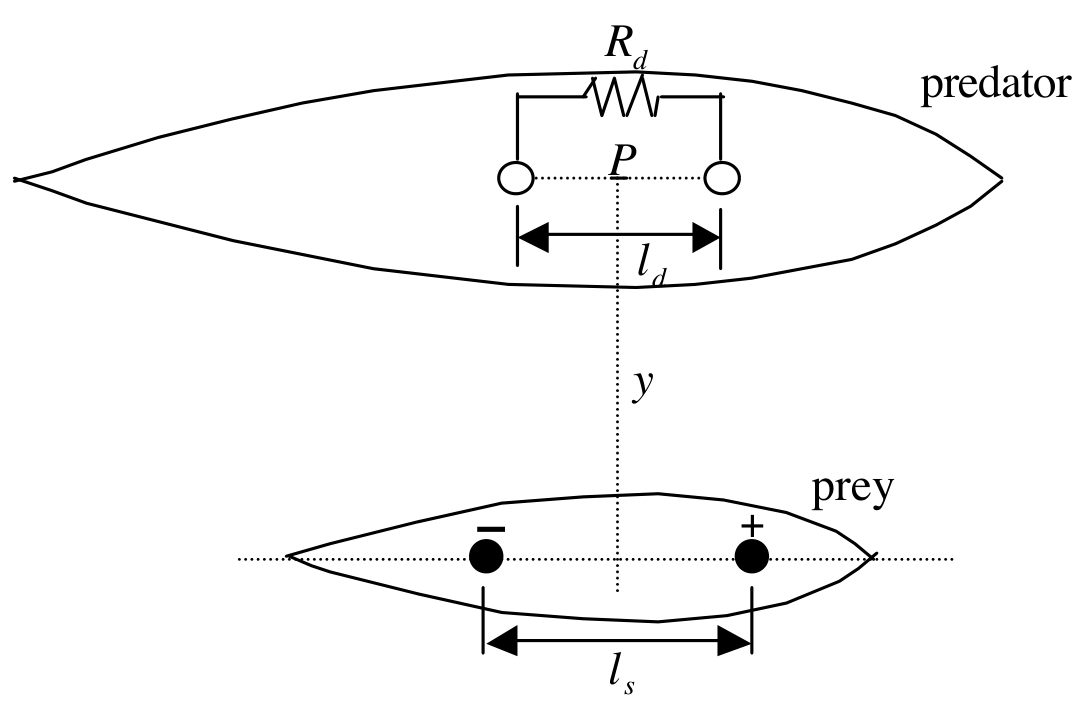
In order to describe the detection of electric power by the predator coming from the prey, the detector is modeled similarly by two spheres on the predator’s body and in contact with the surrounding seawater, lying parallel to the pair in the prey’s body. They are separated by a distance of , each having a radius of which is much smaller than . In this case, the center of the detector is located at a distance right above the source and the line connecting the two spheres is parallel to the electric field as shown in Figure II-1. Both and are also much smaller than . The electric field strength along the line connecting the two spheres is assumed to be constant. Therefore the detector forms a closed circuit system connecting the prey, the surrounding seawater and the predator as described in Figure II-2.
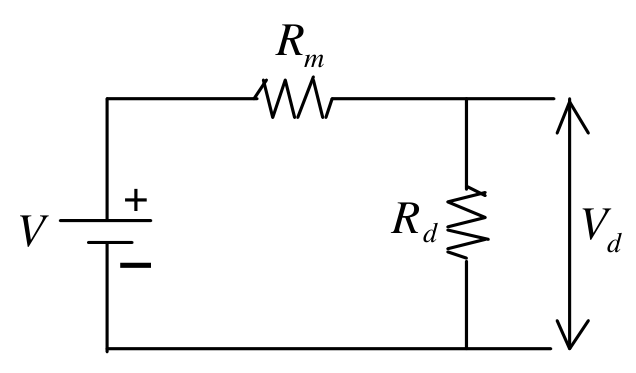
In the figure, is the voltage difference between the detector’s spheres due to the electric field induced by the prey, is the inner resistance due to the surrounding sea water. Further, and are respectively the voltage difference between the detecting spheres and the resistance of the detecting element within the predator.
Questions:
1. Determine the current density vector (current per unit area) caused by a point current source at a distance in an infinite medium. [1.5 pts]
2. Based on the law , determine the electric field strength at the middle of the detecting spheres (at point P) for a given current that flows between two spheres in the prey’s body [2.0 pts].
3. Determine for the same current , the voltage difference between the source spheres () in the prey [1.5 pts]. Determine the resistance between the two source spheres () [0.5 pts] and the power produced by the source () [0.5 pts]. [2,5 т.]
4. Determine [0.5 pts], [1.0 pts] in Figure II-2 and calculate also the power transferred from the source to the detector () [0.5 pts]. [2 т.]
5. Determine the optimum value of leading to maximum detected power [1.5 pts] and determine also the maximum power [0.5 pts]. [2 т.]
Отговори
- 1.
- 2.
- 3.
- 4.
- 5.
Решение
1. When a point current source is in infinite isotropic medium, the current density vector at a distance from the point is
[+1.5 pts] (without vector notation, -0.5 pts)
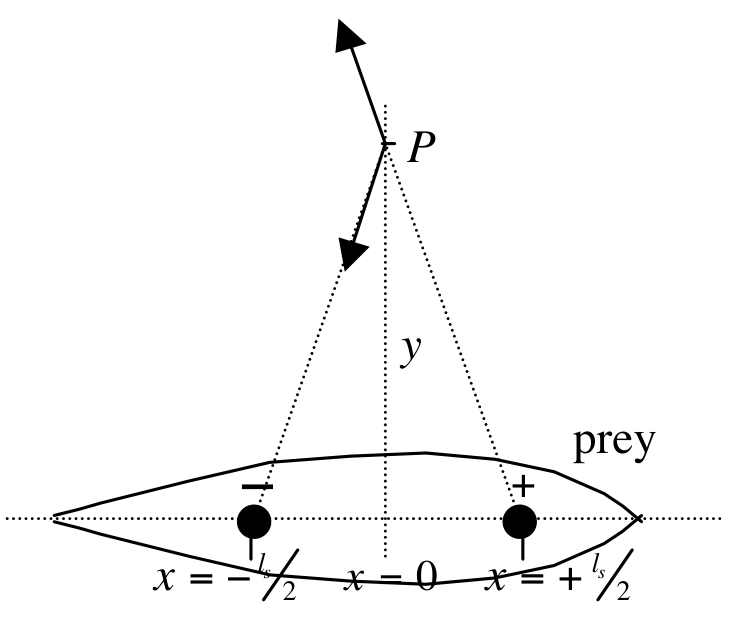
2. Assuming that the resistivities of the prey body and that of the surrounding seawater are the same, implying the elimination of the boundary surrounding the prey, the two spheres seem to be in infinite isotropic medium with the resistivity of . When a small sphere produces current at a rate , the current flux density at a distance r from the sphere's center is also
The seawater resistivity is , therefore the field strength at is
In the model, we have two small spheres. One is at positive voltage relative to the other therefore current flows from the positively charged sphere to the negatively charged sphere. They are separated by . The field strength at P(0,y) is:
3. The field strength along the axis between the two source spheres is:
The voltage difference to produce the given current is
The resistance between the two source spheres is:
[+0.5 pts]
The power produced by the source is:
[+0.5 pts]
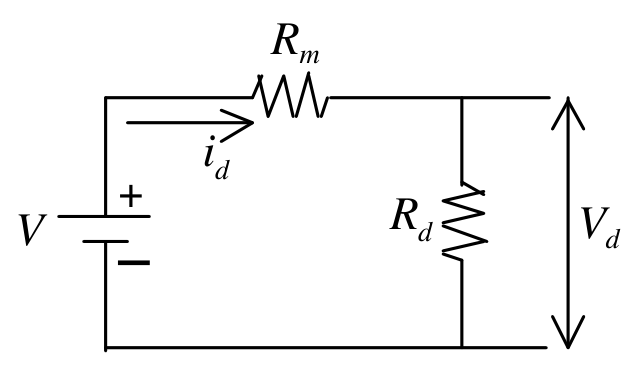
4. is the voltage difference between the detector’s spheres due to the electric field induced by the prey, is the inner resistance due to the surrounding sea water. and are respectively the voltage difference between the detecting spheres and the resistance of the detecting element within the predator and is the current flowing in the closed circuit.
Analog to the resistance between the two source spheres, the resistance of the medium with resistivity between the detector spheres, each having a radius of is:
[+0.5 pts]
Since is much smaller than , the electric field strength between the detector spheres can be assumed to be constant, that is:
Therefore, the voltage difference present in the medium between the detector spheres is:
The voltage difference across the detector spheres is:
[+0.5 pts]
The power transferred from the source to the detector is:
[+0.5 pts]
5. is maximum when
Therefore,
The maximum power is:
[+0.5 pts]