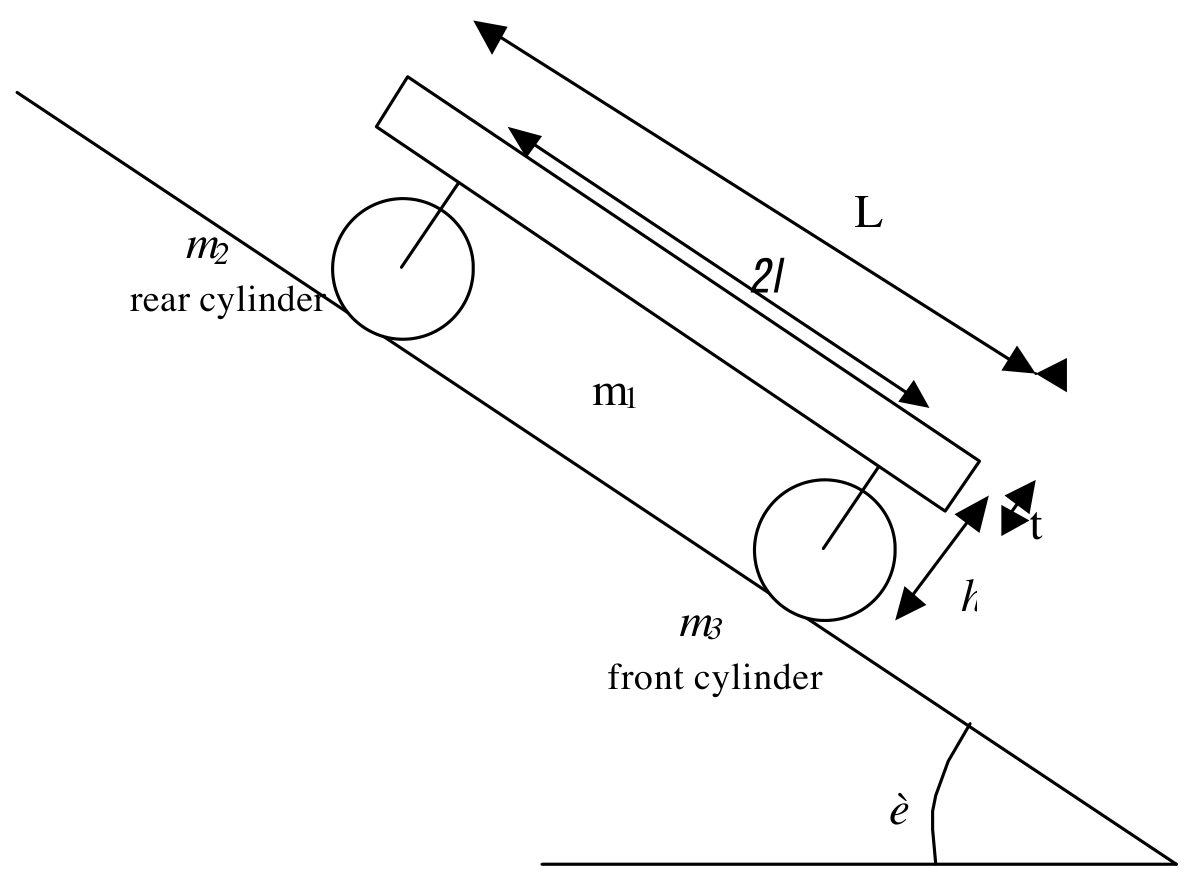
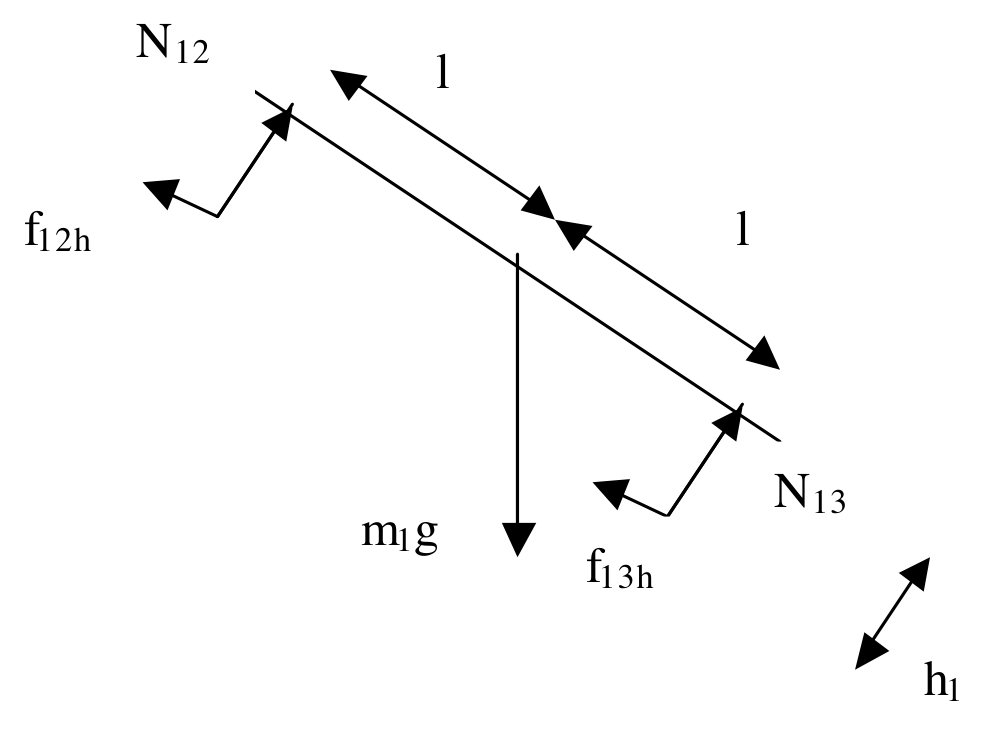
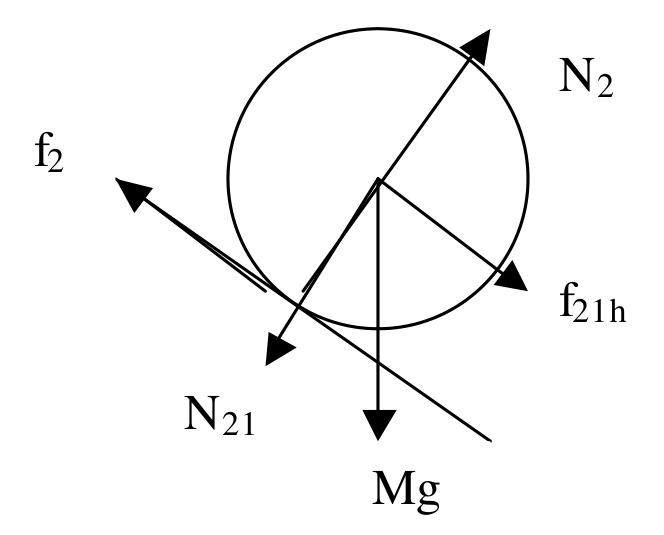
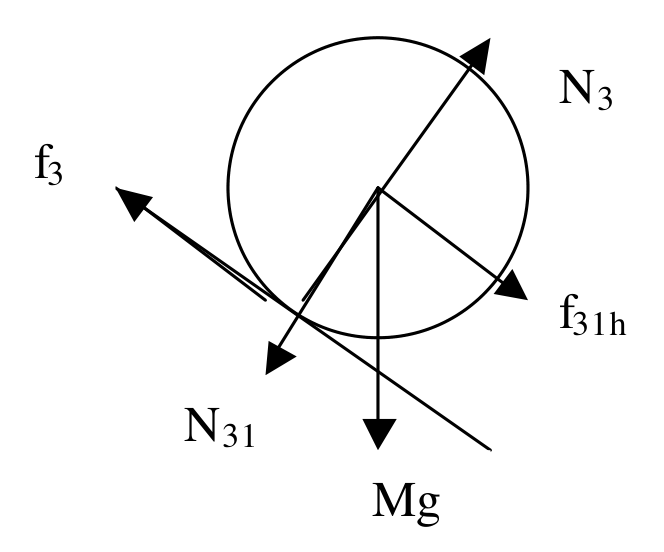
Figure III-1: A simplified model of a heavy vehicle moving on an inclined road.
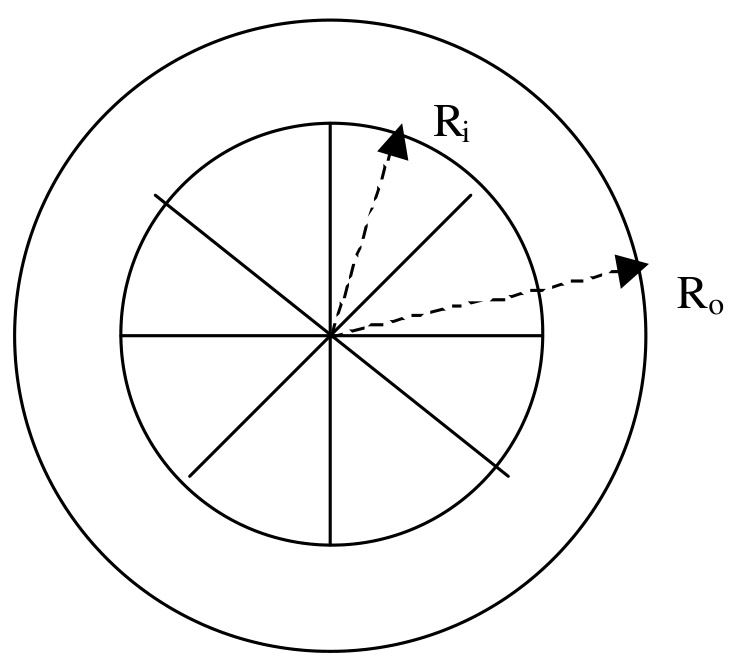
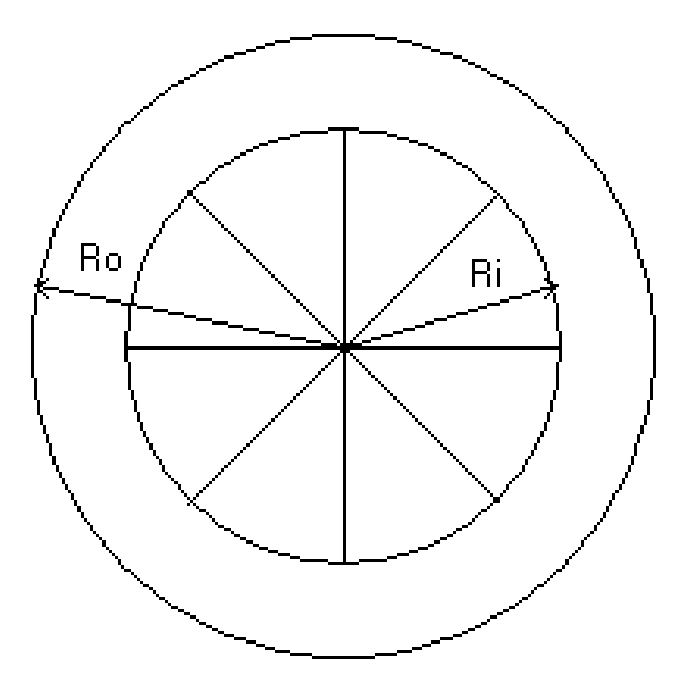
The above figure is a simplified model of a heavy vehicle (road roller) with one rear and one front cylinder as its wheels on an inclined road with inclination angle of θ as shown in Figure III-1. Each of the two cylinders has a total mass M(m2=m3=M) and consists of a cylindrical shell of outer radius Ro , inner radius Ri=0.8Ro and eight number of spokes with total mass 0.2 M. The mass of the undercarriage supporting the vehicle’s body is negligible. The cylinder can be modeled as shown in Figure III-2. The vehicle is moving down the road under the influence of gravitational and frictional forces. The front and rear cylinder are positioned symmetrically with respect to the vehicle.
Figure III-2: A simplified model of the cylinders.
The static and kinetic friction coefficients between the cylinder and the road are μs and μk respectively. The body of the vehicle has a mass of 5M , length of L and thickness of t . The distance between the front and the rear cylinder is 2l while the distance from the center of cylinder to the base of the vehicle’s body is h. Assume that the rolling friction between the cylinder and its axis is negligible.
Questions:
1. Calculate the moment of inertia of either cylinder [1.5 pts]. [1,5 т.]
2. Draw all forces that act on the body, the front cylinder, and the rear one. Write down equations of motion for each part of them [2.5 pts]. [2,5 т.]
3. The vehicle is assumed to move from rest, then freely move under gravitational influence. State all the possible types of motion of the system and derive their accelerations in terms of the given physical quantities [4.0 pts]. [4 т.]
4. Assume that after the vehicle travels a distance d by pure rolling from rest the vehicle enters a section of the road with all the friction coefficients drop to smaller constant values μs’ and μk’ such that the two cylinders start to slide. Calculate the linear and angular velocities of each cylinder after the vehicle has traveled a total distance of s meters. Here we assume that d and s is much larger than the dimension of vehicle [2.0 pts][2 т.]
Отговори
1.I=0.7MR2
Official solution; R = Ro.
3. Official solution: all cylinders in pure rolling a = 0.833 g sin θ; all cylinders sliding a = g sin θ − μk g cos θ; front rolling and rear sliding a = 0.9091 g sin θ − μk N2/(7.7M) with N2 from eq. (25), together with the rolling/sliding conditions on tan θ.
4. Official solution: vt2 = √(1.666 d g sin θ) − vt1 + √(vt1² + 2a2(s − d)); ωt2 = (1/R)√(1.666 d g sin θ) + (μk N R/I)·(−vt1 + √(vt1² + 2a2(s − d)))/a2.
Решение
SOLUTION T3 : . A Heavy Vehicle Moving on An Inclined Road
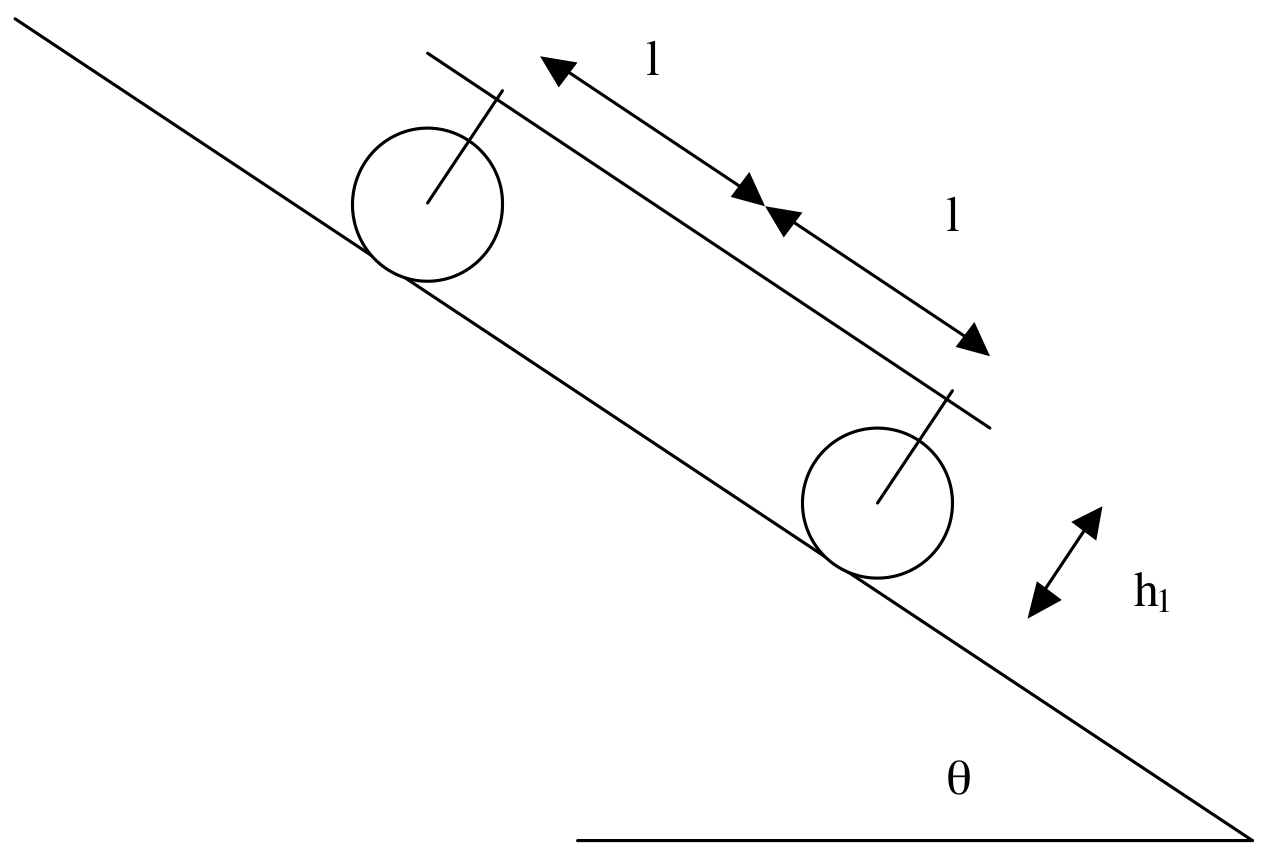
To simplify the model we use the above figure with h1=h+0.5t
Ro=R
1. Calculation of the moment inertia of the cylinder
To simplify the analysis we divide the system into three parts: frame (part1) which mainly can be treated as flat homogeneous plate, rear cylinders (two cylinders are treated collectively as part 2 of the system), and front cylinders (two front cylinders are treated collectively as part 3 of the system).
Part 1 : Frame
0.4 pts
The balance equation related to the forces work to this parts are:
where N2′ and N3′ are normal forces for pure rolling condition
Assumed that after rolling d meter all cylinder start to sliding until reaching the end of incline road (total distant is s meter). Assumed that ηmeter is reached in t1 second.
vt1=vo+at1=0+a1t1=a1t1
d=vot1+21a1t12=21a1t12
t1=a12d
0.5 pts
vt1=a1a12d=2da1=2d0.833gsinθ=1.666dgsinθ
(28)
The angular velocity after rolling d meters is same for front and rear cylinders:
ωt1=Rvt1=R11.666dgsinθ
(29) 0.5 pts
Then the vehicle sliding until the end of declining road. Assumed that the time needed by vehicle to move from d position to the end of the declining road is t2 second.
vt2=vt1+a2t2=1.666dgsinθ+a2t2
s−d=vt1t2+21a2t22
t2=a2−vt1+vt12+2a2(s−d)
vt2=1.666dgsinθ−vt1+vt12+2a2(s−d)
(30) 0.4 pts
Inserting vt1 and a2 from the previous results we get the final results.
For the angular velocity, while sliding they receive torsion: