IPhO 2003, Теория — Задача 1. A Swing with a Falling Weight
Theoretical Question 1
Внимание: Бележка към темата
В отпечатаната схема за оценяване на (j) е дадено , а в уравнение (C18) на пълното решение е дадено . Двете различаващи се формули са запазени както в оригинала.
Условие
A rigid cylindrical rod of radius is held horizontal above the ground. With a string of negligible mass and length ( ), a pendulum bob of mass is suspended from point at the top of the rod as shown in Figure 1a. The bob is raised until it is level with and then released from rest when the string is taut. Neglect any stretching of the string. Assume the pendulum bob may be treated as a mass point and swings only in a plane perpendicular to the axis of the rod. Accordingly, the pendulum bob is also referred to as the particle. The acceleration of gravity is .
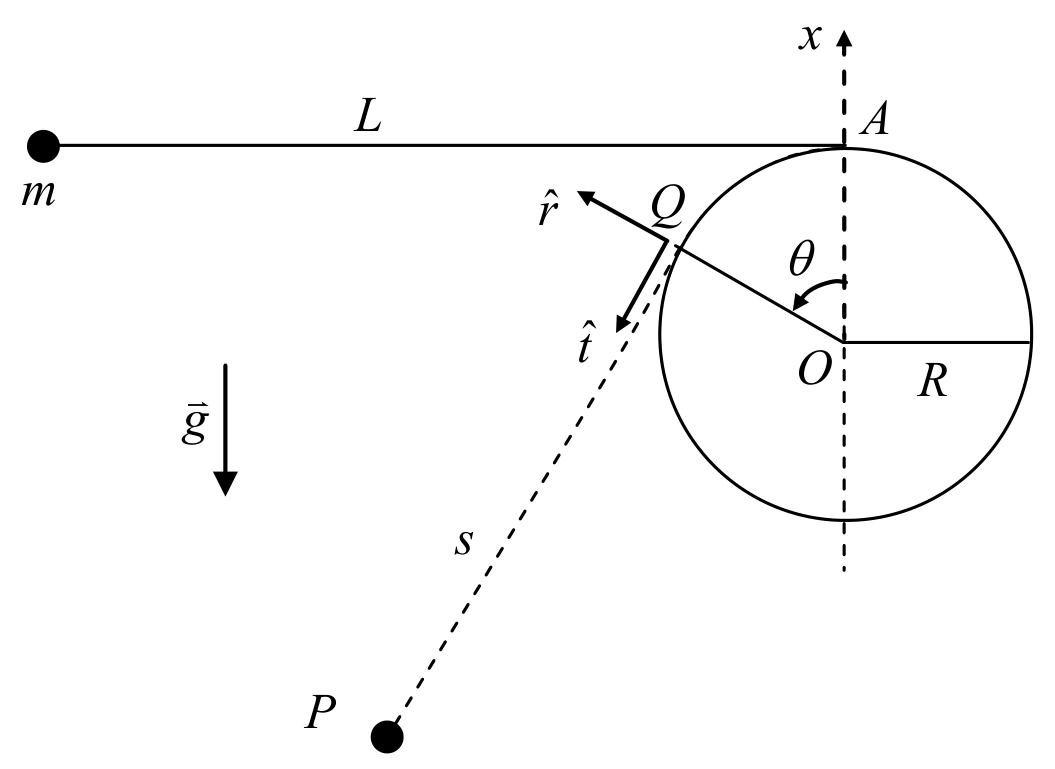
Figure 1a
Let be the origin of the coordinate system. When the particle is at point , the string is tangential to the cylindrical surface at . The length of the line segment is called . The unit tangent vector and the unit radial vector at are given by and , respectively. The angular displacement of the radius , as measured counterclockwise from the vertical -axis along , is taken to be positive.
When , the length is equal to and the gravitational potential energy of the particle is zero. As the particle moves, the instantaneous time rates of change of and are given by and , respectively.
Unless otherwise stated, all the speeds and velocities are relative to the fixed point .
Part A (4,3 т.)
In Part A, the string is taut as the particle moves. In terms of the quantities introduced above (i.e., , , , , , , and ), find:
(a) The relation between and . [0,5 т.]
(b) The velocity of the moving point relative to . [0,5 т.]
(c) The particle’s velocity relative to the moving point when it is at [0,7 т.]
(d) The particle’s velocity relative to when it is at . [0,7 т.]
(e) The -component of the particle’s acceleration relative to when it is at . [0,7 т.]
(f) The particle’s gravitational potential energy when it is at . [0,5 т.]
(g) The speed of the particle at the lowest point of its trajectory. [0,7 т.]
Part B (4,3 т.)
In Part B, the ratio to has the following value:
(h) What is the speed of the particle when the string segment from to is both straight and shortest in length? (in terms of and ) [2,4 т.]
(i) What is the speed of the particle at its highest point when it has swung to the other side of the rod? (in terms of and ) [1,9 т.]
Part C (3,4 т.)
In Part C, instead of being suspended from , the pendulum bob of mass is connected by a string over the top of the rod to a heavier weight of mass , as shown in Figure 1b. The weight can also be treated as a particle.
Initially, the bob is held stationary at the same level as so that, with the weight hanging below , the string is taut with a horizontal section of length . The bob is then released from rest and the weight starts falling. Assume that the bob remains in a vertical plane and can swing past the falling weight without any interruption.
The kinetic friction between the string and the rod surface is negligible. But the static friction is assumed to be large enough so that the weight will remain stationary once it has come to a stop (i.e. zero velocity).
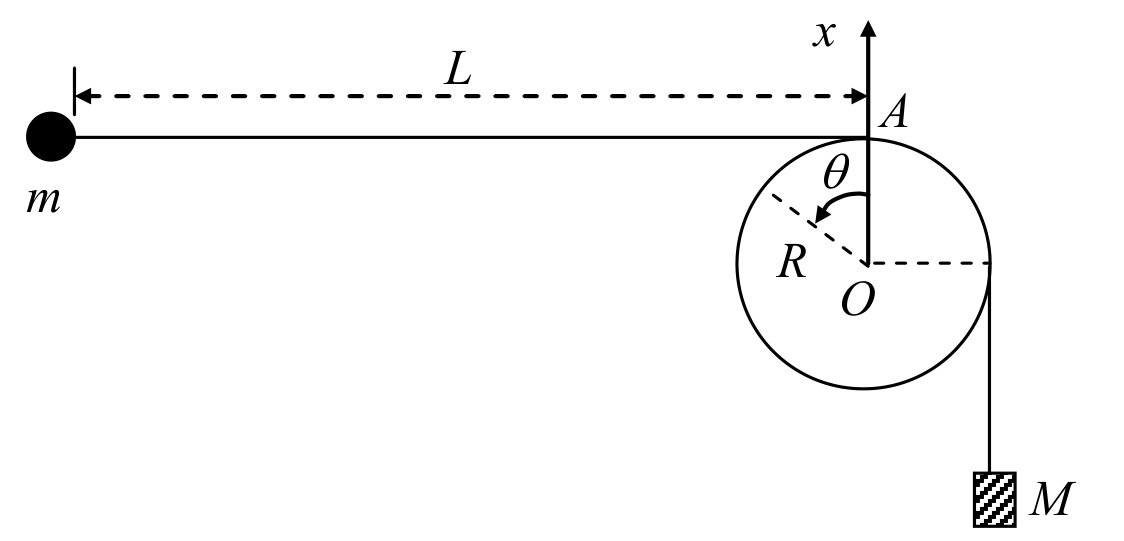
Figure 1b
(j) Assume that the weight indeed comes to a stop after falling a distance and that . If the particle can then swing around the rod to while both segments of the string free from the rod remain straight, the ratio must not be smaller than a critical value . Neglecting terms of the order or higher, obtain an estimate on in terms of . [3,4 т.]
Отговори
Part A, (a)
Part A, (b)
Part A, (c)
Part A, (d)
Part A, (e)
Part A, (f)
Part A, (g)
Part B, (h)
Part B, (i)
Part C, (j)
The marking scheme prints “0.6 for αc = (1 + 2M/3m)”, without the reciprocal; the solution text (C17)–(C18) gives αc = 1/(1 + 2M/3m).
Решение
Part A
(a) Since the length of the string is constant, its rate of change must be zero. Hence we have
(b) Relative to , moves on a circle of radius with angular velocity , so
(c) Refer to Fig. A1. Relative to , the displacement of in a time interval is . It follows
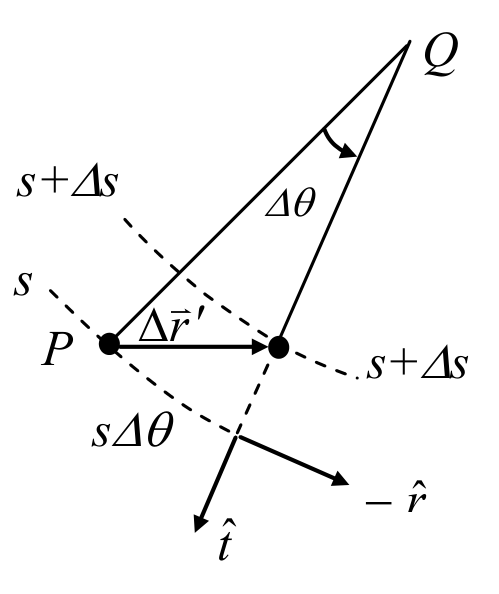
Figure A1
(d) The velocity of the particle relative to is the sum of the two relative velocities given in Eqs. (A2) and (A3) so that
(e) Refer to Fig. A2. The ( )-component of the velocity change is given by . Therefore, the -component of the acceleration is given by . Since the speed of the particle is according to Eq. (A4), we see that the -component of the particle’s acceleration at is given by
Note that, from Fig. A2, the radial component of the acceleration may also be obtained as .
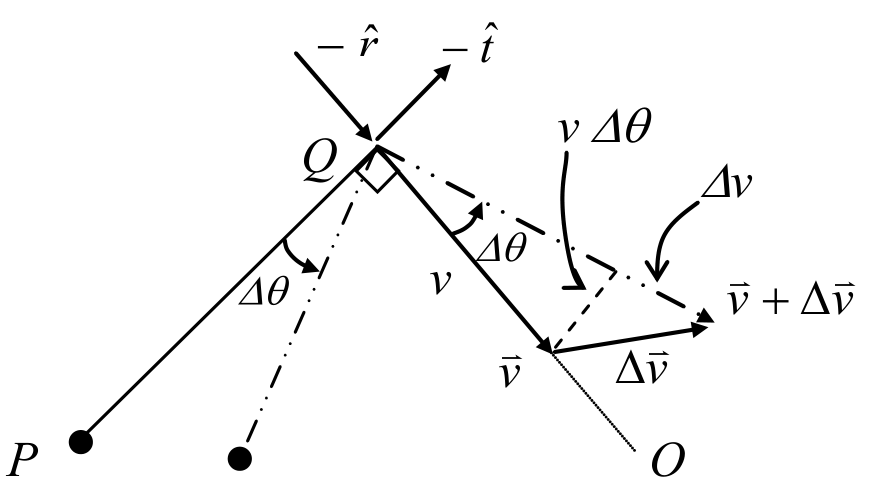
Figure A2
(f) Refer to Fig. A3. The gravitational potential energy of the particle is given by . It may be expressed in terms of and as
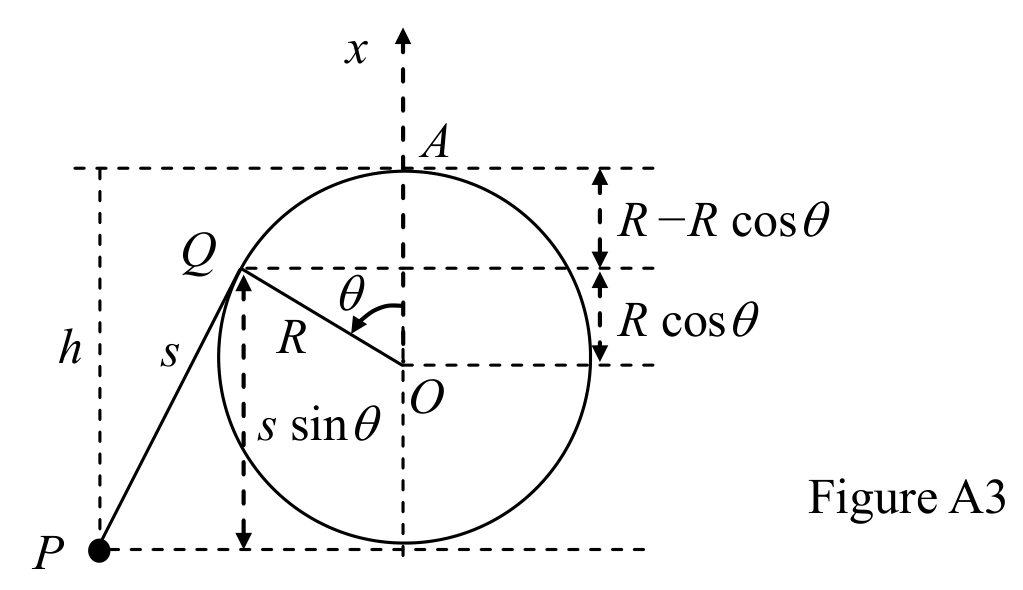
Figure A3
(g) At the lowest point of its trajectory, the particle’s gravitational potential energy must assume its minimum value . By differentiating Eq. (A6) with respect to and using Eq. (A1), the angle corresponding to the minimum gravitational energy can be obtained.
At , . We have . The lowest point of the particle’s trajectory is shown in Fig. A4 where the length of the string segment of QP is .
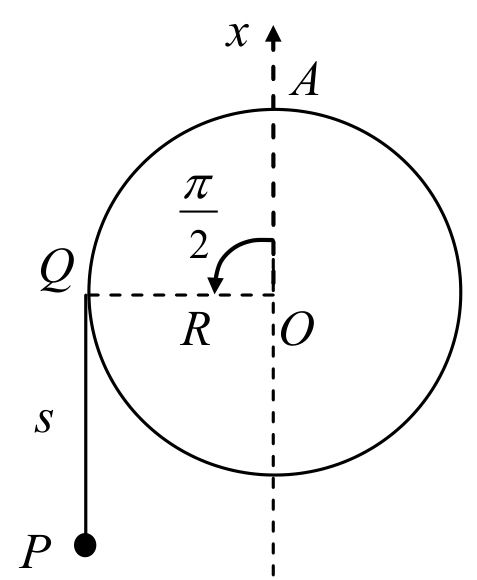
Figure A4
From Fig. A4 or Eq. (A6), the minimum potential energy is then
Initially, the total mechanical energy is 0. Since is conserved, the speed of the particle at the lowest point of its trajectory must satisfy
From Eqs. (A7) and (A8), we obtain
Part B
(h) From Eq. (A6), the total mechanical energy of the particle may be written as
From Eq. (A4), the speed is equal to . Therefore, Eq. (B1) implies
Let be the tension in the string. Then, as Fig. B1 shows, the -component of the net force on the particle is . From Eq. (A5), the tangential acceleration of the particle is . Thus, by Newton’s second law, we have
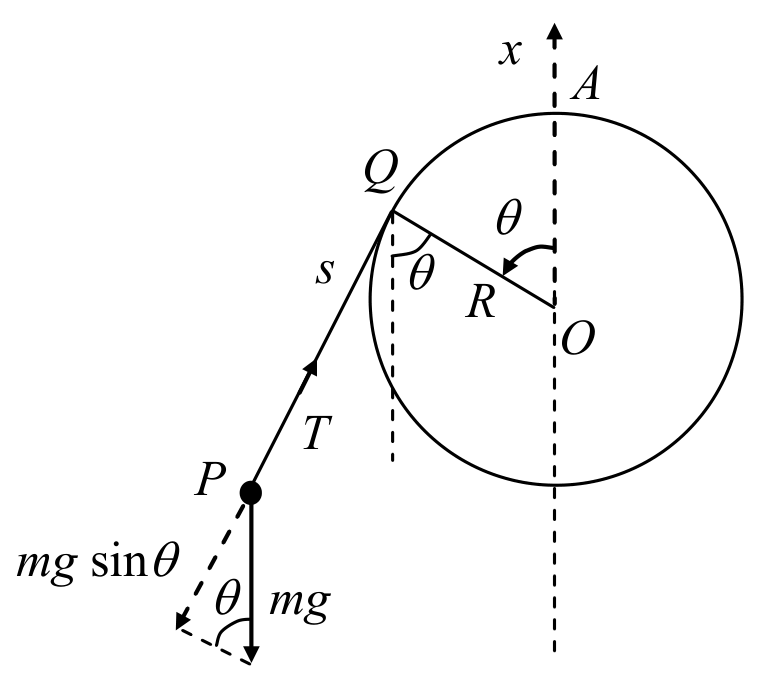
Figure B1
According to the last two equations, the tension may be expressed as
The functions and are plotted in Fig B2.
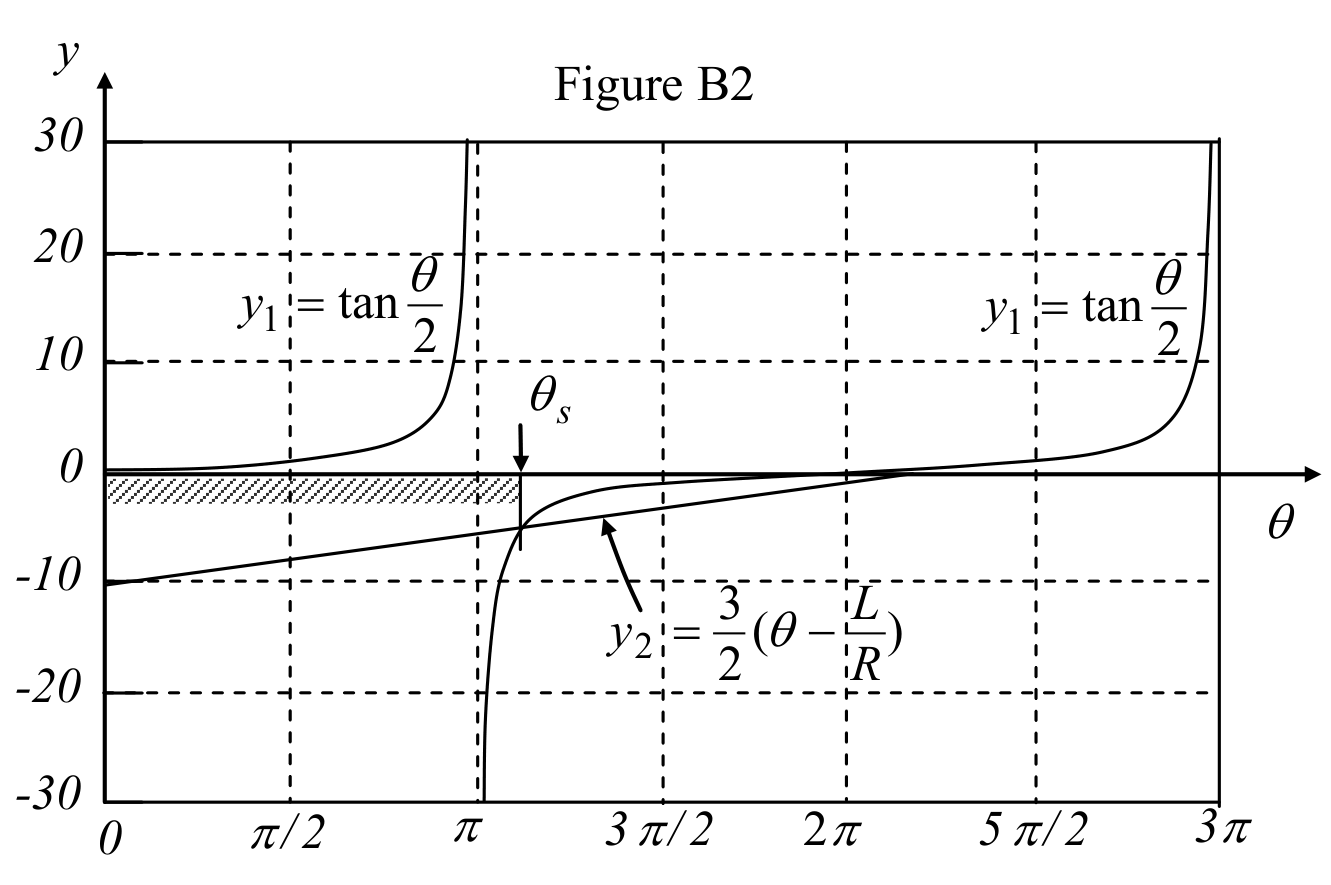
Figure B2
From Eq. (B4) and Fig. B2, we obtain the result shown in Table B1. The angle at which . is called ( ) and is given by
or, equivalently, by
Since the ratio is known to be given by
one can readily see from the last two equations that .
Table B1
| tension | |||
|---|---|---|---|
| positive | positive | positive | |
| 0 | positive | ||
| negative | negative | positive | |
| zero | negative | zero | |
| positive | negative | negative |
Table B1 shows that the tension must be positive (or the string must be taut and straight) in the angular range . Once reaches , the tension becomes zero and the part of the string not in contact with the rod will not be straight afterwards. The shortest possible value for the length of the line segment therefore occurs at and is given by
When , we have and Eqs. (B2) and (B3) then leads to . Hence the speed is
(i) When , the particle moves like a projectile under gravity. As shown in Fig. B3, it is projected with an initial speed from the position in a direction making an angle with the -axis.
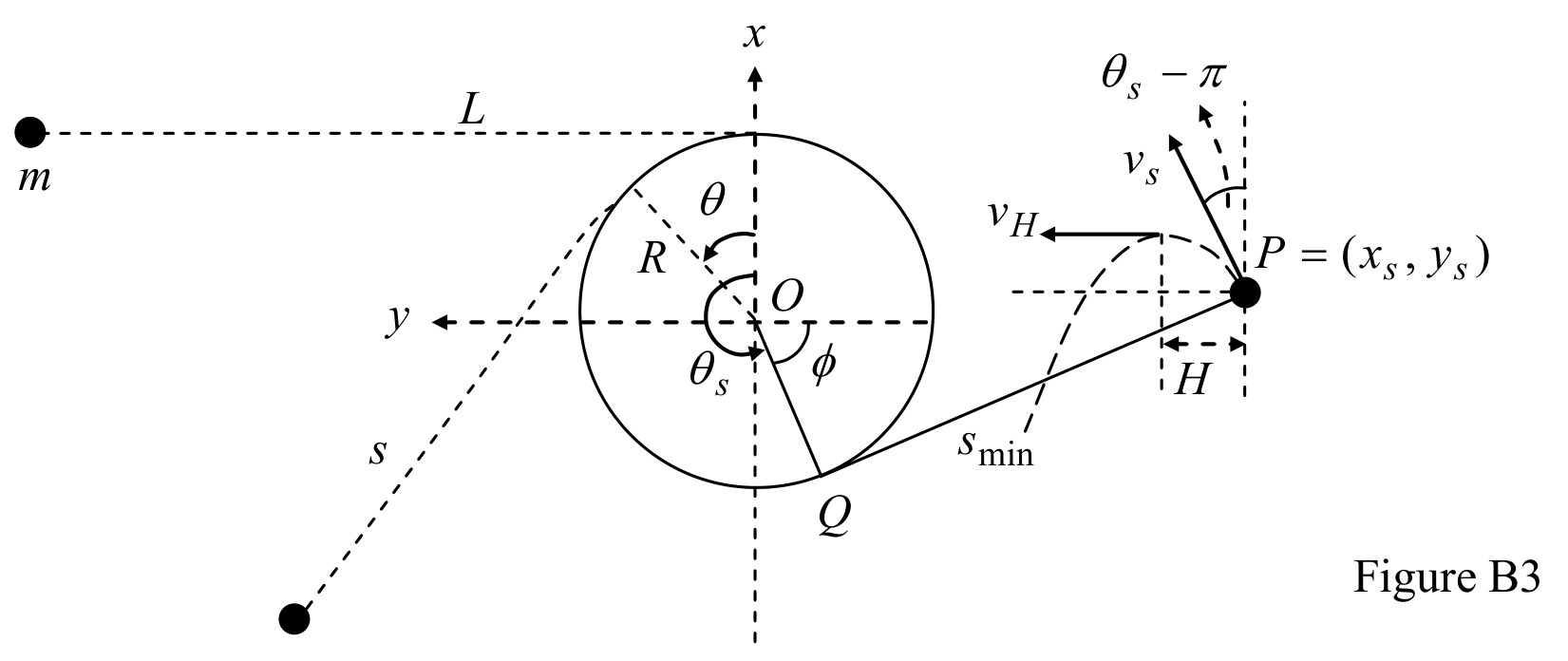
Figure B3
The speed of the particle at the highest point of its parabolic trajectory is equal to the -component of its initial velocity when projected. Thus,
The horizontal distance traveled by the particle from point to the point of maximum height is
The coordinates of the particle when are given by
Evidently, we have . Therefore the particle can indeed reach its maximum height without striking the surface of the rod.
Part C
(j) Assume the weight is initially lower than by as shown in Fig. C1.
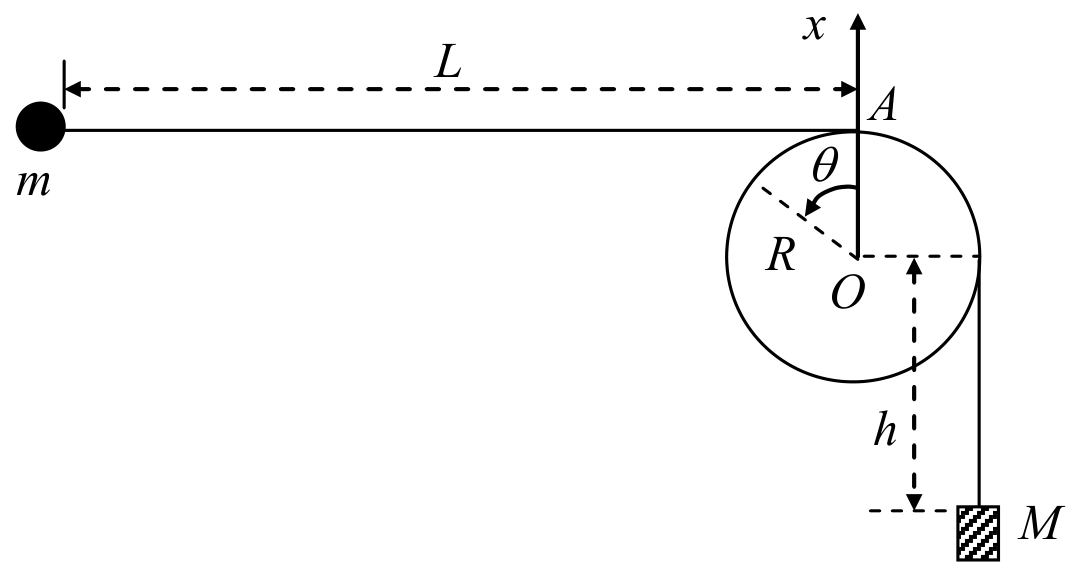
Figure C1
When the weight has fallen a distance and stopped, the law of conservation of total mechanical energy as applied to the particle-weight pair as a system leads to
where is the total mechanical energy of the particle when the weight has stopped. It follows
Let be the total length of the string. Then, its value at must be the same as at any other angular displacement . Thus we must have
Noting that and introducing , we may write
From the last two equations, we obtain
After the weight has stopped, the total mechanical energy of the particle must be conserved. According to Eq. (C2), we now have, instead of Eq. (B1), the following equation:
The square of the particle’s speed is accordingly given by
Since Eq. (B3) stills applies, the tension of the string is given by
From the last two equations, it follows
where Eq. (C5) has been used to obtain the last equality.
We now introduce the function
From the fact , we may write
where we have introduced
From Eq. (C11), the minimum value of is seen to be given by
Since the tension remains nonnegative as the particle swings around the rod, we have from Eq. (C9) the inequality
or
From Eq. (C4), Eq. (C15) may be written as
Neglecting terms of the order () or higher, the last inequality leads to
The critical value for the ratio is therefore
Marking Scheme
Theoretical Question 1 — A Swing with a Falling Weight
| Total Scores | Sub Scores | Marking Scheme for Answers to the Problem |
|---|---|---|
| Part A | (a) | Relation between and . ( ) |
| 4.3 pts. | 0.5 | ➢ 0.2 for . |
| ➢ 0.3 for proportionality constant (-). | ||
| (b) | Velocity of relative to . ( ) | |
| 0.5 | ➢ 0.2 for magnitude . | |
| ➢ 0.3 for direction . | ||
| (c) | Particle’s velocity at relative to . ( ) | |
| 0.7 | ➢ 0.2+0.1 for magnitude and direction of -component. | |
| ➢ 0.3+0.1 for magnitude and direction of -component. | ||
| (d) 0.7 | Particle’s velocity at relative to . ( ) | |
| ➢ 0.3 for vector addition of and . | ||
| ➢ 0.2+0.2 for magnitude and direction of . | ||
| (e) | -component of particle’s acceleration at . | |
| 0.7 | ➢ 0.3 for relating or to the velocity in a way that implies . | |
| ➢ 0.4 for (0.1 for minus sign.) | ||
| (f) | Potential energy . | |
| 0.5 | ➢ 0.2 for formula . | |
| ➢ 0.3 for or as a function of , , and . | ||
| (g) | Speed at lowest point . | |
| 0.7 | ➢ 0.2 for lowest point at or equals minimum . | |
| ➢ 0.2 for total mechanical energy . | ||
| ➢ 0.3 for . | ||
| Part B | (h) | Particle’s speed when is shortest. |
| 4.3 pts. | 2.4 | ➢ 0.4 for tension becomes zero when is shortest. |
| ➢ 0.3 for equation of motion . | ||
| ➢ 0.3 for . | ||
| ➢ 0.4 for . | ||
| ➢ 0.5 for . | ||
| ➢ 0.3+0.2 for | ||
| (i) | The speed of the particle at its highest point. | |
| 1.9 | ➢ 0.4 for particle undergoes projectile motion when . | |
| ➢ 0.3 for angle of projection . | ||
| ➢ 0.3 for is the -component of its velocity at . | ||
| ➢ 0.4 for noting particle does not strike the surface of the rod. | ||
| ➢ 0.3+0.2 for . | ||
| Part C | (j) | The critical value of the ratio . |
| 3.4 pts | 3.4 | ➢ 0.4 for particle’s energy when the weight has stopped. |
| ➢ 0.3 for . | ||
| ➢ 0.3 for . | ||
| ➢ 0.3 for . | ||
| ➢ 0.3 for concluding must not be negative. | ||
| ➢ 0.6 for an inequality leading to the determination of the range of . | ||
| ➢ 0.6 for solving the inequality to give the range of . | ||
| ➢ 0.6 for . |
Answer Sheet
Answer Sheet — Theoretical Question 1 — A Swing with a Falling Weight
(a) The relation between and is
(b) The velocity of the moving point relative to is
(c) When at , the particle’s velocity relative to the moving point is
(d) When at , the particle’s velocity relative to is
(e) When at , the -component of the particle’s acceleration relative to is
(f) When at , the particle’s gravitational potential energy is
(g) The particle’s speed when at the lowest point of its trajectory is
(h) When line segment is straight with the shortest length, the particle‘s speed is (Give expression and value in terms of g and R )
(i) At the highest point, the particle’s speed is (Give expression and value in terms of g and R)
(j) In terms of the mass ratio , the critical value of the ratio is
Оригинал в Архива: 1.pdf · официални решения: 1_sol.pdf · допълнителни данни: IPhO_2003_Theoretical Question 1.pdf · допълнителни данни: IPhO_2003_Theoretical Solution 1.pdf