IPhO 2003, Теория — Задача 2. A Piezoelectric Crystal Resonator under an Alternating Voltage
Theoretical Question 2 — A Piezoelectric Crystal Resonator under an Alternating Voltage · 10 т.
Условие
Consider a uniform rod of unstressed length and cross-sectional area (Figure 2a). Its length changes by when equal and opposite forces of magnitude are applied to its ends faces normally. The stress on the end faces is defined to be . The fractional change in its length, i.e., , is called the strain of the rod. In terms of stress and strain, Hooke’s law may be expressed as
where is called the Young’s modulus of the rod material. Note that a compressive stress corresponds to and a decrease in length (i.e., ). Such a stress is thus negative in value and is related to the pressure by .
For a uniform rod of density , the speed of propagation of longitudinal waves (i.e., sound speed) along the rod is given by
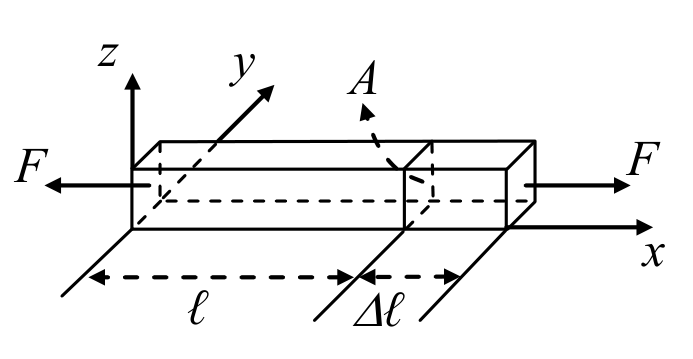
Figure 2a
The effect of damping and dissipation can be ignored in answering the following questions.
Part A: mechanical properties (4 т.)
A uniform rod of semi-infinite length, extending from to (see Figure 2b), has a density . It is initially stationary and unstressed. A piston then steadily exerts a small pressure on its left face at for a very short time , causing a pressure wave to propagate with speed to the right.
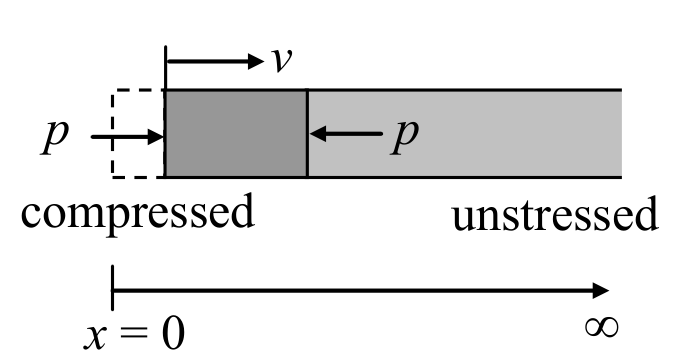
Figure 2b
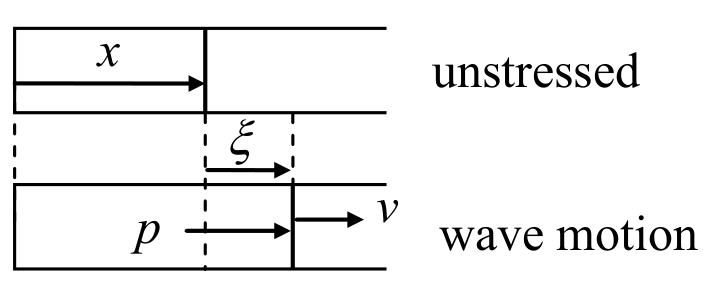
Figure 2c
(a) If the piston causes the rod’s left face to move at a constant velocity (Figure 2b), what are the strain and pressure at the left face during the time ? Answers must be given in terms of , , and only. [1,6 т.]
(b) Consider a longitudinal wave traveling along the direction in the rod. For a cross section at when the rod is unstressed (Figure 2c), let be its displacement at time and assume
where and are constants. Determine the corresponding velocity , strain , and pressure as a function of and . [2,4 т.]
Part B: electromechanical properties (including piezoelectric effect) (6 т.)
Consider a quartz crystal slab of length , thickness , and width (Figure 2d). Its length and thickness are along the -axis and -axis. Electrodes are formed by thin metallic coatings at its top and bottom surfaces. Electrical leads that also serve as mounting support (Figure 2e) are soldered to the electrode’s centers, which may be assumed to be stationary for longitudinal oscillations along the direction.
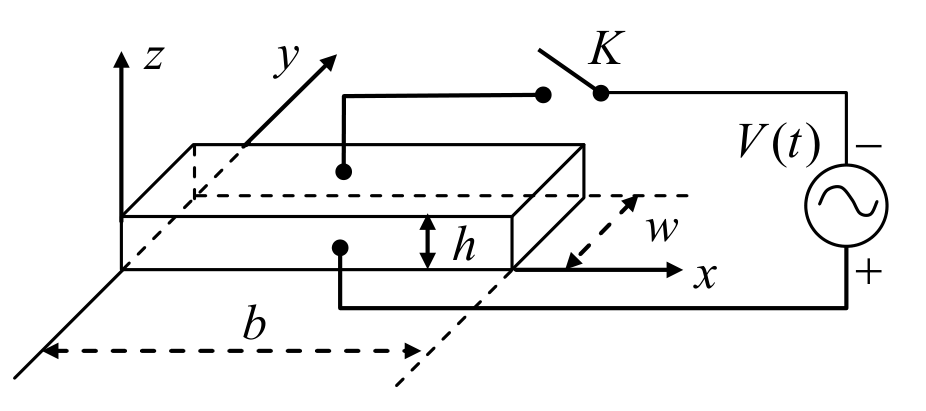
Figure 2d
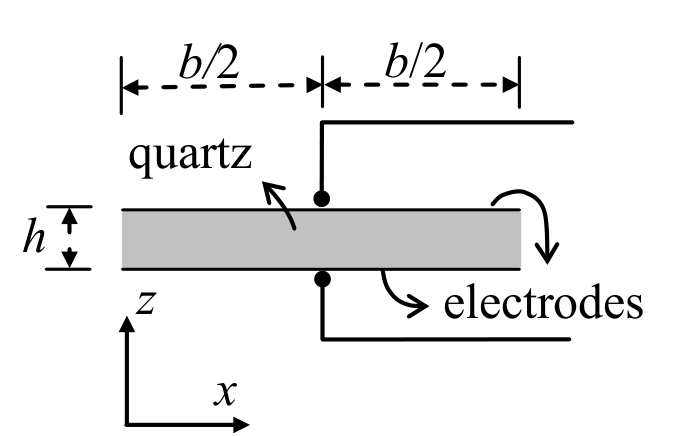
Figure 2e
The quartz crystal under consideration has a density of and Young’s modulus of . The length of the slab is 1.00 cm and the width and height of the slab are such that and . With switch left open, we assume only longitudinal modes of standing wave oscillation in the direction are excited in the quartz slab.
For a standing wave of frequency , the displacement at time of a cross section of the slab with equilibrium position may be written as
where is a positive constant and the spatial function is of the form
has the maximum value of one and . Keep in mind that the centers of the electrodes are stationary and the left and right faces of the slab are free and must have zero stress (or pressure).
(c) Determine the values of and in Eq. (4b) for a longitudinal standing wave in the quartz slab. [1,2 т.]
(d) What are the two lowest frequencies at which longitudinal standing waves may be excited in the quartz slab? [1,2 т.]
The piezoelectric effect is a special property of a quartz crystal. Compression or dilatation of the crystal generates an electric voltage across the crystal, and conversely, an external voltage applied across the crystal causes the crystal to expand or contract depending on the polarity of the voltage. Therefore, mechanical and electrical oscillations can be coupled and made to resonate through a quartz crystal.
To account for the piezoelectric effect, let the surface charge densities on the upper and lower electrodes be and , respectively, when the quartz slab is under an electric field in the direction. Denote the slab’s strain and stress in the direction by and , respectively. Then the piezoelectric effect of the quartz crystal can be described by the following set of equations:
where is the elastic compliance (i.e., inverse of Young’s modulus) at constant electric field and is the permittivity at constant stress, while is the piezoelectric coefficient.
Let switch in Fig. 2d be closed. The alternating voltage now acts across the electrodes and a uniform electric field in the direction appears in the quartz slab. When a steady state is reached, a longitudinal standing wave oscillation of angular frequency appears in the slab in the direction.
With being uniform, the wavelength and the frequency of a longitudinal standing wave in the slab are still related by with given by Eq. (2). But, as Eq. (5a) shows, is no longer valid, although the definitions of strain and stress remain unchanged and the end faces of the slab remain free with zero stress.
(e) Taking Eqs. (5a) and (5b) into account, the surface charge density on the lower electrode as a function of and is of the form,
where . Find the expressions for and . [2,2 т.]
(f) The total surface charge on the lower electrode is related to by
Find the expression for and the expression and numerical value of . [1,4 т.]
Отговори
- Part A: mechanical properties, (a)
- Part A: mechanical properties, (b)
- Part B: electromechanical properties (including piezoelectric effect), (c)
- Part B: electromechanical properties (including piezoelectric effect), (d)
- Part B: electromechanical properties (including piezoelectric effect), (e)
- Part B: electromechanical properties (including piezoelectric effect), (f)
Решение
Part A
(a) Refer to Figure A1. The left face of the rod moves a distance while the pressure wave travels a distance with . The strain at the left face is
From Hooke’s law, the pressure at the left face is
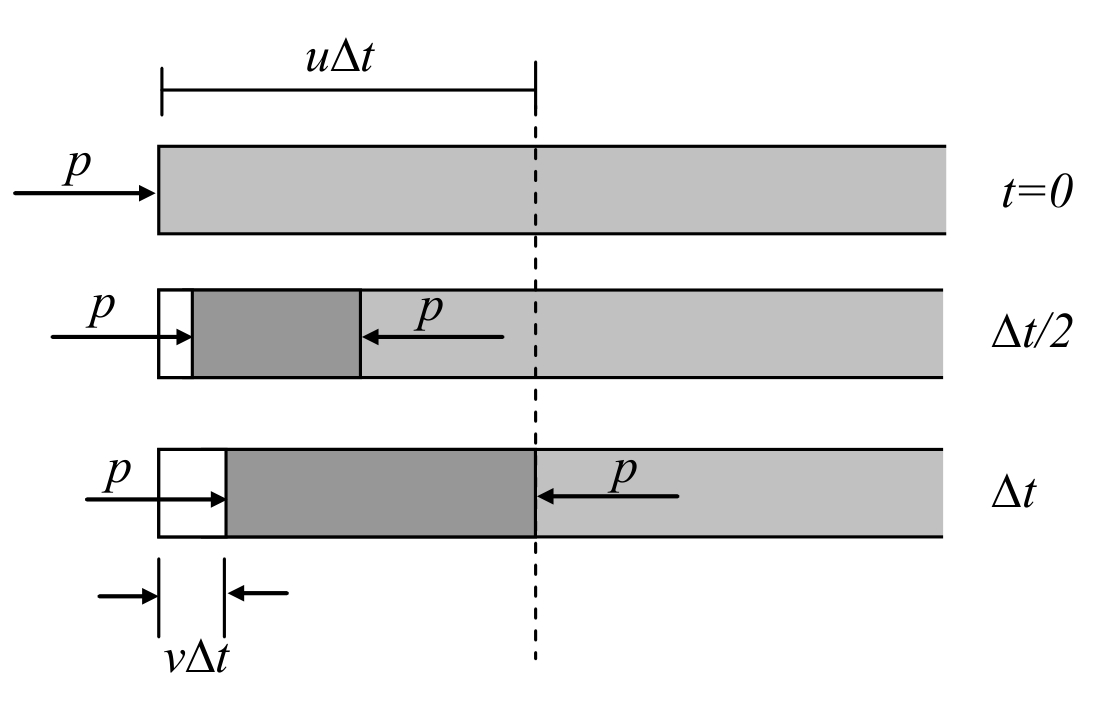
Figure A1
(b) The velocity is related to the displacement as in a simple harmonic motion (or a uniform circular motion, as shown in Figure A2) of angular frequency . Therefore, if , then
The strain and pressure are related to velocity as in Problem (a). Hence,
Alternatively, the answers may be obtained by differentiations:
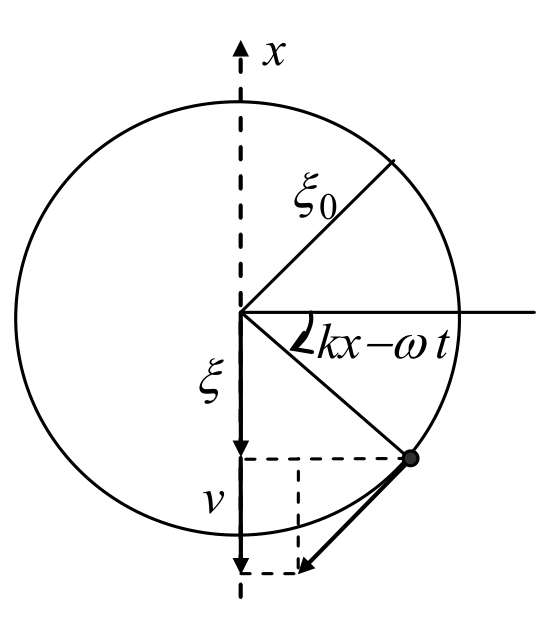
Figure A2
Part B
(c) Since the angular frequency and speed of propagation are given, the wavelength is given by with . The spatial variation of the displacement is therefore described by
Since the centers of the electrodes are assumed to be stationary, . This leads to . Given that the maximum of is 1, we have and
Thus, the displacement is
(d) Since the pressure (or stress ) must vanish at the end faces of the quartz slab (i.e., and ), the answer to this problem can be obtained, by analogy, from the resonant frequencies of sound waves in an open pipe of length . However, given that the centers of the electrodes are stationary, all even harmonics of the fundamental tone must be excluded because they have antinodes, rather than nodes, of displacement at the bisection plane of the slab.
Since the fundamental tone has a wavelength , the fundamental frequency is given by . The speed of propagation is given by
and, given that , the two lowest standing wave frequencies are
[Alternative solution to Problems (c) and (d)]:
A longitudinal standing wave in the quartz slab has a displacement node at . It may be regarded as consisting of two waves traveling in opposite directions. Thus, its displacement and velocity must have the following form
where and the first and second factors in the square brackets represent waves traveling along the and directions, respectively. Note that Eq. (B6) is identical to Eq. (B3) if we set .
For a wave traveling along the direction, the velocity must be replaced by in Eqs. (A1a) and (A1b) so that we have
As in Problem (b), the strain and pressure are therefore given by
Note that , , and may also be obtained by differentiating as in Problem (b).
The stress or pressure must be zero at both ends ( and ) of the slab at all times because they are free. From Eq. (B11), this is possible only if or
In terms of wavelength , Eq. (B12) may be written as
The frequency is given by
This is identical with the results given in Eqs. (B4) and (B5).
(e) From Eqs. (5a) and (5b) in the Question, the piezoelectric effect leads to the equations
Because must be a node of displacement for any longitudinal standing wave in the slab, the displacement and strain must have the form given in Eqs. (B6) and (B10), i.e., with ,
where a phase constant is now included in the time-dependent factors.
By assumption, the electric field between the electrodes is uniform and depends only on time:
Substituting Eqs. (B18) and (B19) into Eq. (B15), we have
The stress must be zero at both ends ( and ) of the slab at all times because they are free. This is possible only if and
Since , Eqs. (B16), (B18), and (B19) imply that the surface charge density must have the same dependence on time and may be expressed as
with the dependence on given by
(f) At time , the total surface charge on the lower electrode is obtained by integrating in Eq. (B22) over the surface of the electrode. The result is
where
(The constant is called the electromechanical coupling coefficient.)
Note: The result can readily be seen by considering the static limit of Eq. (5) in the Question. Since when , we have
Evidently, the constant is the capacitance of the parallel-plate capacitor formed by the electrodes (of area ) with the quartz slab (of thickness and permittivity ) serving as the dielectric medium. It is therefore given by .
Marking Scheme
Theoretical Question 2
A Piezoelectric Crystal Resonator under an Alternating Voltage
| Total Scores | Sub Scores | Marking Scheme for Answers to the Problem |
|---|---|---|
| Part A | (a) | The strain and pressure on the left face. |
| ➢ 0.4 for and . | ||
| 4.0 pts. | 1.6 | ➢ 0.4 for . (0.1 for sign) |
| ➢ 0.4 for relating to as . (0.1 for sign) | ||
| ➢ 0.4 for . (0.1 for sign) | ||
| (b) | The velocity , strain , and pressure . | |
| 2.4 | ➢ 0.3×3 sinusoidal variation with correct phase constant. (0.2 for phase constant.) | |
| ➢ 0.3×3 for amplitude. | ||
| ➢ 0.2×3 for dependence on and as (- ). | ||
| Part B | (c) | The function for a standing wave of angular frequency . |
| ➢ 0.4 for . | ||
| 6.0 pts | 1.2 | ➢ 0.3+0.1 for (0.1 for both signs) |
| ➢ 0.4 for | ||
| (d) | The two lowest standing wave frequencies. | |
| ➢ 0.2 for wavelength of fundamental tone . | ||
| 1.2 | ➢ 0.2 for excluding even harmonics. | |
| ➢ (0.3+0.1) for kHz. (0.1 for value) | ||
| ➢ (0.3+0.1) for kHz. (0.1 for value) | ||
| (e) | The surface charge density as a function of and . | |
| ➢ 0.1×2 for and , each a separable function of and . | ||
| 2.2 | ➢ 0.1×2 for and , each depends on time as with . | |
| ➢ 0.3 for spatial part . | ||
| ➢ 0.3 for spatial part . | ||
| ➢ 0.3 for . | ||
| ➢ 0.3 for . | ||
| ➢ 0.6 for (0.3) and (0.3) in . | ||
| (f) | The constants and . | |
| 1.4 | ➢ 0.2 for relation between and as . | |
| ➢ 0.3 for noting as . | ||
| ➢ 0.4 for . | ||
| ➢ 0.4+0.1 for . (0.1 for value) |
[Answer Sheet] Theoretical Question 2
A Piezoelectric Crystal Resonator under an Alternating Voltage
Wherever requested, give each answer as analytical expressions followed by numerical values and units. For example: area of a circle .
(a) The strain and pressure at the left face are (in terms of , , and )
(b) The velocity , strain , and pressure are
(c) The values of and are
(d) The lowest two frequencies of standing waves are (expression and value)
| The Lowest |
|---|
| The Second Lowest |
(e) The expressions of and are
(f) The constants (expression and value) and are (expression only)
Оригинал в Архива: 2.pdf · официални решения: 2_sol.pdf · допълнителни данни: IPhO_2003_Theoretical Question 2.pdf