IPhO 2003, Теория — Задача 3. Theoretical Question 3
Theoretical Question 3 · 8 т.
Условие
(a) Part A
Neutrino Mass and Neutron Decay
A free neutron of mass decays at rest in the laboratory frame of reference into three non-interacting particles: a proton, an electron, and an anti-neutrino. The rest mass of the proton is , while the rest mass of the anti-neutrino is assumed to be nonzero and much smaller than the rest mass of the electron . Denote the speed of light in vacuum by . The measured values of mass are as follows:
In the following, all energies and velocities are referred to the laboratory frame. Let be the total energy of the electron coming out of the decay.
(a) Find the maximum possible value of and the speed of the anti-neutrino when . Both answers must be expressed in terms of the rest masses of the particles and the speed of light. Given that , compute and the ratio to 3 significant digits. (4.0 points)
(b) Part B
Light Levitation
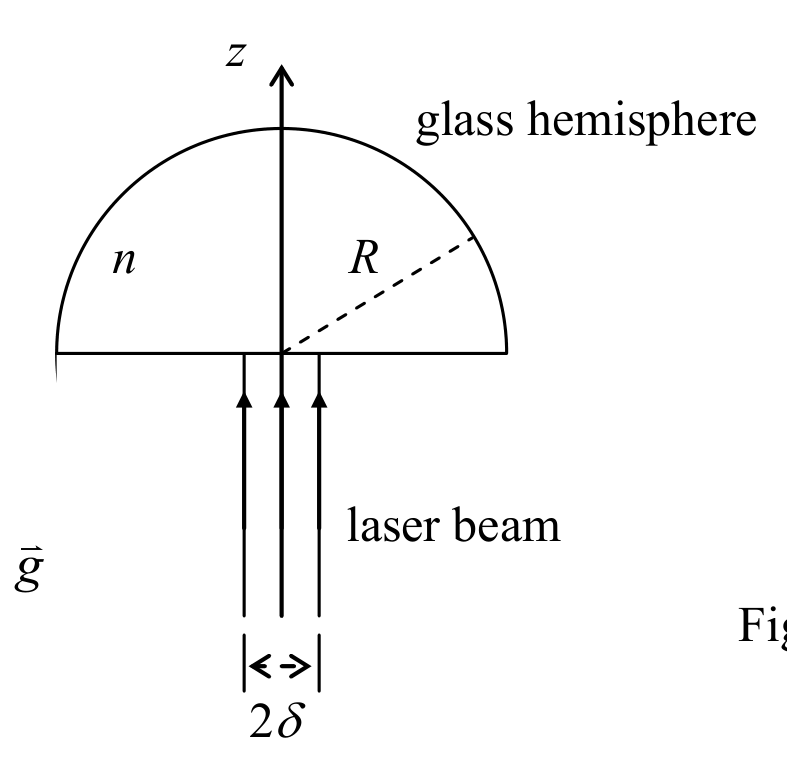
A transparent glass hemisphere with radius and mass has an index of refraction . In the medium outside the hemisphere, the index of refraction is equal to one. A parallel beam of monochromatic laser light is incident uniformly and normally onto the central portion of its planar surface, as shown in Figure 3. The acceleration of gravity is vertically downwards. The radius of the circular cross-section of the laser beam is much smaller than . Both the glass hemisphere and the laser beam are axially symmetric with respect to the -axis.
The glass hemisphere does not absorb any laser light. Its surface has been coated with a thin layer of transparent material so that reflections are negligible when light enters and leaves the glass hemisphere. The optical path traversed by laser light passing through the non-reflecting surface layer is also negligible.
(b) Neglecting terms of the order or higher, find the laser power needed to balance the weight of the glass hemisphere. (4.0 points)
Hint: when is much smaller than one.
Отговори
(a)
Official values: Emax ≈ 1.292569 MeV ≈ 1.29 MeV; vm/c ≈ 0.00126538 ≈ 0.00127.
(b)
Решение
Solution to Theoretical Question 3
Part A
Neutrino Mass and Neutron Decay
(a) Let , , and be the energy-momentum 4-vectors of the electron, the proton, and the anti-neutrino, respectively, in the rest frame of the neutron. Notice that are all in units of mass. The proton and the anti-neutrino may be considered as forming a system of total rest mass , total energy , and total momentum . Thus, we have
Note that the magnitude of the vector is denoted as . The same convention also applies to all other vectors.
Since energy and momentum are conserved in the neutron decay, we have
When squared, the last equation leads to the following equality
From Eq. (A4) and the third equality of Eq. (A1), we obtain
With its second and third terms moved to the other side of the equality, Eq. (A5) may be divided by Eq. (A2) to give
As a system of coupled linear equations, Eqs. (A2) and (A6) may be solved to give
Using Eq. (A8), the last equality in Eq. (A4) may be rewritten as
Eq. (A8) shows that a maximum of corresponds to a minimum of . Now the rest mass is the total energy of the proton and anti-neutrino pair in their center of mass (or momentum) frame so that it achieves the minimum
when the proton and the anti-neutrino are both at rest in the center of mass frame. Hence, from Eqs. (A8) and (A10), the maximum energy of the electron is
When Eq. (A10) holds, the proton and the anti-neutrino move with the same velocity of the center of mass and we have
where the last equality follows from Eq. (A3). By Eqs. (A7) and (A9), the last expression in Eq. (A12) may be used to obtain the speed of the anti-neutrino when . Thus, with , we have
[Alternative Solution]
Assume that, in the rest frame of the neutron, the electron comes out with momentum and energy , the proton with and , and the anti-neutrino with and . With the magnitude of vector denoted by the symbol , we have
Conservation of energy and momentum in the neutron decay leads to
When squared, the last two equations lead to
Subtracting Eq. (5A) from Eq. (4A) and making use of Eq. (1A) then gives
or, equivalently,
If is the angle between and , we have so that Eq. (7A) leads to the relation
Note that the equality in Eq. (8A) holds only if , i.e., the energy of the electron takes on its maximum value only when the anti-neutrino and the proton move in the same direction.
Let the speeds of the proton and the anti-neutrino in the rest frame of the neutron be and , respectively. We then have and . As shown in Fig. A1, we introduce the angle () for the antineutrino by
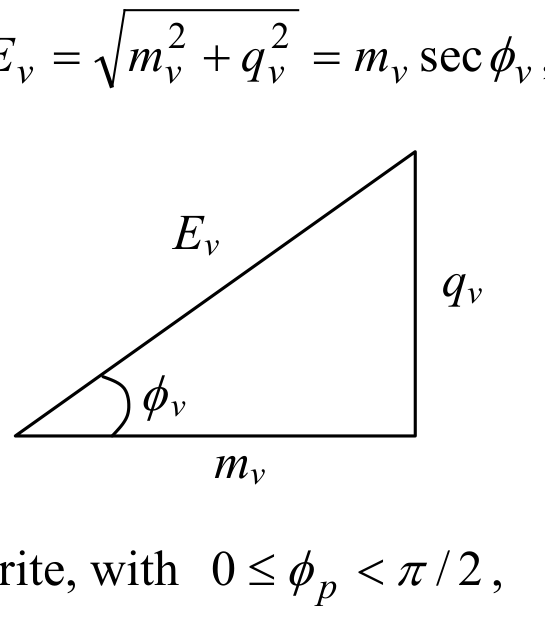
Similarly, for the proton, we write, with ,
Eq. (8A) may then be expressed as
The factor in parentheses at the end of the last equation may be expressed as
and clearly assumes its minimum possible value of 1 when , i.e., when the anti-neutrino and the proton move with the same velocity so that . Thus, it follows from Eq. (11A) that the maximum value of is
and the maximum energy of the electron is
When the anti-neutrino and the proton move with the same velocity, we have, from Eqs. (9A), (10A), (2A) ,(3A), and (1A), the result
Substituting the result of Eq. (13A) into the last equation, the speed of the anti-neutrino when the electron attains its maximum value is, with , given by
Part B
Light Levitation
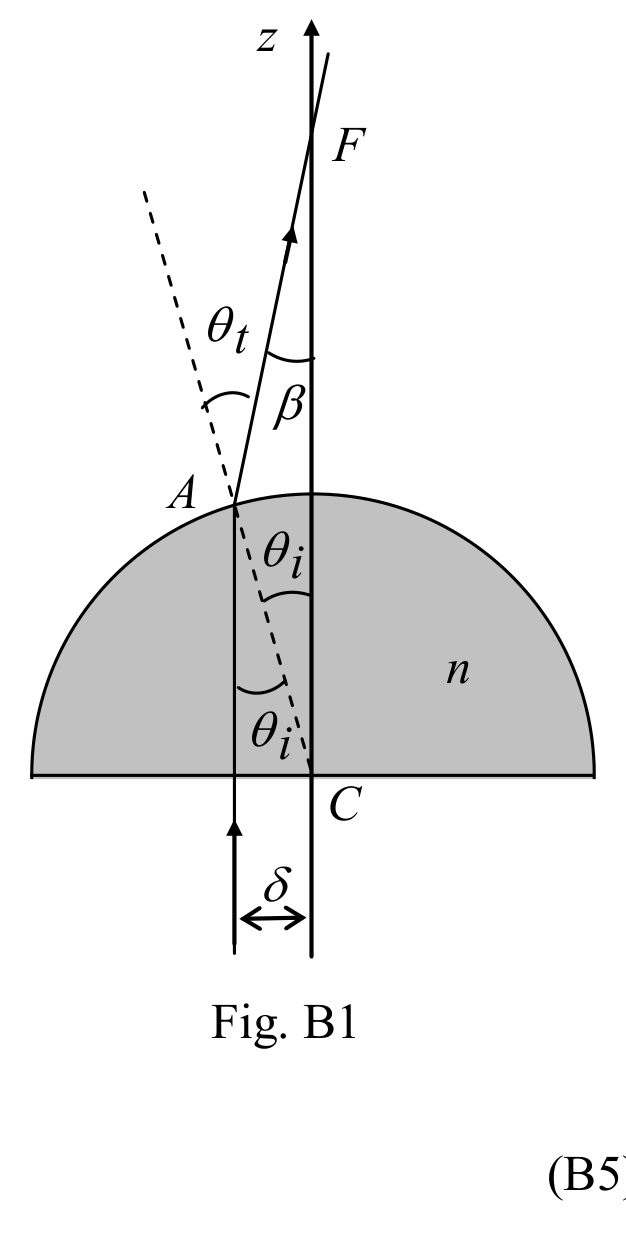
(b) Refer to Fig. B1. Refraction of light at the spherical surface obeys Snell’s law and leads to
Neglecting terms of the order or higher in sine functions, Eq. (B1) becomes
For the triangle in Fig. B1, we have
Let be the frequency of the incident light. If is the number of photons incident on the plane surface per unit area per unit time, then the total number of photons incident on the plane surface per unit time is . The total power of photons incident on the plane surface is , with being Planck’s constant. Hence,
The number of photons incident on an annular disk of inner radius and outer radius on the plane surface per unit time is , where . Therefore,
The -component of the momentum carried away per unit time by these photons when refracted at the spherical surface is
so that the -component of the total momentum carried away per unit time is
where . Therefore, by the result of Eq. (B5), we have
The force of optical levitation is equal to the sum of the -components of the forces exerted by the incident and refracted lights on the glass hemisphere and is given by
Equating this to the weight of the glass hemisphere, we obtain the minimum laser power required to levitate the hemisphere as
Marking Scheme
Theoretical Question 3
Neutrino Mass and Neutron Decay
| Total Scores | Sub Scores | Marking Scheme for Answers to the Problem |
|---|---|---|
| Part A | (a) | The maximum energy of the electron and the corresponding speed of the anti-neutrino. |
| 4.0 pts. | 4.0 | ➢ 0.5 use energy-momentum conservation and can convert it into equations. |
| ➢ 0.5 obtain an expression for that allows the determination of its maximum value. | ||
| ➢ (0.5+0.2) for concluding that proton and anti-neutrino must move with the same velocity when is maximum. (0.2 for the same direction) | ||
| ➢ 0.6 for establishing the minimum value of to be or a conclusion equivalent to it. | ||
| ➢ (0.5+0.1) for expression and value of . | ||
| ➢ 0.5 for concluding . | ||
| ➢ (0.5+0.1) for expression and value of . |
Light Levitation
| Total Scores | Sub Scores | Marking Scheme for Answers to the Problem |
|---|---|---|
| Part B | (b) | Laser power needed to balance the weight of the glass hemisphere. |
| 4.0 pts | 4.0 | ➢ 0.3 for law of refraction . |
| ➢ 0.3 for making the linear approximation . | ||
| ➢ 0.4 for relation between angles of deviation and incidence. | ||
| ➢ 0.3 for photon energy . | ||
| ➢ 0.3 for photon momentum . | ||
| ➢ 0.3 for momentum of incident photons per unit time = . | ||
| ➢ 0.6 for momentum of photons refracted per unit time as a function of the angle of incidence. | ||
| ➢ 0.4 for total momentum of photons refracted per unit time = . | ||
| ➢ 0.4 for force of levitation = sum of forces exerted by incident and refracted photons. | ||
| ➢ 0.4 for force of levitation = . | ||
| ➢ 0.3 for the needed laser power . |
[Answer Sheet] Theoretical Question 3
Wherever requested, give each answer as analytical expressions followed by numerical values and units. For example: area of a circle .
Neutrino Mass and Neutron Decay
(a) (Give expressions in terms of rest masses of the particles and the speed of light)
The maximum energy of the electron is (expression and value)
The ratio of anti-neutrino’s speed at to is (expression and value)
Light Levitation
(b) The laser power needed to balance the weight of the glass hemisphere is
Оригинал в Архива: 3.pdf · официални решения: 3_sol.pdf · допълнителни данни: IPhO_2003_Theoretical Question 3.pdf · допълнителни данни: IPhO_2003_Theoretical Solution 3.pdf