IPhO 2004, Теория — Задача 1. “Ping-Pong” Resistor
Theoretical Question 1: “Ping-Pong” Resistor · 10 т.
Внимание: Бележка към темата
И двете налични архивни издания съдържат една и съща цяла задача с шест свързани подусловия и пълно решение с отговори, алтернативни методи и таблица за оценяване. Печатните несъответствия са запазени: χ е отрицателно в отговор (b), но по-нататък се използва под квадратен корен; в (e13) е отпечатано αV, а етикетите (f21) и (f22) се повтарят. Това са особености на оригиналното решение, а не поправени физични резултати.
Условие
A capacitor consists of two circular parallel plates both with radius separated by distance , where , as shown in Fig. 1.1(a). The top plate is connected to a constant voltage source at a potential while the bottom plate is grounded. Then a thin and small disk of mass with radius () and thickness () is placed on the center of the bottom plate, as shown in Fig. 1.1(b).
Let us assume that the space between the plates is in vacuum with the dielectric constant ; the plates and the disk are made of perfect conductors; and all the electrostatic edge effects may be neglected. The inductance of the whole circuit and the relativistic effects can be safely disregarded. The image charge effect can also be neglected.
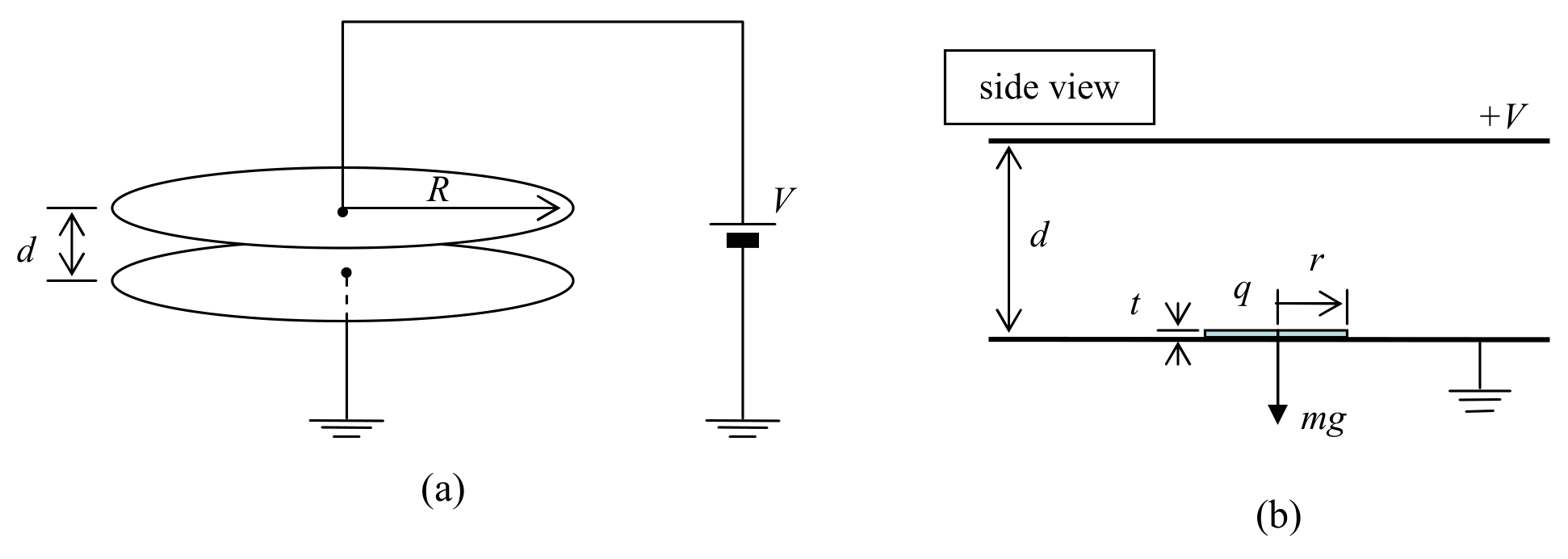
(a) [1.2 points] Calculate the electrostatic force between the plates separated by before inserting the disk in-between as shown in Fig. 1.1(a).
(b) [0.8 points] When the disk is placed on the bottom plate, a charge on the disk of Fig. 1.1(b) is related to the voltage by . Find in terms of , , and .
(c) [0.5 points] The parallel plates lie perpendicular to a uniform gravitational field . To lift up the disk at rest initially, we need to increase the applied voltage beyond a threshold voltage . Obtain in terms of , , , and .
(d) [2.3 points] When , the disk makes an up-and-down motion between the plates. (Assume that the disk moves only vertically without any wobbling.) The collisions between the disk and the plates are inelastic with the restitution coefficient , where and are the speeds of the disk just before and after the collision respectively. The plates are stationarily fixed in position. The speed of the disk just after the collision at the bottom plate approaches a “steady-state speed” , which depends on as follows:
Obtain the coefficients and in terms of , , , , and . Assume that the whole surface of the disk touches the plate evenly and simultaneously so that the complete charge exchange happens instantaneously at every collision.
(e) [2.2 points] After reaching its steady state, the time-averaged current through the capacitor plates can be approximated by when . Express the coefficient in terms of , , , and .
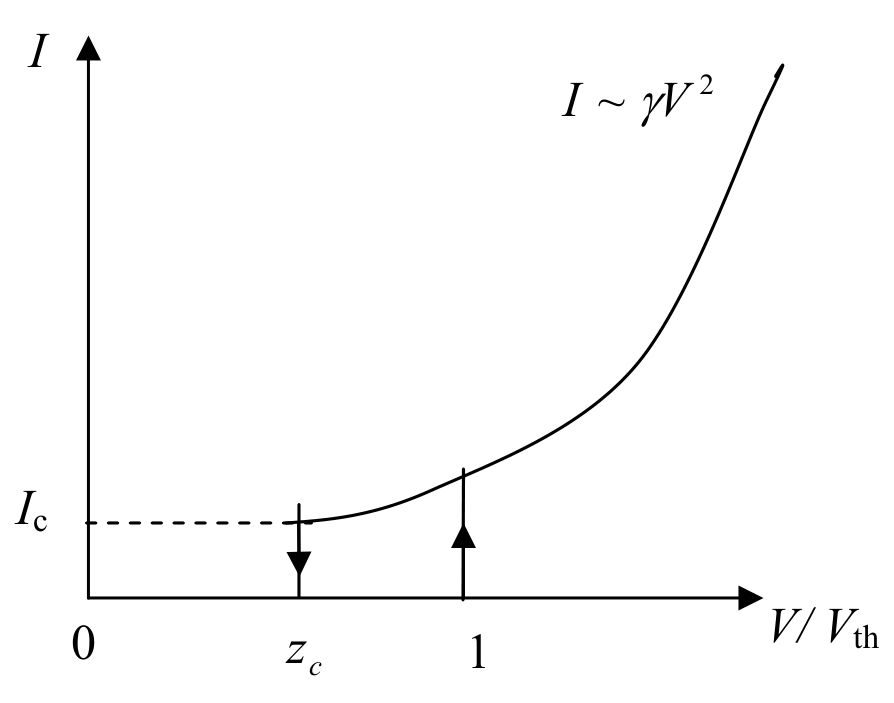
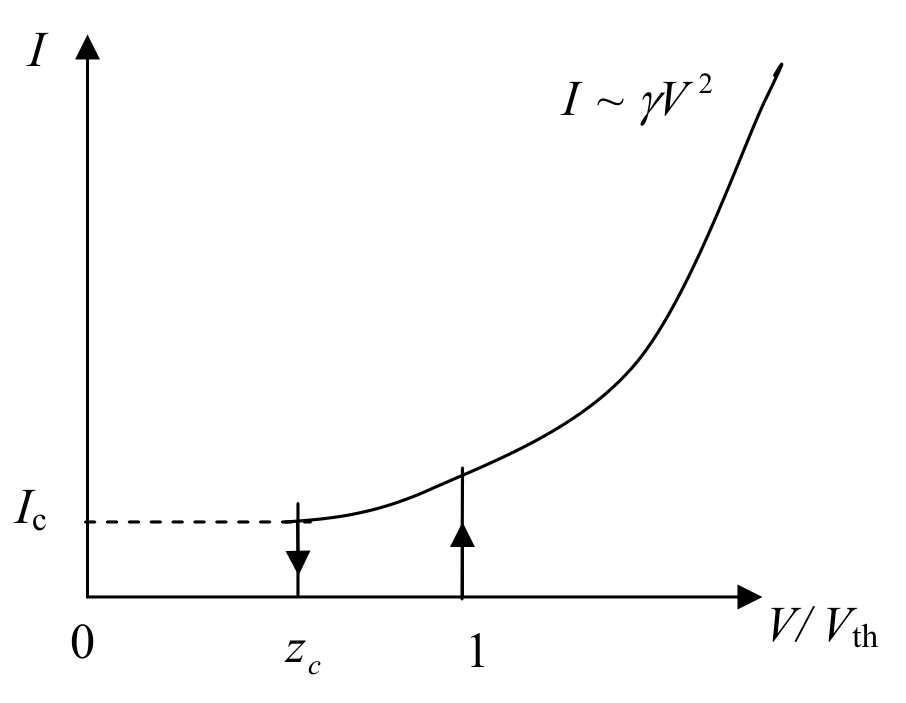
(f) [3 points] When the applied voltage is decreased (extremely slowly), there exists a critical voltage below which the charge will cease to flow. Find and the corresponding current in terms of , , , , and . By comparing with the lift-up threshold discussed in (c), make a rough sketch of the characteristics when is increased and decreased in the range from to .
Отговори
(a)
The official answer names this force .
(b)
(c)
(d)
(e)
(f)
The official solution also gives the I–V sketch: the current jumps up at when V is increased and drops to zero at when V is decreased; asymptotically .
Решение
1. Answers
(a)
(b)
(c)
(d)
(e)
(f)
2. Solutions
(a) [1.2 points]
The charge induced by the external bias voltage can be obtained by applying the Gauss law:
where .
The energy stored in the capacitor:
The force acting on the plate, when the bias voltage is kept constant:
[An alternative solution:]
Since the electric field acting on one plate should be generated by the other plate and its magnitude is
the force acting on the plate can be obtained by
(b) [0.8 points]
The charge on the small disk can also be calculated by applying the Gauss law:
Since one side of the small disk is in contact with the plate,
Alternatively, one may use the area ratio for .
(c) [0.5 points]
The net force, , acting on the small disk should be a sum of the gravitational and electrostatic forces:
The gravitational force: .
The electrostatic force can be derived from the result of (a) above:
In order for the disk to be lifted, one requires :
(d) [2.3 points]
Let be the steady velocity of the small disk just after its collision with the bottom plate. Then the steady-state kinetic energy of the disk just above the bottom plate is given by
For each round trip, the disk gains electrostatic energy by
For each inelastic collision, the disk lose its kinetic energy by
Since is the energy after the collision at the bottom plate and is the energy before the collision at the top plate, the total energy loss during the round trip can be written in terms of :
In its steady state, should be compensated by .
Rearranging Eq. (d5), we have
Therefore,
Comparing with the form:
[An alternative solution:]
Let be the velocity of the small disk just after n-th collision with the bottom plate. Then the kinetic energy of the disk just above the bottom plate is given by
When it reaches the top plate, the disk gains energy by the increase of potential energy:
Thus, the kinetic energy just before its collision with the top plate becomes
Since , the kinetic energy after the collision with the top plate becomes scaled down by a factor of :
Now the potential energy gain by the downward motion is:
so that the kinetic energy just before it collides with the bottom plate becomes:
Again, due to the loss of energy by the collision with the bottom plate, the kinetic energy after its -th collision can be obtained by
As , we expect the velocity , that is, :
(e) [2.2 points]
The amount of charge carried by the disk during its round trip between the plates is , and the time interval , where () is the time spent during the up- (down-) ward motion respectively.
Here () can be determined by
where () is the initial velocity at the bottom (top) plate and () is the up- (down-) ward acceleration respectively.
Since the force acting on the disk is given by
in the limit of , can be approximated by
which implies that the upward and down-ward motion should be symmetric. Thus, Eq.(e1) can be described by a single equation with , , and . Moreover, since the speed of the disk just after the collision should be the same for the top- and bottom-plates, one can deduce the relation:
from which we obtain the time interval ,
From Eq. (d6), in the limit of , we have
By substituting the results of Eqs. (e3) and (e6), we get
Therefore, from ,
[Alternative solution #1:]
Starting from Eq. (e3), we can solve the quadratic equation of Eq. (e1) so that
When it reaches the steady state, the initial velocities are given by
where can be rewritten by using the result of Eq. (e6),
As a result, we get and consequently , which is equivalent to Eq. (e4).
[Alternative solution #2:]
The current can be obtained from
where is an average velocity. Since the up and down motions are symmetric with the same constant acceleration in the limit of ,
Thus, we have
Inserting the expression (Eq. (e15)) of into Eq. (e16), one obtains an expression identical to Eq. (e8).
(f) [3 points]
The disk will lose its kinetic energy and eventually cease to move when the disk can not reach the top plate. In other words, the threshold voltage can be determined from the condition that the velocity of the disk at the top plate is zero, i.e., .
In order for the disk to have at the top plate, the kinetic energy at the top plate should satisfy the relation:
where is the steady-state kinetic energy at the bottom plate after the collision. Therefore, we have
or equivalently,
From the relation ,
In comparison with the threshold voltage of Eq. (c4), we can rewrite Eq. (f5) by
where should be used in the plot of vs. and
[Note that an alternative derivation of Eq. (f1) is possible if one applies the energy compensation condition of Eq. (d5) or the recursion relation of Eq. (d17) at the top plate instead of the bottom plate.]
Now we can setup equations to determine the time interval :
where the accelerations are given by
Since , we have and .
By using , we can solve the quadratic equation of Eq. (f9):
[A more elaborate Solution:]
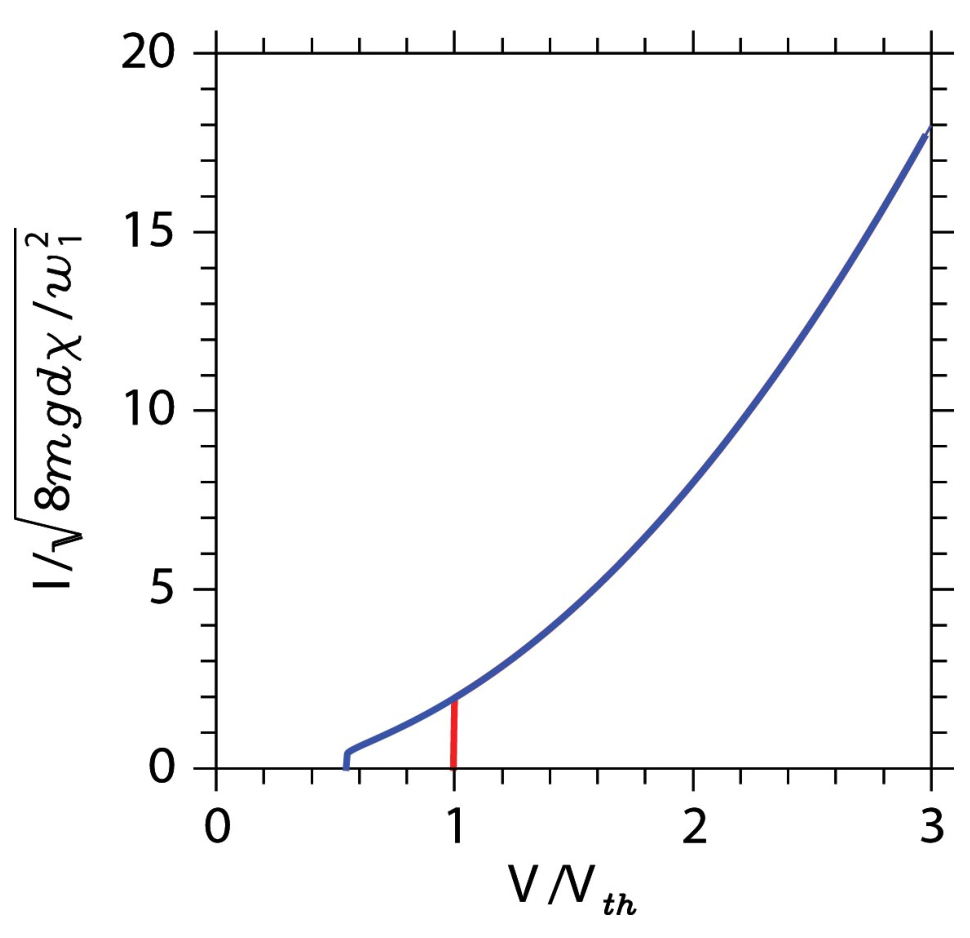
One may find a general solution for an arbitrary value of . By solving the quadratic equations of Eqs. (f8) and (f9), we have
(It is noted that one has to keep the smaller positive root.)
To simplify the notation, we introduce a few variables:
(i) where ,
(ii) , which is defined in Eq. (f7),
(iii) and ,
In terms of , , and ,
where
3. Mark Distribution
| No. | Total Pt. | Partial Pt. | Contents | |
|---|---|---|---|---|
| (a) | 1.2 | 0.3 | Gauss law, or a formula for the capacitance of a parallel plate | |
| 0.5 | Total energy of a capacitor at | = electrical field by the other plate | ||
| 0.4 | Force from the energy expression | |||
| (b) | 0.8 | 0.3 | Gauss law | Use of area ratio and result of (a) |
| 0.5 | Correct answer | |||
| (c) | 0.5 | 0.1 | Correct lift-up condition with force balance | |
| 0.2 | Use of area ratio and result of (a) | |||
| 0.2 | Correct answer | |||
| (d) | 2.3 | 0.5 | Energy conservation and the work done by the field | |
| 0.5 | Loss of energy due to collisions | |||
| 0.8 | Condition for the steady state: energy balance equation (loss = gain) | Condition for the steady state: recursion relation | ||
| 0.5 | Correct answer | |||
| (e) | 2.2 | 0.2 | per trip | |
| 0.5 | Acceleration in the limit of ; by symmetry | |||
| 0.3 | Kinetic equations for , , , and , solutions for | By using the symmetry, derive the relation (e4) | ||
| 0.4 | Expression of and in its steady state | |||
| 0.4 | Solutions of in approximation | |||
| 0.4 | Correct answer | |||
| (f) | 3.0 | 0.5 | Condition for ; or | Using (d8), Recursion relations |
| 0.3 | energy balance equation | |||
| 0.3 | Correct answer of | |||
| 0.7 | Kinetic equations for | |||
| 0.3 | Correct answer of | |||
| 0.9 | Distinction between and , the asymptotic behavior in plots | |||
| Total | 10 |
Оригинал в Архива: 1.pdf · официални решения: 1_sol.pdf · допълнителни данни: IPhO_2004_Theoretical Question 1.pdf · допълнителни данни: IPhO_2004_Theo_solution 1.pdf