IPhO 2004, Теория — Задача 2. Rising Balloon
Theoretical Question 2: Rising Balloon · 10 т.
Условие
A rubber balloon filled with helium gas goes up high into the sky where the pressure and temperature decrease with height. In the following questions, assume that the shape of the balloon remains spherical regardless of the payload, and neglect the payload volume. Also assume that the temperature of the helium gas inside of the balloon is always the same as that of the ambient air, and treat all gases as ideal gases. The universal gas constant is =8.31 J/mol·K and the molar masses of helium and air are kg/mol and = kg/mol, respectively. The gravitational acceleration is m/s.
[Part A ]
(a) Let the pressure of the ambient air be and the temperature be . The pressure inside of the balloon is higher than that of outside due to the surface tension of the balloon. The balloon contains moles of helium gas and the pressure inside is . Find the buoyant force acting on the balloon as a function of and . [1,5 т.]
(b) On a particular summer day in Korea, the air temperature at the height from the sea level was found to be in the range of km with =49 km and =303 K. The pressure and density at the sea level were = 1.0 atm = Pa and = 1.16 kg/m, respectively. For this height range, the pressure takes the form
Express in terms of , , , and , and find its numerical value to the two significant digits. Treat the gravitational acceleration as a constant, independent of height. [2 т.]
[Part B ]
When a rubber balloon of spherical shape with un-stretched radius is inflated to a sphere of radius (), the balloon surface contains extra elastic energy due to the stretching. In a simplistic theory, the elastic energy at constant temperature can be expressed by
where () is the size-inflation ratio and is a constant in units of mol/m.
(c) Express in terms of parameters given in Eq. (2.2), and sketch as a function of . [2 т.]
(d) The constant can be determined from the amount of the gas needed to inflate the balloon. At =303 K and =1.0 atm = Pa, an un-stretched balloon () contains =12.5 moles of helium. It takes =3.6 =45 moles in total to inflate the balloon to =1.5 at the same and . Express the balloon parameter , defined as , in terms of , , and , where . Evaluate to the two significant digits. [1,5 т.]
[Part C]
A balloon is prepared as in (d) at the sea level (inflated to with moles of helium gas at =303 K and =1 atm= Pa). The total mass including gas, balloon itself, and other payloads is kg. Now let the balloon rise from the sea level.
(e) Suppose that the balloon eventually stops at the height where the buoyant force balances the total weight. Find and the inflation ratio at that height. Give the answers in two significant digits. Assume there are no drift effect and no gas leakage during the upward flight. [3 т.]
Отговори
(a)
(b)
The official solution writes the exponent as γ, while the problem statement calls it η.
(c)
(d)
(e)
Решение
1. Answers
(a)
(b)
(c)
(d) =0.110
(e) =11 km, =2.1.
2. Solutions
[Part A]
(a) [1.5 points]
Using the ideal gas equation of state, the volume of the helium gas of moles at pressure and temperature is
while the volume of moles of air gas at pressure and temperature is
Thus the balloon displaces moles of air whose weight is .
This displaced air weight is the buoyant force, i.e.,
(Partial credits for subtracting the gas weight.)
(b) [2 points]
The pressure difference arising from a height difference of is when the air density is a constant. When it varies as a function of the height, we have
where the ideal gas law = constant is used. Inserting Eq. (2.1) and on both sides of Eq. (b1), and comparing the two, one gets
The required numerical value is 5.5.
[Part B]
(c) [2 points]
The work needed to increase the radius from to under the pressure difference is
while the increase of the elastic energy for the same change of is
Equating the two expressions of , one gets
This is the required answer.
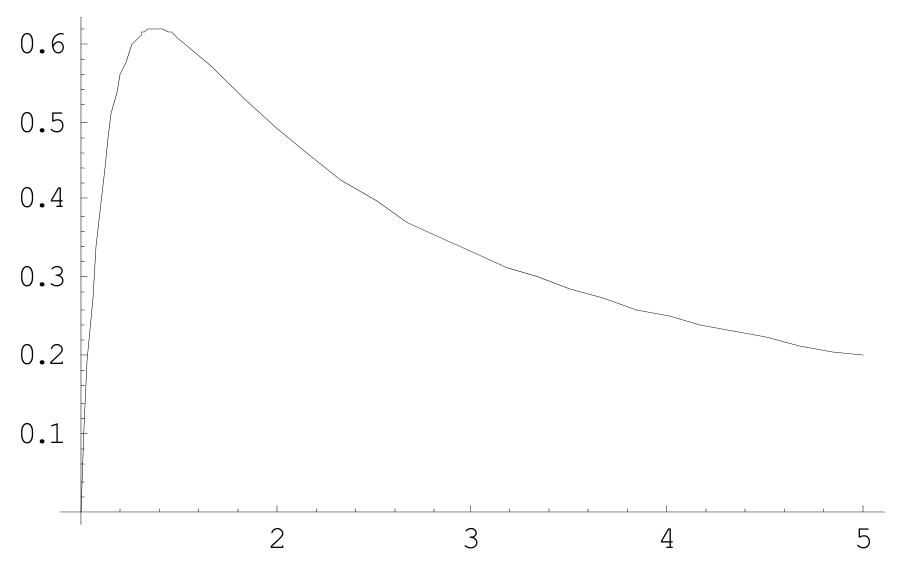
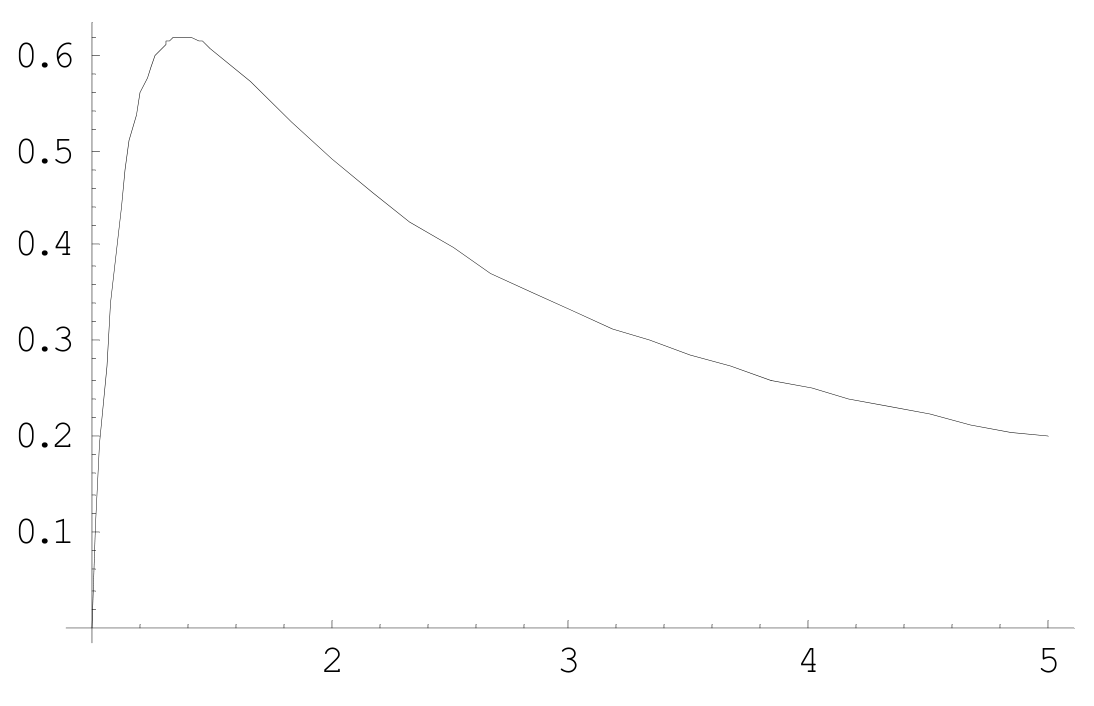
The graph as a function of (>1) increases sharply initially, has a maximum at =1.38, and decreases as for large . The plot of is given below.
(d) [1.5 points]
From the ideal gas law,
where is the unstretched volume.
At volume containing moles, the ideal gas law applied to the gas inside at gives the inside pressure as
On the other hand, the result of (c) at gives
Equating (d2) and (d3) to solve for ,
Inserting =3.6 and =1.5 here, =0.110.
[Part C]
(e) [3 points]
The buoyant force derived in problem (a) should balance the total mass of =1.12 kg. Thus, from Eq. (a3), at the weight balance,
On the other hand, applying again the ideal gas law to the helium gas inside of volume , for arbitrary ambient and , one has
for moles of helium. Eqs. (c3), (e1), and (e2) determine the three unknowns , , and as a function of and other parameters. Using Eq. (e2) in Eq. (e1), one has an alternative condition for the weight balance as
Next using (c3) for in (e2), one has
or, rearranging it,
where the definition of has been used again.
Equating the right hand sides of Eqs. (e3) and (e4), one has the equation for as
The solution for can be obtained by
To find the height, replace on the left hand side of Eq. (e3) as a function of the height given in (b) as
Solution of Eq. (e7) for with =2.13 and =4.5 is
The required answers are , and km.
3. Mark Distribution
| No. | Total Pt. | Partial Pt. | Contents |
|---|---|---|---|
| (a) | 1.5 | 0.5 | Archimedes’ principle |
| 0.5 | Ideal gas law applied correctly | ||
| 0.5 | Correct answer (partial credits 0.3 for subtracting He weight) | ||
| (b) | 2.0 | 0.8 | Relation of pressure difference to air density |
| 0.5 | Application of ideal gas law to convert the density into pressure | ||
| 0.5 | Correct formula for | ||
| 0.2 | Correct number in answer | ||
| (c) | 2.0 | 0.7 | Relation of mechanical work to elastic energy change |
| 0.3 | Relation of pressure to force | ||
| 0.5 | Correct answer in formula | ||
| 0.5 | Correct sketch of the curve | ||
| (d) | 1.5 | 0.3 | Use of ideal gas law for the increased pressure inside |
| 0.4 | Expression of inside pressure in terms of at the given conditions | ||
| 0.5 | Formula or correct expression for | ||
| 0.3 | Correct answer | ||
| (e) | 3.0 | 0.3 | Use of force balance as one condition to determine unknowns |
| 0.3 | Ideal gas law applied to the gas as an independent condition to determine unknowns | ||
| 0.5 | The condition to determine numerically | ||
| 0.7 | Correct answer for | ||
| 0.5 | The relation of versus | ||
| 0.7 | Correct answer for | ||
| Total | 10 |