IPhO 2004, Теория — Задача 3. Atomic Probe Microscope
Theoretical Question 3: Atomic Probe Microscope · 10 т.
Условие
Atomic probe microscopes (APMs) are powerful tools in the field of nano-science. The motion of a cantilever in APM can be detected by a photo-detector monitoring the reflected laser beam, as shown in Fig. 3.1. The cantilever can move only in the vertical direction and its displacement as a function of time can be described by the equation
where is the cantilever mass, is the spring constant of the cantilever, is a small damping coefficient satisfying , and finally is an external driving force of the piezoelectric tube.
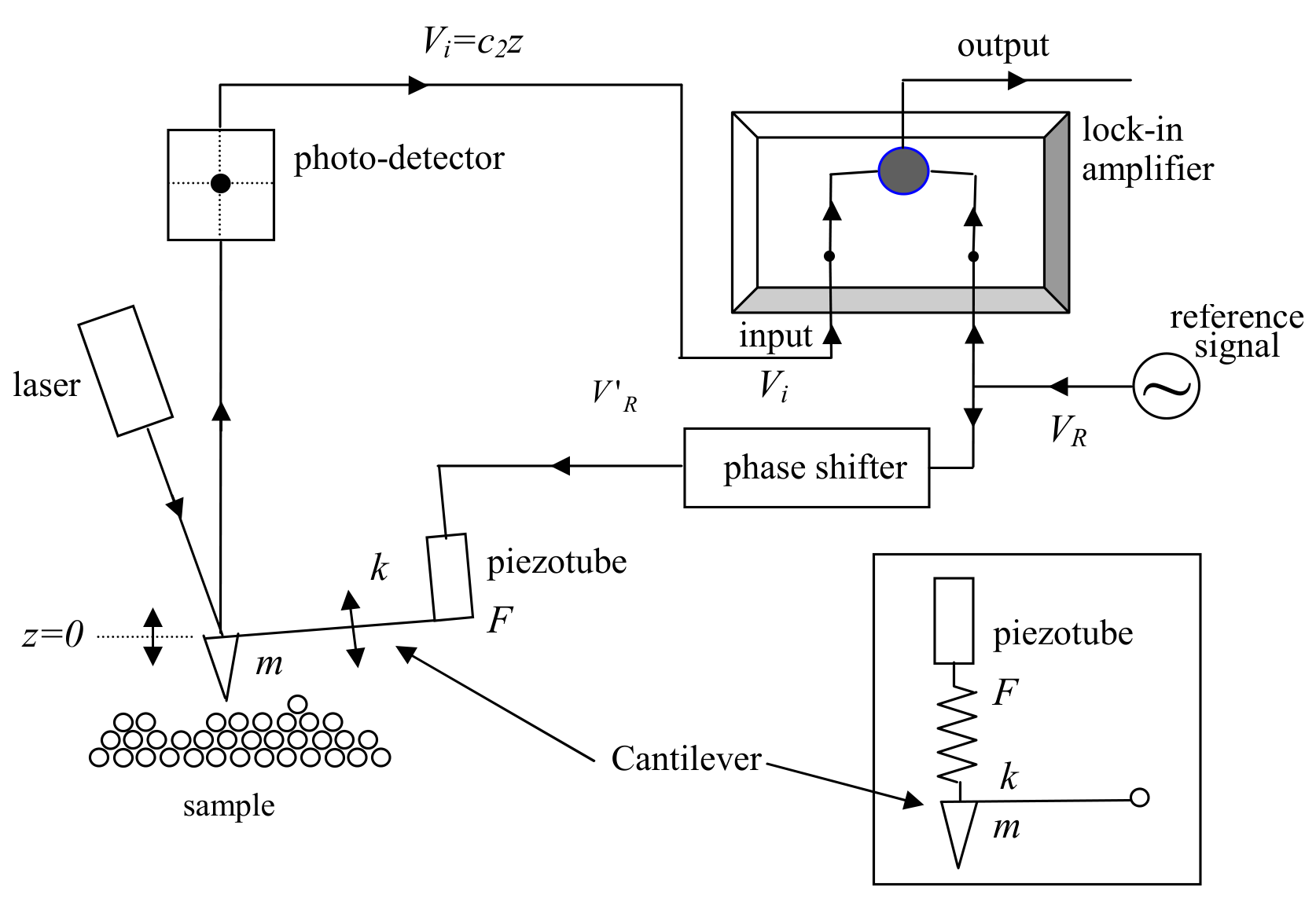
[Part A]
(a) [1.5 points] When , satisfying Eq. (3.1) can be written as , where and . Find the expression of the amplitude and in terms of , , , , and . Obtain and the phase at the resonance frequency .
(b) [1 point] A lock-in amplifier shown in Fig.3.1 multiplies an input signal by the lock-in reference signal, , and then passes only the dc (direct current) component of the multiplied signal. Assume that the input signal is given by . Here , , , and are all positive given constants. Find the condition on () for a non-vanishing output signal. What is the expression for the magnitude of the non-vanishing dc output signal at this frequency?
(c) [1.5 points] Passing through the phase shifter, the lock-in reference voltage changes to . , applied to the piezoelectric tube, drives the cantilever with a force . Then, the photo-detector converts the displacement of the cantilever, , into a voltage . Here and are constants. Find the expression for the magnitude of the dc output signal at .
(d) [2 points] The small change of the cantilever mass shifts the resonance frequency by . As a result, the phase at the original resonance frequency shifts by . Find the mass change corresponding to the phase shift , which is a typical resolution in phase measurements. The physical parameters of the cantilever are given by , , and . Use the approximations and when .
[Part B]
From now on let us consider the situation that some forces, besides the driving force discussed in Part A, act on the cantilever due to the sample as shown in Fig.3.1.
(e) [1.5 points] Assuming that the additional force depends only on the distance between the cantilever and the sample surface, one can find a new equilibrium position . Near , we can write , where is a constant in . Find the new resonance frequency in terms of , , and .
(f) [2.5 points] While scanning the surface by moving the sample horizontally, the tip of the cantilever charged with encounters an electron of charge trapped (localized in space) at some distance below the surface. During the scanning around the electron, the maximum shift of the resonance frequency is observed to be much smaller than . Express the distance from the cantilever to the trapped electron at the maximum shift in terms of , , , , , and the Coulomb constant . Evaluate in nm () for .
The physical parameters of the cantilever are and . Disregard any polarization effect in both the cantilever tip and the surface. Note that and .
Отговори
(a)
The answers section of the official solutions prints ; the derivation (Eq. a3) has in the numerator.
(b)
(c)
(d) kg
(e)
(f) 41 nm
Решение
Theoretical Question 3: Scanning Probe Microscope
1. Answers
(a) and . At , and .
(b) A non-vanishing dc component exists only when .
In this case the amplitude of the dc signal will be .
(c) at the resonance frequency .
(d) .
(e) .
(f)
.
2. Solutions
(a) [1.5 points]
Substituting in the equation yields,
Collecting terms proportional to and , one obtains
Zeroing the each curly square bracket produces
At ,
(b) [1 point]
The multiplied signal is
A non-vanishing dc component exists only when . In this case the amplitude of the dc signal will be
(c) [1.5 points]
Since the lock-in amplifier measures the ac signal of the same frequency with its reference signal, the frequency of the piezoelectric tube oscillation, the frequency of the cantilever, and the frequency of the photodiode detector should be same. The magnitude of the input signal at the resonance is
Then, since the phase of the input signal is at the resonance, and the lock-in amplifier signal is
(d) [2 points]
The original resonance frequency is shifted to
Thus
Near the resonance, by substituting and in Eq. (a3), the change of the phase due to the small change of (not the change of ) is
Therefore,
From Eqs. (d2) and (d4),
(e) [1.5 points]
In the presence of interaction, the equation of motion near the new equilibrium position becomes
where we used with being the displacement from the new equilibrium position . Note that the constant term is cancelled at the new equilibrium position.
Thus the original resonance frequency will be shifted to
Hence the resonance frequency shift is given by
(f) [2.5 points]
The maximum shift occurs when the cantilever is on top of the charge, where the interacting force is given by
From this,
Since , we can approximate Eq. (e4) as
From Eqs. (f2) and (f3), we have
Here Coulomb and Coulomb. Using the values provided,
Thus the trapped electron is 41 nm from the cantilever.
3. Mark Distribution
| No. | Total Pt. | Partial Pt. | Contents |
|---|---|---|---|
| (a) | 1.5 | 0.7 | Equations for and (substitution and manipulation) |
| 0.4 | Correct answers for and | ||
| 0.4 | and at | ||
| (b) | 1.0 | 0.4 | Equation for the multiplied signal |
| 0.3 | Condition for the non-vanishing dc output | ||
| 0.3 | Correct answer for the dc output | ||
| (c) | 1.5 | 0.6 | Relation between and |
| 0.4 | Condition for the maximum dc output | ||
| 0.5 | Correct answer for the magnitude of dc output | ||
| (d) | 2.0 | 0.5 | Relation between and |
| 1.0 | Relations between (or ) and | ||
| 0.5 | Correct answer (Partial credit of 0.2 for the wrong sign.) | ||
| (e) | 1.5 | 1.0 | Modification of the equation with and use of a proper approximation for the equation |
| 0.5 | Correct answer | ||
| (f) | 2.5 | 0.5 | Use of a correct formula of Coulomb force |
| 0.3 | Evaluation of | ||
| 0.6 | Use of the result in (e) for either or | ||
| 0.6 | Expression for | ||
| 0.5 | Correct answer | ||
| Total | 10 |