IPhO 2005, Теория — Задача 1. AN ILL FATED SATELLITE
36th International Physics Olympiad. Salamanca (España) 2005 — Th 1 AN ILL FATED SATELLITE
Условие
The most frequent orbital manoeuvres performed by spacecraft consist of velocity variations along the direction of flight, namely accelerations to reach higher orbits or brakings done to initiate re-entering in the atmosphere. In this problem we will study the orbital variations when the engine thrust is applied in a radial direction.
To obtain numerical values use: Earth radius , Earth surface gravity , and take the length of the sidereal day to be .
We consider a geosynchronous communications satellite of mass placed in an equatorial circular orbit of radius . These satellites have an “apogee engine” which provides the tangential thrusts needed to reach the final orbit.
Marks are indicated at the beginning of each subquestion, in parenthesis.
Question 1
1.1 (0.3) Compute the numerical value of . [0,3 т.]
1.2 (0.3+0.1) Give the analytical expression of the velocity of the satellite as a function of , , and , and calculate its numerical value. [0,4 т.]
1.3 (0.4+0.4) Obtain the expressions of its angular momentum and mechanical energy , as functions of , , and . [0,8 т.]
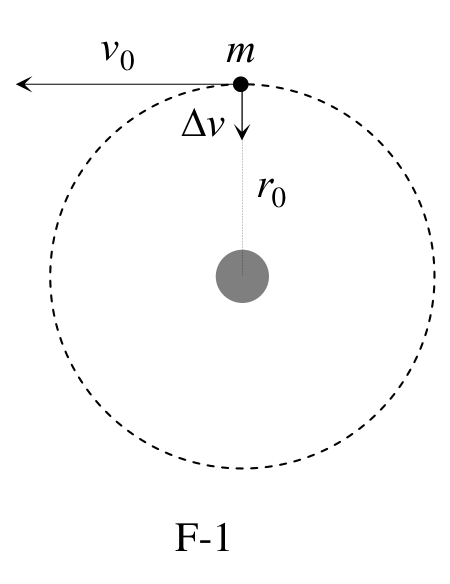
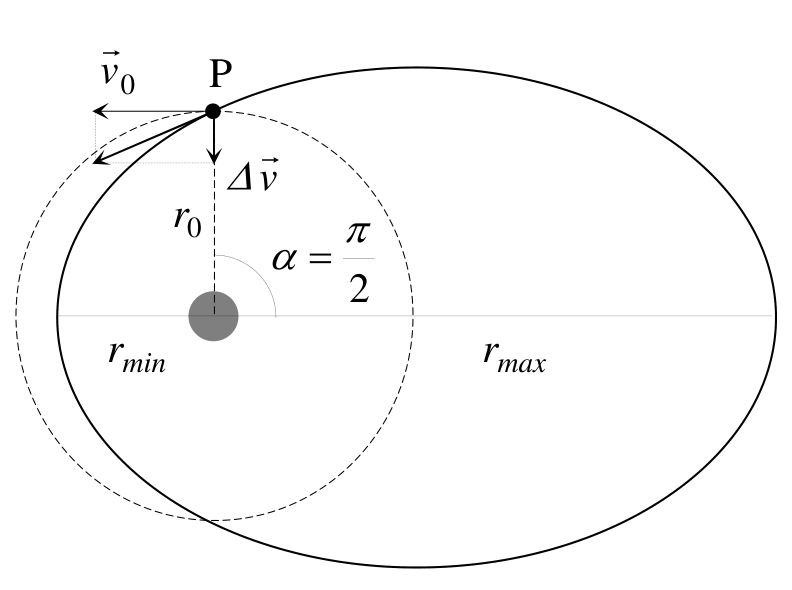
Once this geosynchronous circular orbit has been reached (see Figure F-1), the satellite has been stabilised in the desired location, and is being readied to do its work, an error by the ground controllers causes the apogee engine to be fired again. The thrust happens to be directed towards the Earth and, despite the quick reaction of the ground crew to shut the engine off, an unwanted velocity variation is imparted on the satellite. We characterize this boost by the parameter . The duration of the engine burn is always negligible with respect to any other orbital times, so that it can be considered as instantaneous.
Question 2
Suppose .
2.1 (0.4+0.5) Determine the parameters of the new orbit, semi-latus-rectum and eccentricity , in terms of and . [0,9 т.]
2.2 (1.0) Calculate the angle between the major axis of the new orbit and the position vector at the accidental misfire. [1 т.]
2.3 (1.0+0.2) Give the analytical expressions of the perigee and apogee distances to the Earth centre, as functions of and , and calculate their numerical values for . [1,2 т.]
2.4 (0.5+0.2) Determine the period of the new orbit, , as a function of and , and calculate its numerical value for . [0,7 т.]
Its revolution period is .
See the “hint”.
Question 3
3.1 (0.5) Calculate the minimum boost parameter, , needed for the satellite to escape Earth gravity. [0,5 т.]
3.2 (1.0) Determine in this case the closest approach of the satellite to the Earth centre in the new trajectory, , as a function of . [1 т.]
Question 4
Suppose .
4.1 (1.0) Determine the residual velocity at the infinity, , as a function of and . [1 т.]
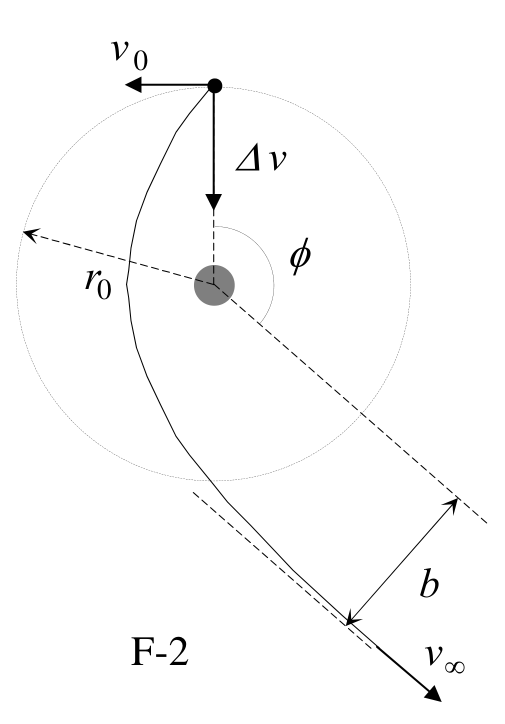
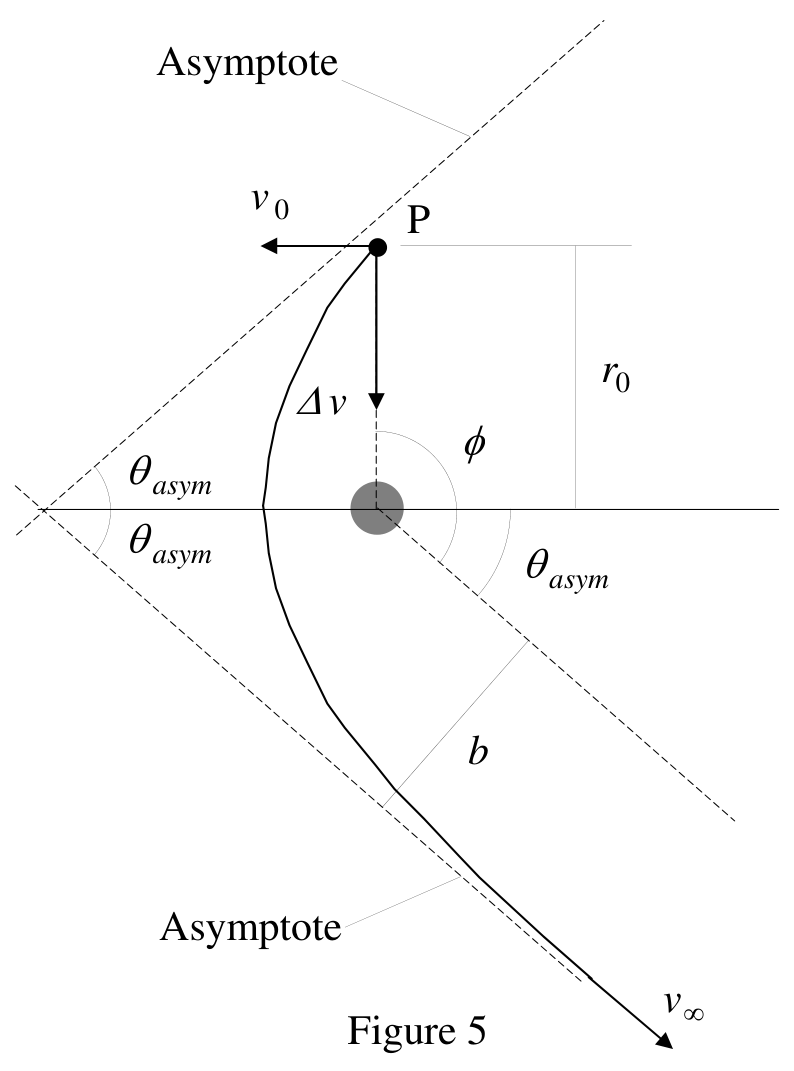
4.2 (1.0) Obtain the “impact parameter” of the asymptotic escape direction in terms of and . (See Figure F-2). [1 т.]
4.3 (1.0+0.2) Determine the angle of the asymptotic escape direction in terms of . Calculate its numerical value for . [1,2 т.]
HINT
Under the action of central forces obeying the inverse-square law, bodies follow trajectories described by ellipses, parabolas or hyperbolas. In the approximation the gravitating mass is at one of the focuses. Taking the origin at this focus, the general polar equation of these curves can be written as (see Figure F-3)
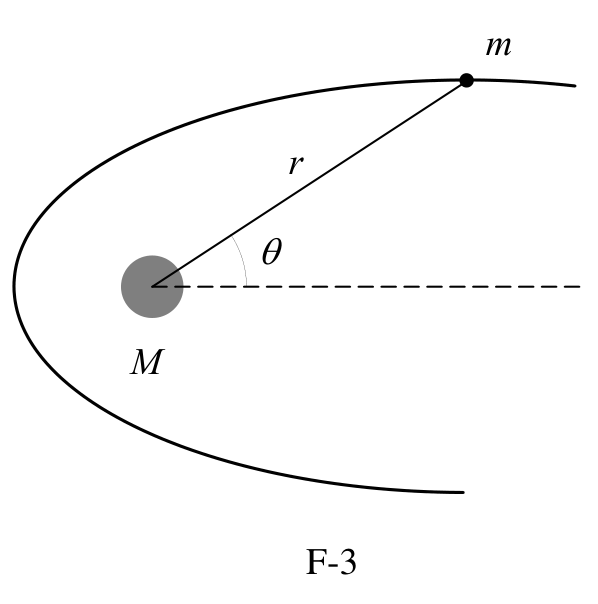
where is a positive constant named the semi-latus-rectum and is the eccentricity of the curve. In terms of constants of motion:
where is the Newton constant, is the modulus of the angular momentum of the orbiting mass, with respect to the origin, and is its mechanical energy, with zero potential energy at infinity.
We may have the following cases:
i) If , the curve is an ellipse (circumference for ).
ii) If , the curve is a parabola.
iii) If , the curve is a hyperbola.
| COUNTRY CODE | STUDENT CODE | PAGE NUMBER | TOTAL No OF PAGES |
|---|---|---|---|
Th 1 ANSWER SHEET
| Question | Basic formulas and ideas used | Analytical results | Numerical results | Marking guideline |
|---|---|---|---|---|
| 1.1 | 0.3 | |||
| 1.2 | 0.4 | |||
| 1.3 | ; | 0.4; 0.4 | ||
| 2.1 | ; | 0.4; 0.5 | ||
| 2.2 | 1.0 | |||
| 2.3 | ; | ; | 1.2 | |
| 2.4 | 0.7 | |||
| 3.1 | 0.5 | |||
| 3.2 | 1.0 | |||
| 4.1 | 1.0 | |||
| 4.2 | 1.0 | |||
| 4.3 | 1.2 |
Отговори
- Final results of every sub-question are listed in the official answer sheet (solutions page 5) and in the part answers.
- 1.1 m
- 1.2 ≈ m/s
- 1.3
- 2.1
- 2.2
- 2.3
- 2.4 ≈ h
- 3.1 1
- 3.2
- 4.1
- 4.2
- 4.3
Решение
1.1 and 1.2
1.3
2.1
The value of the semi-latus-rectum is obtained taking into account that the orbital angular momentum is the same in both orbits. That is
The eccentricity value is
where is the new satellite mechanical energy
that is
Combining both, one gets
This is an elliptical trajectory because .
2.2
The initial and final orbits cross at P, where the satellite engine fired instantaneously (see Figure 4). At this point
2.3
From the trajectory expression one immediately obtains that the maximum and minimum values of correspond to and respectively (see Figure 4). Hence, they are given by
that is
For , one gets
The distances and can also be obtained from mechanical energy and angular momentum conservation, taking into account that and are orthogonal at apogee and at perigee
What remains of them, after eliminating , is a second-degree equation whose solutions are and .
2.4
By the Third Kepler Law, the period in the new orbit satisfies that
where , the semi-major axis of the ellipse, is given by
Therefore
For
3.1
Only if the satellite follows an open trajectory it can escape from the Earth gravity attraction. Then, the orbit eccentricity has to be equal or larger than one. The minimum boost corresponds to a parabolic trajectory, with
This can also be obtained by using that the total satellite energy has to be zero to reach infinity () without residual velocity ()
This also arises from or from .
3.2
Due to , the polar parabola equation is
where the semi-latus-rectum continues to be . The minimum Earth - satellite distance corresponds to , where
This also arises from energy conservation (for ) and from the equality between the angular momenta () at the initial point P and at maximum approximation, where and are orthogonal.
4.1
If the satellite escapes to infinity with residual velocity , by energy conservation
4.2
As the satellite trajectory will be a hyperbola.
The satellite angular momentum is the same at P than at the point where its residual velocity is (Figure 5), thus
So
4.3
The angle between each asymptote and the hyperbola axis is that appearing in its polar equation in the limit . This is the angle for which the equation denominator vanishes
According to Figure 5
For , one gets
Th 1 ANSWER SHEET
| Question | Basic formulas and ideas used | Analytical results | Numerical results | Marking guideline |
|---|---|---|---|---|
| 1.1 | ; ; | 0.3 | ||
| 1.2 | 0.3 + 0.1 | |||
| 1.3 | ; | ; | 0.4; 0.4 | |
| 2.1 | Hint on the conical curves | ; | 0.4; 0.5 | |
| 2.2 | 1.0 | |||
| 2.3 | Results of 2.1, or conservation of and | ; | ; | 1.0 + 0.2 |
| 2.4 | Third Kepler's Law | 0.5 + 0.2 | ||
| 3.1 | , , or | 0.5 | ||
| 3.2 | and results of 2.1 | 1.0 | ||
| 4.1 | Conservation of | 1.0 | ||
| 4.2 | Conservation of | 1.0 | ||
| 4.3 | Hint on the conical curves | 1.0 + 0.2 |