IPhO 2005, Теория — Задача 3. NEUTRONS IN A GRAVITATIONAL FIELD
36th International Physics Olympiad. Salamanca (España) 2005 — Th 3 NEUTRONS IN A GRAVITATIONAL FIELD · 10 т.
Условие
In the familiar classical world, an elastic bouncing ball on the Earth’s surface is an ideal example for perpetual motion. The ball is trapped: it can not go below the surface or above its turning point. It will remain bounded in this state, turning down and bouncing up once and again, forever. Only air drag or inelastic bounces could stop the process and will be ignored in the following.
A group of physicists from the Institute Laue - Langevin in Grenoble reported in 2002 experimental evidence on the behaviour of neutrons in the gravitational field of the Earth. In the experiment, neutrons moving to the right were allowed to fall towards a horizontal crystal surface acting as a neutron mirror, where they bounced back elastically up to the initial height once and again.
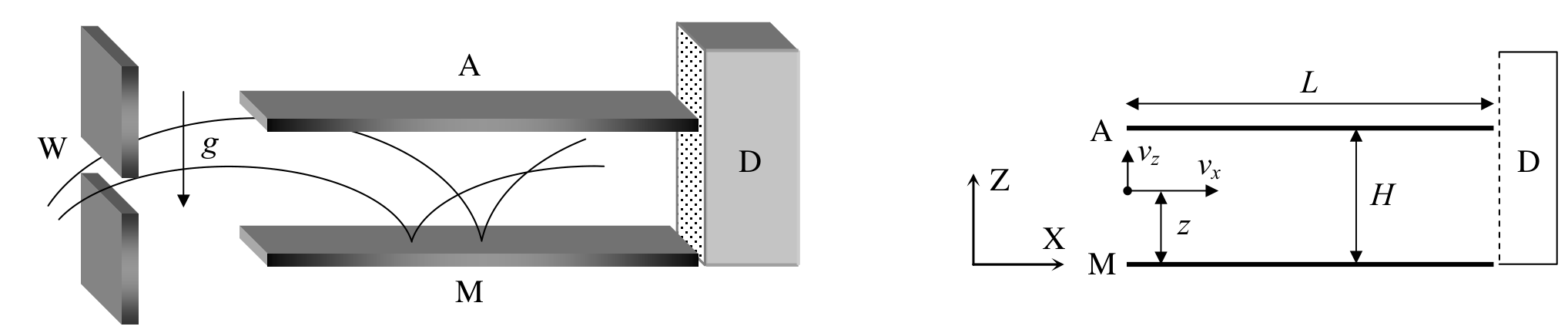
The setup of the experiment is sketched in Figure F-1. It consists of the opening W, the neutron mirror M (at height ), the neutron absorber A (at height and with length ) and the neutron detector D. The beam of neutrons flies with constant horizontal velocity component from W to D through the cavity between A and M. All the neutrons that reach the surface of A are absorbed and disappear from the experiment. Those that reach the surface of M are reflected elastically. The detector D counts the transmission rate , that is, the total number of neutrons that reach D per unit time.
Marks are indicated at the beginning of each subquestion, in parenthesis.
The neutrons enter the cavity with a wide range of positive and negative vertical velocities, . Once in the cavity, they fly between the mirror below and the absorber above.
V. V. Nesvizhevsky et al. “Quantum states of neutrons in the Earth’s gravitational field.” Nature, 415 (2002) 297. Phys Rev D 67, 102002 (2003).
1. (1.5) Compute classically the range of vertical velocities of the neutrons that, entering at a height , can arrive at the detector D. Assume that is much larger than any other length in the problem. [1,5 т.]
2. (1.5) Calculate classically the minimum length of the cavity to ensure that all neutrons outside the previous velocity range, regardless of the values of , are absorbed by A. Use and . [1,5 т.]
The neutron transmission rate is measured at D. We expect that it increases monotonically with .
3. (2.5) Compute the classical rate assuming that neutrons arrive at the cavity with vertical velocity and at height , being all the values of and equally probable. Give the answer in terms of , the constant number of neutrons per unit time, per unit vertical velocity, per unit height, that enter the cavity with vertical velocity and at height . [2,5 т.]
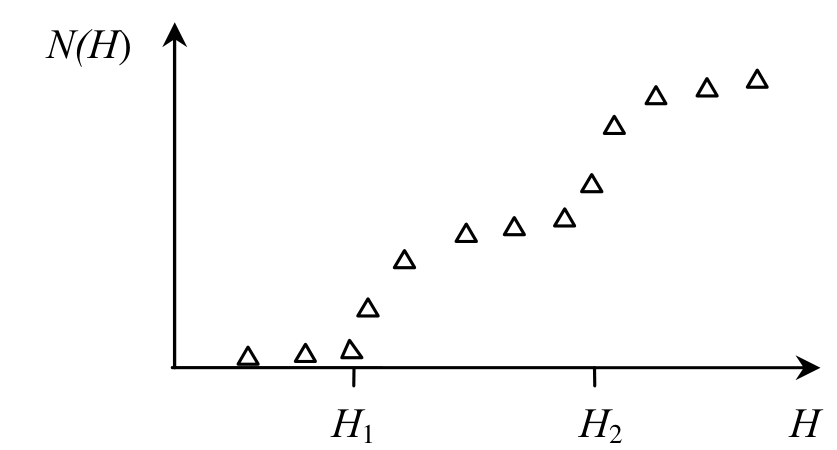
The experimental results obtained by the Grenoble group disagree with the above classical predictions, showing instead that the value of experiences sharp increases when crosses some critical heights , … (Figure F-2 shows a sketch). In other words, the experiment showed that the vertical motion of neutrons bouncing on the mirror is quantized. In the language that Bohr and Sommerfeld used to obtain the energy levels of the hydrogen atom, this can be written as: “The action of these neutrons along the vertical direction is an integer multiple of the Planck action constant ”. Here is given by
where is the vertical component of the classical momentum, and the integral covers a whole bouncing cycle. Only neutrons with these values of are allowed in the cavity.
4. (2.5) Compute the turning heights and energy levels (associated to the vertical motion) using the Bohr-Sommerfeld quantization condition. Give the numerical result for in µm and for in eV. [2,5 т.]
The uniform initial distribution of neutrons at the entrance changes, during the flight through a long cavity, into the step-like distribution detected at D (see Figure F-2). From now on, we consider for simplicity the case of a long cavity with . Classically, all neutrons with energies in the range considered in question 1 were allowed through it, while quantum mechanically only neutrons in the energy level are permitted. According to the time-energy Heisenberg uncertainty principle, this reshuffling requires a minimum time of flight. The uncertainty of the vertical motion energy will be significant if the cavity length is small. This phenomenon will give rise to the widening of the energy levels.
5. (2.0) Estimate the minimum time of flight and the minimum length of the cavity needed to observe the first sharp increase in the number of neutrons at D. Use . [2 т.]
Data:
| Planck action constant | |
| Speed of light in vacuum | |
| Elementary charge | |
| Neutron mass | |
| Acceleration of gravity on Earth | |
| If necessary, use the expression: |
Отговори
- 1.
- 2. ≈ cm
- 3.
- 4.
- 5. tq ≈ ħ/E1 ≈ 0.4 ms; Lq ≈ vx ħ/E1 ≈ 4 mm
Решение
Th3 QUANTUM EFFECTS OF GRAVITY
SOLUTION
1. The only neutrons that will survive absorption at A are those that cannot cross . Their turning points will be below . So that, for a neutron entering to the cavity at height with vertical velocity , conservation of energy implies
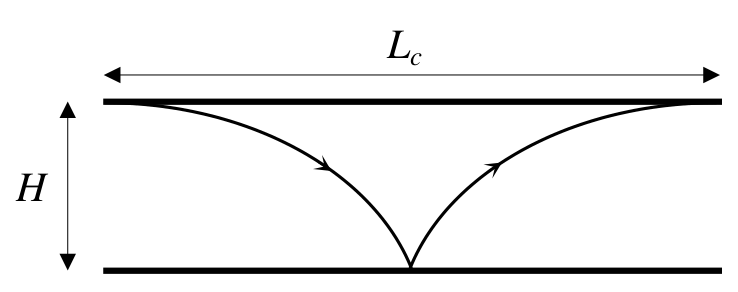
2. The cavity should be long enough to ensure the absorption of all neutrons with velocities outside the allowed range. Therefore, neutrons have to reach its maximum height at least once within the cavity. The longest required length corresponds to neutrons that enter at with (see the figure). Calling to their time of fall
3. The rate of transmitted neutrons entering at a given height , per unit height, is proportional to the range of allowed velocities at that height, being the proportionality constant
The total number of transmitted neutrons is obtained by adding the neutrons entering at all possible heights. Calling
4. For a neutron falling from a height , the action over a bouncing cycle is twice the action during the fall or the ascent
Using the BS quantization condition
The corresponding energy levels (associated to the vertical motion) are
Numerical values for the first level:
Note that is of the same order than the given cavity height, µm. This opens up the possibility for observing the spatial quantization when varying .
5. The uncertainty principle says that the minimum time and the minimum energy satisfy the relation . During this time, the neutrons move to the right a distance
Now, the minimum neutron energy allowed in the cavity is , so that . Therefore, an estimation of the minimum time and the minimum length required is
Th 3 ANSWER SHEET
| Question | Basic formulas used | Analytical results | Numerical results | Marking guideline |
|---|---|---|---|---|
| 1 | 1.5 | |||
| 2 | ; | 1.3 + 0.2 | ||
| 3 | ; | 2.5 | ||
| 4 | ; | ; | 1.6 + 0.2;0.5 + 0.2 | |
| 5 | ;; | ; | ; | 1.3 + 0.2;0.3 + 0.2 |
Th 3 ANSWER SHEET
| COUNTRY CODE | STUDENT CODE | PAGE NUMBER | TOTAL No OF PAGES |
|---|---|---|---|
Th 3 ANSWER SHEET
| Question | Basic formulas used | Analytical results | Numerical results | Marking guideline |
|---|---|---|---|---|
| 1 | 1.5 | |||
| 2 | 1.5 | |||
| 3 | 2.5 | |||
| 4 | ; | µm; eV | 2.5 | |
| 5 | ; | ; | 2.0 |