IPhO 2006, Теория — Задача 1. Gravity in a Neutron Interferometer
Theory Question 1: Gravity in a Neutron Interferometer · 8 юли 2006 г. · 10 т.
Внимание: Бележка към темата
The original PDF and Word editions contain the same single problem, seven connected requests, two interferometer diagrams and three supplied Answer Script pages. The printed answer form divides the 1.0 point for 1.4 into 0.8 for the expression and 0.2 for the numerical volume. Its blank response spaces are retained as unfilled form entries; they are not additional tasks. Native spelling “Collela” and “which tell us that” are retained.
Условие
Enter all your answers into the Answer Script.
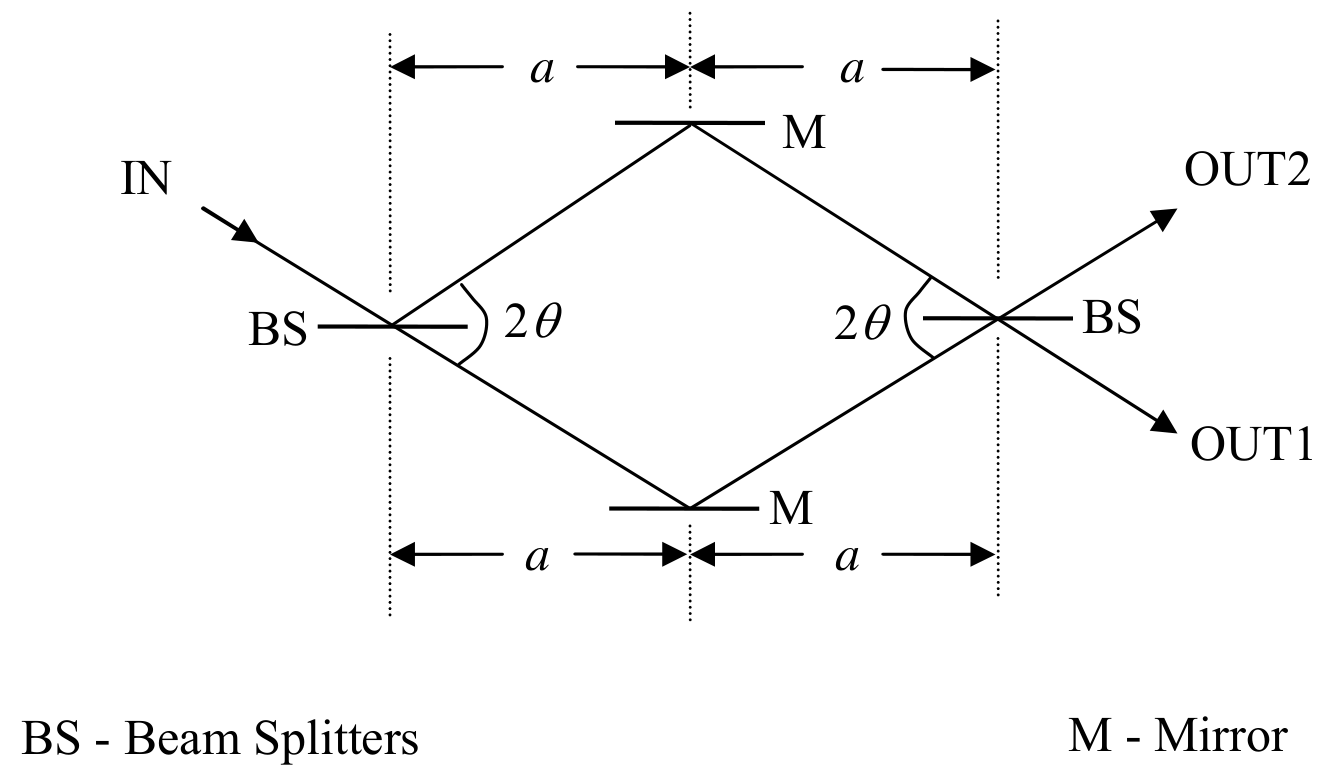
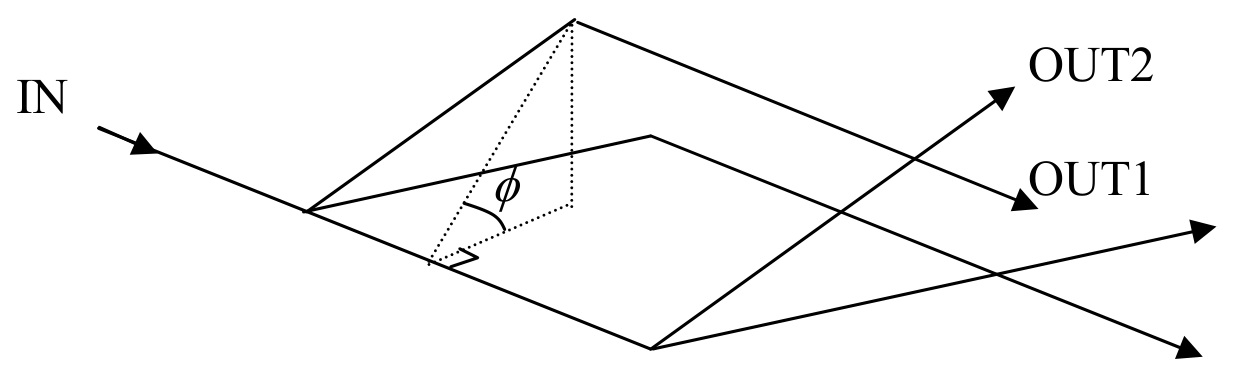
Physical situation
We consider the situation of the famous neutron-interferometer experiment by Collela, Overhauser and Werner, but idealize the set-up inasmuch as we shall assume perfect beam splitters and mirrors within the interferometer. The experiment studies the effect of the gravitational pull on the de Broglie waves of neutrons.
The symbolic representation of this interferometer in analogy to an optical interferometer is shown in Figure 1a. The neutrons enter the interferometer through the IN port and follow the two paths shown. The neutrons are detected at either one of the two output ports, OUT1 or OUT2. The two paths enclose a diamond-shaped area, which is typically a few in size.
The neutron de Broglie waves (of typical wavelength of ) interfere such that all neutrons emerge from the output port OUT1 if the interferometer plane is horizontal. But when the interferometer is tilted around the axis of the incoming neutron beam by angle (Figure 1b), one observes a dependent redistribution of the neutrons between the two output ports OUT1 and OUT2.
Geometry
For the interferometer plane is horizontal; for the plane is vertical with the output ports above the tilt axis.
1.1 (1.0) How large is the diamond-shaped area enclosed by the two paths of the interferometer? [1 т.]
1.2 (1.0) What is the height of output port OUT1 above the horizontal plane of the tilt axis? [1 т.]
Express and in terms of , , and .
Optical path length
The optical path length (a number) is the ratio of the geometrical path length (a distance) and the wavelength . If changes along the path, is obtained by integrating along the path.
1.3 (3.0) What is the difference in the optical path lengths of the two paths when the interferometer has been tilted by angle ? Express your answer in terms of , , and as well as the neutron mass , the de Broglie wavelength of the incoming neutrons, the gravitational acceleration , and Planck’s constant . [3 т.]
1.4 (1.0) Introduce the volume parameter
and express solely in terms of , , , and . State the value of for , , and . [1 т.]
1.5 (2.0) How many cycles — from high intensity to low intensity and back to high intensity — are completed by output port OUT1 when is increased from to ? [2 т.]
Experimental data
The interferometer of an actual experiment was characterized by and , and 19.00 full cycles were observed.
1.6 (1.0) How large was in this experiment? [1 т.]
1.7 (1.0) If one observed 30.00 full cycles in another experiment of the same kind that uses neutrons with , how large would be the area ? [1 т.]
Hint: If , it is permissible to replace by .
Отговори
- Geometry, 1.1
- Geometry, 1.2
- Optical path length, 1.3
- Optical path length, 1.4
- Optical path length, 1.5
- Experimental data, 1.6 0.1441 nm
- Experimental data, 1.7 11.98 cm²
Решение
Geometry
Each side of the diamond has length and the distance between parallel sides is . The area is the product thereof, , giving
1.1
The height by which a tilt of lifts OUT1 above IN is or
1.2
Optical path length
Only the two parallel lines for IN and OUT1 matter, each having length . With the de Broglie wavelength on the IN side and on the OUT1 side, we have
The momentum is or , respectively, and the statement of energy conservation reads
which implies
Upon recognizing that is of the order of , this simplifies to
and we get
or
1.3
A more compact way of writing this is
1.4
where
1.4
is the numerical value for the volume parameter .
There is constructive interference (high intensity in OUT1) when the optical path lengths of the two paths differ by an integer, , and we have destructive interference (low intensity in OUT1) when they differ by an integer plus half, . Changing from to gives
which tell us that
1.5
Experimental data
For and we have , so that
1.6
And 30 full cycles for correspond to an area
1.7
Answer Script — Geometry
Country Code · Student Code · Question Number: 1
For Examiners Use Only
| 1.1 | The area is | 1.0 |
| 1.2 | The height is | 1.0 |
Answer Script — Optical path length
Country Code · Student Code · Question Number: 1
For Examiners Use Only
| 1.3 | In terms of , , , , , , and : | 3.0 |
| 1.4 | In terms of , , , and : | 0.8 |
| The numerical value of is | 0.2 | |
| 1.5 | The number of cycles is | 2.0 |
Answer Script — Experimental data
Country Code · Student Code · Question Number: 1
For Examiners Use Only
| 1.6 | The de Broglie wavelength was | 1.0 |
| 1.7 | The area is | 1.0 |
Оригинал в Архива: IPhO_2006_Theo_question 1.pdf · официални решения: 1_sol.pdf · допълнителни данни: 1.doc