IPhO 2006, Теория — Задача 2. Watching a Rod in Motion
Theory Question 2: Watching a Rod in Motion · 8 юли 2006 г.
Внимание: Бележка към темата
The complete original PDF and Word question editions contain one connected problem with eleven requests and three supplied blank Answer Script pages. All native prompts, checkbox choices and printed mark columns are retained; blank identity and response boxes remain unfilled. The question uses the upsilon glyph for velocity, while the key writes v; the Answer Script prints l in 2.7, while the key uses ℓ. Original formats and both original diagram byte streams are preserved.
Условие
Enter all your answers into the Answer Script.
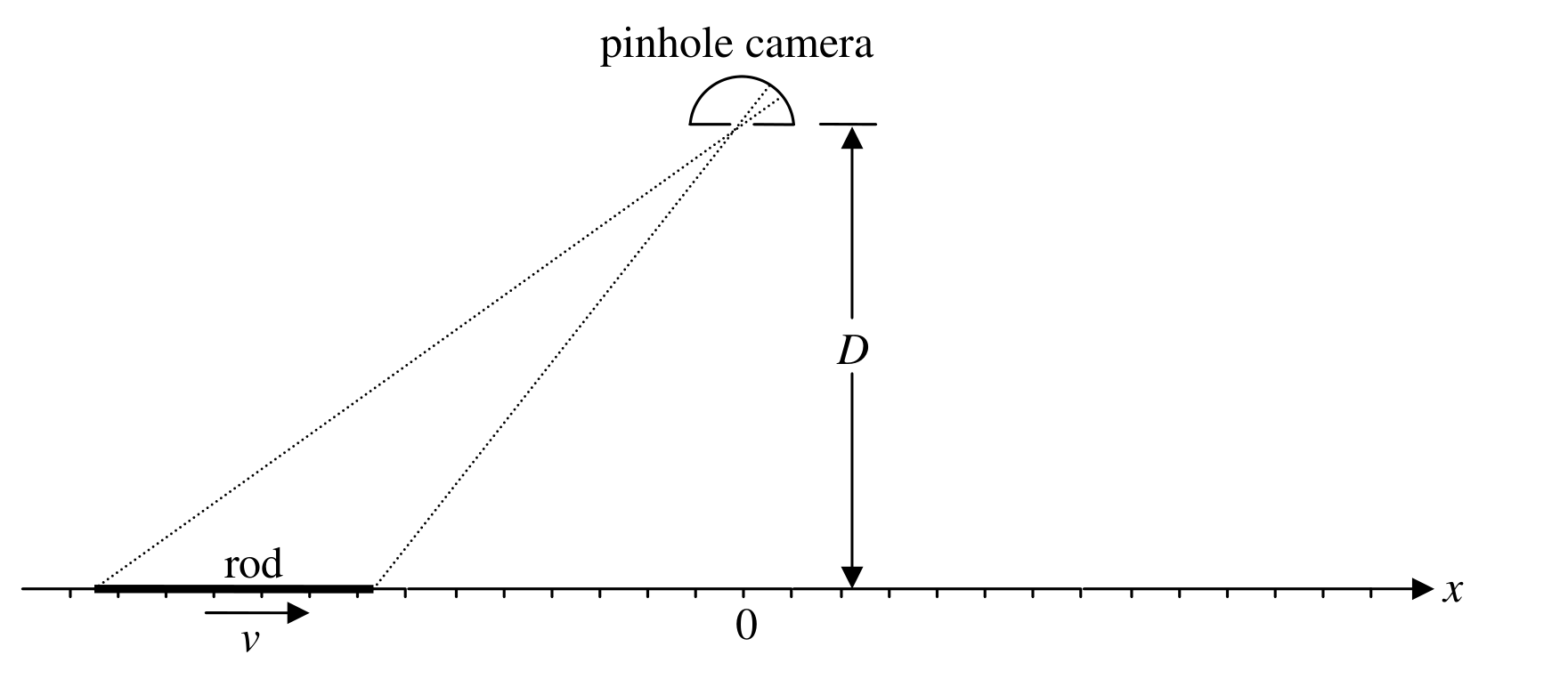
Physical situation
A pinhole camera, with the pinhole at and at distance from the axis, takes pictures of a rod, by opening the pinhole for a very short time. There are equidistant marks along the axis by which the apparent length of the rod, as it is seen on the picture, can be determined from the pictures taken by the pinhole camera. On a picture of the rod at rest, its length is . However, the rod is not at rest, but is moving with constant velocity along the axis.
Basic relations
A picture taken by the pinhole camera shows a tiny segment of the rod at position .
2.1 (0.6) What is the actual position of this segment at the time when the picture is taken? State your answer in terms of , , , , and the speed of light . Employ the quantities
if they help to simplify your result. [0,6 т.]
2.2 (0.9) Find also the corresponding inverse relation, that is: express in terms of , , , , and . [0,9 т.]
Note: The actual position is the position in the frame in which the camera is at rest
Apparent length of the rod
The pinhole camera takes a picture at the instant when the actual position of the center of the rod is at some point .
2.3 (1.5) In terms of the given variables, determine the apparent length of the rod on this picture. [1,5 т.]
2.4 (1.5) Check one of the boxes in the Answer Script to indicate how the apparent length changes with time.
Answer Script: Check one: The apparent length
- increases first, reaches a maximum value, then decreases.
- decreases first, reaches a minimum value, then increases.
- decreases all the time.
- increases all the time. [1,5 т.]
Symmetric picture
One pinhole-camera picture shows both ends of the rod at the same distance from the pinhole.
2.5 (0.8) Determine the apparent length of the rod on this picture. [0,8 т.]
2.6 (1.0) What is the actual position of the middle of the rod at the time when this picture is taken? [1 т.]
2.7 (1.2) Where does the picture show the image of the middle of the rod?
Answer Script: The picture shows the middle of the rod at a distance from the image of the front end of the rod. [1,2 т.]
Very early and very late pictures
The pinhole camera took one picture very early, when the rod was very far away and approaching, and takes another picture very late, when the rod is very far away and receding. On one of the pictures the apparent length is , on the other picture it is .
2.8 (0.5) Check the box in the Answer Script to indicate which length is seen on which picture.
Answer Script: Check one:
- The apparent length is 1 m on the early picture and 3 m on the late picture.
- The apparent length is 3 m on the early picture and 1 m on the late picture. [0,5 т.]
2.9 (1.0) Determine the velocity . [1 т.]
2.10 (0.6) Determine the length of the rod at rest. [0,6 т.]
2.11 (0.4) Infer the apparent length on the symmetric picture. [0,4 т.]
Отговори
- Basic relations, 2.1
- Basic relations, 2.2
- Apparent length of the rod, 2.3
- Apparent length of the rod, 2.4 decreases all the time.
- Symmetric picture, 2.5
- Symmetric picture, 2.6
- Symmetric picture, 2.7
- Very early and very late pictures, 2.8 The apparent length is 3 m on the early picture and 1 m on the late picture.
- Very early and very late pictures, 2.9
- Very early and very late pictures, 2.10 1.73 m
- Very early and very late pictures, 2.11 1.5 m
Решение
Basic relations
Position shows up on the picture if light was emitted from there at an instant that is earlier than the instant of the picture taking by the light travel time that is given by
During the lapse of the respective segment of the rod has moved the distance , so that its actual position at the time of the picture taking is
2.1
Upon solving for we find
2.2
Apparent length of the rod
Owing to the Lorentz contraction, the actual length of the moving rod is , so that the actual positions of the two ends of the rod are
The picture taken by the pinhole camera shows the images of the rod ends at
The apparent length is therefore
2.3
Since the rod moves with the constant speed , we have and therefore the question is whether increases or decreases when increases. We sketch the two square root terms:
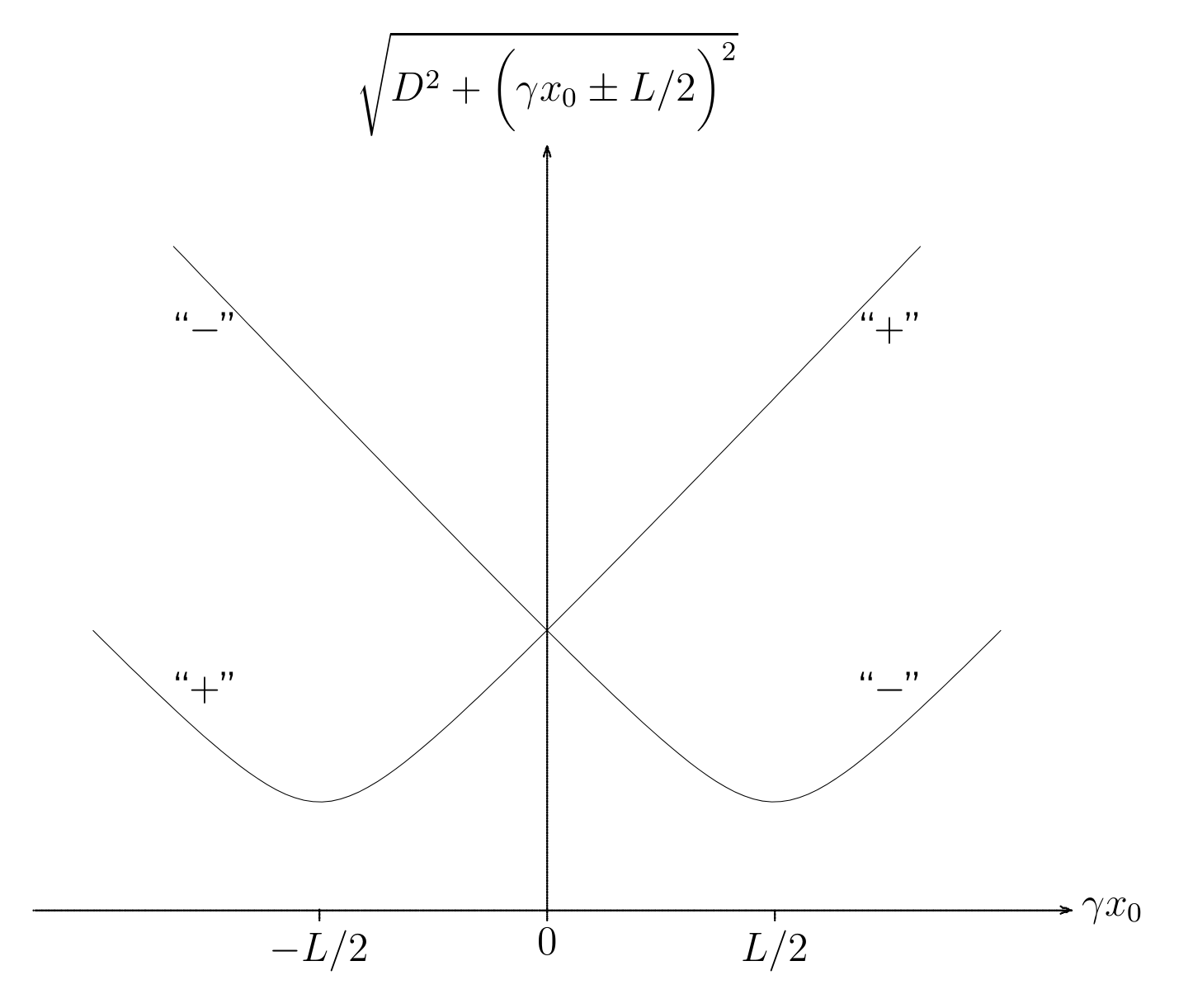
The difference of the square roots with “” and “” appears in the expression for , and this difference clearly decreases when increases.
2.4 The apparent length decreases all the time.
Symmetric picture
For symmetry reasons, the apparent length on the symmetric picture is the actual length of the moving rod, because the light from the two ends was emitted simultaneously to reach the pinhole at the same time, that is:
2.5
The apparent endpoint positions are such that , or
In conjunction with
this tells us that
As they should, both the version with the upper signs and the version with the lower signs give the same answer for , namely
2.6
The image of the middle of the rod on the symmetric picture is, therefore, located at
which is at a distance from the image of the front end, that is
2.7
or
Very early and very late pictures
At the very early time, we have a very large negative value for , so that the apparent length on the very early picture is
Likewise, at the very late time, we have a very large positive value for , so that the apparent length on the very late picture is
It follows that , that is:
2.8 The apparent length is 3 m on the early picture and 1 m on the late picture.
Further, we have
so that and the velocity is
2.9
It follows that . Combined with
2.10
this gives the length on the symmetric picture as
2.11
Answer Script — Basic Relations and Apparent length of the rod
Country Code · Student Code · Question Number: 2
For Examiners Use Only
| 2.1 | value for given value: | 0.6 |
| 2.2 | value for given value: | 0.9 |
| 2.3 | The apparent length is | 1.5 |
| 2.4 | Check one: The apparent length | 1.5 |
- ☐ increases first, reaches a maximum value, then decreases.
- ☐ decreases first, reaches a minimum value, then increases.
- ☐ decreases all the time.
- ☐ increases all the time.
Answer Script — Symmetric picture
Country Code · Student Code · Question Number: 2
For Examiners Use Only
| 2.5 | The apparent length is | 0.8 |
| 2.6 | The actual position of the middle of the rod is | 1.0 |
| 2.7 | The picture shows the middle of the rod at a distance from the image of the front end of the rod. | 1.2 |
Answer Script — Very early and very late pictures
Country Code · Student Code · Question Number: 2
For Examiners Use Only
| 2.8 | Check one: | 0.5 |
| 2.9 | The velocity is | 1.0 |
| 2.10 | The rod has length at rest. | 0.6 |
| 2.11 | The apparent length on the symmetric picture is | 0.4 |
- ☐ The apparent length is 1 m on the early picture and 3 m on the late picture.
- ☐ The apparent length is 3 m on the early picture and 1 m on the late picture.
Оригинал в Архива: IPhO_2006_Theo_question 2.pdf · официални решения: 2_sol.pdf · допълнителни данни: 2.doc