IPhO 2006, Теория — Задача 3. Theory Question 3
Theory Question 3 · 8 юли 2006 г.
Внимание: Бележка към темата
The source contains one Theory Question3 with five named independent parts and sixteen numbered requests. All four supplied blank Answer Script pages are retained with their literal prompts and printed mark columns; blank identity and response fields remain unfilled. The Word edition differs from the published PDF in part3.4 and its Data line: arcsec vs arcmin. The primary question follows the published PDF and the Word variation is explicitly retained. The native question and key give opposite lightning charge polarities and use different velocity/peak-current symbols; these source differences are preserved. No whole-question total is printed.
Original Word edition — angular-unit variation
The original Word edition of part 3.4 prints arcsec and its Data line prints arcsec rad. The published PDF prints arcmin and arcmin rad. The primary question follows the PDF; the Word source and its printed angular-unit variation are retained without silently correcting them.
Условие
This question consists of five independent parts. Each of them asks for an estimate of an order of magnitude only, not for a precise answer. Enter all your answers into the Answer Script.
Digital Camera
Consider a digital camera with a square CCD chip with linear dimension mm having Mpix (1 Mpix = pixels). The lens of this camera has a focal length of mm. The well known sequence of numbers (2, 2.8, 4, 5.6, 8, 11, 16, 22) that appear on the lens refer to the so called F-number, which is denoted by and defined as the ratio of the focal length and the diameter of the aperture of the lens, .
3.1 (1.0) Find the best possible spatial resolution , at the chip, of the camera as limited by the lens. Express your result in terms of the wavelength and the F-number and give the numerical value for nm. [1 т.]
3.2 (0.5) Find the necessary number of Mpix that the CCD chip should possess in order to match this optimal resolution. [0,5 т.]
3.3 (0.5) Sometimes, photographers try to use a camera at the smallest practical aperture. Suppose that we now have a camera of Mpix, with the chip size and focal length as given above. Which value is to be chosen for such that the image quality is not limited by the optics? [0,5 т.]
3.4 (0.5) Knowing that the human eye has an approximate angular resolution of arcmin and that a typical photo printer will print a minimum of 300 dpi (dots per inch), at what minimal distance should you hold the printed page from your eyes so that you do not see the individual dots? [0,5 т.]
Data
1 inch = 25.4 mm
1 arcmin = rad
Hard-boiled egg
An egg, taken directly from the fridge at temperature , is dropped into a pot with water that is kept boiling at temperature .
3.5 (0.5) How large is the amount of energy that is needed to get the egg coagulated? [0,5 т.]
3.6 (0.5) How large is the heat flow that is flowing into the egg? [0,5 т.]
3.7 (0.5) How large is the heat power transferred to the egg? [0,5 т.]
3.8 (0.5) For how long do you need to cook the egg so that it is hard-boiled? [0,5 т.]
Hint
You may use the simplified form of Fourier’s Law , where is the temperature difference associated with , the typical length scale of the problem. The heat flow is in units of .
Data
Mass density of the egg:
Specific heat capacity of the egg:
Radius of the egg:
Coagulation temperature of albumen (egg protein):
Heat transport coefficient: (assumed to be the same for liquid and solid albumen)
Lightning
An oversimplified model of lightning is presented. Lightning is caused by the build-up of electrostatic charge in clouds. As a consequence, the bottom of the cloud usually gets positively charged and the top gets negatively charged, and the ground below the cloud gets negatively charged. When the corresponding electric field exceeds the breakdown strength value of air, a disruptive discharge occurs: this is lightning.
Answer the following questions with the aid of this simplified curve for the current as a function of time and these data:
Distance between the bottom of the cloud and the ground: km;
Breakdown electric field of humid air: ;
Total number of lightning striking Earth per year: ;
Total human population: people.
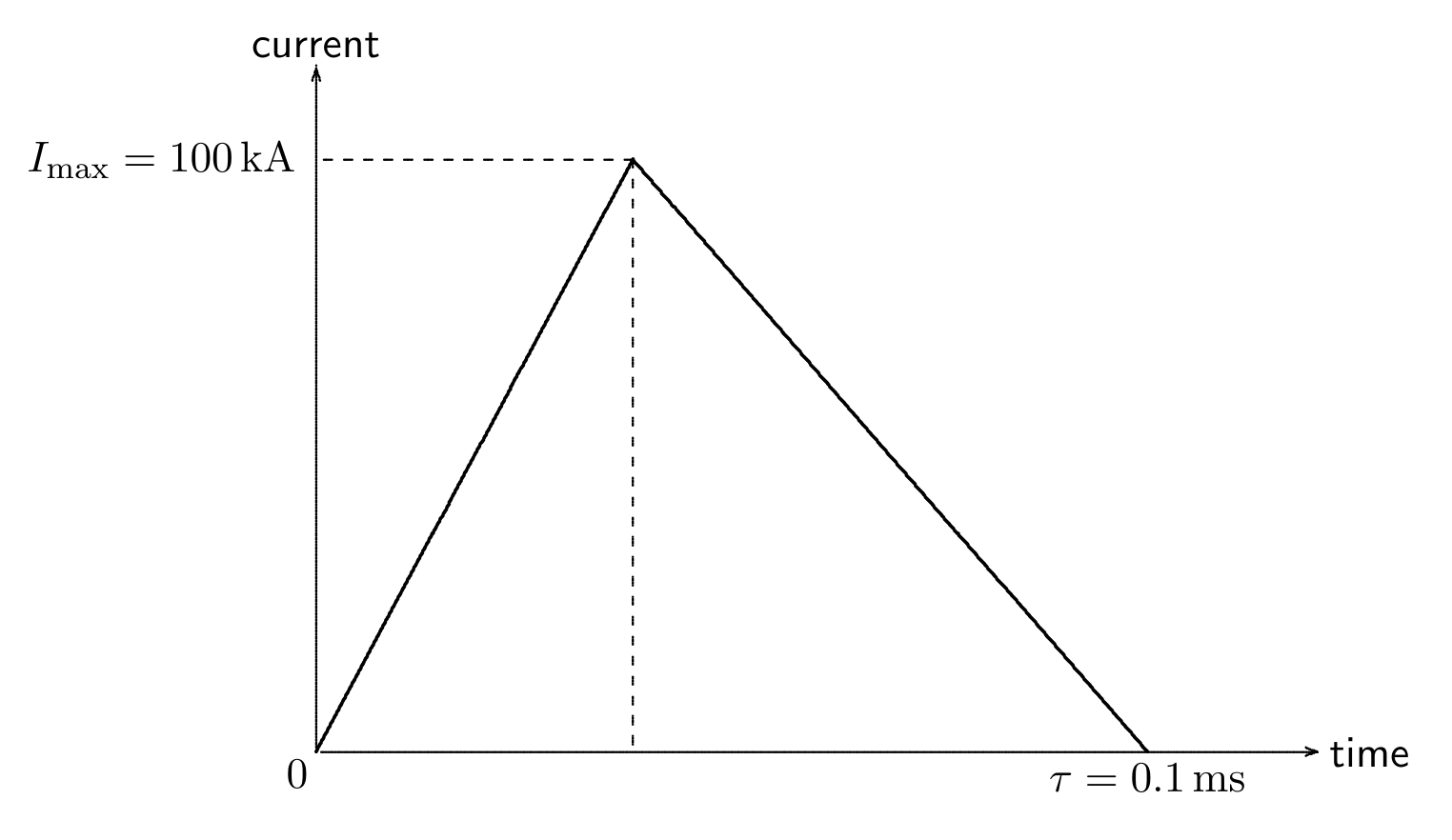
3.9 (0.5) What is the total charge released by lightning? [0,5 т.]
3.10 (0.5) What is the average current flowing between the bottom of the cloud and the ground during lightning? [0,5 т.]
3.11 (1.0) Imagine that the energy of all storms of one year is collected and equally shared among all people. For how long could you continuously light up a 100 W light bulb for your share? [1 т.]
Capillary Vessels
Let us regard blood as an incompressible viscous fluid with mass density similar to that of water and dynamic viscosity . We model blood vessels as circular straight pipes with radius and length and describe the blood flow by Poiseuille’s law,
the Fluid Dynamics analog of Ohm’s law in Electricity. Here is the pressure difference between the entrance and the exit of the blood vessel, is the volume flow through the cross-sectional area of the blood vessel and is the blood velocity. The hydraulic resistance is given by
For the systemic blood circulation (the one flowing from the left ventricle to the right auricle of the heart), the blood flow is for a man at rest. Answer the following questions under the assumption that all capillary vessels are connected in parallel and that each of them has radius and length mm and operates under a pressure difference kPa.
3.12 (1.0) How many capillary vessels are in the human body? [1 т.]
3.13 (0.5) How large is the velocity with which blood is flowing through a capillary vessel? [0,5 т.]
Skyscraper
At the bottom of a 1000 m high skyscraper, the outside temperature is . The objective is to estimate the outside temperature at the top. Consider a thin slab of air (ideal nitrogen gas with adiabatic coefficient ) rising slowly to height where the pressure is lower, and assume that this slab expands adiabatically so that its temperature drops to the temperature of the surrounding air.
3.14 (0.5) How is the fractional change in temperature related to , the fractional change in pressure? [0,5 т.]
3.15 (0.5) Express the pressure difference in terms of , the change in height. [0,5 т.]
3.16 (1.0) What is the resulting temperature at the top of the building? [1 т.]
Data
Boltzmann constant:
Mass of a nitrogen molecule:
Gravitational acceleration:
Отговори
Digital Camera, 3.1
Numerical value for the smallest F-number F# = 2 and λ = 500 nm.
Digital Camera, 3.2 823 Mpix
Digital Camera, 3.3 11
Digital Camera, 3.4 15 cm
The official solution gives z = 14.55 cm ≈ 15 cm.
Hard-boiled egg, 3.5 16768 J
Hard-boiled egg, 3.6 2458 W m⁻²
Hard-boiled egg, 3.7 19.3 W
Hard-boiled egg, 3.8 869 s
The official solution gives τ = 869 s ≈ 14.5 min.
Lightning, 3.9 5 C
Lightning, 3.10 50 kA
Lightning, 3.11 10 h
Capillary Vessels, 3.12
The official solution gives N ≈ 4.5 × 10⁹.
Capillary Vessels, 3.13 0.44 mm s⁻¹
Skyscraper, 3.14
Skyscraper, 3.15
Skyscraper, 3.16 20.6 °C
Решение
Digital Camera
Two factors limit the resolution of the camera as a photographic tool: the diffraction by the aperture and the pixel size. For diffraction, the inherent angular resolution is the ratio of the wavelength of the light and the aperture of the camera,
where the standard factor of 1.22 reflects the circular shape of the aperture. When taking a picture, the object is generally sufficiently far away from the photographer for the image to form in the focal plane of the camera where the CCD chip should thus be placed. The Rayleigh diffraction criterion then states that two image points can be resolved if they are separated by more than
3.1
which gives
if we choose the largest possible aperture (or smallest value ) and assume for the typical wavelength of daylight
The digital resolution is given by the distance between the center of two neighboring pixels. For our 5 Mpix camera this distance is roughly
Ideally we should match the optical and the digital resolution so that neither aspect is overspecified. Taking the given optical resolution in the expression for the digital resolution, we obtain
3.2
Now looking for the unknown optimal aperture, we note that we should have , that is: with
Since this value is not available, we choose the nearest value that has a higher optical resolution,
3.3
When looking at a picture at distance from the eye, the (small) subtended angle between two neighboring dots is where, as above, is the distance between neighboring dots. Accordingly,
3.4
Hard-boiled egg
All of the egg has to reach coagulation temperature. This means that the increase in temperature is
Thus the minimum amount of energy that we need to get into the egg such that all of it has coagulated is given by where is the egg volume. We thus find
3.5
The simplified equation for heat flow then allows us to calculate how much energy has flown into the egg through the surface per unit time. To get an approximate value for the time we assume that the center of the egg is at the initial temperature . The typical length scale is , and the temperature difference associated with it is where (boiling water). We thus get
3.6
Heat is transferred from the boiling water to the egg through the surface of the egg. This gives
3.7
for the amount of energy transferred to the egg per unit time. From this we get an estimate for the time required for the necessary amount of heat to flow into the egg all the way to the center:
3.8
Lightning
The total charge is just the area under the curve of the figure. Because of the triangular shape, we immediately get
3.9
The average current is
3.10
simply half the maximal value.
Since the bottom of the cloud gets negatively charged and the ground positively charged, the situation is essentially that of a giant parallel-plate capacitor. The amount of energy stored just before lightning occurs is where is the voltage difference between the bottom of the cloud and the ground, and lightning releases this energy. Altogether we thus get for one lightning the energy . It follows that you could light up the 100 W bulb for the duration
3.11
Capillary Vessels
Considering all capillaries, one has
All capillaries are assumed to be connected in parallel. The analogy between Poiseuille’s and Ohm’s laws then gives the hydraulic resistance of one capillary as
We thus get
for the number of capillary vessels in the human body. Now calculate using Poiseuille’s law,
and arrive at
3.12
The volume flow is where is the total cross-sectional area associated with all capillary vessels. We then get
3.13
where the second expression is found by alternatively considering one capillary vessel by itself.
Skyscraper
When the slab is at height above the ground, the air in the slab has pressure and temperature and the slab has volume where is the cross-sectional area and is the thickness of the slab. At any given height , we combine the ideal gas law
with the adiabatic law
to conclude that . Upon differentiation this gives , so that
3.14
Since the slab is not accelerated, the weight must be balanced by the force that results from the difference in pressure at the top and bottom of the slab. Taking downward forces as positive, we have the net force
so that or
3.15
Taken together, the two expressions say that
and therefore we have
for a building of height , which gives
3.16
for and .
Answer Script — Digital Camera
Country Code · Student Code · Question Number: 3
For Examiners Use Only
| 3.1 | The best spatial resolution is (formula:) | 0.7 |
| which gives (numerical:) for nm. | 0.3 | |
| 3.2 | The number of Mpix is | 0.5 |
| 3.3 | The best F-number value is | 0.5 |
| 3.4 | The minimal distance is | 0.5 |
Answer Script — Hard-boiled egg
Country Code · Student Code · Question Number: 3
For Examiners Use Only
| 3.5 | The required energy is | 0.5 |
| 3.6 | The heat flow is | 0.5 |
| 3.7 | The heat power transferred is | 0.5 |
| 3.8 | The time needed to hard-boil the egg is | 0.5 |
Answer Script — Lightning and Capillary Vessels
Country Code · Student Code · Question Number: 3
For Examiners Use Only
| 3.9 | The total charge is | 0.5 |
| 3.10 | The average current is | 0.5 |
| 3.11 | The light bulb would burn for the duration | 1.0 |
| 3.12 | There are capillary vessels in a human body. | 1.0 |
| 3.13 | The blood flows with velocity | 0.5 |
Answer Script — Skyscraper
Country Code · Student Code · Question Number: 3
For Examiners Use Only
| 3.14 | The fractional change in temperature is | 0.5 |
| 3.15 | The pressure difference is | 0.5 |
| 3.16 | The temperature at the top is | 1.0 |
Оригинал в Архива: IPhO_2006_Theo_question 3.pdf · официални решения: 3_sol.pdf · допълнителни данни: 3.doc