IPhO 2007, Теория — Задача 1.1
ORANGE — 38th International Physics Olympiad, Isfahan-Iran, July 2007
Условие
In this problem we deal with a simplified model of accelerometers designed to activate the safety air bags of automobiles during a collision. We would like to build an electromechanical system in such a way that when the acceleration exceeds a certain limit, one of the electrical parameters of the system such as the voltage at a certain point of the circuit will exceed a threshold and the air bag will be activated as a result.
Note: Ignore gravity in this problem.
1 Consider a capacitor with parallel plates as in Figure 1. The area of each plate in the capacitor is and the distance between the two plates is . The distance between the two plates is much smaller than the dimensions of the plates. One of these plates is in contact with a wall through a spring with a spring constant , and the other plate is fixed. When the distance between the plates is the spring is neither compressed nor stretched, in other words no force is exerted on the spring in this state. Assume that the permittivity of the air between the plates is that of free vacuum . The capacitance corresponding to this distance between the plates of the capacitor is . We put charges and on the plates and let the system achieve mechanical equilibrium.
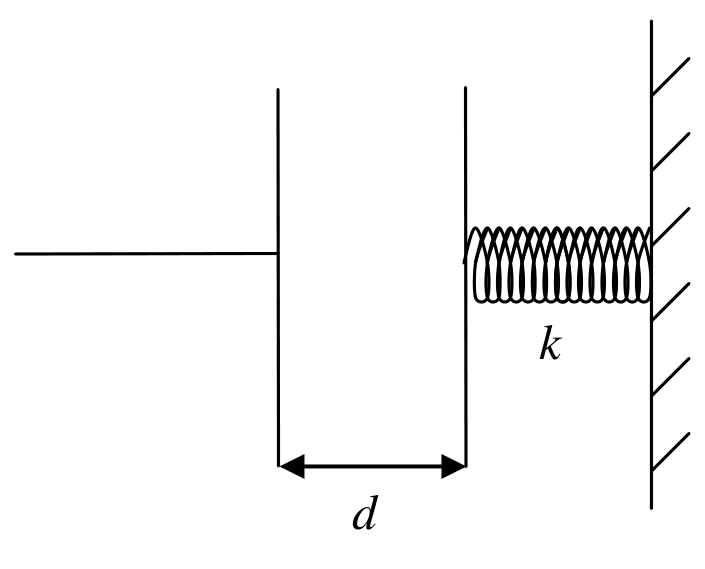
1.1 Calculate the electrical force, , exerted by the plates on each other. [0,8 т.]
1.2 Let be the displacement of the plate connected to the spring. Find . [0,6 т.]
1.3 In this state, what is the electrical potential difference between the plates of the capacitor in terms of , , , ? [0,4 т.]
1.4 Let be the capacitance of the capacitor, defined as the ratio of charge to potential difference. Find as a function of , , and . [0,3 т.]
1.5 What is the total energy, , stored in the system in terms of , , and ? [0,6 т.]
Отговори
- 1.1
- 1.2
- 1.3
- 1.4
- 1.5
Решение
Question “Orange”
1.1)
First of all, we use the Gauss’s law for a single plate to obtain the electric field,
(0.2)
The density of surface charge for a plate with charge, and area, is
(0.2)
Note that the electric field is resulted by two equivalent parallel plates. Hence the contribution of each plate to the electric field is . Force is defined by the electric filed times the charge, then we have
(0.2)+ (0.2) ( The ½ coefficient + the final result)
1.2)
The Hook’s law for a spring is
(0.2)
In 1.2 we derived the electric force between two plates is
The system is stable. The equilibrium condition yields
(0.2)
(0.2)
1.3)
The electric field is constant thus the potential difference, is given by
(0.2)
(Other reasonable approaches are acceptable. For example one may use the definition of capacity to obtain .)
By substituting the electric field obtained from previous section to the above equation, we get,
(0.2)
1.4)
is defined by the ratio of charge to potential difference, then
(0.1)
Using the answer to 1.3, we get
(0.2)
1.5)
Note that we have both the mechanical energy due to the spring
(0.2)
and the electrical energy stored in the capacitor.
(0.2)
Therefore the total energy stored in the system is
(0.2)