IPhO 2008, Теория — Задача 1. WATER-POWERED RICE-POUNDING MORTAR
39th International Physics Olympiad - Hanoi - Vietnam - 2008, Theoretical Problem No. 1
Условие
A. Introduction
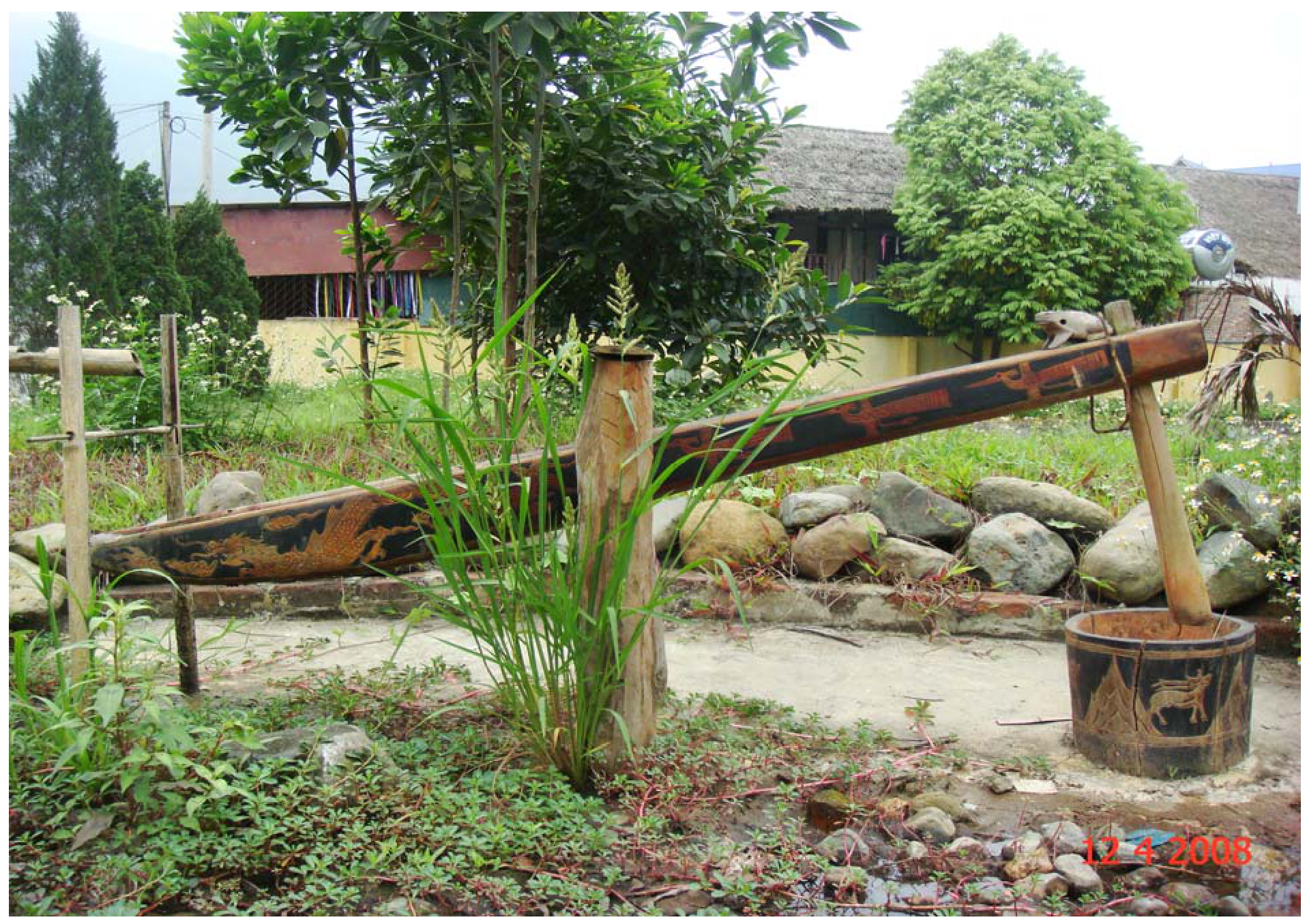
Rice is the main staple food of most people in Vietnam. To make white rice from paddy rice, one needs separate of the husk (a process called "hulling") and separate the bran layer ("milling"). The hilly parts of northern Vietnam are abundant with water streams, and people living there use water-powered rice-pounding mortar for bran layer separation. Figure 1 shows one of such mortars., Figure 2 shows how it works.
B. Design and operation
1. Design.
The rice-pounding mortar shown in Figure 1 has the following parts:
The mortar, basically a wooden container for rice.
The lever, which is a tree trunk with one larger end and one smaller end. It can rotate around a horizontal axis. A pestle is attached perpendicularly to the lever at the smaller end. The length of the pestle is such that it touches the rice in the mortar when the lever lies horizontally. The larger end of the lever is carved hollow to form a bucket. The shape of the bucket is crucial for the mortar's operation.
2. Modes of operation
The mortar has two modes.
Working mode. In this mode, the mortar goes through an operation cycle illustrated in Figure 2.
The rice-pounding function comes from the work that is transferred from the pestle to the rice during stage f) of Figure 2. If, for some reason, the pestle never touches the rice, we say that the mortar is not working.
Rest mode with the lever lifted up**.** During stage c) of the operation cycle (Figure 2), as the tilt angle increases, the amount of water in the bucket decreases. At one particular moment in time, the amount of water is just enough to counterbalance the weight of the lever. Denote the tilting angle at this instant by . If the lever is kept at angle and the initial angular velocity is zero, then the lever will remain at this position forever. This is the rest mode with the lever lifted up. The stability of this position depends on the flow rate of water into the bucket, . If exceeds some value , then this rest mode is stable, and the mortar cannot be in the working mode. In other words, is the minimal flow rate for the mortar not to work.
OPERATION CYCLE OF A WATER-POWERED RICE-POUNDING MORTAR (Figure 2)
a) At the beginning there is no water in the bucket, the pestle rests on the mortar. Water flows into the bucket with a small rate, but for some time the lever remains in the horizontal position.
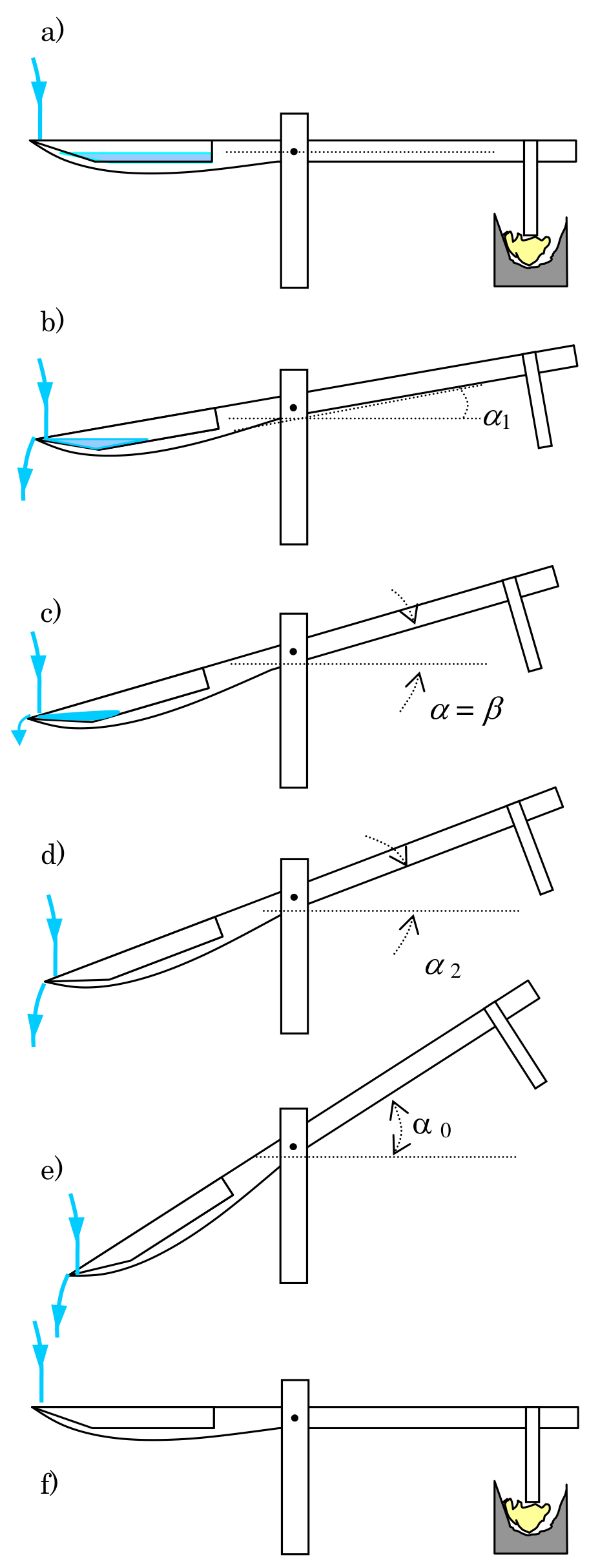
b) At some moment the amount of water is enough to lift the lever up. Due to the tilt, water rushes to the farther side of the bucket, tilting the lever more quickly. Water starts to flow out at .
c) As the angle increases, water starts to flow out. At some particular tilt angle, , the total torque is zero.
d) continues increasing, water continues to flow out until no water remains in the bucket.
e) keeps increasing because of inertia. Due to the shape of the bucket, water falls into the bucket but immediately flows out. The inertial motion of the lever continues until reaches the maximal value .
f) With no water in the bucket, the weight of the lever pulls it back to the initial horizontal position. The pestle gives the mortar (with rice inside) a pound and a new cycle begins.
C. The problem
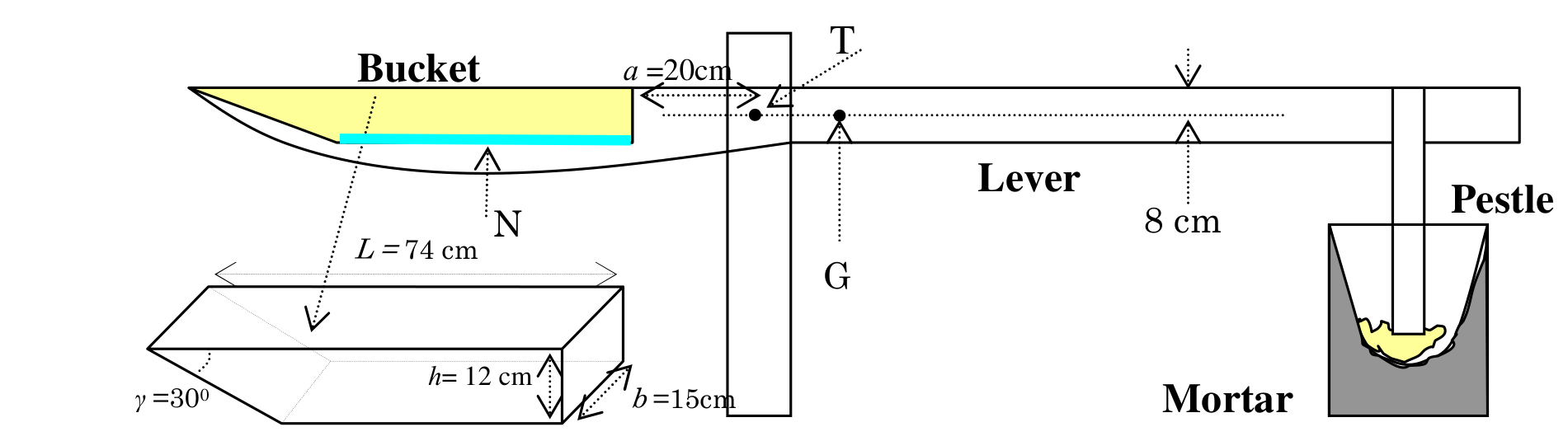
Consider a water-powered rice-pounding mortar with the following parameters (Figure 3)
The mass of the lever (including the pestle but without water) is kg,
The center of mass of the lever is G.. The lever rotates around the axis T (projected onto the point T on the figure).
The moment of inertia of the lever around T is .
When there is water in the bucket, the mass of water is denoted as , the center of mass of the water body is denoted as N.
The tilt angle of the lever with respect to the horizontal axis is .
The main length measurements of the mortar and the bucket are as in Figure 3.
Neglect friction at the rotation axis and the force due to water falling onto the bucket. In this problem, we make an approximation that the water surface is always horizontal.
1. The structure of the mortar
At the beginning, the bucket is empty, and the lever lies horizontally. Then water flows into the bucket until the lever starts rotating. The amount of water in the bucket at this moment is kg.
1.1. Determine the distance from the center of mass G of the lever to the rotation axis T. It is known that GT is horizontal when the bucket is empty.
1.2. Water starts flowing out of the bucket when the angle between the lever and the horizontal axis reaches . The bucket is completely empty when this angle is . Determine and .
1.3. Let be the total torque (relative to the axis T) which comes from the weight of the lever and the water in the bucket. is zero when . Determine and the mass of water in the bucket at this instant.
2. Parameters of the working mode
Let water flow into the bucket with a flow rate which is constant and small. The amount of water flowing into the bucket when the lever is in motion is negligible. In this part, neglect the change of the moment of inertia during the working cycle.
2.1. Sketch a graph of the torque as a function of the angle , , during one operation cycle. Write down explicitly the values of at angle , , and .
2.2. From the graph found in section 2.1., discuss and give the geometric interpretation of the value of the total energy produced by and the work that is transferred from the pestle to the rice.
2.3. From the graph representing versus , estimate and (assume the kinetic energy of water flowing into the bucket and out of the bucket is negligible.) You may replace curve lines by zigzag lines, if it simplifies the calculation.
3. The rest mode
Let water flow into the bucket with a constant rate , but one cannot neglect the amount of water flowing into the bucket during the motion of the lever.
3.1. Assuming the bucket is always overflown with water,
3.1.1. Sketch a graph of the torque as a function of the angle in the vicinity of . To which kind of equilibrium does the position of the lever belong?
3.1.2. Find the analytic form of the torque as a function of when , and is small.
3.1.3. Write down the equation of motion of the lever, which moves with zero initial velocity from the position ( is small). Show that the motion is, with good accuracy, harmonic oscillation. Compute the period .
3.2. At a given , the bucket is overflown with water at all times only if the lever moves sufficiently slowly. There is an upper limit on the amplitude of harmonic oscillation, which depends on . Determine the minimal value of (in kg/s) so that the lever can make a harmonic oscillator motion with amplitude .
3.3. Assume that is sufficiently large so that during the free motion of the lever when the tilting angle decreases from to the bucket is always overflown with water. However, if is too large the mortar cannot operate. Assuming that the motion of the lever is that of a harmonic oscillator, estimate the minimal flow rate for the rice-pounding mortar to not work.
Отговори
- 1.1. 0.016 m
- 1.2. α1 = 20.6°, α2 = 30°
- 1.3. m = 0.61 kg and β = 23.6°
- 2.1. μ(α1) = μmax = 2.7 N·m; μ(α2) = −4.0 N·m; μ(0) = −4.62 N·m
- 2.2. Wtotal is the area enclosed by the curve OABCDFO of μ(α); Wpounding is the area OEDFO, equal to gM × TG × sin α0 = 4.6 sin α0 (J).
- 2.3. α0 = 34.7°, Wpounding ≈ 2.6 J
- 3.1.1. α = β is a stable equilibrium.
- 3.1.2.
- 3.1.3. 3.2 s
- 3.2. 0.23 kg/s
- 3.3. 0.7 kg/s
Решение
Solution
1. The structure of the mortar
1.1. Calculating the distance TG
The volume of water in the bucket is . The length of the bottom of the bucket is .
(as the initial data are given with two significant digits, we shall keep only two significant digits in the final answer, but we keep more digits in the intermediate steps). The height of the water layer in the bucket is calculated from the formula:
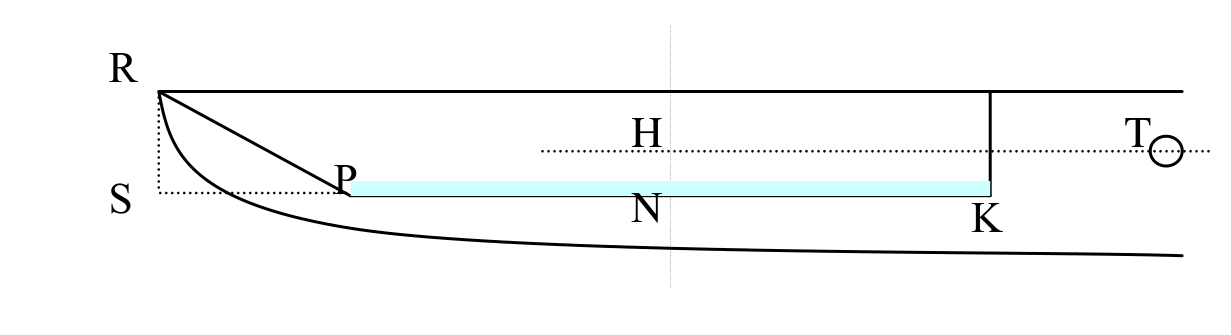
Inserting numerical values for , and , we find . When the lever lies horizontally, the distance, on the horizontal axis, between the rotation axis and the center of mass of water N, is , and (see the figure below).
Answer: .
1.2. Calculating the values of and .
When the lever tilts with angle , water level is at the edge of the bucket. At that point the water volume is . Assume . From geometry , from which . The assumption is obviously satisfied ().
To compute the angle , we note that . From this we find .
When the tilt angle is , the bucket is empty : .
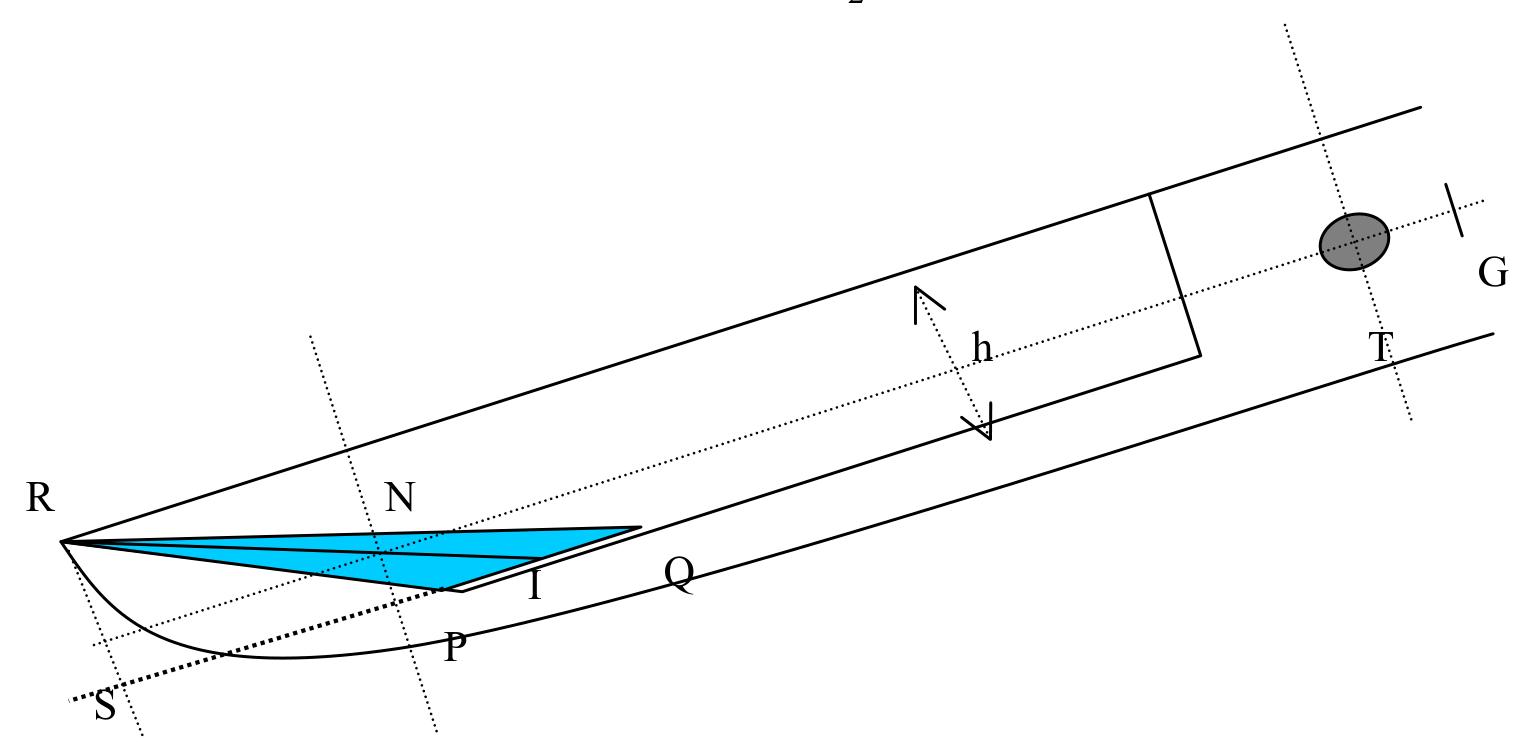
1.3. Determining the tilt angle of the lever and the amount of water in the bucket when the total torque on the lever is equal to zero
Denote . The amount of water in the bucket is .
when the torque coming from the water in the bucket cancels out the torque coming from the weight of the lever. The cross section of the water in the bucket is the triangle PQR in the figure. The center of mass N of water is located at 2/3 of the meridian RI, therefore NTG lies on a straight line. Then: or
Calculating from then substitute (1) :
which implies
So we find an equation for :
The solutions to (3) are and . Since has to be smaller than 0.5322, we have to take and .
Answer: and .
2. Parameters of the working mode
2.1.Graphs of , , and during one operation cycle .
Initially when there is no water in the bucket, , has the largest magnitude equal to . Our convention will be that the sign of this torque is negative as it tends to decrease .
As water flows into the bucket, the torque coming from the water (which carries positive sign) makes increase until is slightly positive, when the lever starts to lift up. From that moment, by assumption, the amount of water in the bucket is constant.
The lever tilts so the center of mass of water moves away from the rotation axis, leading to an increase of , which reaches maximum when water is just about to overflow the edge of the bucket. At this moment .
A simple calculation shows that
Therefore .
As the bucket tilts further, the amount of water in the bucket decreases, and when , . Due to inertia, keeps increasing and keeps decreasing. The bucket is empty when , when equals . After that keeps increasing due to inertia to (), then quickly decreases to 0 ().
On this basis we can sketch the graphs of , , and as in the figure below
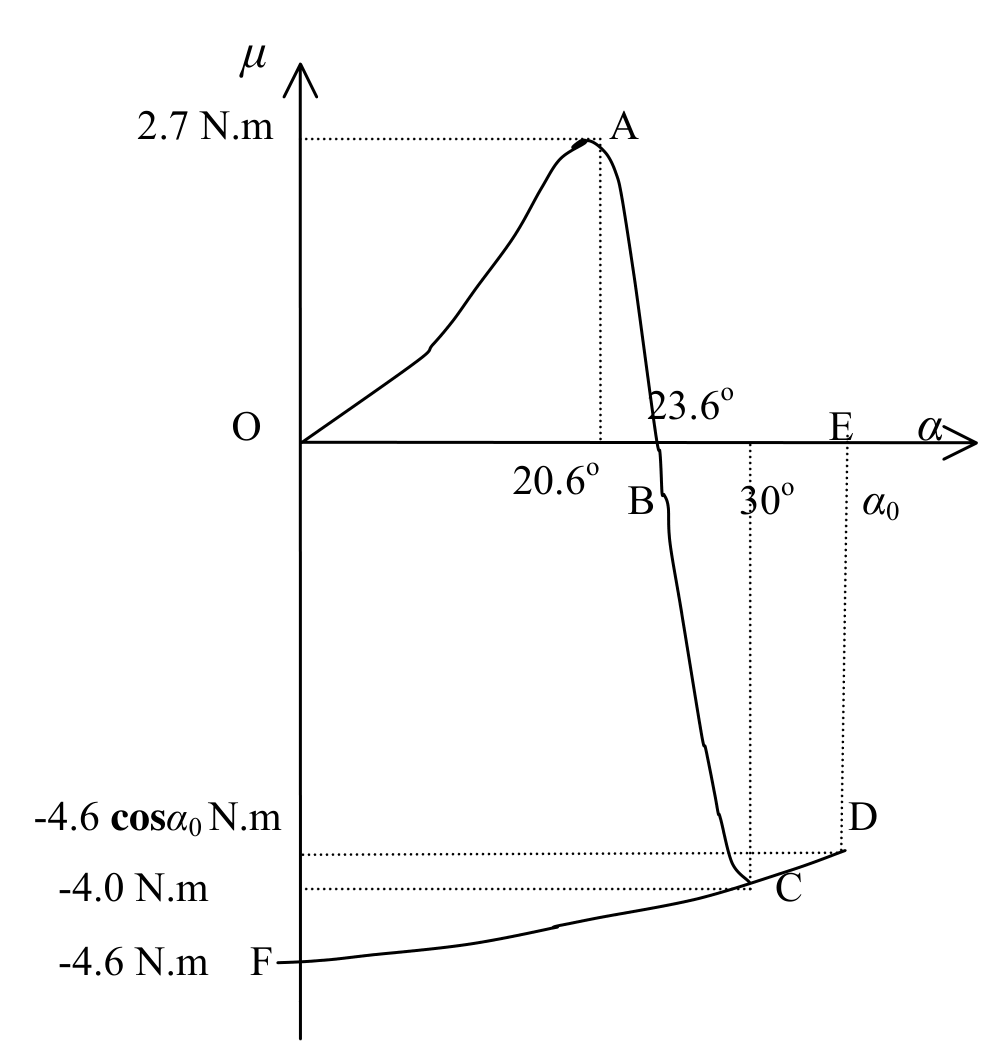
2.2. The infinitesimal work produced by the torque is . The energy obtained by the lever during one cycle due to the action of is , which is the area limited by the line . Therefore is equal to the area enclosed by the curve (OABCDFO) on the graph .
The work that the lever transfers to the mortar is the energy the lever receives as it moves from the position to the horizontal position . We have equals to the area of (OEDFO) on the graph . It is equal to (J).
2.3. The magnitudes of can be estimated from the fact that at point D the energy of the lever is zero. We have
area (OABO) = area (BEDCB)
Approximating OABO by a triangle, and BEDCB by a trapezoid, we obtain:
which implies . From this we find
Thus we find J.
3. The rest mode
3.1.
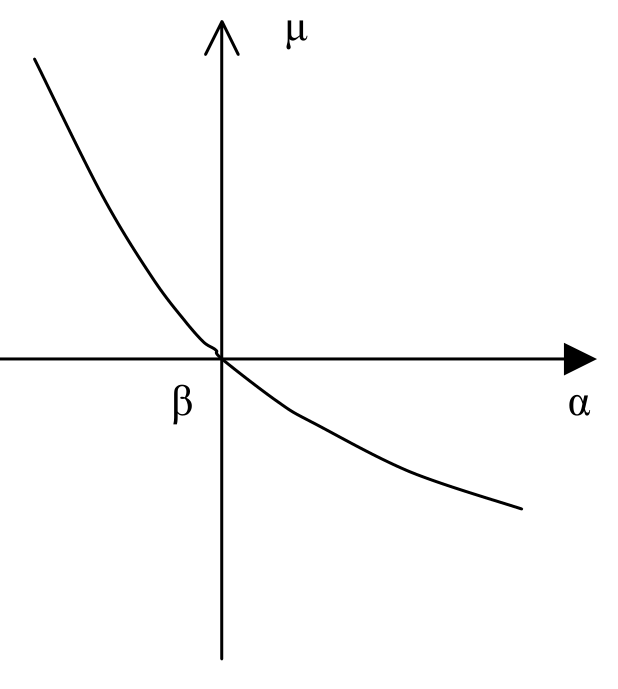
3.1.1. The bucket is always overflown with water. The two branches of in the vicinity of corresponding to increasing and decreasing coincide with each other.
The graph implies that is a stable equilibrium of the mortar.
3.1.2. Find the expression for the torque when the tilt angle is ( is small ).
The mass of water in bucket when the lever tilts with angle is , where . A simple calculation shows that when increases from to , the mass of water increases by . The torque acting on the lever when the tilt is equals the torque due to .
We have . TN is found from the equilibrium condition of the lever at tilting angle :
We find at the end .
3.1.3. Equation of motion of the lever
where , , and is the sum of moments of inertia of the lever and of the water in bucket relative to the axis T. Here is not constant the amount of water in the bucket depends on . When is small, one can consider the amount and the shape of water in the bucket to be constant, so is approximately a constant. Consider water in bucket as a material point with mass 0.6 kg, a simple calculation gives . We have . That is the equation for a harmonic oscillator with period
. The answer is therefore .
3.2 . Harmonic oscillation of lever (around ) when bucket is always overflown. Assume the lever oscillate harmonically with amplitude around . At time , , the bucket is overflown. At time the tilt changes by . We are interested in the case , i.e., the motion of lever is in the direction of decreasing , and one needs to add more water to overflow the bucket. The equation of motion is: , therefore .
For the bucket to be overflown, during this time the amount of water falling to the bucket should be at least ; is maximum at , .
The amount of water falling to the bucket is related to flow rate ; , therefore .
An overflown bucket is the necessary condition for harmonic oscillations of the lever, therefore the condition for the lever to have harmonic oscillations with amplitude or rad is with
So .
3.3 Determination of
If the bucket remains overflown when the tilt decreases to , then the amount of water in bucket should reach 1 kg at this time, and the lever oscillate harmonically with amplitude equal . The flow should exceed , therefore
This is the minimal flow rate for the rice-pounding mortar not to work .