IPhO 2008, Теория — Задача 2. CHERENKOV LIGHT AND RING IMAGING COUNTER
39th International Physics Olympiad - Hanoi - Vietnam - 2008. Theoretical Problem No. 2
Условие
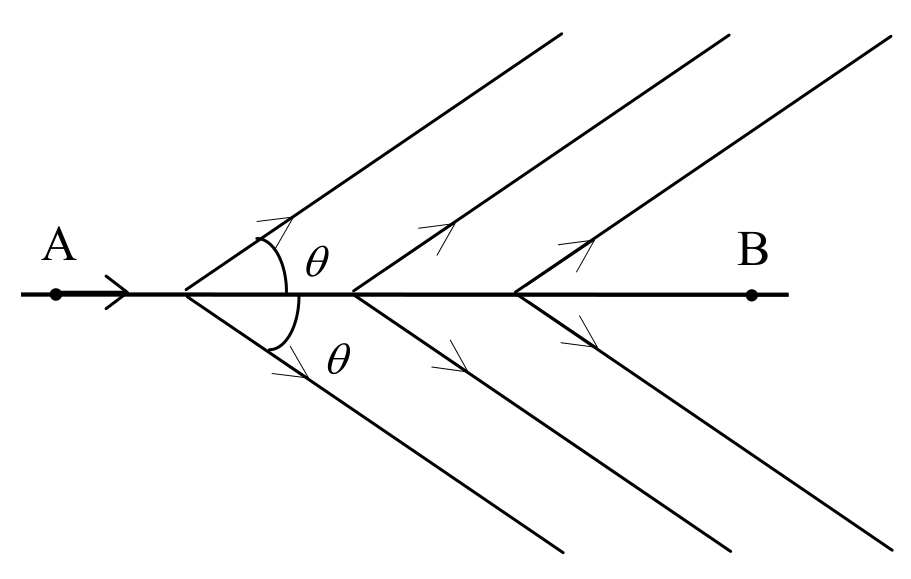
Light propagates in vacuum with the speed . There is no particle which moves with a speed higher than . However, it is possible that in a transparent medium a particle moves with a speed higher than the speed of the light in the same medium , where is the refraction index of the medium. Experiment (Cherenkov, 1934) and theory (Tamm and Frank, 1937) showed that a charged particle, moving with a speed in a transparent medium with refractive index such that , radiates light, called Cherenkov light, in directions forming with the trajectory an angle
where .
1. To establish this fact, consider a particle moving at constant velocity on a straight line. It passes A at time 0 and B at time . As the problem is symmetric with respect to rotations around AB, it is sufficient to consider light rays in a plane containing AB.
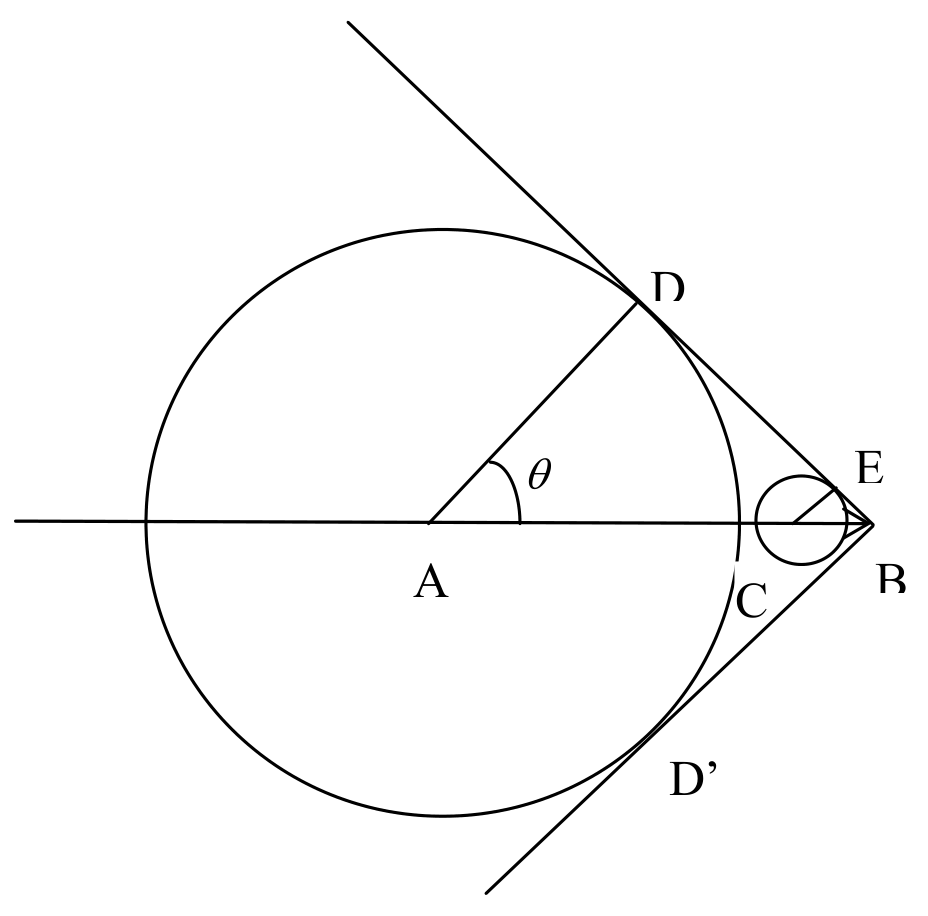
At any point C between A and B, the particle emits a spherical light wave, which propagates with velocity . We define the wave front at a given time as the envelope of all these spheres at this time.
1.1 Determine the wave front at time and draw its intersection with a plane containing the trajectory of the particle.
1.2 Express the angle between this intersection and the trajectory of the particle in terms of and .
2 Let us consider a beam of particles moving with velocity , such that the angle is small, along a straight line IS. The beam crosses a concave spherical mirror of focal length and center C, at point S. SC makes with SI a small angle (see the figure in the Answer Sheet). The particle beam creates a ring image in the focal plane of the mirror. Explain why with the help of a sketch illustrating this fact. Give the position of the center O and the radius of the ring image.
This set up is used in ring imaging Cherenkov counters (RICH) and the medium which the particle traverses is called the radiator.
Note: in all questions of the present problem, terms of second order and higher in and will be neglected.
3. A beam of particles of known momentum consists of three types of particles: protons, kaons and pions, with rest mass , and , respectively. Remember that and have the dimension of an energy, and 1 eV is the energy acquired by an electron after being accelerated by a voltage 1 V, and 1 GeV = eV, 1 MeV = eV.
The particle beam traverses an air medium (the radiator) under the pressure . The refraction index of air depends on the air pressure according to the relation where
3.1 Calculate for each of the three particle types the minimal value of the air pressure such that they emit Cherenkov light.
3.2 Calculate the pressure such that the ring image of kaons has a radius equal to one half of that corresponding to pions. Calculate the values of and in this case.
Is it possible to observe the ring image of protons under this pressure?
4. Assume now that the beam is not perfectly monochromatic: the particles momenta are distributed over an interval centered at 10 having a half width at half height . This makes the ring image broaden, correspondingly distribution has a half width at half height . The pressure of the radiator is determined in 3.2.
4.1 Calculate and , the values taken by in the pions and kaons cases.
4.2 When the separation between the two ring images, , is greater than 10 times the half-width sum , that is , it is possible to distinguish well the two ring images. Calculate the maximal value of such that the two ring images can still be well distinguished.
5. Cherenkov first discovered the effect bearing his name when he was observing a bottle of water located near a radioactive source. He saw that the water in the bottle emitted light.
5.1 Find out the minimal kinetic energy of a particle with a rest mass moving in water, such that it emits Cherenkov light. The index of refraction of water is .
5.2 The radioactive source used by Cherenkov emits either α particles (i.e. helium nuclei) having a rest mass or β particles (i.e. electrons) having a rest mass . Calculate the numerical values of for α particles and β particles.
Knowing that the kinetic energy of particles emitted by radioactive sources never exceeds a few MeV, find out which particles give rise to the radiation observed by Cherenkov.
6. In the previous sections of the problem, the dependence of the Cherenkov effect on wavelength has been ignored. We now take into account the fact that the Cherenkov radiation of a particle has a broad continuous spectrum including the visible range (wavelengths from 0.4 μm to 0.8 μm). We know also that the index of refraction of the radiator decreases linearly by 2% of when increases over this range.
6.1 Consider a beam of pions with definite momentum of moving in air at pressure 6 atm. Find out the angular difference associated with the two ends of the visible range.
6.2 On this basis, study qualitatively the effect of the dispersion on the ring image of pions with momentum distributed over an interval centered at and having a half width at half height .
6.2.1 Calculate the broadening due to dispersion (varying refraction index) and that due to achromaticity of the beam (varying momentum).
6.2.2 Describe how the color of the ring changes when going from its inner to outer edges by checking the appropriate boxes in the Answer Sheet.
Отговори
1.1 The wave front is the cone of summit B; its intersection with the plane is two straight lines, BD and BD'.
1.2
2 The ring image has its center at O on the line through C parallel to IS, with FO = fα, and radius r = MO = fθ.
3.1 Pmin = 16 atm for protons, 4.6 atm for kaons, 0.36 atm for pions.
3.2 P1/2 = 6 atm; θκ = 1.6°, θπ = 3.2°; the proton ring is not observed since 6 atm < 16 atm.
4.1 Δθκ/Δp = 0.51 °/(GeV/c); Δθπ/Δp = 0.02 °/(GeV/c).
4.2 0.3 GeV/c
5.1
5.2 Tmin = 1.96 GeV for α particles and 0.264 MeV for electrons; the radiation observed by Cherenkov is due to electrons (β particles).
6.1 0.033 °
6.2.1 Dispersion: ½δθ = 0.017°; achromaticity: 0.006°, three times smaller.
In the official solution these results are numbered 6.2.1 and 6.2.2.
6.2.2 From red to white then blue, from the inner edge to the outer one.
In the official solution this result is numbered 6.2.3.
Решение
1.
Let us consider a plane containing the particle trajectory. At , the particle position is at point A. It reaches point B at . According to the Huygens principle, at moment , the radiation emitted at A reaches the circle with a radius equal to AD and the one emitted at C reaches the circle of radius CE. The radii of the spheres are proportional to the distance of their centre to B:
The spheres are therefore transformed into each other by homothety of vertex B and their envelope is the cone of summit B and half aperture , where is the angle made by the light ray CE with the particle trajectory.
1.1. The intersection of the wave front with the plane is two straight lines, BD and BD'.
1.2. They make an angle with the particle trajectory.
2. The construction for finding the ring image of the particles beam is taken in the plane containing the trajectory of the particle and the optical axis of the mirror.
We adopt the notations:
S – the point where the beam crosses the spherical mirror
F – the focus of the spherical mirror
C – the center of the spherical mirror
IS – the straight-line trajectory of the charged particle making a small angle with the optical axis of the mirror.
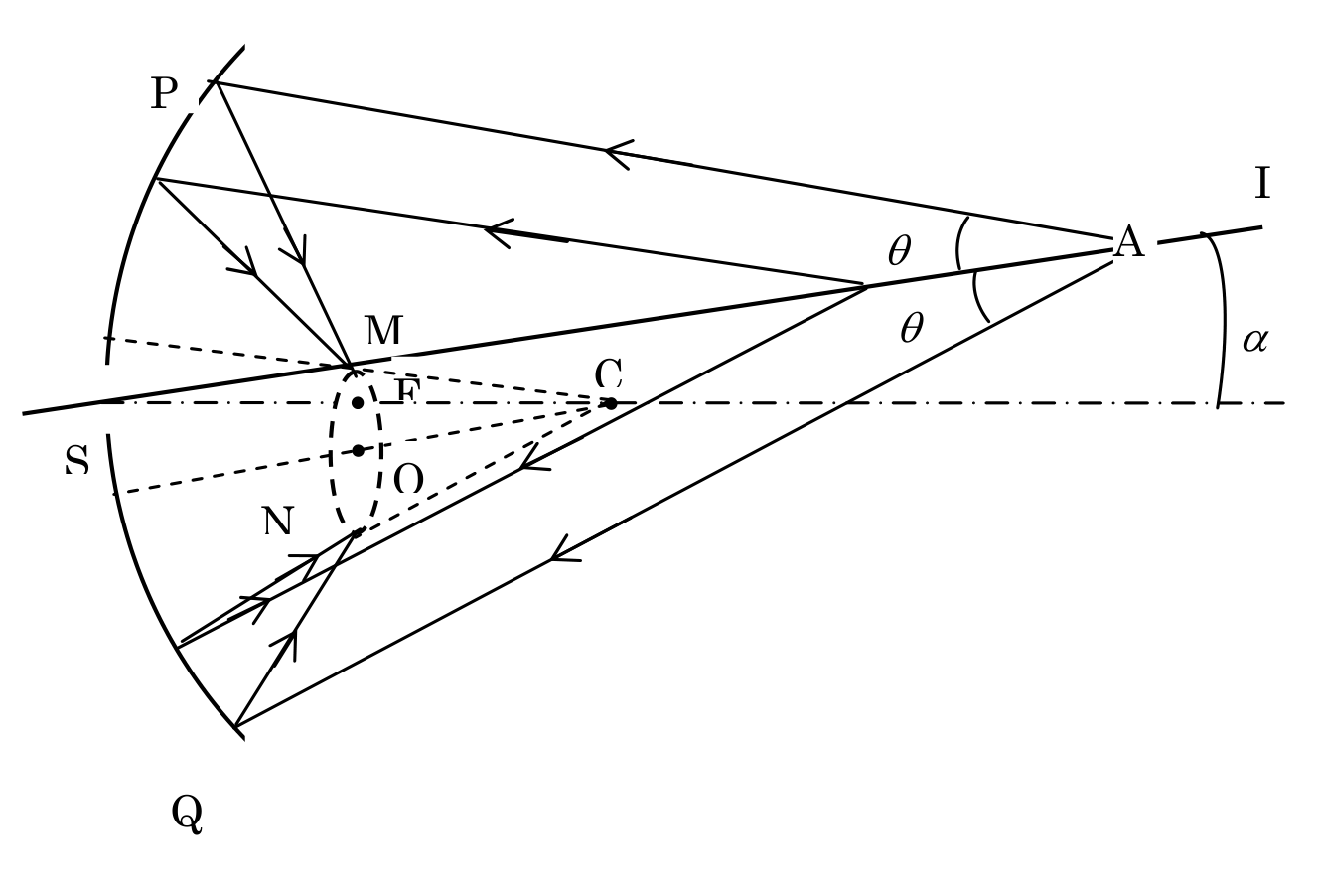
CF = FS =
CO//IS
CM//AP
CN//AQ
We draw a straight line parallel to IS passing through the center C. The line intersects the focal plane at O. We have FO .
Starting from C, we draw two lines in both sides of the line CO making with it an angle . These two lines intersect the focal plane at M and N, respectively. All the rays of Cherenkov radiation in the plane of the sketch, striking the mirror and being reflected, intersect at M or N.
In three-dimension case, the Cherenkov radiation gives a ring in the focal plane with the center at O (FO ) and with the radius MO .
In the construction, all the lines are in the plane of the sketch. Exceptionally, the ring is illustrated spatially by a dash line.
3.
3.1. For the Cherenkov effect to occur it is necessary that , that is .
Putting , we get
Because
then = 0.094 ; 0.05 ; 0.014 for proton, kaon and pion, respectively.
From (2) we can express through as
Since for all three kinds of particles we can neglect the terms of order higher than 2 in . We get
Putting (3b) into (1), we obtain
We get the following numerical values of the minimal pressure:
for protons,
for kaons,
for pions.
3.2. For we have
We denote
From (5) we obtain
Substituting and into (7), we get approximately:
The corresponding value of refraction index is = 1.00162. We get:
; .
We do not observe the ring image of protons since
for protons.
4.
4.1. Taking logarithmic differentiation of both sides of the equation , we obtain
Logarithmically differentiating equation (3a) gives
Combining (8) and (9), taking into account (3b) and putting approximately , we derive
We obtain
-for kaons , , and so, ,
-for pions , , and .
4.2. .
The condition for two ring images to be distinguishable is .
It follows .
5.
5.1. The lower limit of giving rise to Cherenkov effect is
The kinetic energy of a particle having rest mass and energy is given by the expression
Substituting the limiting value (11) of into (12), we get the minimal kinetic energy of the particle for Cherenkov effect to occur:
5.2.
For α particles, .
For electrons, .
Since the kinetic energy of the particles emitted by radioactive source does not exceed a few MeV, these are electrons which give rise to Cherenkov radiation in the considered experiment.
6. For a beam of particles having a definite momentum the dependence of the angle on the refraction index of the medium is given by the expression
6.1. Let be the difference of between two rings corresponding to two wavelengths limiting the visible range, i.e. to wavelengths of 0.4 μm (violet) and 0.8 μm (red), respectively. The difference in the refraction indexes at these wavelengths is .
Logarithmically differentiating both sides of equation (14) gives
Corresponding to the pressure of the radiator = 6 atm we have from 4.2. the values , = 1.00162.
Putting approximately and = 1, we get .
6.2.
6.2.1. The broadening due to dispersion in terms of half width at half height is, according to (6.1), .
6.2.2. The broadening due to achromaticity is, from 4.1., , that is three times smaller than above.
6.2.3. The color of the ring changes from red to white then blue from the inner edge to the outer one.