IPhO 2008, Теория — Задача 3. CHANGE OF AIR TEMPERATURE WITH ALTITUDE, ATMOSPHERIC STABILITY AND AIR POLLUTION
39th International Physics Olympiad - Hanoi - Vietnam - 2008. Theoretical Problem No. 3
Условие
Vertical motion of air governs many atmospheric processes, such as the formation of clouds and precipitation and the dispersal of air pollutants. If the atmosphere is stable, vertical motion is restricted and air pollutants tend to be accumulated around the emission site rather than dispersed and diluted. Meanwhile, in an unstable atmosphere, vertical motion of air encourages the vertical dispersal of air pollutants. Therefore, the pollutants’ concentrations depend not only on the strength of emission sources but also on the stability of the atmosphere.
We shall determine the atmospheric stability by using the concept of air parcel in meteorology and compare the temperature of the air parcel rising or sinking adiabatically in the atmosphere to that of the surrounding air. We will see that in many cases an air parcel containing air pollutants and rising from the ground will come to rest at a certain altitude, called a mixing height. The greater the mixing height, the lower the air pollutant concentration. We will evaluate the mixing height and the concentration of carbon monoxide emitted by motorbikes in the Hanoi metropolitan area for a morning rush hour scenario, in which the vertical mixing is restricted due to a temperature inversion (air temperature increases with altitude) at elevations above 119 m.
Let us consider the air as an ideal diatomic gas, with molar mass .
Quasi equilibrium adiabatic transformation obey the equation , where is the ratio between isobaric and isochoric heat capacities of the gas.
The student may use the following data if necessary:
The universal gas constant is .
The atmospheric pressure on ground is
The acceleration due to gravity is constant,
The molar isobaric heat capacity is for air.
The molar isochoric heat capacity is for air.
Mathematical hints
a.
b. The solution of the differential equation (with and constant) is where is the solution of the differential equation .
c.
1. Change of pressure with altitude.
1.1 Assume that the temperature of the atmosphere is uniform and equal to . Write down the expression giving the atmospheric pressure as a function of the altitude .
1.2. Assume that the temperature of the atmosphere varies with the altitude according to the relation
where is a constant, called the temperature lapse rate of the atmosphere (the vertical gradient of temperature is ).
1.2.1 Write down the expression giving the atmospheric pressure as a function of the altitude .
1.2.2 A process called free convection occurs when the air density increases with altitude. At which values of does the free convection occur?
2. Change of the temperature of an air parcel in vertical motion
Consider an air parcel moving upward and downward in the atmosphere. An air parcel is a body of air of sufficient dimension, several meters across, to be treated as an independent thermodynamical entity, yet small enough for its temperature to be considered uniform. The vertical motion of an air parcel can be treated as a quasi adiabatic process, i.e. the exchange of heat with the surrounding air is negligible. If the air parcel rises in the atmosphere, it expands and cools. Conversely, if it moves downward, the increasing outside pressure will compress the air inside the parcel and its temperature will increase.
As the size of the parcel is not large, the atmospheric pressure at different points on the parcel boundary can be considered to have the same value , with - the altitude of the parcel center. The temperature in the parcel is uniform and equals to , which is generally different from the temperature of the surrounding air . In parts 2.1 and 2.2, we do not make any assumption about the form of .
2.1 The change of the parcel temperature with altitude is defined by . Derive the expression of .
2.2. Consider a special atmospheric condition in which at any altitude the temperature of the atmosphere equals to that of the parcel , . We use to denote the value of when , that is (with ). is called dry adiabatic lapse rate.
2.2.1 Derive the expression of
2.2.2 Calculate the numerical value of .
2.2.3 Derive the expression of the atmospheric temperature as a function of the altitude.
2.3 Assume that the atmospheric temperature depends on altitude according to the relation , where is a constant. Find the dependence of the parcel temperature on altitude .
2.4 Write down the approximate expression of when and .
3. The atmospheric stability.
In this part, we assume that changes linearly with altitude.
3.1 Consider an air parcel initially in equilibrium with its surrounding air at altitude , i.e. it has the same temperature as that of the surrounding air. If the parcel is moved slightly up and down (e.g. by atmospheric turbulence), one of the three following cases may occur:
- The air parcel finds its way back to the original altitude , the equilibrium of the parcel is stable. The atmosphere is said to be stable.
- The parcel keeps moving in the original direction, the equilibrium of the parcel is unstable. The atmosphere is unstable.
- The air parcel remains at its new position, the equilibrium of the parcel is indifferent. The atmosphere is said to be neutral.
What is the condition on for the atmosphere to be stable, unstable or neutral?
3.2 A parcel has its temperature on ground higher than the temperature of the surrounding air. The buoyancy force will make the parcel rise. Derive the expression for the maximal altitude the parcel can reach in the case of a stable atmosphere in terms of and .
4. The mixing height
4.1 Table 1 shows air temperatures recorded by a radio sounding balloon at 7: 00 am on a November day in Hanoi. The change of temperature with altitude can be approximately described by the formula with different lapse rates in the three layers , and .
Consider an air parcel with temperature ascending from ground. On the basis of the data given in Table 1 and using the above linear approximation, calculate the temperature of the parcel at the altitudes of 96 m and 119 m.
4.2 Determine the maximal elevation the parcel can reach, and the temperature of the parcel.
is called the mixing height. Air pollutants emitted from ground can mix with the air in the atmosphere (e.g. by wind, turbulence and dispersion) and become diluted within this layer.
Table 1
Data recorded by a radio sounding balloon at 7:00 am on a November day in Hanoi.
| Altitude, m | Temperature, °C |
|---|---|
| 5 | 21.5 |
| 60 | 20.6 |
| 64 | 20.5 |
| 69 | 20.5 |
| 75 | 20.4 |
| 81 | 20.3 |
| 90 | 20.2 |
| 96 | 20.1 |
| 102 | 20.1 |
| 109 | 20.1 |
| 113 | 20.1 |
| 119 | 20.1 |
| 128 | 20.2 |
| 136 | 20.3 |
| 145 | 20.4 |
| 153 | 20.5 |
| 159 | 20.6 |
| 168 | 20.8 |
| 178 | 21.0 |
| 189 | 21.5 |
| 202 | 21.8 |
| 215 | 22.0 |
| 225 | 22.1 |
| 234 | 22.2 |
| 246 | 22.3 |
| 257 | 22.3 |
5. Estimation of carbon monoxide (CO) pollution during a morning motorbike rush hour in Hanoi.
Hanoi metropolitan area can be approximated by a rectangle with base dimensions and as shown in the figure, with one side taken along the south-west bank of the Red River.
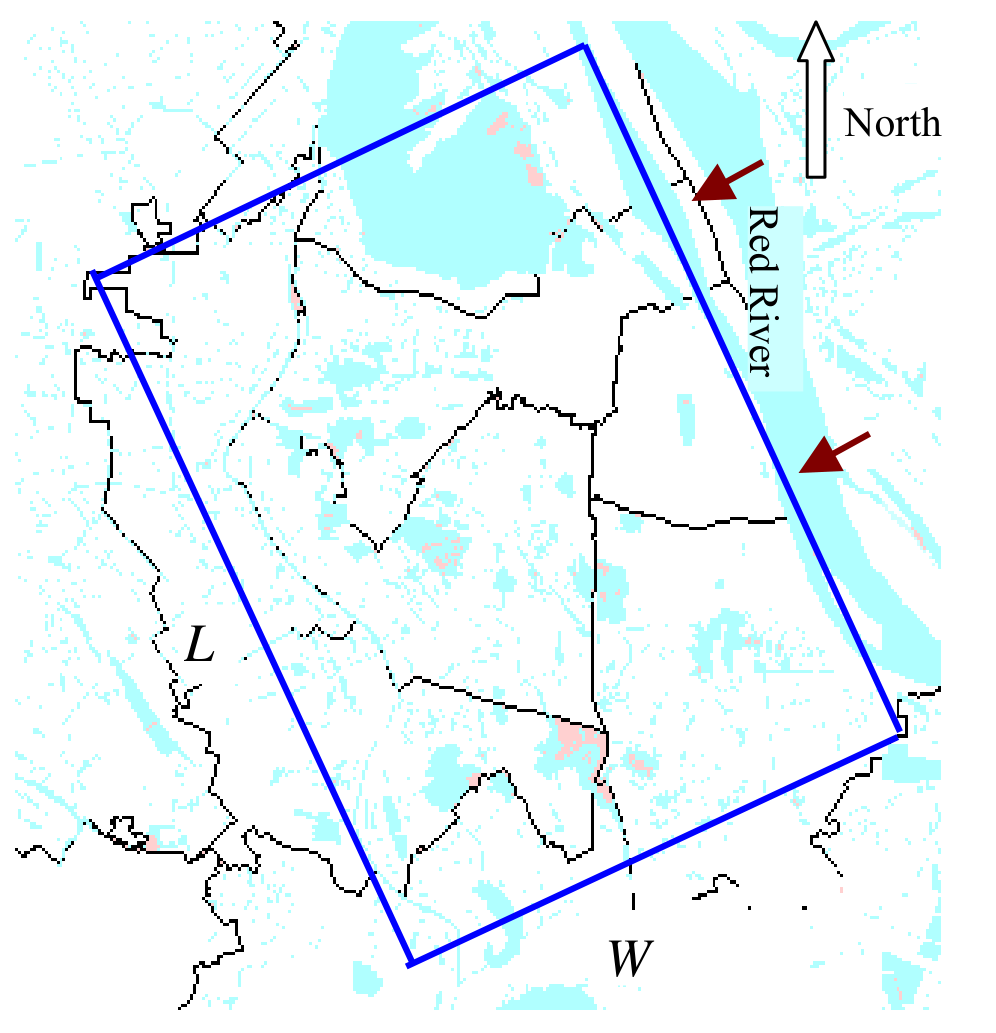
It is estimated that during the morning rush hour, from 7:00 am to 8:00 am, there are 8x10 motorbikes on the road, each running on average 5 km and emitting 12 g of CO per kilometer. The amount of CO pollutant is approximately considered as emitted uniformly in time, at a constant rate during the rush hour. At the same time, the clean north-east wind blows perpendicularly to the Red River (i.e. perpendicularly to the sides of the rectangle) with velocity , passes the city with the same velocity, and carries a part of the CO-polluted air out of the city atmosphere.
Also, we use the following rough approximate model:
- The CO spreads quickly throughout the entire volume of the mixing layer above the Hanoi metropolitan area, so that the concentration of CO at time can be assumed to be constant throughout that rectangular box of dimensions , and .
- The upwind air entering the box is clean and no pollution is assumed to be lost from the box through the sides parallel to the wind.
- Before 7:00 am, the CO concentration in the atmosphere is negligible.
5.1 Derive the differential equation determining the CO pollutant concentration as a function of time.
5.2 Write down the solution of that equation for .
5.3 Calculate the numerical value of the concentration at 8:00 a.m.
Given , , .
Отговори
1.1
1.2.1
1.2.2
2.1
2.2.1
2.2.2 0.00978 K/m
The official solution also gives Γ ≈ 10⁻² K/m.
2.2.3
2.3
2.4
3.1 Λ < Γ: stable; Λ > Γ: unstable; Λ = Γ: neutral.
3.2
4.1 Tparcel(96 m) = 294.04 K ≈ 294.0 K (21.0 °C); Tparcel(119 m) = 293.81 K (20.8 °C).
4.2 H = 119 + 23 = 142 m; Tparcel(142 m) = 293.6 K (20.6 °C).
5.1
5.2
5.3 2.3 mg/m³
Решение
Solution
1. For an altitude change , the atmospheric pressure change is :
where is the acceleration of gravity, considered constant, is the specific mass of air, which is considered as an ideal gas:
Put this expression in (1) :
1.1. If the air temperature is uniform and equals , then
After integration, we have :
1.2. If
then
1.2.1. Knowing that :
by integrating both members of (4), we obtain :
1.2.2. The free convection occurs if:
The ratio of specific masses can be expressed as follows:
The last term is larger than unity if its exponent is negative:
Then :
2. In vertical motion, the pressure of the parcel always equals that of the surrounding air, the latter depends on the altitude. The parcel temperature depends on the pressure.
2.1. We can write:
is simultaneously the pressure of air in the parcel and that of the surrounding air.
Expression for
By using the equation for adiabatic processes and equation of state, we can deduce the equation giving the change of pressure and temperature in a quasi-equilibrium adiabatic process of an air parcel:
where is the ratio of isobaric and isochoric thermal capacities of air. By logarithmic differentiation of the two members of (6), we have:
Or
Note: we can use the first law of thermodynamic to calculate the heat received by the parcel in an elementary process: , this heat equals zero in an adiabatic process. Furthermore, using the equation of state for air in the parcel we can derive (6)
Expression for
From (1) we can deduce:
where is the temperature of the surrounding air.
On the basis of these two expressions, we derive the expression for :
In general, is not a constant.
2.2.
2.2.1. If at any altitude, , then instead of in (8), we have :
or
2.2.2. Numerical value:
2.2.3. Thus, the expression for the temperature at the altitude in this special atmosphere (called adiabatic atmosphere) is :
2.3. Search for the expression of
Substitute in (7) by its expression given in (3), we have:
Integration gives:
Finally, we obtain:
2.4.
From (11) we obtain
If , then by putting , we obtain
hence,
3. Atmospheric stability
In order to know the stability of atmosphere, we can study the stability of the equilibrium of an air parcel in this atmosphere.
At the altitude , where , the air parcel is in equilibrium. Indeed, in this case the specific mass of air in the parcel equals - that of the surrounding air in the atmosphere. Therefore, the buoyant force of the surrounding air on the parcel equals the weight of the parcel. The resultant of these two forces is zero.
Remember that the temperature of the air parcel is given by (7), in which we can assume approximately at any altitude near .
Now, consider the stability of the air parcel equilibrium:
Suppose that the air parcel is lifted into a higher position, at the altitude (with ), and .
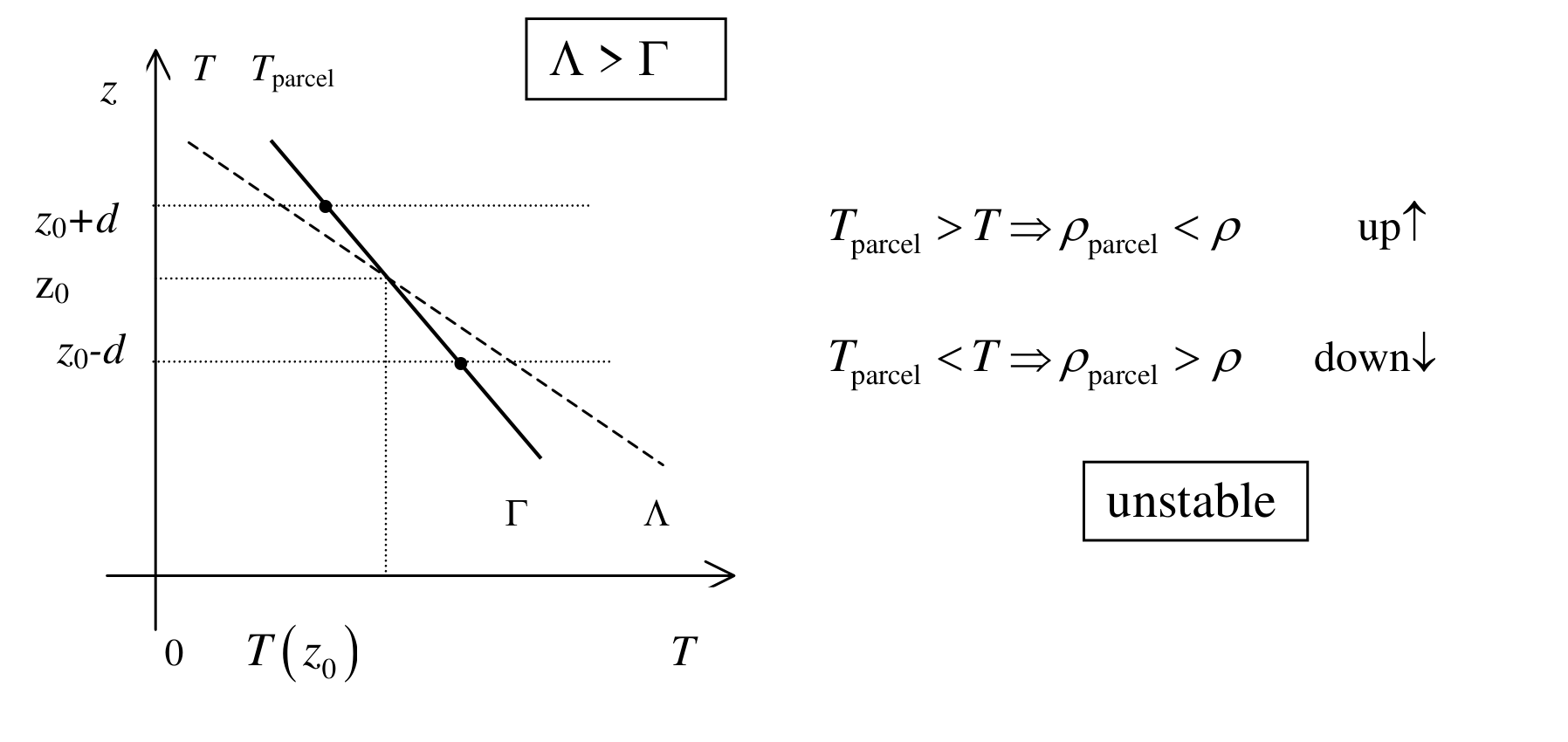
- In the case the atmosphere has temperature lapse rate , we have , then . The buoyant force is then larger than the air parcel weight, their resultant is oriented upward and tends to push the parcel away from the equilibrium position.
Conversely, if the air parcel is lowered to the altitude (), and then .
The buoyant force is then smaller than the air parcel weight; their resultant is oriented downward and tends to push the parcel away from the equilibrium position (see Figure 1)
So the equilibrium of the parcel is unstable, and we found that: An atmosphere with a temperature lapse rate is unstable.
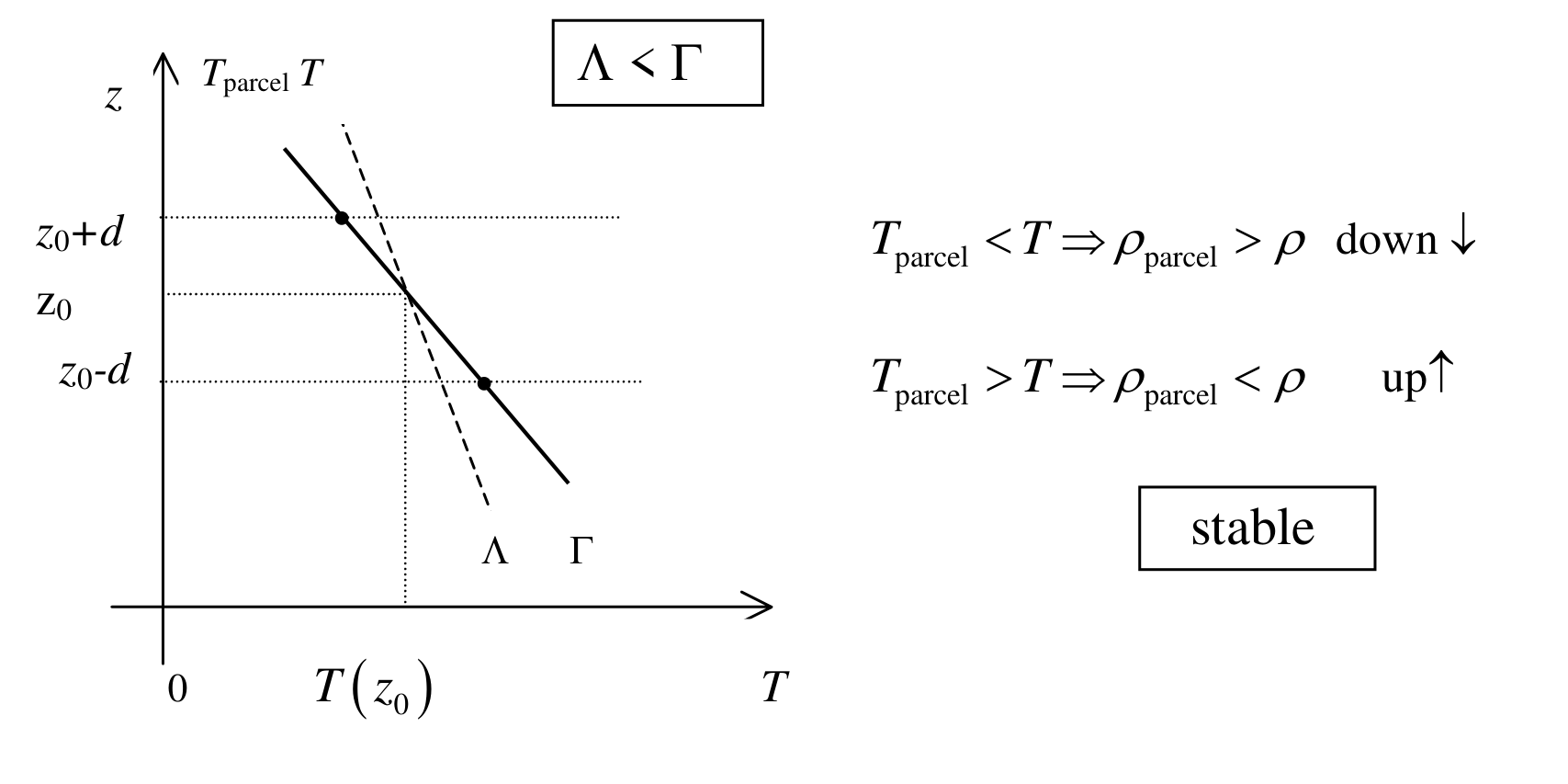
- In an atmosphere with temperature lapse rate , if the air parcel is lifted to a higher position, at altitude (with ), , then . The buoyant force is then smaller than the air parcel weight, their resultant is oriented downward and tends to push the parcel back to the equilibrium position.
Conversely, if the air parcel is lowered to altitude (), and then . The buoyant force is then larger than the air parcel weight, their resultant is oriented upward and tends to push the parcel also back to the equilibrium position (see Figure 2).
So the equilibrium of the parcel is stable, and we found that: An atmosphere with a temperature lapse rate is stable.
- In an atmosphere with lapse rate , if the parcel is brought from equilibrium position and put in any other position, it will stay there, the equilibrium is indifferent. An atmosphere with a temperature lapse rate is neutral
3.2. In a stable atmosphere, with , a parcel, which on ground has temperature and pressure equal to that of the atmosphere, can rise and reach a maximal altitude , where .
In vertical motion from the ground to the altitude , the air parcel realizes an adiabatic quasi-static process, in which its temperature changes from to . Using (11), we can write:
So that the maximal altitude has the following expression:
4.
Using data from the Table, we obtain the plot of versus shown in Figure 3.
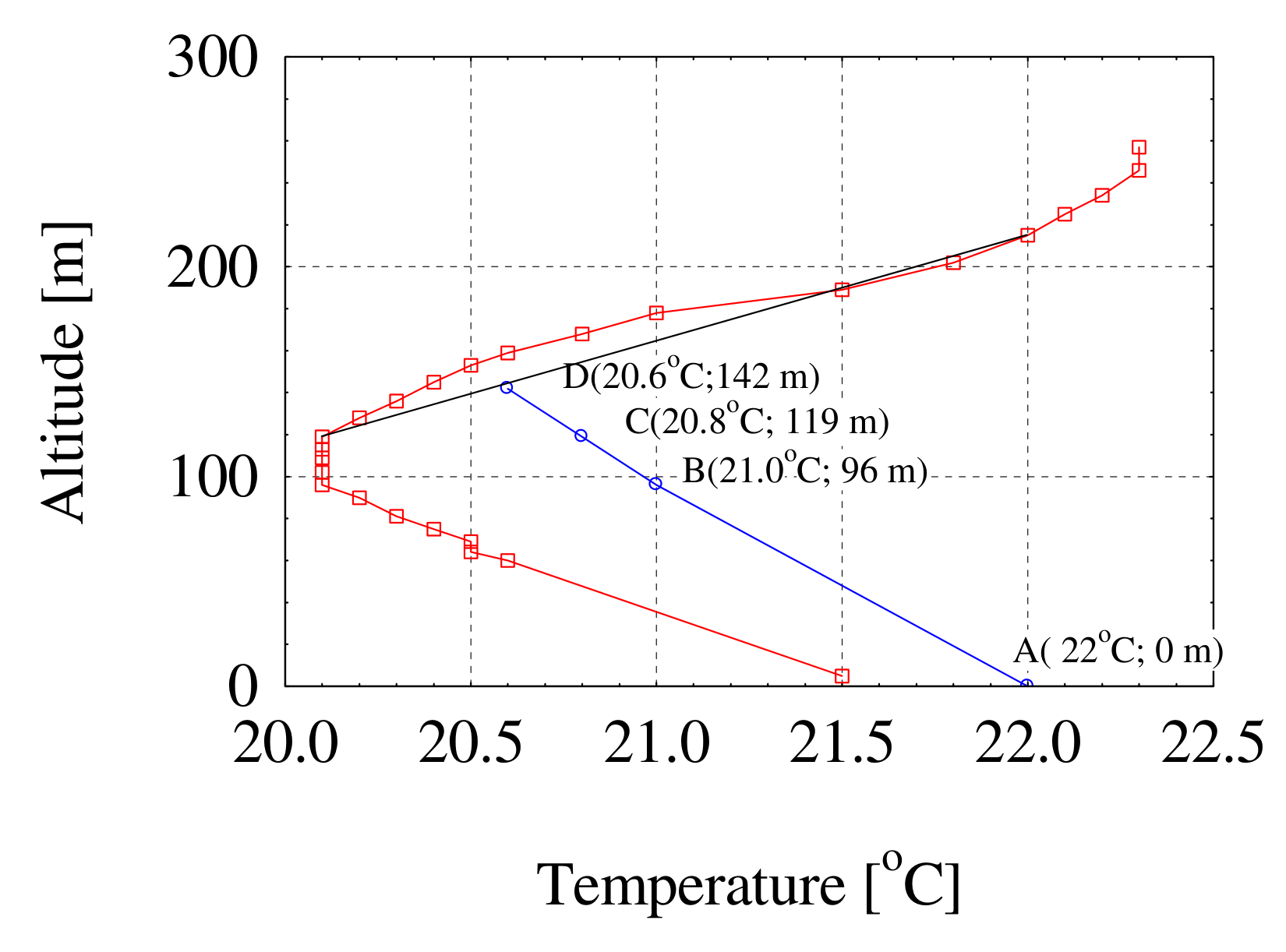
4.1. We can divide the atmosphere under 200m into three layers, corresponding to the following altitudes:
, .
, , isothermal layer.
, .
In the layer 1), the parcel temperature can be calculated by using (11)
In the layer 2), the parcel temperature can be calculated by using its expression in isothermal atmosphere .
The altitude 96 m is used as origin, corresponding to 0 m. The altitude 119 m corresponds to 23 m. We obtain the following value for parcel temperature:
4.2. In the layer 3), starting from 119 m, by using (13) we find the maximal elevation = 23 m, and the corresponding temperature 293.6 K (or 20.6 C).
Finally, the mixing height is
= 119 + 23 = 142 m.
And
From this relation, we can find and .
Note: By using approximate expression (12) we can easily find and 293.8 K at elevations 96 m and 119 m, respectively. At 119 m elevation, the difference between parcel and surrounding air temperatures is 0.7 K (= 293.8 – 293.1), so that the maximal distance the parcel will travel in the third layer is m.
5.
Consider a volume of atmosphere of Hanoi metropolitan area being a parallelepiped with height , base sides and . The emission rate of CO gas by motorbikes from 7:00 am to 8:00 am
= 800 000 × 5 × 12 /3600 = 13 300 g/s
The CO concentration in air is uniform at all points in the parallelepiped and denoted by .
5.1. After an elementary interval of time , due to the emission of the motorbikes, the mass of CO gas in the box increases by . The wind blows parallel to the short sides , bringing away an amount of CO gas with mass . The remaining part raises the CO concentration by a quantity in all over the box. Therefore:
or
5.2. The general solution of (14) is :
From the initial condition , we can deduce :
5.3. Taking as origin of time the moment 7:00 am, then 8:00 am corresponds to =3600 s. Putting the given data in (15), we obtain :