IPhO 2009, Теория — Задача 2. Doppler Laser Cooling and Optical Molasses
THEORETICAL PROBLEM 2. DOPPLER LASER COOLING AND OPTICAL MOLASSES
Условие
The purpose of this problem is to develop a simple theory to understand the so-called “laser cooling” and “optical molasses” phenomena. This refers to the cooling of a beam of neutral atoms, typically alkaline, by counterpropagating laser beams with the same frequency. This is part of the Physics Nobel Prize awarded to S. Chu, P. Phillips and C. Cohen-Tannoudji in 1997.
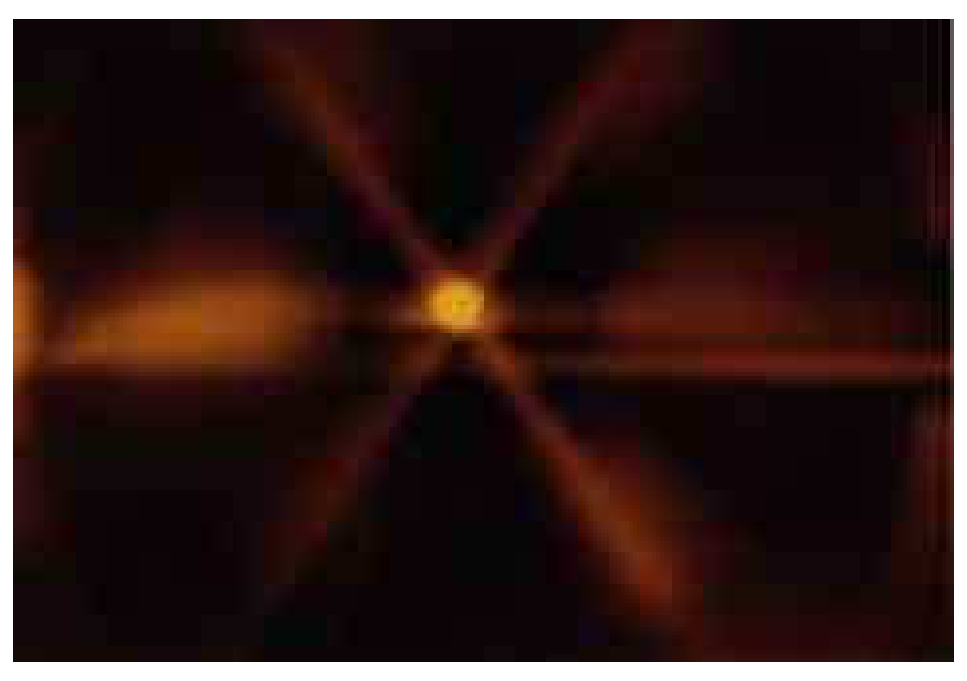
The image above shows sodium atoms (the bright spot in the center) trapped at the intersection of three orthogonal pairs of opposing laser beams. The trapping region is called “optical molasses” because the dissipative optical force resembles the viscous drag on a body moving through molasses.
In this problem you will analyze the basic phenomenon of the interaction between a photon incident on an atom and the basis of the dissipative mechanism in one dimension.
PART I: BASICS OF LASER COOLING
Consider an atom of mass moving in the direction with velocity . For simplicity, we shall consider the problem to be one-dimensional, namely, we shall ignore the and directions (see figure 1). The atom has two internal energy levels. The energy of the lowest state is considered to be zero and the energy of the excited state to be , where . The atom is initially in the lowest state. A laser beam with frequency in the laboratory is directed in the direction and it is incident on the atom. Quantum mechanically the laser is composed of a large number of photons, each with energy and momentum . A photon can be absorbed by the atom and later spontaneously emitted; this emission can occur with equal probabilities along the and directions. Since the atom moves at non-relativistic speeds, (with the speed of light) keep terms up to first order in this quantity only. Consider also , namely, that the momentum of the atom is much larger than the momentum of a single photon. In writing your answers, keep only corrections linear in either of the above quantities.
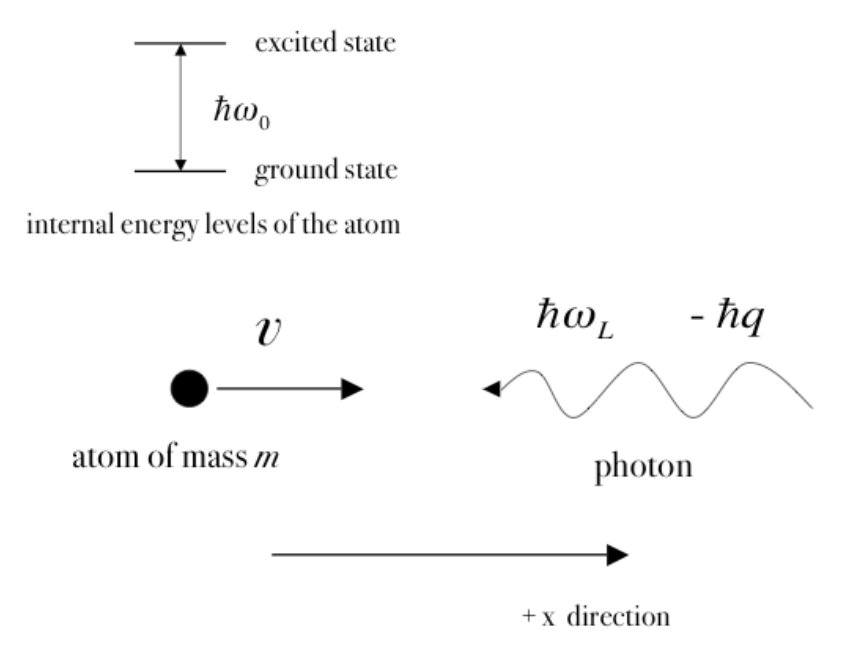
Assume that the laser frequency is tuned such that, as seen by the moving atom, it is in resonance with the internal transition of the atom. Answer the following questions:
1. Absorption.
1a Write down the resonance condition for the absorption of the photon. [0,2 т.]
1b Write down the momentum of the atom after absorption, as seen in the laboratory. [0,2 т.]
1c Write down the total energy of the atom after absorption, as seen in the laboratory. [0,2 т.]
2. Spontaneous emission of a photon in the direction.
At some time after the absorption of the incident photon, the atom may emit a photon in the direction.
2a Write down the energy of the emitted photon, , after the emission process in the direction, as seen in the laboratory. [0,2 т.]
2b Write down the momentum of the emitted photon , after the emission process in the direction, as seen in the laboratory. [0,2 т.]
2c Write down the momentum of the atom , after the emission process in the direction, as seen in the laboratory. [0,2 т.]
2d Write down the total energy of the atom , after the emission process in the direction, as seen in the laboratory. [0,2 т.]
3. Spontaneous emission of a photon in the direction.
At some time after the absorption of the incident photon, the atom may instead emit a photon in the direction.
3a Write down the energy of the emitted photon, , after the emission process in the direction, as seen in the laboratory. [0,2 т.]
3b Write down the momentum of the emitted photon , after the emission process in the direction, as seen in the laboratory. [0,2 т.]
3c Write down the momentum of the atom , after the emission process in the direction, as seen in the laboratory. [0,2 т.]
3d Write down the total energy of the atom , after the emission process in the direction, as seen in the laboratory. [0,2 т.]
4. Average emission after the absorption.
The spontaneous emission of a photon in the or in the directions occurs with the same probability. Taking this into account, answer the following questions.
4a Write down the average energy of an emitted photon, , after the emission process. [0,2 т.]
4b Write down the average momentum of an emitted photon , after the emission process. [0,2 т.]
4c Write down the average total energy of the atom , after the emission process. [0,2 т.]
4d Write down the average momentum of the atom , after the emission process. [0,2 т.]
5. Energy and momentum transfer.
Assuming a complete one-photon absorption-emission process only, as described above, there is a net average momentum and energy transfer between the laser radiation and the atom.
5a Write down the average energy change of the atom after a complete one-photon absorption-emission process. [0,2 т.]
5b Write down the average momentum change of the atom after a complete one-photon absorption-emission process. [0,2 т.]
6. Energy and momentum transfer by a laser beam along the direction.
Consider now that a laser beam of frequency is incident on the atom along the direction, while the atom moves also in the direction with velocity . Assuming a resonance condition between the internal transition of the atom and the laser beam, as seen by the atom, answer the following questions:
6a Write down the average energy change of the atom after a complete one-photon absorption-emission process. [0,3 т.]
6b Write down the average momentum change of the atom after a complete one-photon absorption-emission process. [0,3 т.]
PART II: DISSIPATION AND THE FUNDAMENTALS OF OPTICAL MOLASSES
Nature, however, imposes an inherent uncertainty in quantum processes. Thus, the fact that the atom can spontaneously emit a photon in a finite time after absorption, gives as a result that the resonance condition does not have to be obeyed exactly as in the discussion above. That is, the frequency of the laser beams and may have any value and the absorption-emission process can still occur. These will happen with different (quantum) probabilities and, as one should expect, the maximum probability is found at the exact resonance condition. On the average, the time elapsed between a single process of absorption and emission is called the lifetime of the excited energy level of the atom and it is denoted by .
Consider a collection of atoms at rest in the laboratory frame of reference, and a laser beam of frequency incident on them. The atoms absorb and emit continuously such that there is, on average, atoms in the excited state (and therefore, atoms in the ground state). A quantum mechanical calculation yields the following result:
where is the resonance frequency of the atomic transition and is the so-called Rabi frequency; is proportional to the intensity of the laser beam. As mentioned above, you can see that this number is different from zero even if the resonance frequency is different from the frequency of the laser beam . An alternative way of expressing the previous result is that the number of absorption-emission processes per unit of time is .
Consider the physical situation depicted in Figure 2, in which two counter propagating laser beams with the same but arbitrary frequency are incident on a gas of atoms that move in the direction with velocity .
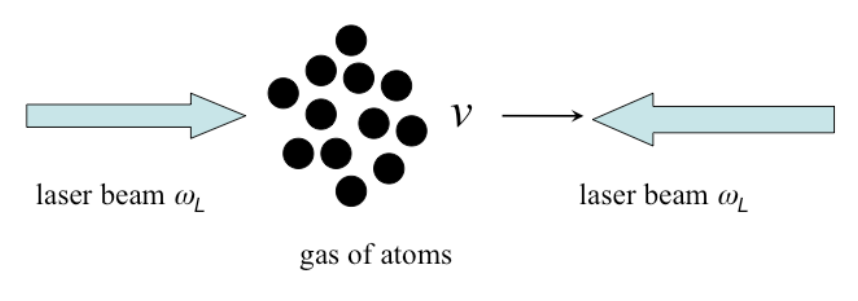
7. Force on the atomic beam by the lasers.
7a With the information found so far, find the force that the lasers exert on the atomic beam. You should assume that . [1,5 т.]
8. Low velocity limit.
Assume now that the velocity of the atoms is small enough, such that you can expand the force up to first order in .
8a Find an expression for the force found in Question (7a), in this limit. [1,5 т.]
Using this result, you can find the conditions for speeding up, slowing down, or no effect at all on the atoms by the laser radiation.
8b Write down the condition to obtain a positive force (speeding up the atoms). [0,25 т.]
8c Write down the condition to obtain a zero force. [0,25 т.]
8d Write down the condition to obtain a negative force (slowing down the atoms). [0,25 т.]
8e Consider now that the atoms are moving with a velocity (in the direction). Write down the condition to obtain a slowing down force on the atoms. [0,25 т.]
9. Optical molasses.
In the case of a negative force, one obtains a frictional dissipative force. Assume that initially, at , the gas of atoms has velocity .
9a In the limit of low velocities, find the velocity of the atoms after the laser beams have been on for a time . [1,5 т.]
9b Assume now that the gas of atoms is in thermal equilibrium at a temperature . Find the temperature after the laser beams have been on for a time . [0,5 т.]
This model does not allow you to go to arbitrarily low temperatures.
Отговори
1a
1b
1c
2a
2b
2c
2d
3a
3b
3c
3d
4a
4b
Zero to first order (the printed result is second order).
4c
4d
5a
5b
6a
6b
7a
8a
8b
8c
8d
8e
9a
The official solution writes the result with ; is read from (8a).
9b
Решение
The key to this problem is the Doppler effect (to be precise, the longitudinal Doppler effect): The frequency of a monochromatic beam of light detected by an observer depends on its state of motion relative to the emitter, i.e. the observed frequency is
where is the relative speed of emitter and observer and the frequency of the emitter. The upper-lower signs correspond, respectively, when source and observer move towards or away from each other. The second equality holds in the limit of low velocities (non-relativistic limit).
The frequency of the laser in the lab is ; is the transition frequency of the atom; the atom moves with speed towards the incident direction of the laser:
It is important to point out that the results must be given to first significant order in or .
PART I: BASICS OF LASER COOLING
1. Absorption.
1a Write down the resonance condition for the absorption of the photon. [0.2]
1b Write down the momentum of the atom after absorption, as seen in the laboratory [0.2]
1c Write down the energy of the atom after absorption, as seen in the laboratory [0.2]
2. Spontaneous emission in the direction.
First, one calculates the energy of the emitted photon, as seen in the lab reference frame. One must be careful to keep the correct order; this is because the velocity of the atom changes after the absorption, however, this is second order correction for the emitted frequency:
thus,
2a Write down the energy of the emitted photon, , after the emission process in the direction, as seen in the laboratory. [0.2]
2b Write down the momentum of the emitted photon , after the emission process in the direction, as seen in the laboratory. [0.2]
Use conservation of momentum (see 1b):
2c Write down the momentum of the atom , after the emission process in the direction, as seen in the laboratory. [0.2]
2d Write down the energy of the atom , after the emission process in the direction, as seen in the laboratory. [0.2]
3. Spontaneous emission in the direction.
The same as in the previous questions, keeping the right order
3a Write down the energy of the emitted photon, , after the emission process in the direction, as seen in the laboratory. [0.2]
3b Write down the momentum of the emitted photon , after the emission process in the direction, as seen in the laboratory. [0.2]
3c Write down the momentum of the atom , after the emission process in the direction, as seen in the laboratory. [0.2]
3d Write down the energy of the atom , after the emission process in the direction, as seen in the laboratory. [0.2]
4. Average emission after absorption.
The spontaneous emission processes occur with equal probabilities in both directions.
4a Write down the average energy of an emitted photon, , after the emission process. [0.2]
4b Write down the average momentum of an emitted photon , after the emission process. [0.2]
4c Write down the average energy of the atom , after the emission process. [0.2]
4d Write down the average momentum of the atom , after the emission process. [0.2]
5. Energy and momentum transfer.
Assuming a complete one-photon absorption-emission process only, as described above, there is a net average momentum and energy transfer between the laser and the atom.
5a Write down the average energy change of the atom after a complete one-photon absorption-emission process. [0.2]
5b Write down the average momentum change of the atom after a complete one-photon absorption-emission process. [0.2]
6. Energy and momentum transfer by a laser beam along the direction.
6a Write down the average energy change of the atom after a complete one-photon absorption-emission process. [0.3]
6b Write down the average momentum change of the atom after a complete one-photon absorption-emission process. [0.3]
PART II: DISSIPATION AND THE FUNDAMENTALS OF OPTICAL MOLASSES
Two counterpropagating laser beams with the same but arbitrary frequency are incident on a beam of atoms that move in the direction with (average) velocity .
7. Force on the atomic beam by the lasers.
On the average, the fraction of atoms found in the excited state is given by,
where is the resonance frequency of the atoms and is the so-called Rabi frequency; is proportional to the intensity of the laser beam. The lifetime of the excited energy level of the atom is .
The force is calculated as the number of absorption-emission cycles, times the momentum exchange in each event, divided by the time of each event. CAREFUL! One must take into account the Doppler shift of each laser, as seen by the atoms:
7a With the information found so far, find the force that the lasers exert on the atomic beam. You must assume that . [1.5]
8. Low velocity limit.
Assume now the velocity to be small enough in order to expand the force to first order in .
8a Find an expression for the force found in Question (7a), in this limit. [1.5]
8b Write down the condition to obtain a positive force (speeding up the atom). [0.25]
8c Write down the condition to obtain a zero force. [0.25]
8d Write down the condition to obtain a negative force (slowing down the atom). [0.25]
… this is the famous rule “tune below resonance for cooling down”
8e Consider now that the atoms are moving with a velocity (in the direction). Write down the condition to obtain a slowing down force on the atoms. [0.25]
… i.e. independent of the direction motion of the atom.
9. Optical molasses
In the case of a negative force, one obtains a frictional dissipative force. Assume that initially, , the gas of atoms has velocity .
9a In the limit of low velocities, find the velocity of the atoms after the laser beams have been on for a time . [1.5]
can be read from (8a)
9b Assume now that the gas of atoms is in thermal equilibrium at a temperature . Find the temperature after the laser beams have been on for a time . [0.5]
Recalling that in 1 dimension, and using as the average thermal velocity in the equation of (9a), we can write down