IPhO 2009, Теория — Задача 3. WHY ARE STARS SO LARGE?
THEORETICAL PROBLEM No. 3. WHY ARE STARS SO LARGE?
Условие
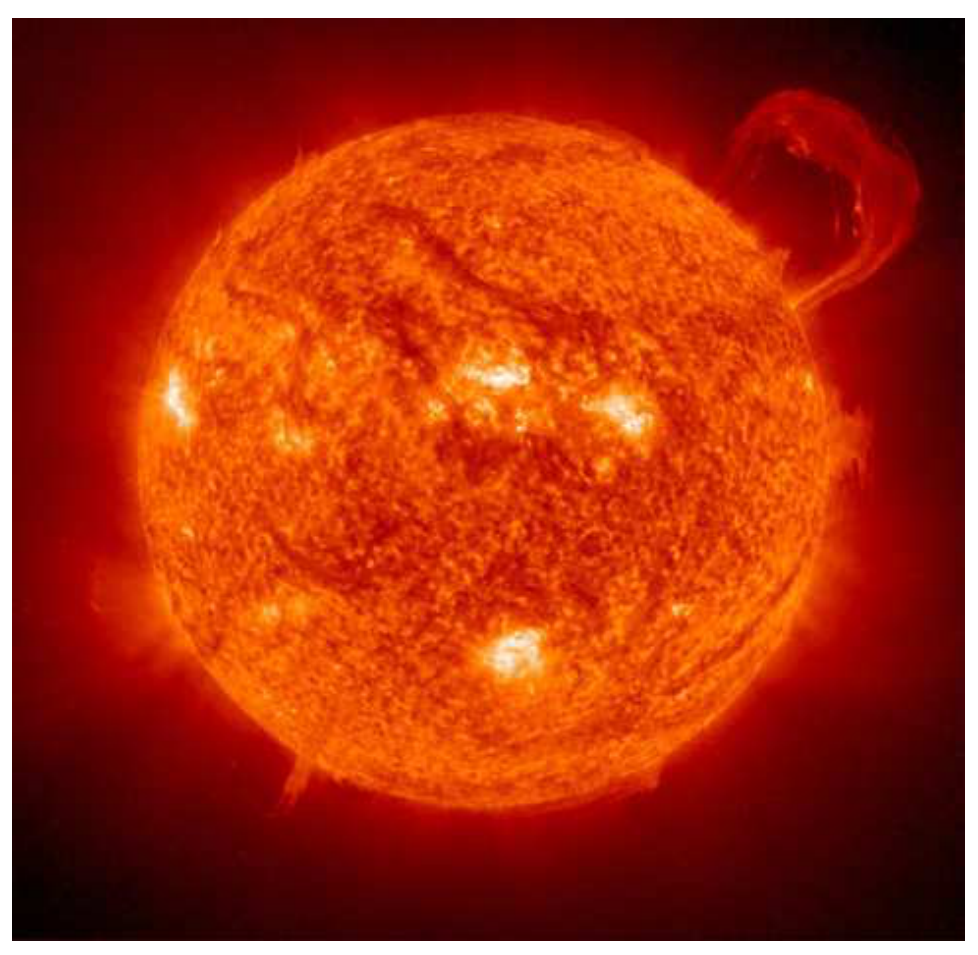
The stars are spheres of hot gas. Most of them shine because they are fusing hydrogen into helium in their central parts. In this problem we use concepts of both classical and quantum mechanics, as well as of electrostatics and thermodynamics, to understand why stars have to be big enough to achieve this fusion process and also derive what would be the mass and radius of the smallest star that can fuse hydrogen.
USEFUL CONSTANTS
Gravitational constant =
Boltzmann´s constant =
Planck’s constant =
Mass of the proton =
Mass of the electron =
Unit of electric charge =
Electric constant (vacuum permittivity) =
Radius of the Sun =
Mass of the Sun =
1. A classical estimate of the temperature at the center of the stars.
Assume that the gas that forms the star is pure ionized hydrogen (electrons and protons in equal amounts), and that it behaves like an ideal gas. From the classical point of view, to fuse two protons, they need to get as close as for the short range strong nuclear force, which is attractive, to become dominant. However, to bring them together they have to overcome first the repulsive action of Coulomb’s force. Assume classically that the two protons (taken to be point sources) are moving in an antiparallel way, each with velocity , the root-mean-square (rms) velocity of the protons, in a one-dimensional frontal collision.
1a What has to be the temperature of the gas, , so that the distance of closest approach of the protons, , equals ? Give this and all numerical values in this problem up to two significant figures. [1,5 т.]
2. Finding that the previous temperature estimate is wrong.
To check if the previous temperature estimate is reasonable, one needs an independent way of estimating the central temperature of a star. The structure of the stars is very complicated, but we can gain significant understanding making some assumptions. Stars are in equilibrium, that is, they do not expand or contract because the inward force of gravity is balanced by the outward force of pressure (see Figure 2). For a slab of gas the equation of hydrostatic equilibrium at a given distance from the center of the star, is given by
where is the pressure of the gas, the gravitational constant, the mass of the star within a sphere of radius , and is the density of the gas in the slab.
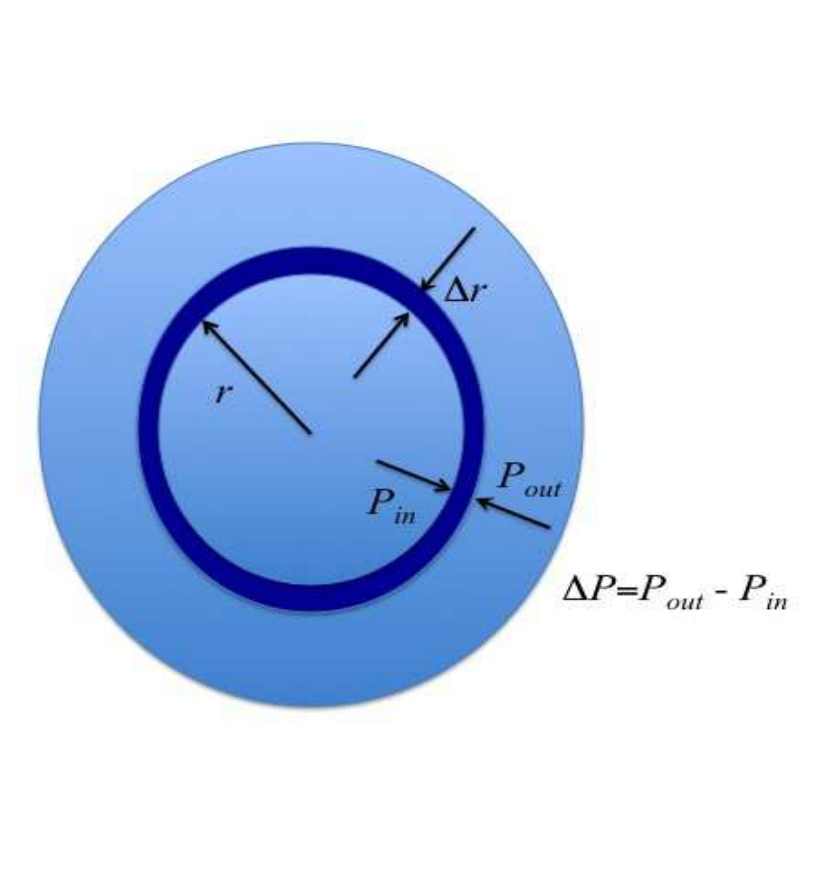
An order of magnitude estimate of the central temperature of the star can be obtained with values of the parameters at the center and at the surface of the star, making the following approximations:
where and are the pressures at the center and surface of the star, respectively.
Since , we can assume that
Within the same approximation, we can write
where is the total radius of the star, and
with the total mass of the star.
The density may be approximated by its value at the center,
You can assume that the pressure is that of an ideal gas.
2a Find an equation for the temperature at the center of the star, , in terms of the radius and mass of the star and of physical constants only. [0,5 т.]
We can use now the following prediction of this model as a criterion for its validity:
2b Using the equation found in (2a) write down the ratio expected for a star in terms of physical constants and only. [0,5 т.]
2c Use the value of derived in section (1a) and find the numerical value of the ratio expected for a star. [0,5 т.]
2d Now, calculate the ratio , and verify that this value is much smaller than the one found in (2c). [0,5 т.]
3. A quantum mechanical estimate of the temperature at the center of the stars
The large discrepancy found in (2d) suggests that the classical estimate for obtained in (1a) is not correct. The solution to this discrepancy is found when we consider quantum mechanical effects, that tell us that the protons behave as waves and that a single proton is smeared on a size of the order of , the de Broglie wavelength. This implies that if , the distance of closest approach of the protons is of the order of , the protons in a quantum mechanical sense overlap and can fuse.
3a Assuming that is the condition that allows fusion, for a proton with velocity , find an equation for in terms of physical constants only. [1 т.]
3b Evaluate numerically the value of obtained in (3a). [0,5 т.]
3c Use the value of derived in (3b) to find the numerical value of the ratio expected for a star, using the formula derived in (2b). Verify that this value is quite similar to the ratio observed. [0,5 т.]
Indeed, stars in the so-called main sequence (fusing hydrogen) approximately do follow this ratio for a large range of masses.
4. The mass/radius ratio of the stars.
The previous agreement suggests that the quantum mechanical approach for estimating the temperature at the center of the Sun is correct.
4a Use the previous results to demonstrate that for any star fusing hydrogen, the ratio of mass to radius is the same and depends only on physical constants. Find the equation for the ratio for stars fusing hydrogen. [0,5 т.]
5. The mass and radius of the smallest star.
The result found in (4a) suggests that there could be stars of any mass as long as such a relationship is fulfilled; however, this is not true.
The gas inside normal stars fusing hydrogen is known to behave approximately as an ideal gas. This means that , the typical separation between electrons is on the average larger that , their typical de Broglie wavelength. If closer, the electrons would be in a so-called degenerate state and the stars would behave differently. Note the distinction in the ways we treat protons and electrons inside the star. For protons, their de Broglie waves should overlap closely as they collide in order to fuse, whereas for electrons their de Broglie waves should not overlap in order to remain as an ideal gas.
The density in the stars increases with decreasing radius. Nevertheless, for this order-of-magnitude estimate assume they are of uniform density. You may further use that .
5a Find an equation for , the average electron number density inside the star. [0,5 т.]
5b Find an equation for , the typical separation between electrons inside the star. [0,5 т.]
5c Use the condition to write down an equation for the radius of the smallest normal star possible. Take the temperature at the center of the star as typical for all the stellar interior. [1,5 т.]
5d Find the numerical value of the radius of the smallest normal star possible, both in meters and in units of solar radius. [0,5 т.]
5e Find the numerical value of the mass of the smallest normal star possible, both in kg and in units of solar masses. [0,5 т.]
6. Fusing helium nuclei in older stars.
As stars get older they will have fused most of the hydrogen in their cores into helium (He), so they are forced to start fusing helium into heavier elements in order to continue shining. A helium nucleus has two protons and two neutrons, so it has twice the charge and approximately four times the mass of a proton. We saw before that is the condition for the protons to fuse.
6a Set the equivalent condition for helium nuclei and find , the rms velocity of the helium nuclei and , the temperature needed for helium fusion. [0,5 т.]
Отговори
1a
2a
2b
2c kg/m
2d kg/m
Three orders of magnitude smaller than the value found in (2c).
3a
3b K
3c kg/m
For the Sun, M(Sun)/R(Sun) = 2.9×10²¹ kg m⁻¹.
4a
5a
5b
5c
5d m
R = 6.9×10⁷ m = 0.10 R(Sun).
5e kg
M = 1.7×10²⁹ kg = 0.09 M(Sun).
6a K
T(He) = 6.5×10⁸ K; vrms(He) = 2.0×10⁶ m s⁻¹.
Решение
Answers
Theoretical Problem No. 3
Why are stars so large?
1) A first, classic estimate of the temperature at the center of the stars.
1a (1.5)
We equate the initial kinetic energy of the two protons to the electric potential energy at the distance of closest approach:
and since
we obtain
2) Finding that the previous temperature estimate is wrong.
2a (0.5)
Since we have that
making the assumptions given above, we obtain that:
Now, the pressure of an ideal gas is
where is Boltzmann´s constant, is the central temperature of the star, and is the proton mass. The factor of 2 in the previous equation appears because we have two particles (one proton and one electron) per proton mass and that both contribute equally to the pressure. Equating the two previous equations, we finally obtain that:
2b (0.5)
From section (2a) we have that:
2c (0.5)
From section (2b) we have that, for :
2d (0.5)
For the Sun we have that:
that is, three orders of magnitude smaller.
3) A quantum mechanical estimate of the temperature at the center of the stars
3a (1.0)
We have that
and since
and
we obtain:
3b (0.5)
3c (0.5)
From section (2b) we have that, for :
while for the Sun we have that:
4) The mass/radius ratio of the stars.
4a (0.5)
Taking into account that
and that
we obtain:
5) The mass and radius of the smallest star.
5a (0.5)
5b (0.5)
5c (1.5)
We assume that
Since
and
we get that
5d (0.5)
5e (0.5)
The mass to radius ratio is:
from where we derive that
6) Fusing helium nuclei in older stars.
6a (0.5)
For helium we have that
from where we get
We now use:
This value is of the order of magnitude of the estimates of stellar models.