IPhO 2010, Теория — Задача 1. Image of a charge in a metallic object
41st International Physics Olympiad, Croatia – Theoretical Competition, July 19th 2010
Условие
Introduction – Method of images
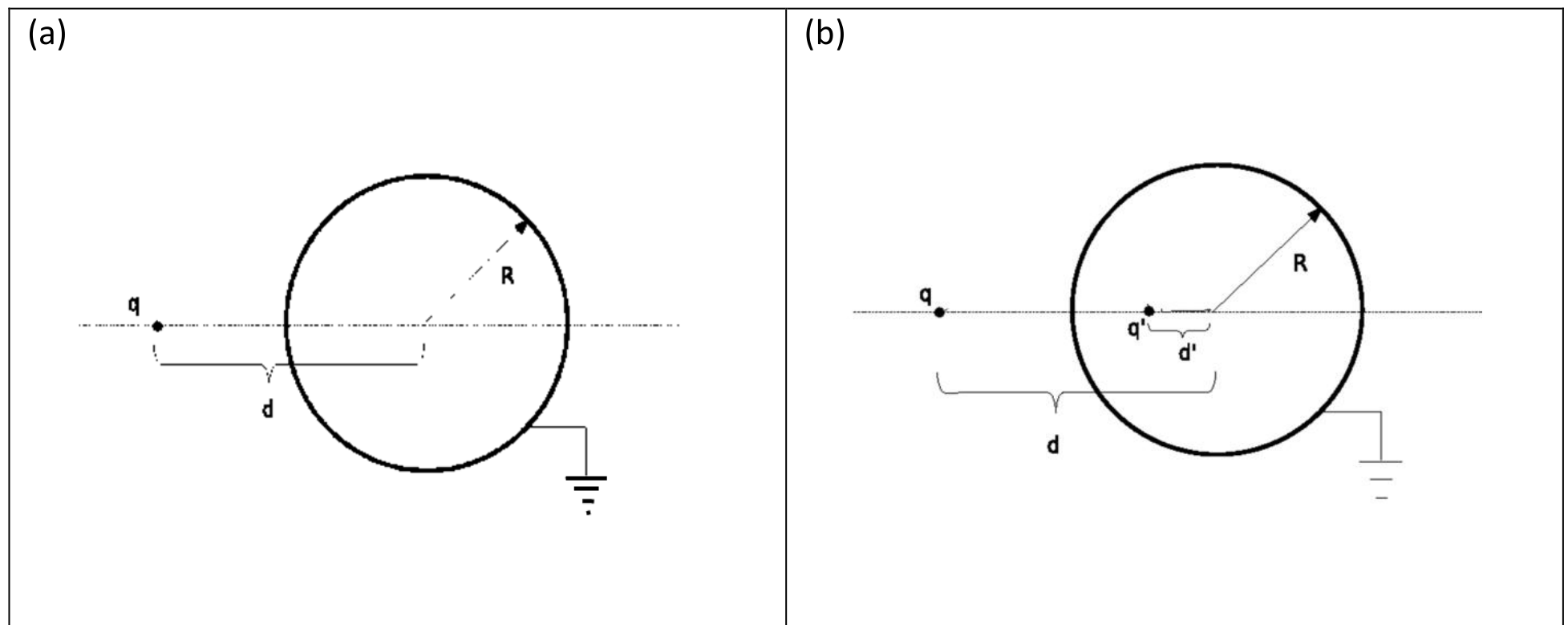
A point charge is placed in the vicinity of a grounded metallic sphere of radius [see Fig. 1(a)], and consequently a surface charge distribution is induced on the sphere. To calculate the electric field and potential from the distribution of the surface charge is a formidable task. However, the calculation can be considerably simplified by using the so called method of images. In this method, the electric field and potential produced by the charge distributed on the sphere can be represented as an electric field and potential of a single point charge placed inside the sphere (you do not have to prove it). Note: The electric field of this image charge reproduces the electric field and the potential only outside the sphere (including its surface).
1a) Task 1 – The image charge
The symmetry of the problem dictates that the charge should be placed on the line connecting the point charge and the center of the sphere [see Fig. 1(b)].
a) What is the value of the potential on the sphere? (0.3 points)
1b) b) Express and the distance of the charge from the center of the sphere, in terms of , , and . (1.9 points)
1c) c) Find the magnitude of force acting on charge . Is the force repulsive? (0.5 points)
2a) Task 2 – Shielding of an electrostatic field
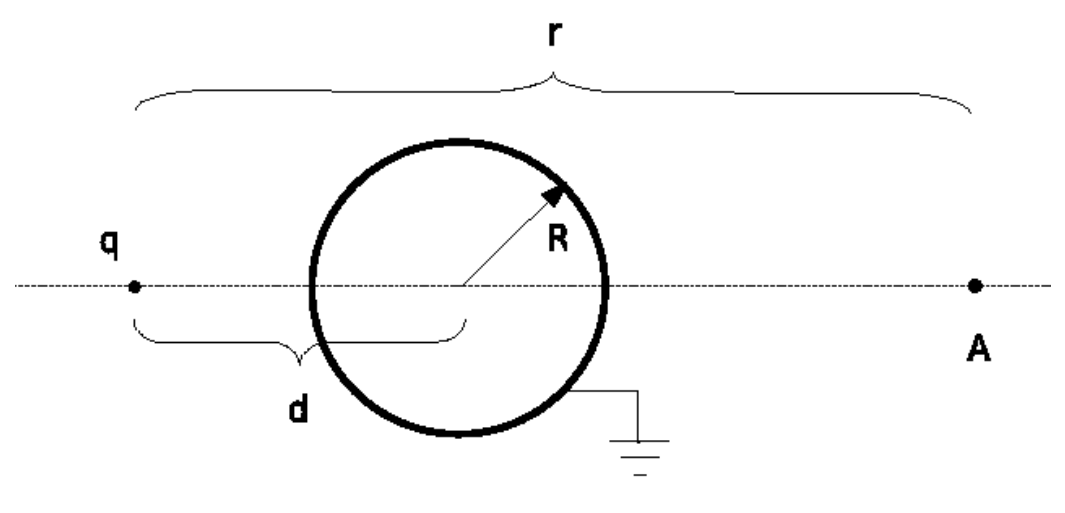
Consider a point charge q placed at a distance d from the center of a grounded metallic sphere of radius R. We are interested in how the grounded metallic sphere affects the electric field at point A on the opposite side of the sphere (see Fig. 2). Point A is on the line connecting charge q and the center of the sphere; its distance from the point charge q is r.
a) Find the vector of the electric field at point A. (0.6 points)
2b) b) For a very large distance , find the expression for the electric field by using the approximation (1+a) ≈ 1-2a, where . (0.6 points)
2c) c) In which limit of d does the grounded metallic sphere screen the field of the charge q completely, such that the electric field at point A is exactly zero? (0.3 points)
3a) Task 3 – Small oscillations in the electric field of the grounded metallic sphere
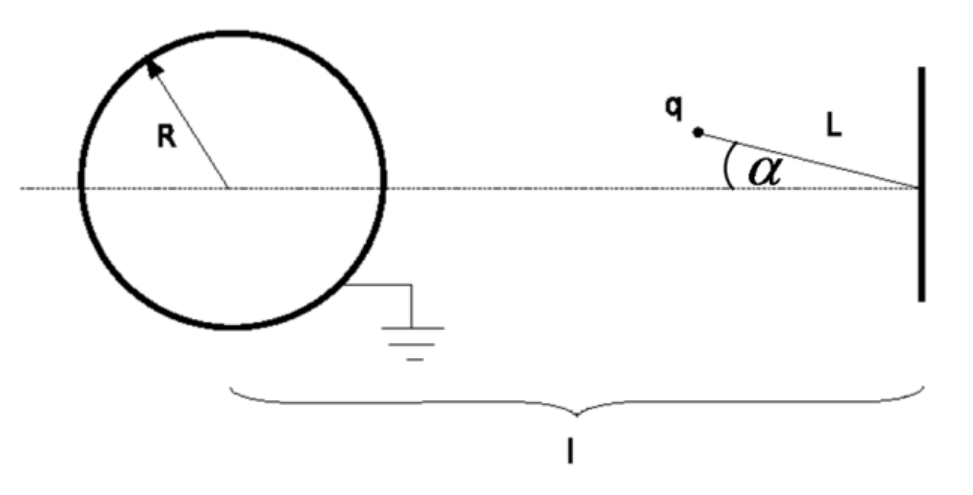
A point charge q with mass m is suspended on a thread of length L which is attached to a wall, in the vicinity of the grounded metallic sphere. In your considerations, ignore all electrostatic effects of the wall. The point charge makes a mathematical pendulum (see Fig. 3). The point at which the thread is attached to the wall is at a distance from the center of the sphere. Assume that the effects of gravity are negligible.
a) Find the magnitude of the electric force acting on the point charge q for a given angle and indicate the direction in a clear diagram (0.8 points)
3b) b) Determine the component of this force acting in the direction perpendicular to the thread in terms of , L, R, q and . (0.8 points)
3c) c) Find the frequency for small oscillations of the pendulum. (1.0 points)
4a) Task 4 – The electrostatic energy of the system
For a distribution of electric charges it is important to know the electrostatic energy of the system. In our problem (see Fig. 1a), there is an electrostatic interaction between the external charge q and the induced charges on the sphere, and there is an electrostatic interaction among the induced charges on the sphere themselves. In terms of the charge q, radius of the sphere R and the distance d determine the following electrostatic energies:
a) the electrostatic energy of the interaction between charge q and the induced charges on the sphere; (1.0 points)
4b) b) the electrostatic energy of the interaction among the induced charges on the sphere; (1.2 points)
4c) c) the total electrostatic energy of the interaction in the system. (1.0 points)
Hint: There are several ways of solving this problem:
(1) In one of them, you can use the following integral,
(2) In another one, you can use the fact that for a collection of N charges located at points , the electrostatic energy is a sum over all pairs of charges:
Отговори
1a) 0 V
1b)
1c)
The force is attractive.
2a)
2b)
2c)
3a)
3b)
3c)
4a)
4b)
4c)
Решение
Solution of Task 1
Task 1a)
As the metallic sphere is grounded, its potential vanishes, V=0.
Task1b)
Let us consider an arbitrary point B on the surface of the sphere as depicted in Fig. 1.
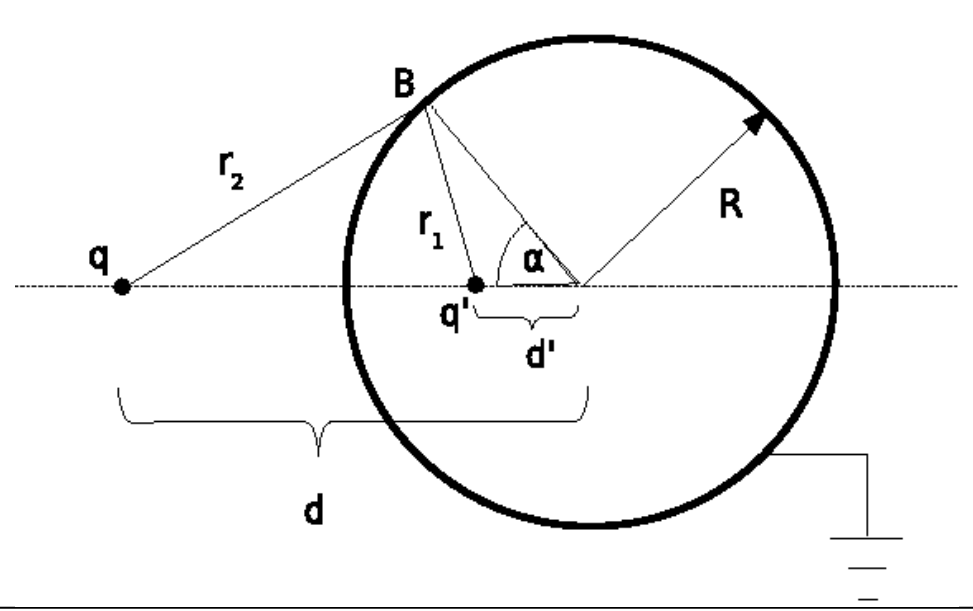
The distance of point B from the charge q' is
whereas the distance of the point B from the charge q is given with the expression
The electric potential at the point B is
This potential must vanish,
i.e. its numerical value is 0 V.
Combining (1), (2) and (3) we obtain
As the surface of the sphere must be equipotential, the condition (5) must be satisfied for every angle α what leads to the following results
and
By solving of (6) and (7) we obtain the expression for the distance d' of the charge q' from the center of the sphere
and the size of the charge q'
Task 1c)
Finally, the magnitude of force acting on the charge q is
The force is apparently attractive.
Solution of Task 2
Task 2a)
The electric field at the point A amounts to
Task 2b)
For very large distances r we can apply approximate formula (1+a) ≈ 1-2a to the expression (11) what leads us to
In general a grounded metallic sphere cannot completely screen a point charge q at a distance d (even in the sense that its electric field would decrease with distance faster than ) and the dominant dependence of the electric field on the distance r is as in standard Coulomb law.
Task 2c)
In the limit d → R the electric field at the point A vanishes and the grounded metallic sphere screens the point charge completely.
Solution of Task 3
Task 3a)
Let us consider a configuration as in Fig. 2.
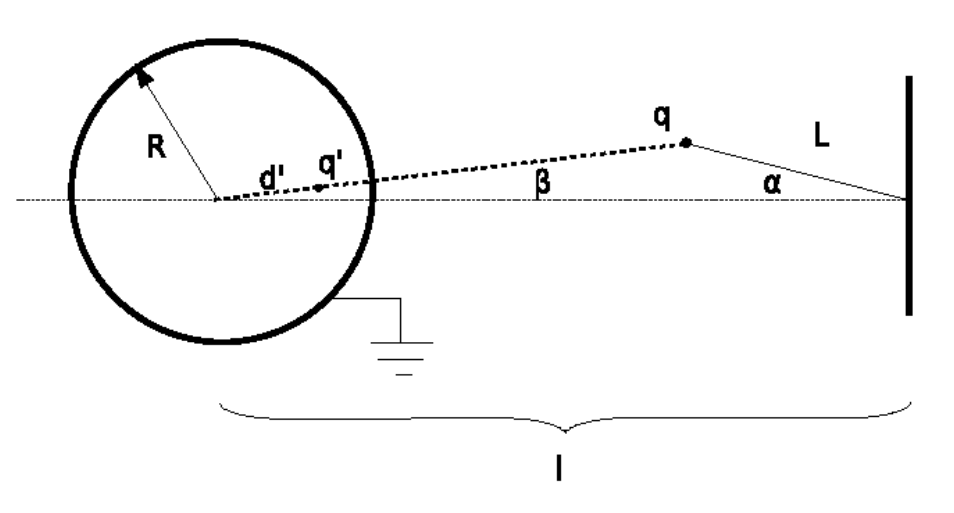
The distance of the charge q from the center of the sphere is
The magnitude of the electric force acting on the charge q is
From which we have
Task 3b)
The direction of the vector of the electric force (17) is described in Fig. 3.
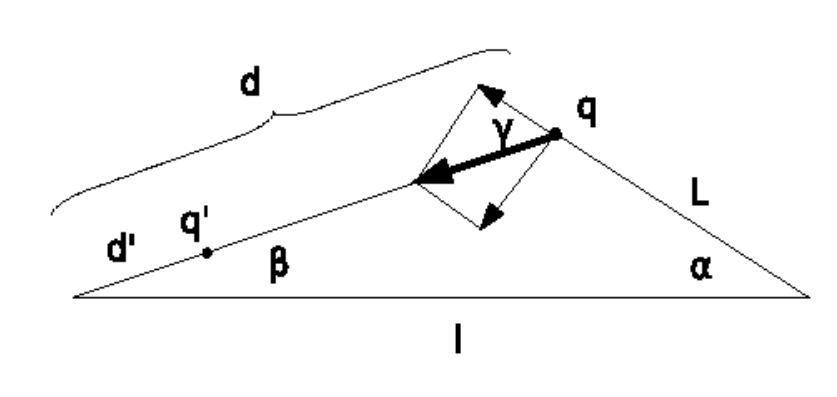
The angles α and β are related as
whereas for the angle γ the relation γ=α+β is valid. The component of the force perpendicular to the thread is F sin γ, that is ,
where
Task 3c)
The equation of motion of the mathematical pendulum is
As we are interested in small oscillations, the angle α is small, i.e. for its value in radians we have α much smaller than 1. For a small value of argument of trigonometric functions we have approximate relations sin x ≈ x and cos x ≈ 1-x/2. So for small oscillations of the pendulum we have and .
Combining these relations with (13) we obtain
Where what leads to
Solution of Task 4
First we present a solution based on the definition of the electrostatic energy of a collection of charges.
Task 4a)
The total energy of the system can be separated into the electrostatic energy of interaction of the external charge with the induced charges on the sphere, , and the electrostatic energy of mutual interaction of charges on the sphere, , i.e.
Let there be N charges induced on the sphere. These charges are located at points on the sphere. We use the definition of the image charge, i.e., the potential on the surface of the sphere from the image charge is identical to the potential arising from the induced charges:
where is a vector on the sphere and denotes the vector position of the image charge. When coincides with some , then we just have
From the requirement that the potential on the surface of the sphere vanishes we have
where denotes the vector position of the charge ( is on the sphere).
For the interaction of the external charge with the induced charges on the sphere we have
Here the first equality is the definition of this energy as the sum of interactions of the charge q with each of the induced charges on the surface of the sphere. The second equality follows from (21).
In fact, the interaction energy follows directly from the definition of an image charge.
Task 4b)
The energy of mutual interactions of induced charges on the surface of the sphere is given with
Here the second line is obtained using (22). From the second line we obtain the third line applying (23), whereas from the third line we obtain the fourth using (22) again.
Task 4c)
Combining expressions (19) and (20) with the quantitative results for the image charge we finally obtain the total energy of electrostatic interaction
An alternative solution follows from the definition of work. By knowing the integral
We can obtain the total energy in the system by calculating the work needed to bring the charge q from infinity to the distance d from the center of the sphere:
This solves Task 4c).
The electrostatic energy between the charge q and the sphere must be equal to the energy between the charges q and q’ according to the definition of the image charge:
This solves Task 4a).
From this we immediately have that the electrostatic energy among the charges on the sphere is:
This solves Task 4b).