IPhO 2010, Теория — Задача 2. Chimney physics
41st International Physics Olympiad, Croatia – Theoretical competition, July 19th, 2010 · 19 юли 2010 г.
Условие
Introduction
Gaseous products of burning are released into the atmosphere of temperature through a high chimney of cross-section and height (see Fig. 1). The solid matter is burned in the furnace which is at temperature . The volume of gases produced per unit time in the furnace is .
Assume that:
- the velocity of the gases in the furnace is negligibly small
- the density of the gases (smoke) does not differ from that of the air at the same temperature and pressure; while in furnace, the gases can be treated as ideal
- the pressure of the air changes with height in accordance with the hydrostatic law; the change of the density of the air with height is negligible
- the flow of gases fulfills the Bernoulli equation which states that the following quantity is conserved in all points of the flow:
where is the density of the gas, is its velocity, is pressure, and is the height - the change of the density of the gas is negligible throughout the chimney
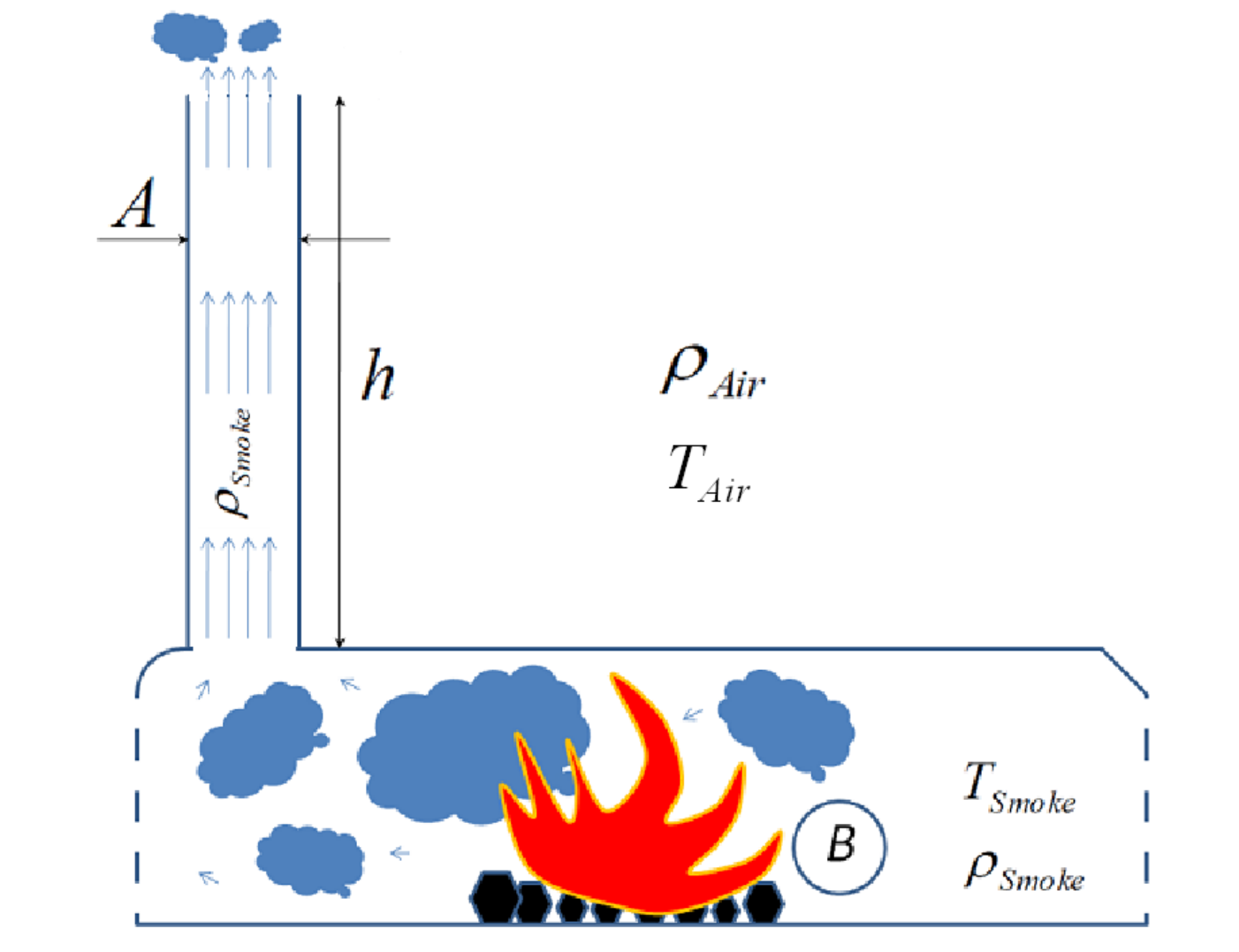
Task 1
Task 1 a) What is the minimal height of the chimney needed in order that the chimney functions efficiently, so that it can release all of the produced gas into the atmosphere? Express your result in terms of , , , , . Important: in all subsequent tasks assume that this minimal height is the height of the chimney. (3.5 points)
Task 1 b) Assume that two chimneys are built to serve exactly the same purpose. Their cross sections are identical, but are designed to work in different parts of the world: one in cold regions, designed to work at an average atmospheric temperature of -30 and the other in warm regions, designed to work at an average atmospheric temperature of 30 . The temperature of the furnace is 400 . It was calculated that the height of the chimney designed to work in cold regions is 100 m. How high is the other chimney? (0.5 points)
Task 1 c) How does the velocity of the gases vary along the height of the chimney? Make a sketch/diagram assuming that the chimney cross-section does not change along the height. Indicate the point where the gases enter the chimney. (0.6 points)
Task 1 d) How does the pressure of the gases vary along the height of the chimney? (0.5 points)
Solar power plant
The flow of gases in a chimney can be used to construct a particular kind of solar power plant (solar chimney). The idea is illustrated in Fig. 2. The Sun heats the air underneath the collector of area with an open periphery to allow the undisturbed inflow of air (see Fig. 2). As the heated air rises through the chimney (thin solid arrows), new cold air enters the collector from its surrounding (thick dotted arrows) enabling a continuous flow of air through the power plant. The flow of air through the chimney powers a turbine, resulting in the production of electrical energy. The energy of solar radiation per unit time per unit of horizontal area of the collector is . Assume that all that energy can be used to heat the air in the collector (the mass heat capacity of the air is , and one can neglect its dependence on the air temperature). We define the efficiency of the solar chimney as the ratio of the kinetic energy of the gas flow and the solar energy absorbed in heating of the air prior to its entry into the chimney.
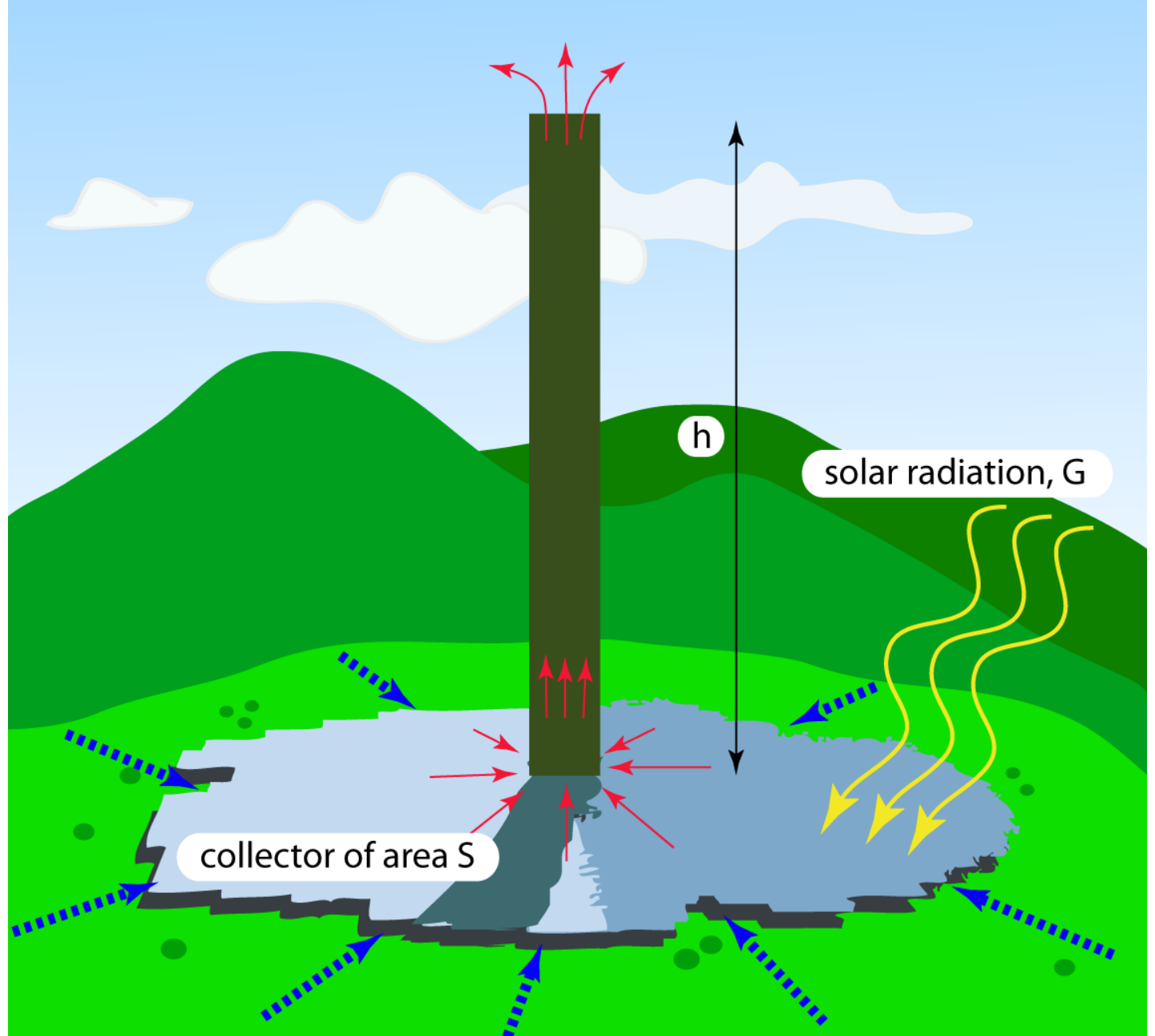
Task 2
Task 2 a) What is the efficiency of the solar chimney power plant? (2.0 points)
Task 2 b) Make a diagram showing how the efficiency of the chimney changes with its height. (0.4 points)
Manzanares prototype
The prototype chimney built in Manzanares, Spain, had a height of 195 m, and a radius 5 m. The collector is circular with diameter of 244 m. The specific heat of the air under typical operational conditions of the prototype solar chimney is 1012 J/kg K, the density of the hot air is about 0.9 kg/m, and the typical temperature of the atmosphere = 295 K. In Manzanares, the solar power per unit of horizontal surface is typically 150 W/m during a sunny day.
Task 3
Task 3 a) What is the efficiency of the prototype power plant? Write down the numerical estimate. (0.3 points)
Task 3 b) How much power could be produced in the prototype power plant? (0.4 points)
Task 3 c) How much energy could the power plant produce during a typical sunny day? (0.3 points)
Task 4
Task 4 a) How large is the rise in the air temperature as it enters the chimney (warm air) from the surrounding (cold air)? Write the general formula and evaluate it for the prototype chimney. (1.0 points)
Task 4 b) What is the mass flow rate of air through the system? (0.5 points)
Отговори
Task 1 a)
Task 1 b) 145 m
Task 1 c) The velocity is constant, , with a sudden jump from approximately zero when the gases enter the chimney from the furnace.
Task 1 d)
Task 2 a)
Task 2 b) The change is linear.
Task 3 a) 0.0064
0.64%
Task 3 b) 45 kW
Task 3 c) 360 kWh
Assuming 8 sunny hours per day, as in the official solution.
Task 4 a) ≈ K
Task 4 b) 760 kg/s
Решение
Solution - Chimney physics
This problem was inspired and posed by using the following two references:
- W.W. Christie, Chimney design and theory, D. Van Nostrand Company, New York, 1902.
- J. Schlaich, R. Bergermann, W. Schiel, G. Weinrebe, Design of Commercial Solar Updraft Tower Systems — Utilization of Solar Induced Convective Flows for Power Generation, Journal of Solar Energy Engineering 127, 117 (2005).
Solution of Task 1
a) What is the minimal height of the chimney needed in order that the chimney functions efficiently, so that it can release all of the produced gas in the atmosphere?
Let denote the pressure of air at height ; then, according to one of the assumptions , where is the atmospheric pressure at zero altitude.
Throughout the chimney the Bernoulli law applies, that is, we can write
where is the pressure of smoke at height , is its density, and denotes the velocity of smoke; here we have used the assumption that the density of smoke does not vary throughout the chimney. Now we apply this equation at two points, (i) in the furnace, that is at point , where is a negligibly small positive number, and (ii) at the top of the chimney where to obtain:
On the right hand side we have used the assumption that the velocity of gases in the furnace is negligible (and also ).
We are interested in the minimal height at which the chimney will operate. The pressure of smoke at the top of the chimney has to be equal or larger than the pressure of air at altitude ; for minimal height of the chimney we have . In the furnace we can use . The Bernoulli law applied in the furnace and at the top of the chimney [Eq. (2)] now reads
From this we get
The chimney will be efficient if all of its products are released in the atmosphere, i.e.,
from which we have
We can treat the smoke in the furnace as an ideal gas (which is at atmospheric pressure and temperature ). If the air was at the same temperature and pressure it would have the same density according to our assumptions. We can use this to relate the ratio to that is,
and finally
For minimal height of the chimney we use the equality sign.
b) How high should the chimney in warm regions be?
c) How does the velocity of the gases vary along the height of the chimney?
The velocity is constant,
This can be seen from the equation of continuity ( is constant). It has a sudden jump from approximately zero velocity to this constant value when the gases enter the chimney from the furnace. In fact, since the chimney operates at minimal height this constant is equal to , that is .
d) At some height , from the Bernoulli equation one gets
Thus the pressure of smoke suddenly changes as it enters the chimney from the furnace and acquires velocity.
Solution of Task 2
a) The kinetic energy of the hot air released in a time interval is
Where the index “Hot” refer to the hot air heated by the Sun. If we denote the mass of the air that exits the chimney in unit time with , then the power which corresponds to kinetic energy above is
This is the maximal power that can be obtained from the kinetic energy of the gas flow.
The Sun power used to heat the air is
The efficiency is evidently
b) The change is apparently linear.
Solution of Task 3
a) The efficiency is
b) The power is
c) If there are 8 sunny hours per day we get 360kWh.
Solution of Task 4
The result can be obtained by expressing the mass flow of air as
which yields
From this we get