41st International Physics Olympiad, Croatia – Theoretical Competition, July 19th 2010 — 3. Simple model of an atomic nucleus · 10 т.
Условие
Introduction
Although atomic nuclei are quantum objects, a number of phenomenological laws for their basic properties (like radius or binding energy) can be deduced from simple assumptions: (i) nuclei are built from nucleons (i.e. protons and neutrons); (ii) strong nuclear interaction holding these nucleons together has a very short range (it acts only between neighboring nucleons); (iii) the number of protons (Z) in a given nucleus is approximately equal to the number of neutrons (N), i.e. Z≈N≈A/2, where A is the total number of nucleons (A≫1). Important: Use these assumptions in Tasks 1-4 below.
1aTask 1 - Atomic nucleus as closely packed system of nucleons
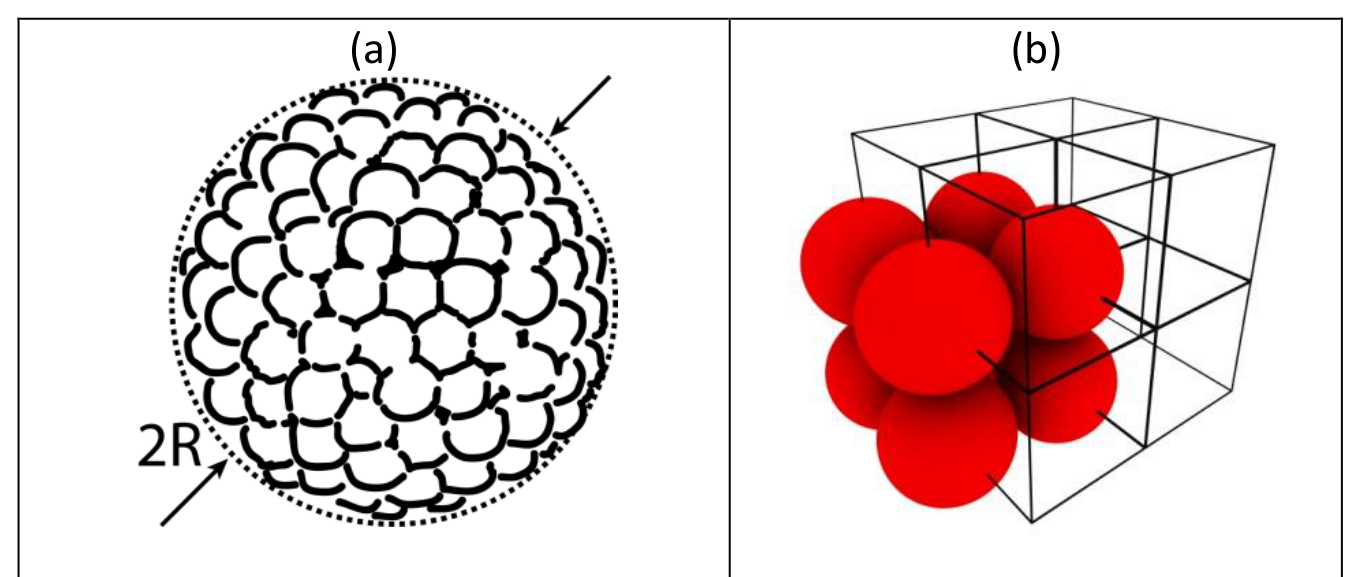
In a simple model, an atomic nucleus can be thought of as a ball consisting of closely packed nucleons [see Fig. 1(a)], where the nucleons are hard balls of radius rN=0.85 fm (1 fm = 10−15 m). The nuclear force is present only for two nucleons in contact. The volume of the nucleus V is larger than the volume of all nucleons AVN, where VN=34rN3π. The ratio f=AVN/V is called the packing factor and gives the percentage of space filled by the nuclear matter.
Fig. 1. (a) An atomic nucleus as a ball of closely packed nucleons. (b) The SC packing.
a) Calculate what would be the packing factor f if nucleons were arranged in a “simple cubic” (SC) crystal system, where each nucleon is centered on a lattice point of an infinite cubic lattice [see Fig. 1(b)]. (0.3 points)
Important: In all subsequent tasks, assume that the actual packing factor for nuclei is equal to the one from Task 1a. If you are not able to calculate it, in subsequent tasks use f=1/2.
1b b) Estimate the average mass density ρm, charge density ρc, and the radius R for a nucleus having A nucleons. The average mass of a nucleon is 1.67⋅10−27 kg. (1.0 points)
2Task 2 - Binding energy of atomic nuclei – volume and surface terms
Binding energy of a nucleus is the energy required to disassemble it into separate nucleons and it essentially comes from the attractive nuclear force of each nucleon with its neighbors. If a given nucleon is not on the surface of the nucleus, it contributes to the total binding energy with aV= 15.8 MeV (1 MeV = 1.602⋅10−13 J). The contribution of one surface nucleon to the binding energy is approximately aV/2. Express the binding energy Eb of a nucleus with A nucleons in terms of A, aV, and f, and by including the surface correction. (1.9 points)
3aTask 3 - Electrostatic (Coulomb) effects on the binding energy
The electrostatic energy of a homogeneously charged ball (with radius R and total charge Q0) is Uc=20πε0R3Q02, where ε0=8.85⋅10−12C2N−1m−2.
a) Apply this formula to get the electrostatic energy of a nucleus. In a nucleus, each proton is not acting upon itself (by Coulomb force), but only upon the rest of the protons. One can take this into account by replacing Z2→Z(Z−1) in the obtained formula. Use this correction in subsequent tasks. (0.4 points)
3b b) Write down the complete formula for binding energy, including the main (volume) term, the surface correction term and the obtained electrostatic correction. (0.3 points)
4aTask 4 - Fission of heavy nuclei
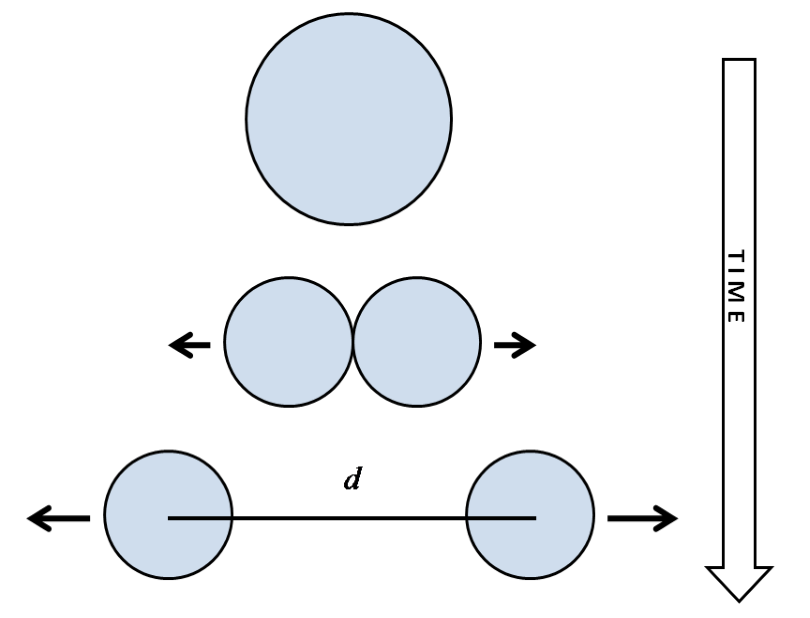
Fission is a nuclear process in which a nucleus splits into smaller parts (lighter nuclei). Suppose that a nucleus with A nucleons splits into only two equal parts as depicted in Fig. 2.
a) Calculate the total kinetic energy of the fission products Ekin when the centers of two lighter nuclei are separated by the distance d≥2R(A/2), where R(A/2) is their radius. The large nucleus was initially at rest. (1.3 points)
4b b) Assume that d=2R(A/2) and evaluate the expression for Ekin obtained in part a) for A= 100, 150, 200 and 250 (express the results in units of MeV). Estimate the values of A for which fission is possible in the model described above? (1.0 points)
Fig. 2. A schematic description of nuclear fission in our model.
5aTask 5 – Transfer reactions
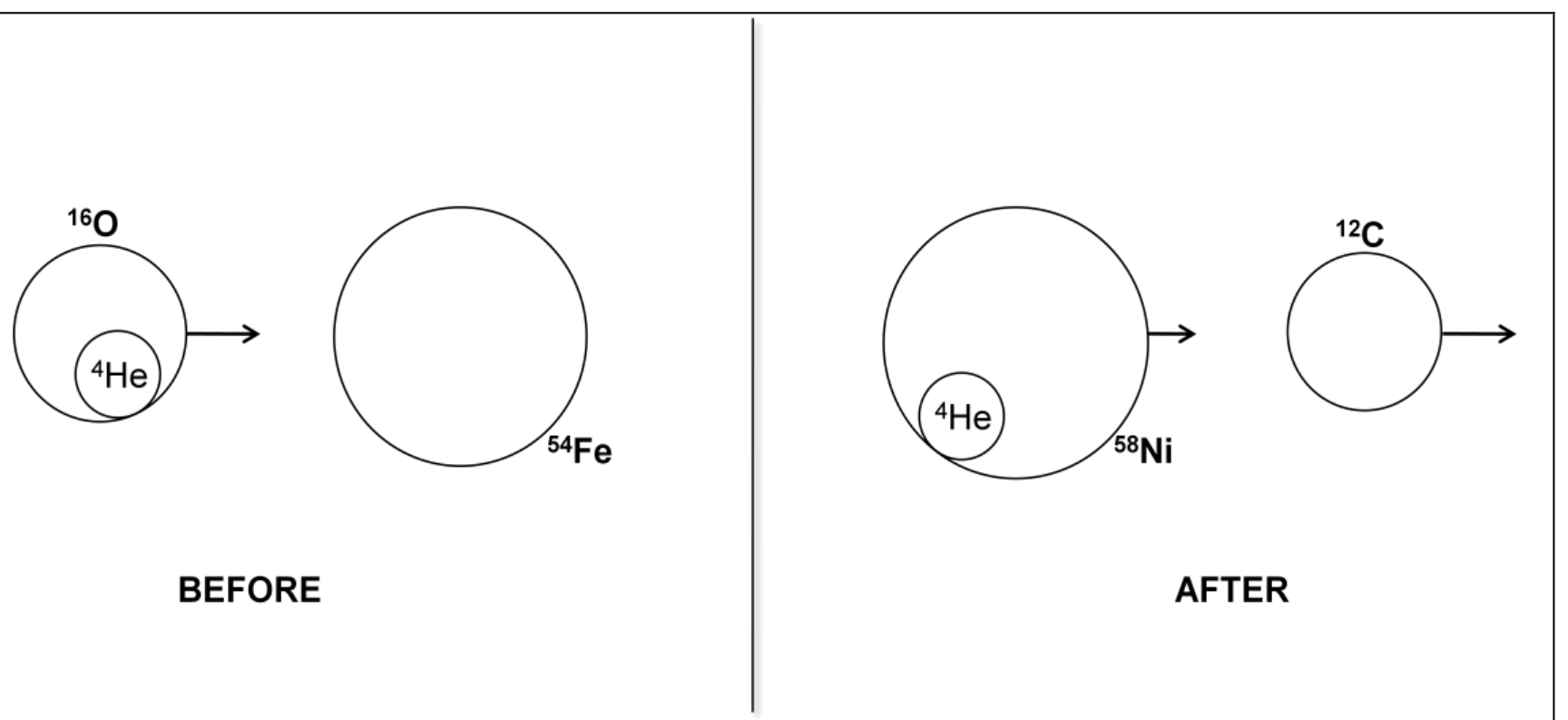
a) In modern physics, the energetics of nuclei and their reactions is described in terms of masses. For example, if a nucleus (with zero velocity) is in an excited state with energy Eexc above the ground state, its mass is m=m0+Eexc/c2, where m0 is its mass in the ground state at rest. The nuclear reaction 16O+54Fe→12C+58Ni is an example of the so-called “transfer reactions”, in which a part of one nucleus (“cluster”) is transferred to the other (see Fig. 3). In our example the transferred part is a 4He-cluster (α -particle). The transfer reactions occur with maximum probability if the velocity of the projectile-like reaction product (in our case: 12C) is equal both in magnitude and direction to the velocity of projectile (in our case: 16O). The target 54Fe is initially at rest. In the reaction, 58Ni is excited into one of its higher-lying states. Find the excitation energy of that state (and express it units of MeV) if the kinetic energy of the projectile 16O is 50 MeV. The speed of light is c= 3⋅108 m/s. (2.2 points)
1.
M(16O)
15.99491 a.m.u.
2.
M(54Fe)
53.93962 a.m.u.
3.
M(12C)
12.00000 a.m.u.
4.
M(58Ni)
57.93535 a.m.u.
Table 1. The rest masses of the reactants in their ground states. 1 a.m.u.= 1.6605⋅10−27 kg. [2,2 т.]
5b b) The 58Ni nucleus produced in the excited state discussed in the part a), deexcites into its ground state by emitting a gamma-photon in the direction of its motion. Consider this decay in the frame of reference in which 58Ni is at rest to find the recoil energy of 58Ni (i.e. kinetic energy which 58Ni acquires after the emission of the photon). What is the photon energy in that system? What is the photon energy in the lab system of reference (i.e. what would be the energy of the photon measured in the detector which is positioned in the direction in which the 58Ni nucleus moves)? (1.6 points)
4b Ekin = (0.02203A^(5/3) − 10.0365A^(2/3) + 36.175A^(1/3) − 33.091) MeV: −33.95 MeV (A=100), −30.93 MeV (A=150), −14.10 MeV (A=200), +15.06 MeV (A=250); fission is possible for A ≥ 227.
5a 10.866 MeV
Non-relativistic result 10.866 MeV; the relativistic solution gives 10.8636 MeV (equal within 2 keV).
5b Recoil energy Erecoil = 1.1 keV; photon energy in the rest frame of 58Ni Eγ = 10.8633 MeV; photon energy in the lab system Edetector = 10.925 MeV.
Решение
Solution - model of an atomic nucleus
Solution of Task 1
a) In the SC-system, in each of 8 corners of a given cube there is one unit (atom, nucleon, etc.), but it is shared by 8 neighboring cubes – this gives a total of one nucleon per cube. If nucleons are touching, as we assume in our simplified model, then a=2rN is the cube edge length a. The volume of one nucleon is then
The numerical constant (1.06 fm) in the equation above will be denoted as r0 in the sequel.
Solution of Task 2
First one needs to estimate the number of surface nucleons. The surface nucleons are in a spherical shell of width 2rN at the surface. The volume of this shell is
where Z≈A/2 has been used. The Coulomb repulsion reduces the binding energy, hence the negative sign before the first (main) term. The complete formula for binding energy now gives:
a) The kinetic energy comes from the difference of binding energies (2 small nuclei – the original large one) and the Coulomb energy between two smaller nuclei (with Z/2=A/4 nucleons each):
In our model, fission is possible when Ekin(d=2R(A/2))≥0. From the numerical evaluations given above, one sees that this happens approximately halfway between A=200 and A=250 – a rough estimate would be A≈225. Precise numerical evaluation of the equation:
Taking into account that 1 MeV is equal to 1.602⋅10−13 J, we get:
Q=−1.2237⋅10−13/1.602⋅10−13=−0.761MeV(21)
This exercise is now solved using the laws of conservation of energy and momentum. The latter gives (we are interested only for the case when 12C and 16O are having the same direction so we don’t need to use vectors):
m(16O)v(16O)=m(12C)v(12C)+m(58Ni)v(58Ni)(22)
while the conservation of energy gives:
Ek(16O)+Q=Ek(12C)+Ek(58Ni)+Ex(58Ni)(23)
where Ex(58Ni) is the excitation energy of 58Ni, and Q is calculated in the first part of this task. But since 12C and 16O have the same velocity, conservation of momentum reduced to:
[m(16O)−m(12C)]v(16O)=m(58Ni)v(58Ni)(24)
Now we can easily find the kinetic energy of 58Ni:
Note that the first bracket in numerator is approximately equal to the mass of transferred particle (the 4He nucleus), while the second one is approximately equal to the mass of target nucleus 54Fe. Inserting the numbers we get:
In the relativistic version, solution is found starting from the following pair of equations (the first one is the law of conservation of energy and the second one the law of conservation of momentum):
All the masses in the equations are the rest masses; the 58Ni is NOT in its ground-state, but in one of its excited states (having the mass denoted with m∗). Since 12C and 16O have the same velocity, this set of equations reduces to:
The relativistic and non-relativistic results are equal within 2 keV so both can be considered as correct –we can conclude that at the given beam energy, relativistic effects are not important.
Task 5b) For gamma-emission from the static nucleus, laws of conservation of energy and momentum give:
Ex(58Ni)=Eγ+Erecoilpγ=precoil(36)
Gamma-ray and recoiled nucleus have, of course, opposite directions. For gamma-ray (photon), energy and momentum are related as:
Eγ=pγ⋅c(37)
In part a) we have seen that the nucleus motion in this energy range is not relativistic, so we have:
The equation (37) can also be reduced to an approximate equation before inserting numbers:
Eγ=Ex(1−2m(58Ni)c2Ex)=10.8633MeV(43)
The recoil energy is now easily found as:
Erecoil=Ex(58Ni)−Eγ=1.1keV(44)
Due to the fact that nucleus emitting gamma-ray (58Ni) is moving with the high velocity, the energy of gamma ray will be changed because of the Doppler effect. The relativistic Doppler effect (when source is moving towards observer/detector) is given with this formula:
fdetector=fγ,emitted1−β1+β(45)
and since there is a simple relation between photon energy and frequency (E=hf), we get the similar expression for energy:
Edetector=Eγ,emitted1−β1+β(46)
where β=v/c and v is the velocity of emitter (the 58Ni nucleus). Taking the calculated value of the 58Ni velocity (equation 29) we get: