Theoretical Competition: 12 July 2011 — Question 1 · 12 юли 2011 г.
Условие
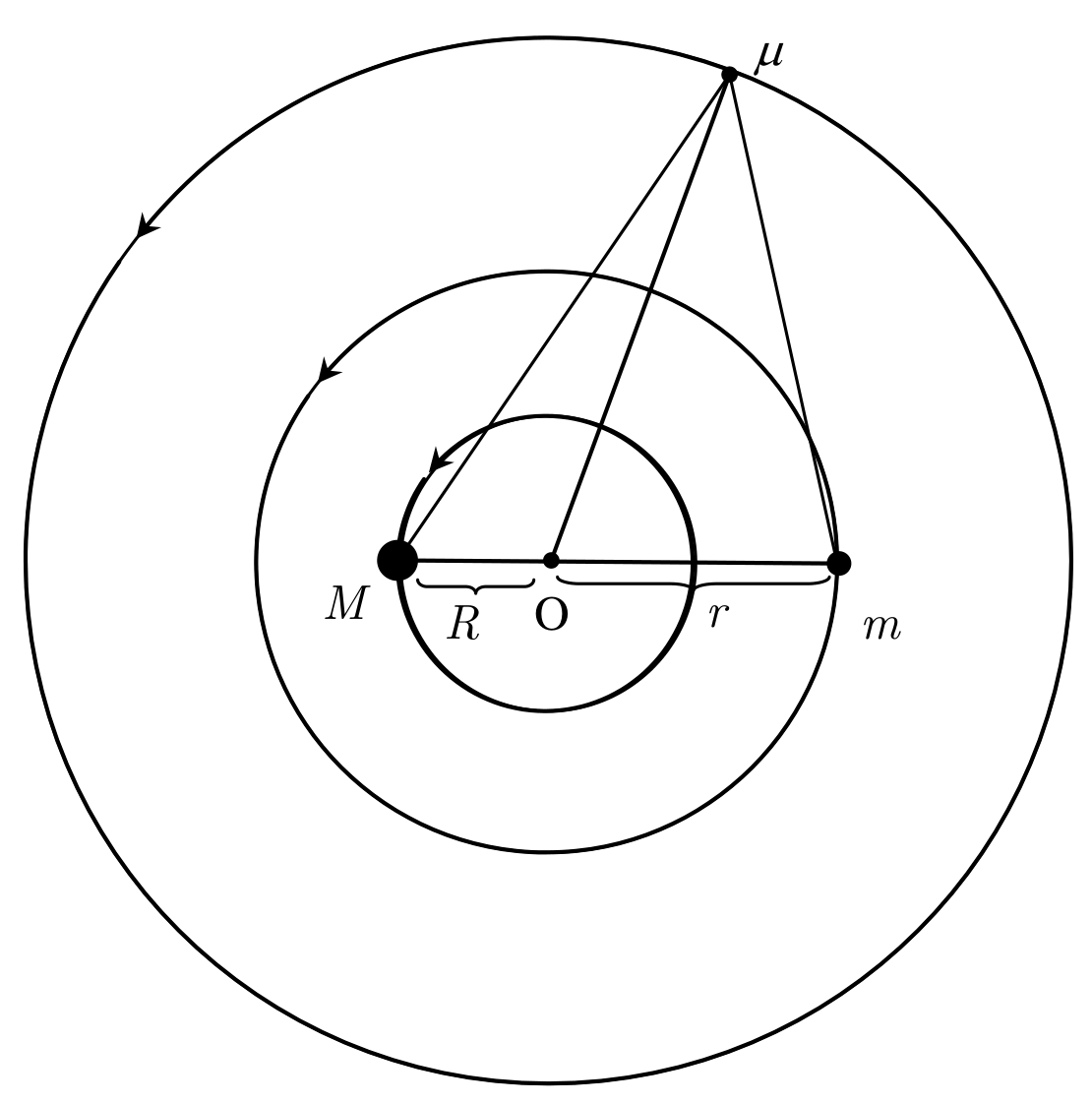
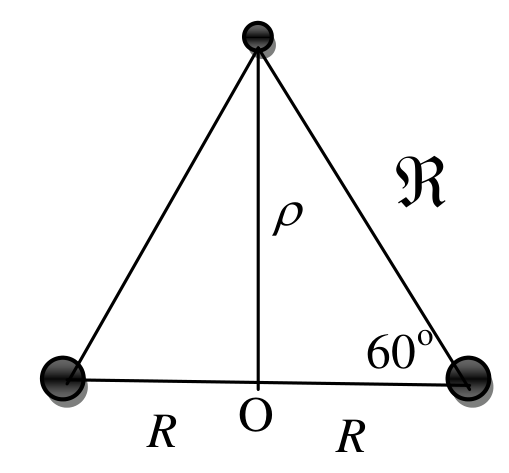
FIGURE 1 Coplanar orbits of three bodies.
1.1 Two gravitating masses M and m are moving in circular orbits of radii R and r, respectively, about their common centre of mass. Find the angular velocity ω0 of the line joining M and m in terms of R,r,M,m and the universal gravitational constant G. [1,5 т.]
1.2 A third body of infinitesimal mass μ is placed in a coplanar circular orbit about the same centre of mass so that μ remains stationary relative to both M and m as shown in Figure 1. Assume that the infinitesimal mass is not collinear with M and m. Find the values of the following parameters in terms of R and r:
1.2.1 distance from μ to M.
1.2.2 distance from μ to m.
1.2.3 distance from μ to the centre of mass. [3,5 т.]
1.3 Consider the case M=m. If μ is now given a small radial perturbation (along Oμ), what is the angular frequency of oscillation of μ about the unperturbed position in terms of ω0? Assume that the angular momentum of μ is conserved. [3,2 т.]
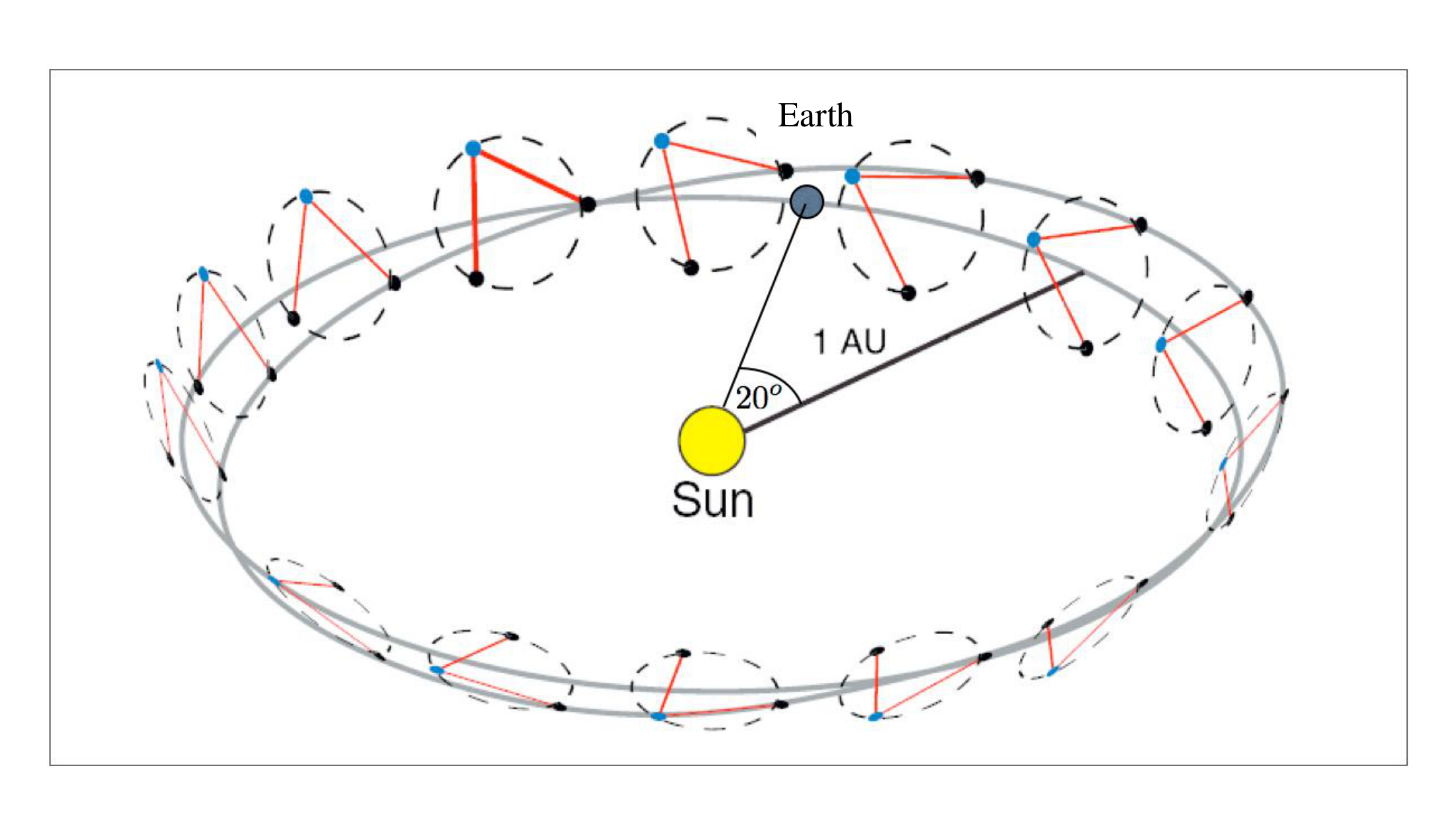
The Laser Interferometry Space Antenna (LISA) is a group of three identical spacecrafts for detecting low frequency gravitational waves. Each of the spacecrafts is placed at the corners of an equilateral triangle as shown in Figure 2 and Figure 3. The sides (or ‘arms’) are about 5.0 million kilometres long. The LISA constellation is in an earth-like orbit around the Sun trailing the Earth by 20∘. Each of them moves on a slightly inclined individual orbit around the Sun. Effectively, the three spacecrafts appear to roll about their common centre one revolution per year.
They are continuously transmitting and receiving laser signals between each other. Overall, they detect the gravitational waves by measuring tiny changes in the arm lengths using interferometric means. A collision of massive objects, such as blackholes, in nearby galaxies is an example of the sources of gravitational waves.
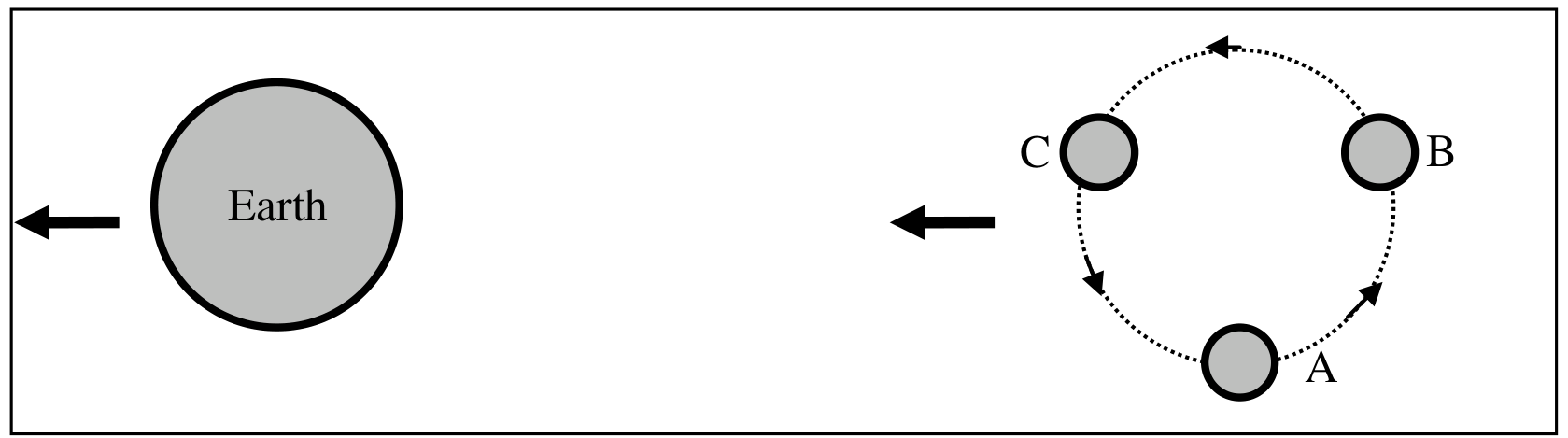
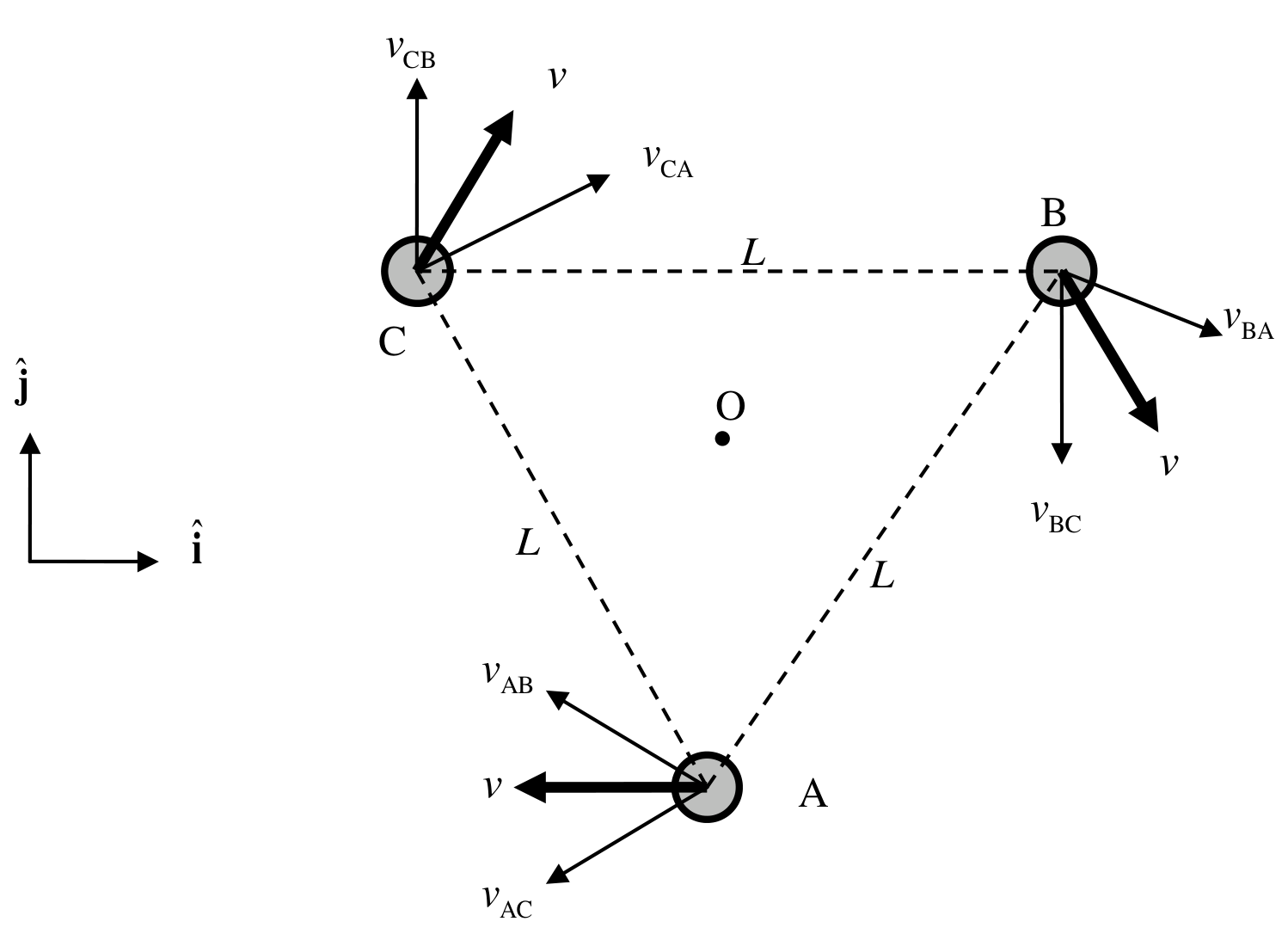
FIGURE 2 Illustration of the LISA orbit. The three spacecraft roll about their centre of mass with a period of 1 year. Initially, they trail the Earth by 20∘. (Picture from D.A. Shaddock, “An Overview of the Laser Interferometer Space Antenna”, Publications of the Astronomical Society of Australia, 2009, 26, pp.128-132.).FIGURE 3 Enlarged view of the three spacecrafts trailing the Earth. A, B and C are the three spacecrafts at the corners of the equilateral triangle.
1.4 In the plane containing the three spacecrafts, what is the relative speed of one spacecraft with respect to another? [1,8 т.]
Отговори
1.1ω02=(R+r)3G(M+m)=r(R+r)2GM=R(R+r)2Gm
1.2r1=r2=R+r,ρ=r2+rR+R2
Distances from μ to M and to m are both R + r; distance from μ to the centre of mass O is ρ.
1.327ω0
1.4 996 m/s
Relative speed 3v≈996 m/s, with v=575 m/s the speed of each spacecraft about the centre.
Решение
I. Solution
1.1 Let O be their centre of mass. Hence
MR−mr=0(1)
mω02r=(R+r)2GMm,Mω02R=(R+r)2GMm(2)
From Eq. (2), or using reduced mass, ω02=(R+r)3G(M+m)
Hence,
ω02=(R+r)3G(M+m)=r(R+r)2GM=R(R+r)2Gm.(3)
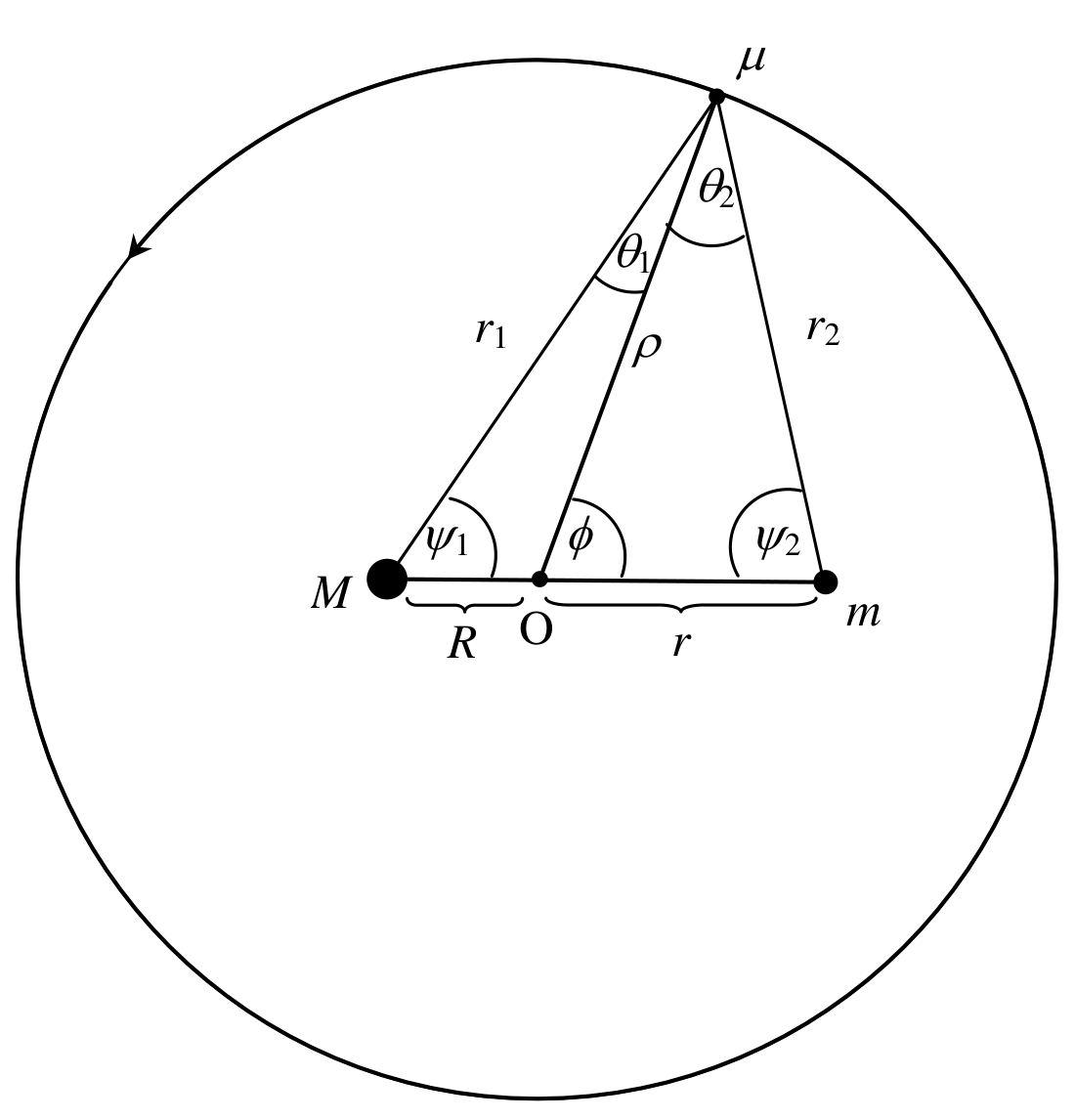
1.2 Since μ is infinitesimal, it has no gravitational influences on the motion of neither M nor m. For μ to remain stationary relative to both M and m we must have:
Substituting r12GM from Eq. (5) into Eq. (4), and using the identity sinθ1cosθ2+cosθ1sinθ2=sin(θ1+θ2), we get
mr22sin(θ1+θ2)=(R+r)3(M+m)ρsinθ1(6)
The distances r2 and ρ, the angles θ1 and θ2 are related by two Sine Rule equations
ρsinψ1=Rsinθ1,r2sinψ1=R+rsin(θ1+θ2)(7)
Substitute (7) into (6)
r231=(R+r)4Rm(M+m)(10)
Since M+mm=R+rR,Eq. (10) gives
r2=R+r(11)
By substituting r22Gm from Eq. (5) into Eq. (4), and repeat a similar procedure, we get
r1=R+r(12)
Alternatively,
sin(180∘−ϕ)r1=sinθ1Randsinϕr2=sinθ2r
sinθ2sinθ1=rR×r1r2=Mm×r1r2
Combining with Eq. (5) gives r1=r2
Hence, it is an equilateral triangle with
ψ1=60∘,ψ2=60∘(13)
The distance ρ is calculated from the Cosine Rule.
ρ2=r2+(R+r)2−2r(R+r)cos60∘,ρ=r2+rR+R2(14)
Alternative Solution to 1.2
Since μ is infinitesimal, it has no gravitational influences on the motion of neither M nor m .For μ to remain stationary relative to both M and m we must have:
M=m gives R=r and ω02=(R+R)3G(M+M)=4R3GM. The unperturbed radial distance of μ is 3R, so the perturbed radial distance can be represented by 3R+ζ where ζ≪3R as shown in the following figure.
Let v = speed of each spacecraft as it moves in circle around the centre O.
The relative velocities are denoted by the subscripts A, B and C.
For example, vBA is the velocity of B as observed by A.
The period of circular motion is 1 year T=365×24×60×60s. (28)
The angular frequency ω=T2π
The speed v=ω2cos30∘L=575m/s(29)
The speed is much less than the speed light → Galilean transformation.
In Cartesian coordinates, the velocities of B and C (as observed by O) are
For B, vB=vcos60∘i^−vsin60∘j^
For C, vC=vcos60∘i^+vsin60∘j^
Hence vBC=−2vsin60∘j^=−3vj^
The speed of B as observed by C is 3v≈996m/s(30)
Notice that the relative velocities for each pair are anti-parallel.
Alternative solution for 1.4
One can obtain vBC by considering the rotation about the axis at one of the spacecrafts.