Theoretical Competition: 12 July 2011 — Question 2 · 12 юли 2011 г.
Условие
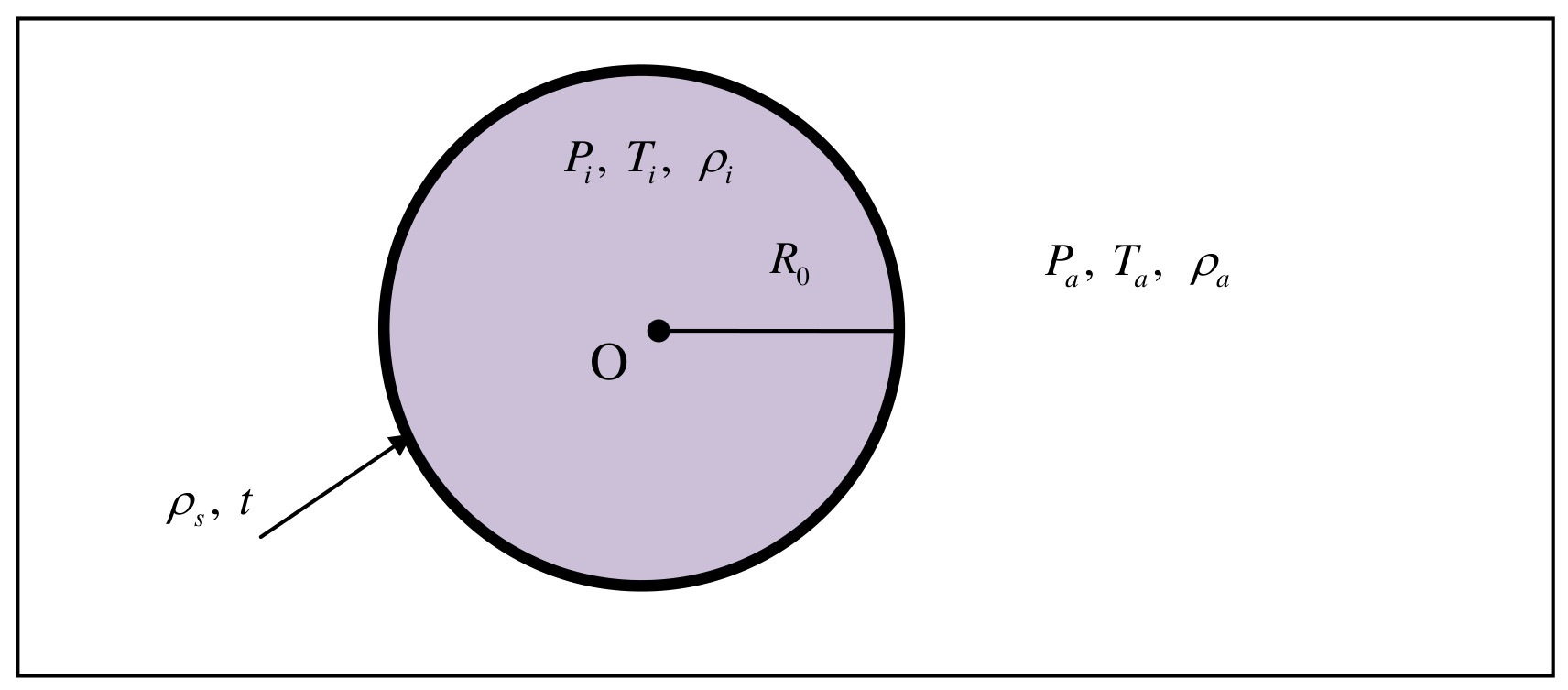
A spherical soap bubble with internal air density ρi, temperature Ti and radius R0 is surrounded by air with density ρa, atmospheric pressure Pa and temperature Ta. The soap film has surface tension γ, density ρs and thickness t. The mass and the surface tension of the soap do not change with the temperature. Assume that R0≫t.
The increase in energy, dE, that is needed to increase the surface area of a soap-air interface by dA, is given by dE=γdA where γ is the surface tension of the film.
2.1 Find the ratio ρaTaρiTi in terms of γ, Pa and R0. [1,7 т.]
2.2 Find the numerical value of ρaTaρiTi−1 using γ=0.0250Nm−1, R0=1.00cm, and Pa=1.013×10⁵Nm−2. [0,4 т.]
2.3 The bubble is initially formed with warmer air inside. Find the minimum numerical value of Ti such that the bubble can float in still air. Use Ta=300K, ρs=1000kgm−3, ρa=1.30kgm−3, t=100nm and g=9.80ms−2. [2 т.]
After the bubble is formed for a while, it will be in thermal equilibrium with the surrounding. This bubble in still air will naturally fall towards the ground.
2.4 Find the minimum velocity u of an updraught (air flowing upwards) that will keep the bubble from falling at thermal equilibrium. Give your answer in terms of ρs, R0, g, t and the air’s coefficient of viscosity η. You may assume that the velocity is small such that Stokes’s law applies, and ignore the change in the radius when the temperature lowers to the equilibrium. The drag force from Stokes’ Law is F=6πηR0u. [1,6 т.]
2.5 Calculate the numerical value for u using η=1.8×10⁻⁵kgm−1s−1. [0,4 т.]
The above calculations suggest that the terms involving the surface tension γ add very little to the accuracy of the result. In all of the questions below, you can neglect the surface tension terms.
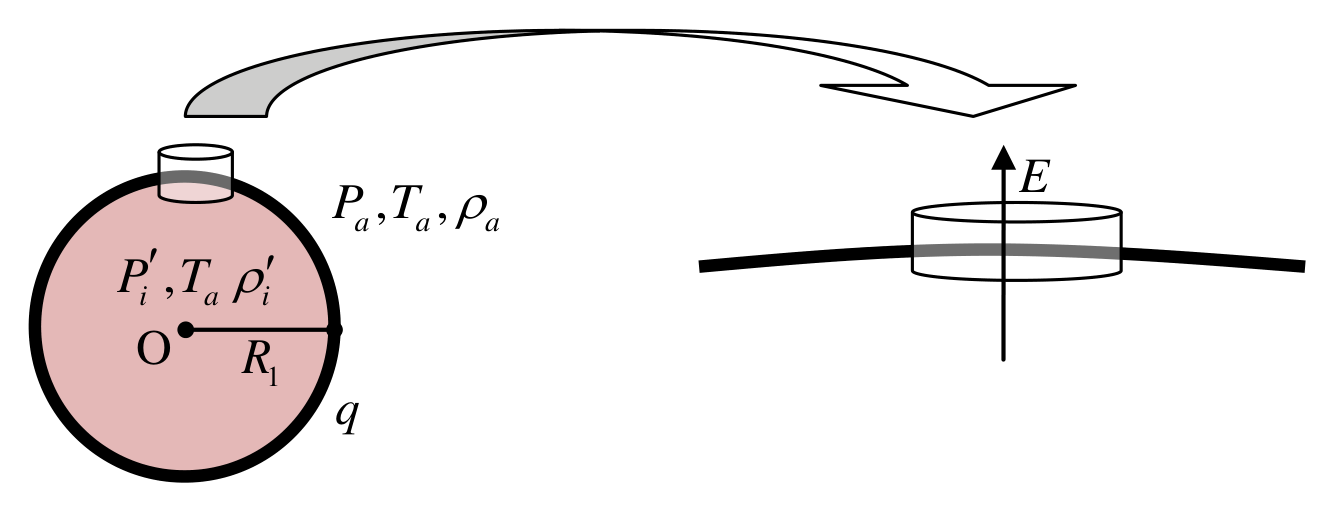
2.6 If this spherical bubble is now electrified uniformly with a total charge q, find an equation describing the new radius R1 in terms of R0,Pa,q and the permittivity of free space ε0. [2 т.]
2.7 Assume that the total charge is not too large (i.e. ε0R04q2≪Pa) and the bubble only experiences a small increase in its radius, find ΔR where R1=R0+ΔR. Given that (1+x)n≈1+nx where x≪1. [0,7 т.]
2.8 What must be the magnitude of this charge q in terms of t,ρa,ρs,ε0,R0,Pa in order that the bubble will float motionlessly in still air? Calculate also the numerical value of q. The permittivity of free space ε0=8.85×10⁻¹²farad/m. [1,2 т.]
Отговори
2.1ρaTaρiTi=PaPi=1+R0Pa4γ
2.2 0.0001
The official solution gives ρaTaρiTi=1+0.0001.
2.3 307.1 K
Ti≥307.1K; the air inside must be about 7.1∘C warmer.
2.4u≥6η4R0ρstg+6η34R02ρag(R0Pa4γ)
2.5 0.36 m/s
u≥0.36m/s
2.6(R0R1)4−(R0R1)−32π2ε0R04Paq2=0
2.7ΔR≈96π2ε0R03Paq2
2.82.56×10−7 C
q2≥ρa96π2R03ρstε0Pa, q≈256×10−9C≈256nC
Решение
2. SOLUTION
2.1. The bubble is surrounded by air.
Cutting the sphere in half and using the projected area to balance the forces give
PiπR02=PaπR02+2(2πR0γ)
Pi=Pa+R04γ…(1)
The pressure and density are related by the ideal gas law:
PV=nRTorP=MρRT, where M=the molar mass of air.…(2)
Apply the ideal gas law to the air inside and outside the bubble, we get
ρiTi=PiRM
ρaTa=PaRM,
ρaTaρiTi=PaPi=[1+R0Pa4γ]…(3)
2.2. Using γ=0.025Nm−1, R0=1.0cm and Pa=1.013×10⁵Nm−2, the numerical value of the ratio is
ρaTaρiTi=1+R0Pa4γ=1+0.0001…(4)
(The effect of the surface tension is very small.)
2.3. Let W = total weight of the bubble, F = buoyant force due to air around the bubble