IPhO 2011, Теория — Задача 3. To Commemorate the Centenary of Rutherford’s Atomic Nucleus: the Scattering of an Ion by a Neutral Atom
Theoretical Competition: 12 July 2011 — Question 3 · 12 юли 2011 г.
Условие
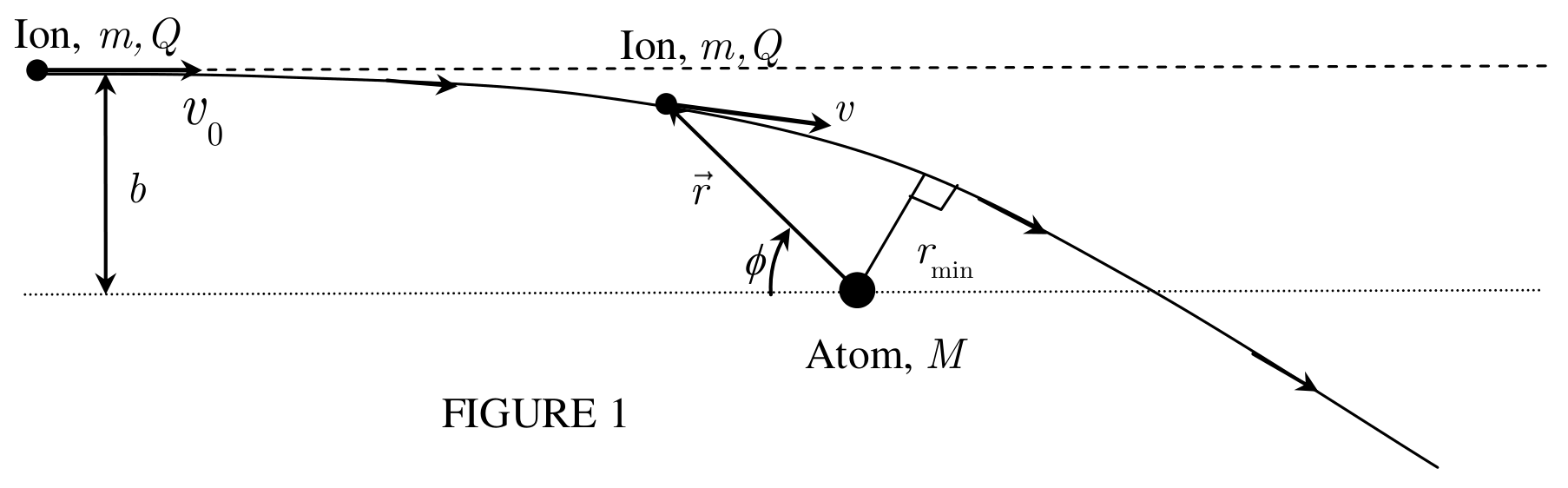
An ion of mass , charge , is moving with an initial non-relativistic speed from a great distance towards the vicinity of a neutral atom of mass and of electrical polarisability . The impact parameter is as shown in Figure 1.
The atom is instantaneously polarised by the electric field of the in-coming (approaching) ion.
The resulting electric dipole moment of the atom is . Ignore any radiative losses in this problem.
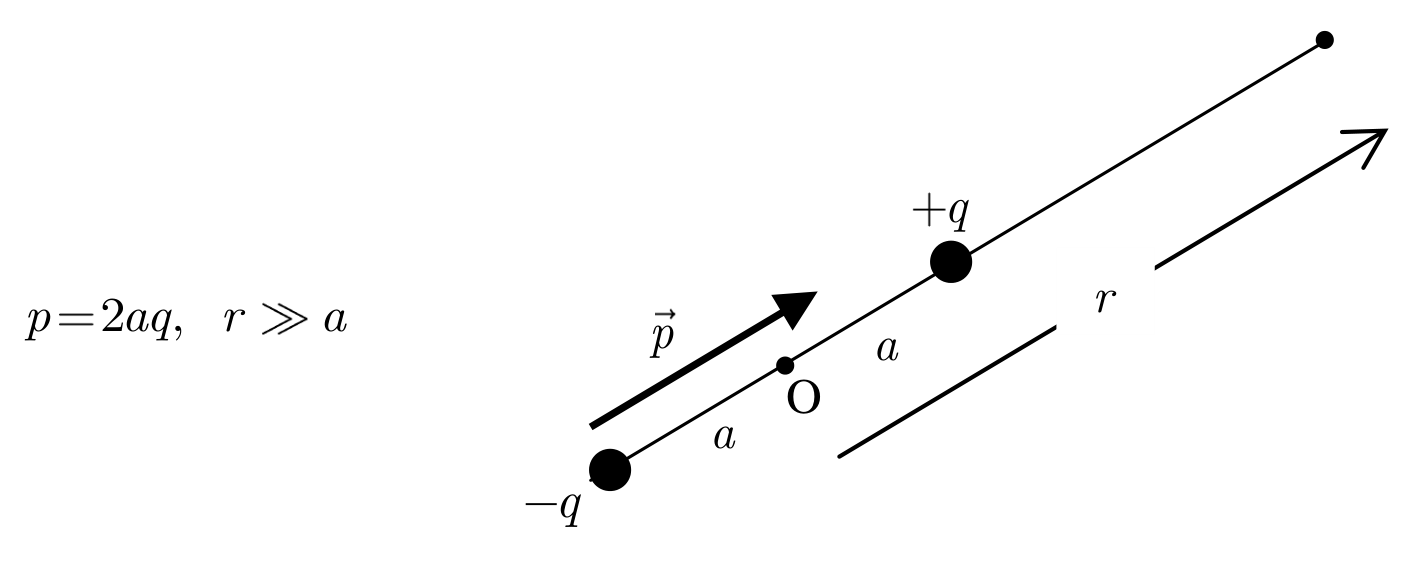
3.1 Calculate the electric field intensity at a distance from an ideal electric dipole at the origin O along the direction of in Figure 2. [1,2 т.]
3.2 Find the expression for the force acting on the ion due to the polarised atom. Show that this force is attractive regardless of the sign of the charge of the ion. [3 т.]
3.3 What is the electric potential energy of the ion-atom interaction in terms of and ? [0,9 т.]
3.4 Find the expression for , the distance of the closest approach, as shown in Figure 1. [2,4 т.]
3.5 If the impact parameter is less than a critical value , the ion will descend along a spiral to the atom. In such a case, the ion will be neutralized, and the atom is, in turn, charged. This process is known as the “charge exchange” interaction. What is the cross sectional area of this “charge exchange” collision of the atom as seen by the ion? [2,5 т.]
Отговори
- 3.1
- 3.2
- 3.3
- 3.4
- 3.5
Решение
QUESTION 3: SOLUTION
- Using Coulomb’s Law, we write the electric field at a distance is given by
Using binomial expansion for small ,
- The electric field seen by the atom from the ion is
The induced dipole moment is then simply
From eq. (2)
The electric field intensity at the position of an ion at that instant is, using eq. (4),
The force acting on the ion is
The “-’’ sign implies that this force is attractive and implies that the force is attractive regardless of the sign of .
- The potential energy of the ion-atom is given by
Using this,
[Remark: Students might use the term which changes only the factor in front.]
- At the position we have, according to the Principle of Conservation of Angular Momentum,
And according to the Principle of Conservation of Energy:
Eqs.(12) & (13):
The roots of eq. (14) are:
[Note that the equation (14) implies that cannot be zero, unless is itself zero.]
Since the expression has to be valid at , which gives
We have to choose “+” sign to make
Hence,
- A spiral trajectory occurs when (16) is imaginary (because there is no minimum distance of approach).
is real under the condition:
For the ion will collide with the atom.
Hence the atom, as seen by the ion, has a cross-sectional area ,