IPhO 2012, Теория, друг препис — Задача 2. Problem T2. Kelvin water dropper
The 43rd International Physics Olympiad — Theoretical Competition. Tartu, Estonia — Tuesday, July 17th 2012 · 17 юли 2012 г. · 8 т.
Корица
- The examination lasts for 5 hours. There are 3 problems worth a total of 30 points. Please note that the point values of the three theoretical problems are not equal.
- You must not open the envelope with the problems before the sound signal indicating the beginning of competition (three short signals).
- You are not allowed to leave your working place without permission. If you need any assistance (broken calculator, need to visit a restroom, etc), please raise the corresponding flag (“HELP” or “TOILET” with a long handle at your seat) above your seat box walls and keep it raised until an organizer arrives.
- Your answers must be expressed in terms of those quantities, which are highlighted in the problem text, and can contain also fundamental constants, if needed. So, if it is written that “the box height is and the width - ” then can be used in the answer, and cannot be used (unless it is highlighted somewhere else, see below). Those quantities which are highlighted in the text of a subquestion can be used only in the answer to that subquestion; the quantities which are highlighted in the introductory text of the Problem (or a Part of a Problem), i.e. outside the scope of any subquestion, can be used for all the answers of that Problem (or of that Problem Part).
- Use only the front side of the sheets of paper.
- For each problem, there are dedicated Solution Sheets (see header for the number and pictogramme). Write your solutions onto the appropriate Solution Sheets. For each Problem, the Solution Sheets are numbered; use the sheets according to the enumeration. Always mark which Problem Part and Question you are dealing with. Copy the final answers into the appropriate boxes of the Answer Sheets. There are also Draft papers; use these for writing things which you don’t want to be graded. If you have written something what you don’t want to be graded onto the Solution Sheets (such as initial and incorrect solutions), cross these out.
- If you need more paper for a certain problem, please raise the flag “HELP” and tell an organizer the problem number; you are given two Solution sheets (you can do this more than once).
- You should use as little text as possible: try to explain your solution mainly with equations, numbers, symbols and diagrams.
- The first single sound signal tells you that there are 30 min of solving time left; the second double sound signal means that 5 min is left; the third triple sound signal marks the end of solving time. After the third sound signal you must stop writing immediately. Put all the papers into the envelope at your desk. You are not allowed to take any sheet of paper out of the room. If you have finished solving before the final sound signal, please raise your flag.
Условие
The following facts about the surface tension may turn out to be useful for this problem. For the molecules of a liquid, the positions at the liquid-air interface are less favourable as compared with the positions in the bulk of the liquid. This interface is described by the so-called surface energy, , where is the surface area of the interface and is the surface tension coefficient of the liquid. Moreover, two fragments of the liquid surface pull each other with a force , where is the length of a straight line separating the fragments.
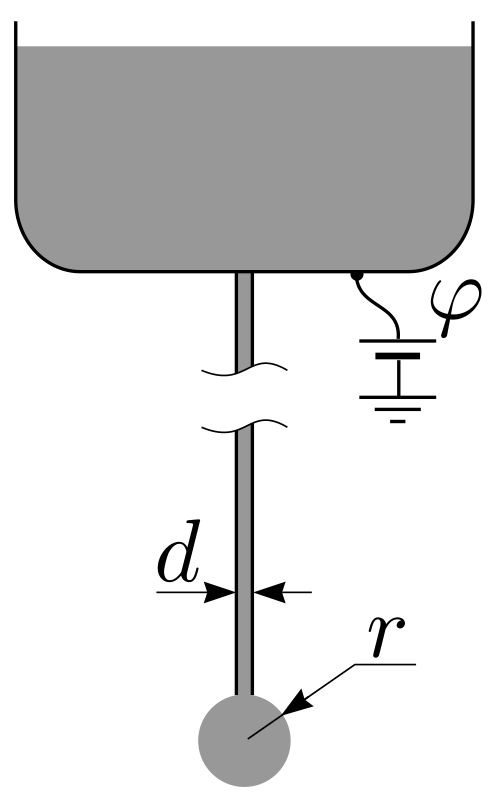
A long metallic pipe with internal diameter is pointing directly downwards. Water is slowly dripping from a nozzle at its lower end, see fig. Water can be considered to be electrically conducting; its surface tension is and its density is . A droplet of radius hangs below the nozzle. The radius grows slowly in time until the droplet separates from the nozzle due to the free fall acceleration . Always assume that .
Part A. Single pipe (4 points)
A.i. Find the radius of a drop just before it separates from the nozzle. [1,2 т.]
A.ii. Relative to the far-away surroundings, the pipe’s electrostatic potential is . Find the charge of a drop when its radius is . [1,2 т.]
A.iii. Consider the situation in which is kept constant and is slowly increased. The droplet becomes unstable and breaks into pieces if the hydrostatic pressure inside the droplet becomes smaller than the atmospheric pressure. Find the critical potential at which this will happen. [1,6 т.]
Part B. Two pipes (4 points)
An apparatus called the “Kelvin water dropper” consists of two pipes, each identical to the one described in Part A, connected via a T-junction, see fig. The ends of both pipes are at the centres of two cylindrical electrodes (with height and diameter with ). For both tubes, the dripping rate is droplets per unit time. Droplets fall from height into conductive bowls underneath the nozzles, cross-connected to the electrodes as shown in the diagram. The electrodes are connected via a capacitance . There is no net charge on the system of bowls and electrodes. Note that the top water container is earthed as shown. The first droplet to fall will have some microscopic charge which will cause an imbalance between the two sides and a small charge separation across the capacitor.
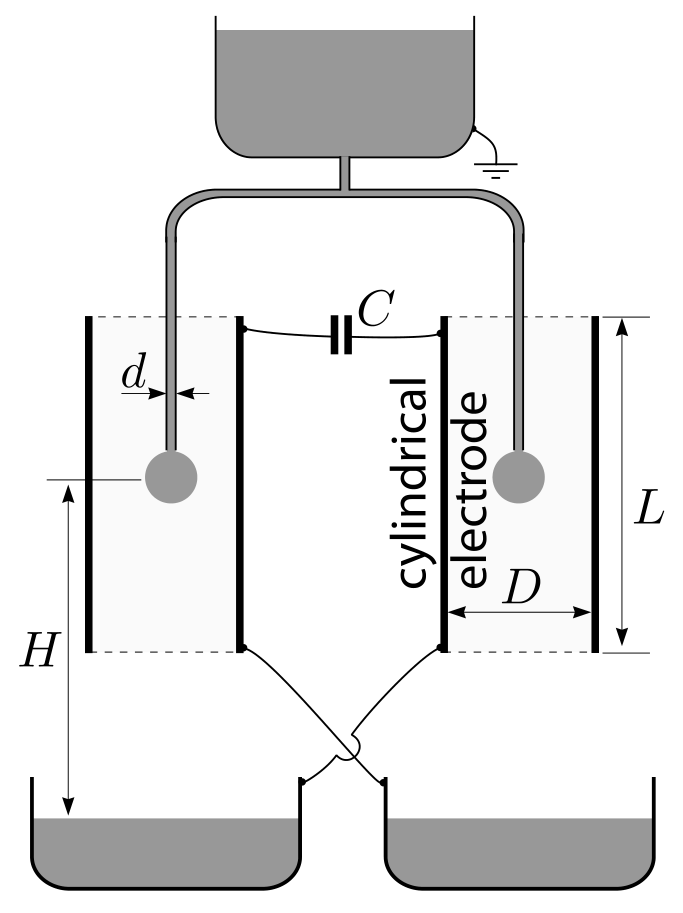
B.i. Express the absolute value of the charge of the drops as they separate from the tubes, and at the instant when the capacitor’s charge is . Express in terms of (from Part A-i) and neglect the effect described in Part A-iii. [1,2 т.]
B.ii. Find the dependence of on time by approximating it with a continuous function and assuming that . [1,5 т.]
B.iii. The dropper’s functioning can be hindered by the effect shown in Part A-iii. In addition, a limit to the achievable potential between the electrodes is set by the electrostatic push between a droplet and the bowl beneath it. Find . [1,3 т.]
Отговори
- A.i.
- A.ii.
- A.iii.
- B.i.
- B.ii.
- B.iii.
Решение
Part A. Single pipe (4 points)
i. (1.2 pts) Let us write the force balance for the droplet. Since , we can neglect the force due to the excess pressure inside the tube. So, the gravity force is balanced by the capillary force. When the droplet separates from the tube, the water surface forms in the vicinity of the nozzle a “neck”, which has vertical tangent. In the horizontal cross-section of that “neck”, the capillary force is vertical and can be calculated as . So,
ii. (1.2 pts) Since , we can neglect the change of the droplet’s capacitance due to the tube. On the one hand, the droplet’s potential is ; on the other hand, it is . So,
iii. (1.6 pts) Excess pressure inside the droplet is caused by the capillary pressure (increases the inside pressure), and by the electrostatic pressure (decreases the pressure). So, the sign of the excess pressure will change, if , hence
The expression for the electrostatic pressure used above can be derived as follows. The electrostatic force acting on a surface charge of density and surface area is given by , where is the field at the site without the field created by the surface charge element itself. Note that this force is perpendicular to the surface, so can be interpreted as a pressure. The surface charge gives rise to a field drop on the surface equal to (which follows from the Gauss law); inside the droplet, there is no field due to the conductivity of the droplet: ; outside the droplet, there is field , therefore . Bringing everything together, we obtain the expression used above.
Note that alternatively, this expression can be derived by considering a virtual displacement of a capacitor’s surface and comparing the pressure work with the change of the electrostatic field energy .
Finally, the answer to the question can be also derived from the requirement that the mechanical work done for an infinitesimal droplet inflation needs to be zero. From the energy conservation law, , where the droplet’s capacitance ; the electrical work . Putting we obtain an equation for , which recovers the earlier result.
Part B. Two pipes (4 points)
i. (1.2 pts) This is basically the same as Part A-ii, except that the surroundings’ potential is that of the surrounding electrode, (where is the capacitor’s voltage) and droplet has the ground potential (0). As it is not defined which electrode is the positive one, opposite sign of the potential may be chosen, if done consistently. Note that since the cylindrical electrode is long, it shields effectively the environment’s (ground, wall, etc) potential. So, relative to its surroundings, the droplet’s potential is . Using the result of Part A we obtain
ii. (1.5 pts) The sign of the droplet’s charge is the same as that of the capacitor’s opposite plate (which is connected to the farther electrode). So, when the droplet falls into the bowl, it will increase the capacitor’s charge by :
where is the number of droplets which fall during the time This is a simple linear differential equation which is solved easily to obtain
iii. (1.3 pts) The droplets can reach the bowls if their mechanical energy (where is the droplet’s mass) is large enough to overcome the electrostatic push: The droplet starts at the point where the electric potential is 0, which is the sum of the potential , due to the electrode, and of its self-generated potential . Its motion is not affected by the self-generated field, so it needs to fall from the potential down to the potential , resulting in the change of the electrostatic energy equal to , where (see above). So,
Оригинал в Архива: 2012-08-09 IPhO2012_Theoretical_problems.pdf · официални решения: 2012-08-09 IPO2012 Theory_Solutions_ENG.pdf