IPhO 2012, Теория — Задача 1. Focus on sketches
The 43rd International Physics Olympiad — Theoretical Competition. Tartu, Estonia — Tuesday, July 17th 2012 · 17 юли 2012 г. · 13 т.
Cover — general instructions
- The examination lasts for 5 hours. There are 3 problems worth a total of 30 points. Please note that the point values of the three theoretical problems are not equal.
- You must not open the envelope with the problems before the sound signal indicating the beginning of competition (three short signals).
- You are not allowed to leave your working place without permission. If you need any assistance (broken calculator, need to visit a restroom, etc), please raise the corresponding flag (“HELP” or “TOILET” with a long handle at your seat) above your seat box walls and keep it raised until an organizer arrives.
- Your answers must be expressed in terms of those quantities, which are highlighted in the problem text, and can contain also fundamental constants, if needed. So, if it is written that “the box height is and the width - ” then can be used in the answer, and cannot be used (unless it is highlighted somewhere else, see below). Those quantities which are highlighted in the text of a subquestion can be used only in the answer to that subquestion; the quantities which are highlighted in the introductory text of the Problem (or a Part of a Problem), i.e. outside the scope of any subquestion, can be used for all the answers of that Problem (or of that Problem Part).
- Use only the front side of the sheets of paper.
- For each problem, there are dedicated Solution Sheets (see header for the number and pictogramme). Write your solutions onto the appropriate Solution Sheets. For each Problem, the Solution Sheets are numbered; use the sheets according to the enumeration. Always mark which Problem Part and Question you are dealing with. Copy the final answers into the appropriate boxes of the Answer Sheets. There are also Draft papers; use these for writing things which you don’t want to be graded. If you have written something what you don’t want to be graded onto the Solution Sheets (such as initial and incorrect solutions), cross these out.
- If you need more paper for a certain problem, please raise the flag “HELP” and tell an organizer the problem number; you are given two Solution sheets (you can do this more than once).
- You should use as little text as possible: try to explain your solution mainly with equations, numbers, symbols and diagrams.
- The first single sound signal tells you that there are 30 min of solving time left; the second double sound signal means that 5 min is left; the third triple sound signal marks the end of solving time. After the third sound signal you must stop writing immediately. Put all the papers into the envelope at your desk. You are not allowed to take any sheet of paper out of the room. If you have finished solving before the final sound signal, please raise your flag.
Условие
Part A. Ballistics (4.5 points)
A ball, thrown with an initial speed , moves in a homogeneous gravitational field in the - plane, where the -axis is horizontal, and the -axis is vertical and antiparallel to the free fall acceleration . Neglect the effect of air drag.
A-i By adjusting the launching angle for a ball thrown with a fixed initial speed from the origin, targets can be hit within the region given by
You can use this fact without proving it. Find the constants and . [0,8 т.]
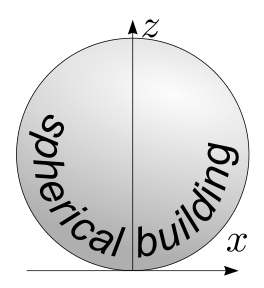
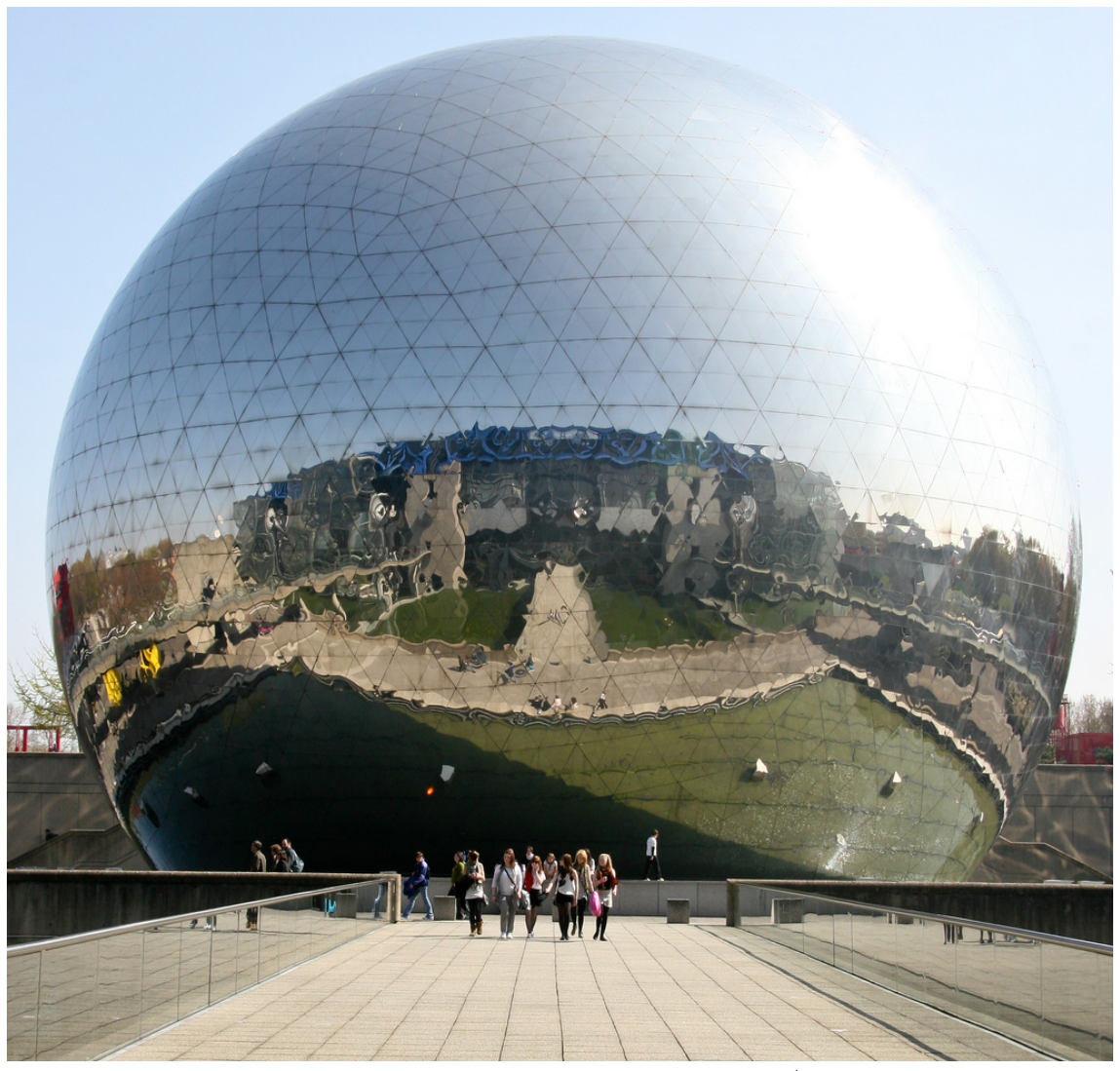
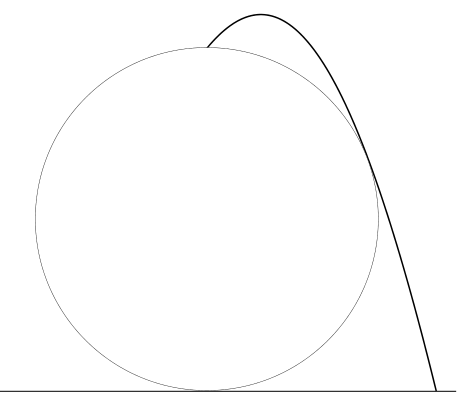
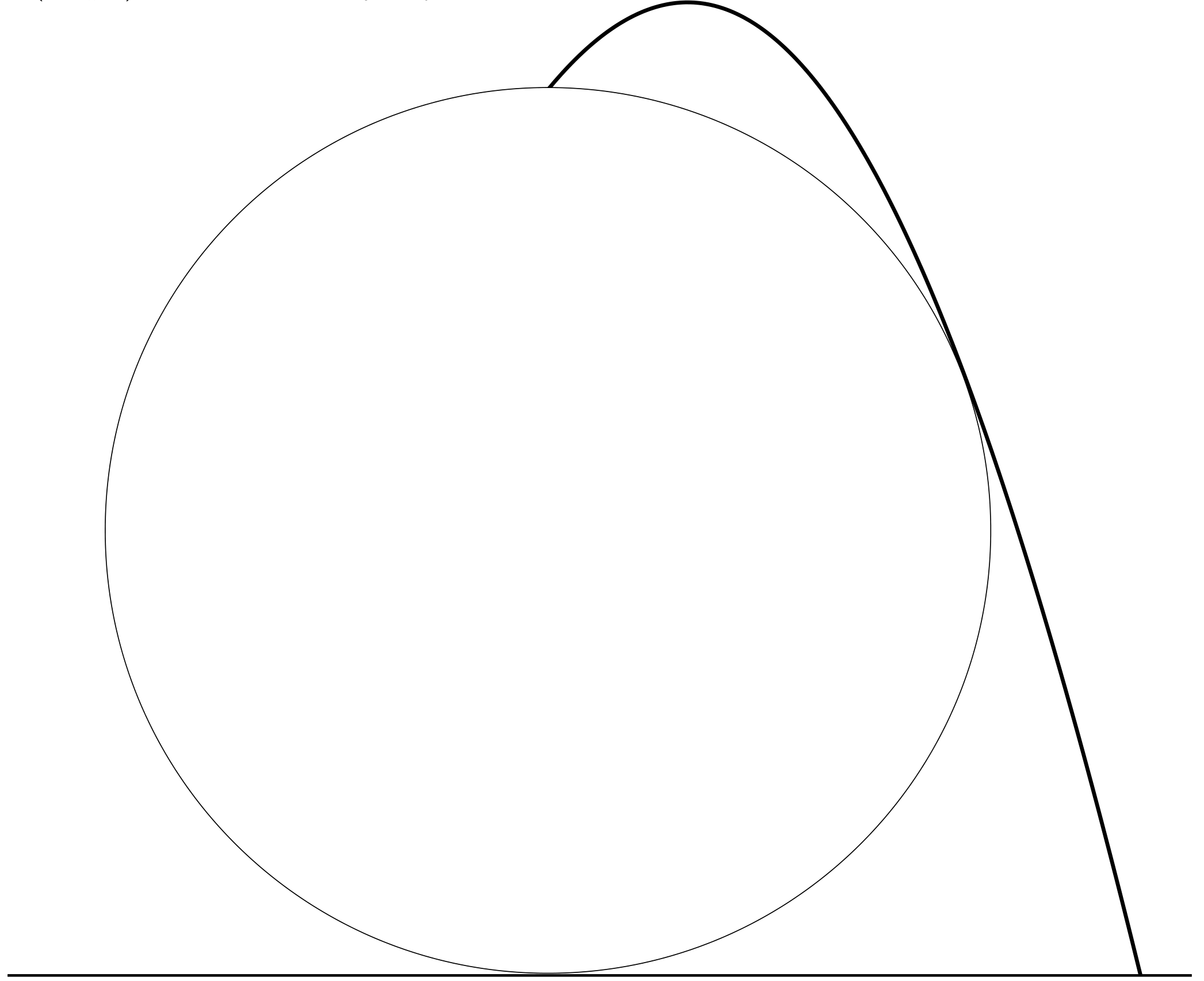
A-ii The launching point can now be freely selected on the ground level , and the launching angle can be adjusted as needed. The aim is to hit the topmost point of a spherical building of radius (see fig.) with the minimal initial speed . Bouncing off the roof prior to hitting the target is not allowed. Sketch qualitatively the shape of the optimal trajectory of the ball (use the designated box on the answer sheet). Note that the marks are given only for the sketch. [1,2 т.]
A-iii What is the minimal launching speed needed to hit the topmost point of a spherical building of radius ? [2,5 т.]
Part B. Air flow around a wing (4 points)
For this part of the problem, the following information may be useful. For a flow of liquid or gas in a tube along a streamline, , assuming that the velocity is much less than the speed of sound. Here is the density, is the height, is free fall acceleration and is hydrostatic pressure. Streamlines are defined as the trajectories of fluid particles (assuming that the flow pattern is stationary). Note that the term is called the dynamic pressure.
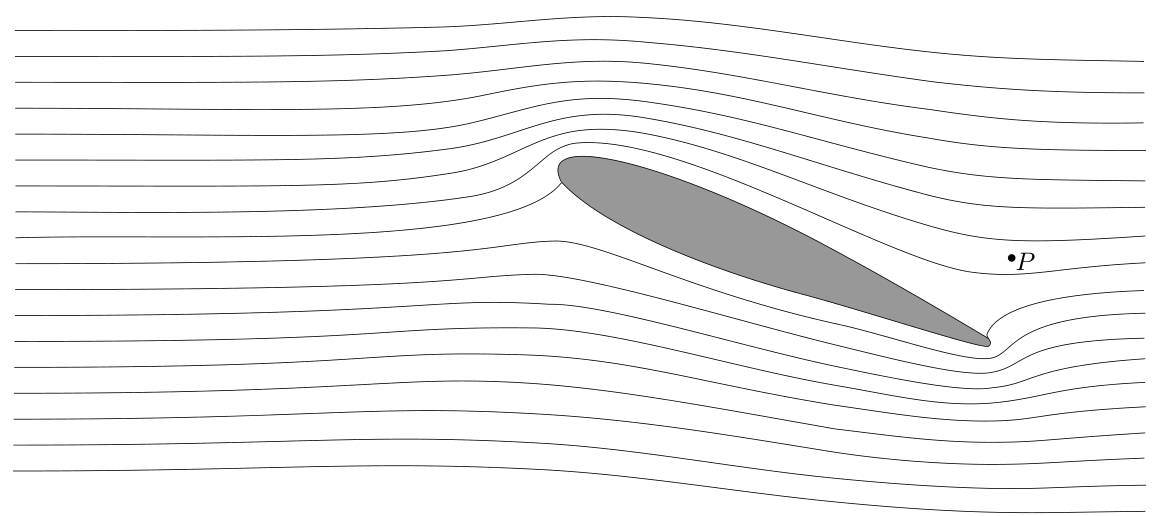
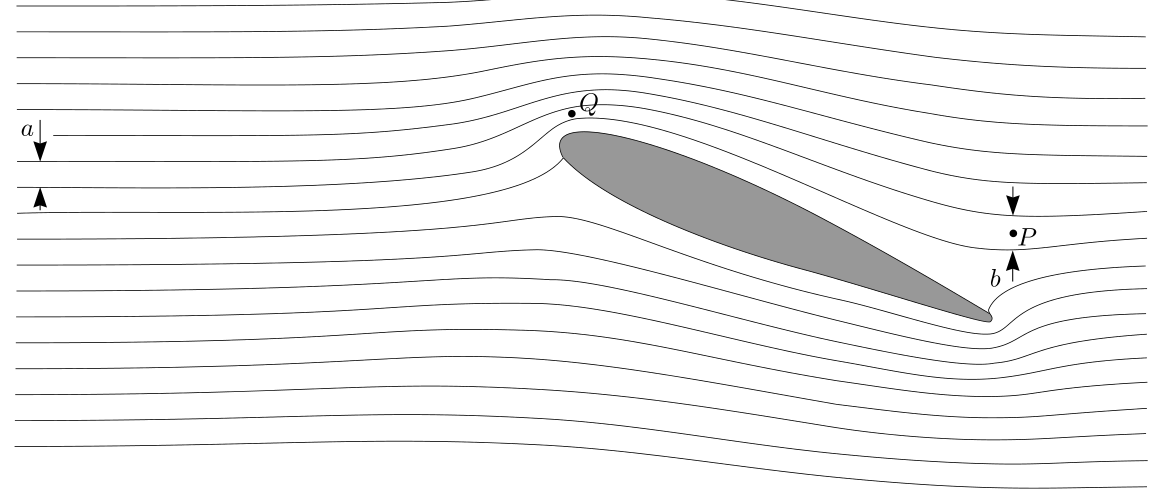
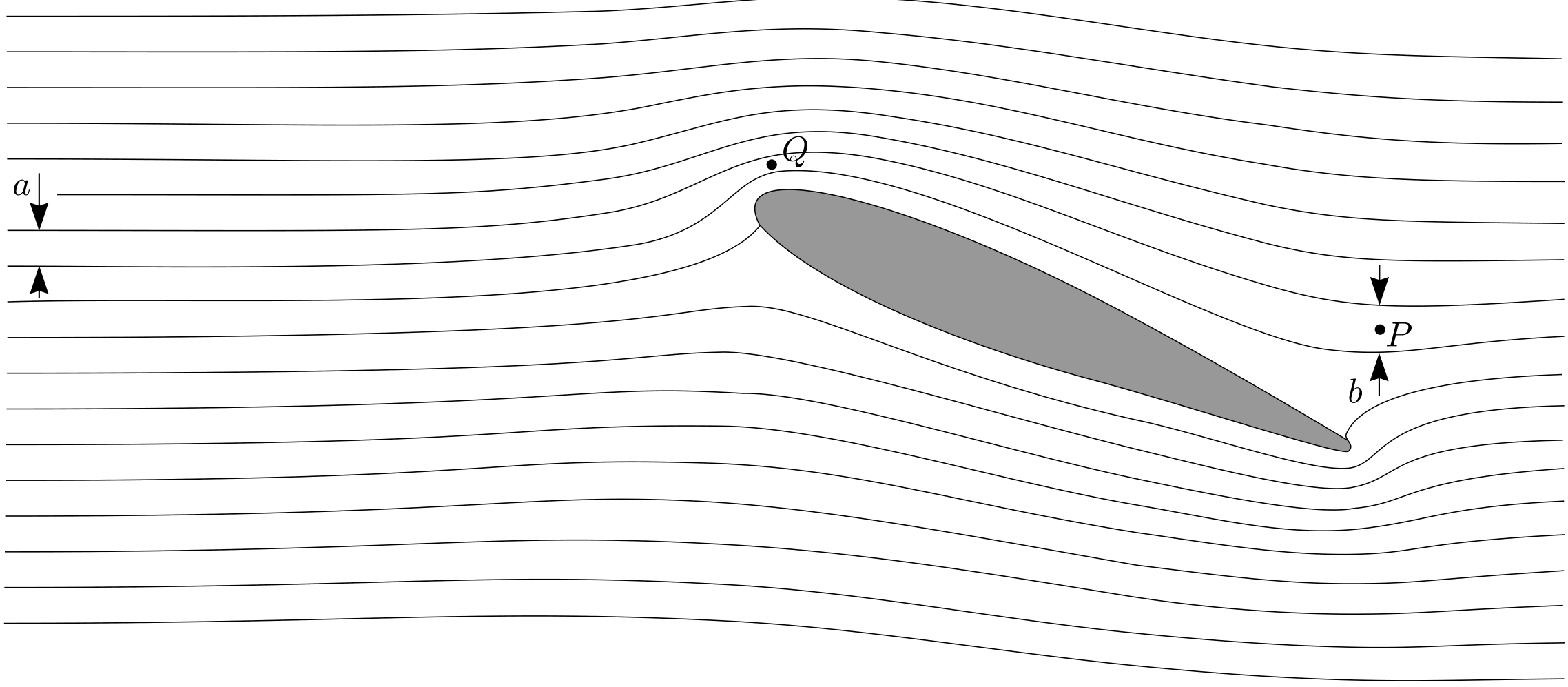
In the fig. shown below, a cross-section of an aircraft wing is depicted together with streamlines of the air flow around the wing, as seen in the wing’s reference frame. Assume that (a) the air flow is purely two-dimensional (i.e. that the velocity vectors of air lie in the plane of the figure); (b) the streamline pattern is independent of the aircraft speed; (c) there is no wind; (d) the dynamic pressure is much smaller than the atmospheric pressure, .
You can use a ruler to take measurements from the fig. on the answer sheet.
B-i If the aircraft’s ground speed is , what is the speed of the air, , at the point (marked in the fig.) with respect to the ground? [0,8 т.]
B-ii In the case of high relative humidity, as the ground speed of the aircraft increases over a critical value , a stream of water droplets is created behind the wing. The droplets emerge at a certain point . Mark the point in the fig. on the answer sheet. Explain qualitatively (using formulae and as little text as possible) how you determined the position of . [1,2 т.]
B-iii Estimate the critical speed using the following data: relative humidity of the air is , specific heat capacity of air at constant pressure , pressure of saturated water vapour: at the temperature of the unperturbed air and at . Depending on your approximations, you may also need the specific heat capacity of air at constant volume . Note that the relative humidity is defined as the ratio of the vapour pressure to the saturated vapour pressure at the given temperature. Saturated vapour pressure is defined as the vapour pressure by which vapour is in equilibrium with the liquid. [2 т.]
Part C. Magnetic straws (4.5 points)
Consider a cylindrical tube made of a superconducting material. The length of the tube is and the inner radius is with . The centre of the tube coincides with the origin, and its axis coincides with the -axis.
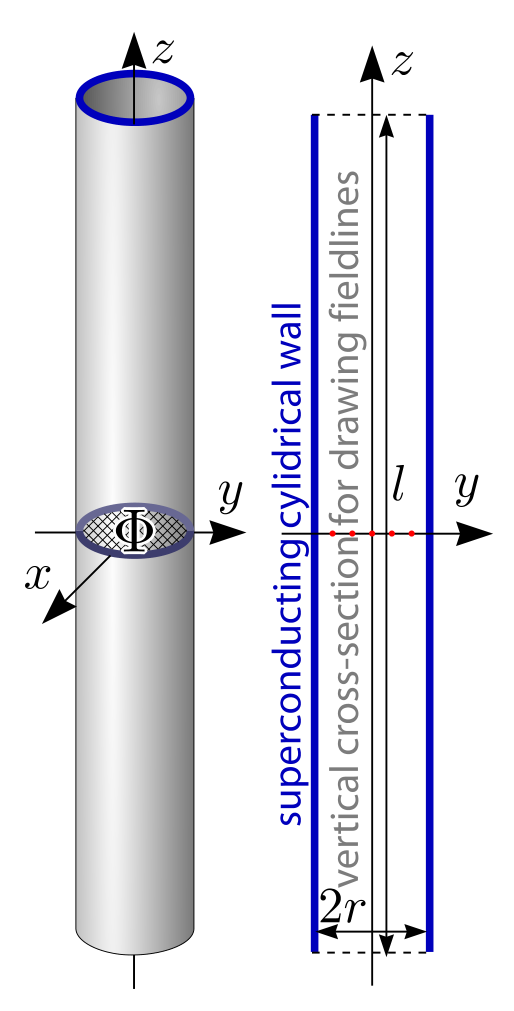
There is a magnetic flux through the central cross-section of the tube, , . A superconductor is a material which expels any magnetic field (the field is zero inside the material).
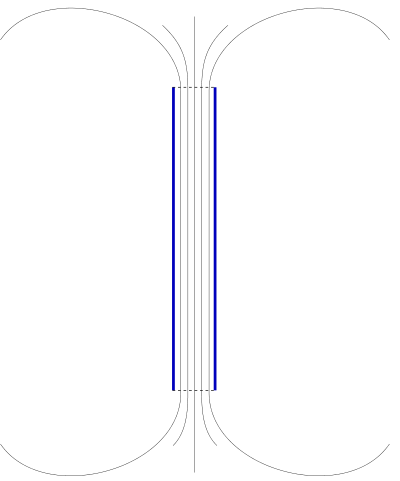
C-i Sketch five such magnetic field lines, which pass through the five red dots marked on the axial cross-section of the tube, on the designated diagram on the answer sheet. [0,8 т.]
C-ii Find the tension force along the -axis in the middle of the tube (i.e. the force by which two halves of the tube, and , interact with each other). [1,2 т.]
C-iii Consider another tube, identical and parallel to the first one.
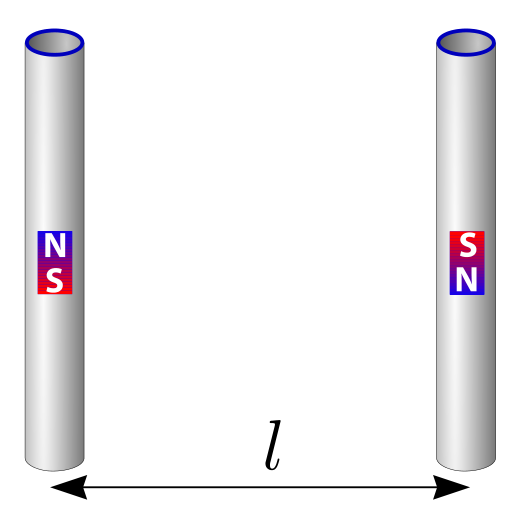
The second tube has the same magnetic field but in the opposite direction and its centre is placed at (so that the tubes form opposite sides of a square). Determine the magnetic interaction force between the two tubes. [2,5 т.]
Отговори
A-i
A-ii The optimal trajectory touches the roof of the building once and ends at its topmost point (see the sketch on the official answer sheet).
A-iii
B-i 23 m/s
B-ii Q is where the air speed in the wing’s frame is maximal and the streamline distance minimal (just above the leading edge of the wing), because there the hydrostatic pressure and the temperature are lowest; formulae: av = const, p + ρv²/2 = const, p^(1−γ)T^γ = const.
B-iii
Official formula: vcrit = c·sqrt(2cpΔT/(a² − c²)), with c ≈ 4.5 mm and ΔT = 1.5 K; an order-of-magnitude estimate.
C-i Inside the tube the field lines are straight, parallel to the axis (homogeneous field); outside they close around from one end to the other, like those of a solenoid (see the sketch on the official answer sheet).
C-ii
C-iii
Решение
Part A. Ballistics (4.5 points)
i. (0.8 pts) When the stone is thrown vertically upwards, it can reach the point , (as it follows from the energy conservation law). Comparing this with the inequality we conclude that
Let us consider the asymptotics ; the trajectory of the stone is a parabola, and at this limit, the horizontal displacement (for the given ) is very sensitive with respect to the curvature of the parabola: the flatter the parabola, the larger the displacement. The parabola has the flattest shape when the stone is thrown horizontally, and , i.e. its trajectory is given by . Now, let us recall that , i.e. . Note that would imply that there is a gap between the parabolic region and the given trajectory . This trajectory is supposed to be optimal for hitting targets far below (), so there should be no such a gap, and hence, we can exclude the option . This leaves us with
ii. (1.2 pts) Let us note that the stone trajectory is reversible and due to the energy conservation law, one can equivalently ask, what is the minimal initial speed needed for a stone to be thrown from the topmost point of the spherical building down to the ground without hitting the roof, and what is the respective trajectory. It is easy to understand that the trajectory either needs to touch the roof, or start horizontally from the topmost point with the curvature radius equal to . Indeed, if neither were the case, it would be possible to keep the same throwing angle and just reduce the speed a little bit — the stone would still reach the ground without hitting the roof. Further, if it were tangent at the topmost point, the trajectory wouldn’t touch nor intersect the roof anywhere else, because the curvature of the parabola has maximum at its topmost point. Then, it would be possible to keep the initial speed constant, and increase slightly the throwing angle (from horizontal to slightly upwards): the new trajectory wouldn’t be neither tangent at the top nor touch the roof at any other point; now we can reduce the initial speed as we argued previously. So we conclude that the optimal trajectory needs to touch the roof somewhere, as shown in Fig.
iii. (2.5 pts) The brute force approach would be writing down the condition that the optimal trajectory intersects with the building at two points and touches at one. This would be described by a fourth order algebraic equation and therefore, it is not realistic to accomplish such a solution within a reasonable time frame.
Note that the interior of the building needs to lie inside the region where the targets can be hit with a stone thrown from the top with initial speed . Indeed, if we can throw over the building, we can hit anything inside by lowering the throwing angle. On the other hand, the boundary of the targetable region needs to touch the building. Indeed, if there were a gap, it would be possible to hit a target just above the point where the optimal trajectory touches the building; the trajectory through that target wouldn’t touch the building anywhere, hence we arrive at a contradiction.
So, with corresponding to the optimal trajectory, the targetable region touches the building; due to symmetry, overall there are two touching points (for smaller speeds, there would be four, and for larger speeds, there would be none). With the origin at the top of the building, the intersection points are defined by the following system of equations:
Upon eliminating , this becomes a biquadratic equation for :
Hence the speed by which the real-valued solutions disappear can be found from the condition that the discriminant vanishes:
Bearing in mind that due to the energy conservation law, at the ground level the squared speed is increased by . Thus we finally obtain
Part B. Mist (4 points)
i. (0.8 pts) In the plane’s reference frame, along the channel between two streamlines the volume flux of air (volume flow rate) is constant due to continuity. The volume flux is the product of speed and channel’s cross-section area, which, due to the two-dimensional geometry, is proportional to the channel width and can be measured from the Fig. Due to the absence of wind, the unperturbed air’s speed in the plane’s frame is just . So, upon measuring the dimensions and (see Fig), we can write and hence . Since at point , the streamlines are horizontal where all the velocities are parallel, the vector addition is reduced to the scalar addition: the air’s ground speed .
ii. (1.2 pts) Although the dynamic pressure is relatively small, it gives rise to some adiabatic expansion and compression. In expanding regions the temperature will drop and hence, the pressure of saturated vapours will also drop. If the dew point is reached, a stream of droplets will appear. This process will start in a point where the adiabatic expansion is maximal, i.e. where the hydrostatic pressure is minimal and consequently, as it follows from the Bernoulli’s law , the dynamic pressure is maximal: in the place where the air speed in wing’s frame is maximal and the streamline distance minimal. Such a point is marked in Fig.
iii. (2 pts) First we need to calculate the dew point for the air of given water content (since the relative pressure change will be small, we can ignore the dependence of the dew point on pressure). The water vapour pressure is . The relative change of the pressure of the saturated vapour is small, so we can linearize its temperature dependence:
numerically . Further we need to relate the air speed to the temperature. To this end we need to use the energy conservation law. A convenient ready-to-use form of it is provided by the Bernoulli’s law. Applying this law will give a good approximation of the reality, but strictly speaking, it needs to be modified to take into account the compressibility of air and the associated expansion/contraction work. Consider one mole of air, which has the mass and the volume . Apparently the process is fast and the air parcels are large, so that heat transfer across the air parcels is negligible. Additionally, the process is subsonic; all together we can conclude that the process is adiabatic. Consider a segment of a tube formed by the streamlines. Let us denote the physical quantities at its one end by index 1, and at the other end — by index 2. Then, while one mole of gas flows into the tube at one end, as much flows out at the other end. The inflow carries in kinetic energy , and the outflow carries out . The inflowing gas receives work due to the pushing gas equal to , the outflowing gas performs work . Let’s define molar heat capacities and . The inflow carries in heat energy , and the outflow carries out . All together, the energy balance can be written as . From this we can easily express , where is the streamline distance at the point , and further
where we have used and . Note that in reality, the required speed is probably somewhat higher, because for a fast condensation, a considerable over-saturation is needed. However, within an order of magnitude, this estimate remains valid.
Part C. Magnetic straws (4.5 points)
i. (0.8 pts) Due to the superconducting walls, the magnetic field lines cannot cross the walls, so the flux is constant along the tube. For a closed contour inside the tube, there should be no circulation of the magnetic field, hence the field lines cannot be curved, and the field needs to be homogeneous. The field lines close from outside the tube, similarly to a solenoid.
ii. (1.2 pts) Let us consider the change of the magnetic energy when the tube is stretched (virtually) by a small amount . Note that the magnetic flux trough the tube is conserved: any change of flux would imply a non-zero electromotive force , and for a zero resistivity, an infinite current. So, the induction . The energy density of the magnetic field is . Thus, the change of the magnetic energy is calculated as
This energy increase is achieved owing to the work done by the stretching force, . Hence, the force
iii. (2.5 pts) Let us analyse, what would be the change of the magnetic energy when one of the straws is displaced to a small distance. The magnetic field inside the tubes will remain constant due to the conservation of magnetic flux, but outside, the magnetic field will be changed. The magnetic field outside the straws is defined by the following condition: there is no circulation of (because there are no currents outside the straws); there are no sources of the field lines, other than the endpoints of the straws; each of the endpoints of the straws is a source of streamlines with a fixed magnetic flux . These are exactly the same condition as those which define the electric field of four charges . We know that if the distance between charges is much larger than the geometrical size of a charge, the charges can be considered as point charges (the electric field near the charges remains almost constant, so that the respective contribution to the change of the overall electric field energy is negligible). Therefore we can conclude that the endpoints of the straws can be considered as magnetic point charges. In order to calculate the force between two magnetic charges (magnetic monopoles), we need to establish the correspondence between magnetic and electric quantities.
For two electric charges separated by a distance , the force is , and at the position of one charge, the electric field of the other charge has energy density ; hence we can write . This is a universal expression for the force (for the case when the field lines have the same shape as in the case of two opposite and equal by modulus electric charges) relying only on the energy density, and not related to the nature of the field; so we can apply it to the magnetic field. Indeed, the force can be calculated as a derivative of the full field energy with respect to a virtual displacement of a field line source (electric or magnetic charge); if the energy densities of two fields are respectively equal at one point, they are equal everywhere, and so are equal the full field energies. As it follows from the Gauss law, for a point source of a fixed magnetic flux at a distance , the induction . So, the energy density , hence
For the two straws, we have four magnetic charges. The longitudinal (along a straw axis) forces cancel out (the diagonally positioned pairs of same-sign-charges push in opposite directions). The normal force is a superposition of the attraction due to the two pairs of opposite charges, , and the repulsive forces of diagonal pairs, . The net attractive force will be
Answer sheet (official answers) — Problem T1. Focus on sketches (13 points)
Part A. Ballistics (4.5 points)
i. (0.8 pts) ;
ii. (1.2 pts) The sketch of the trajectory: see the figure.
iii. (2.5 pts)
Part B. Air flow around a wing (4 points)
i. (0.8 pts)
ii. (1.2 pts) Mark on this fig. the point Q. Use it also for taking measurements (questions i and iii).
Formulae motivating the choice of point Q:
iii. (2.0 pts) Formula:
Numerical:
Part C. Magnetic straws (4.5 points)
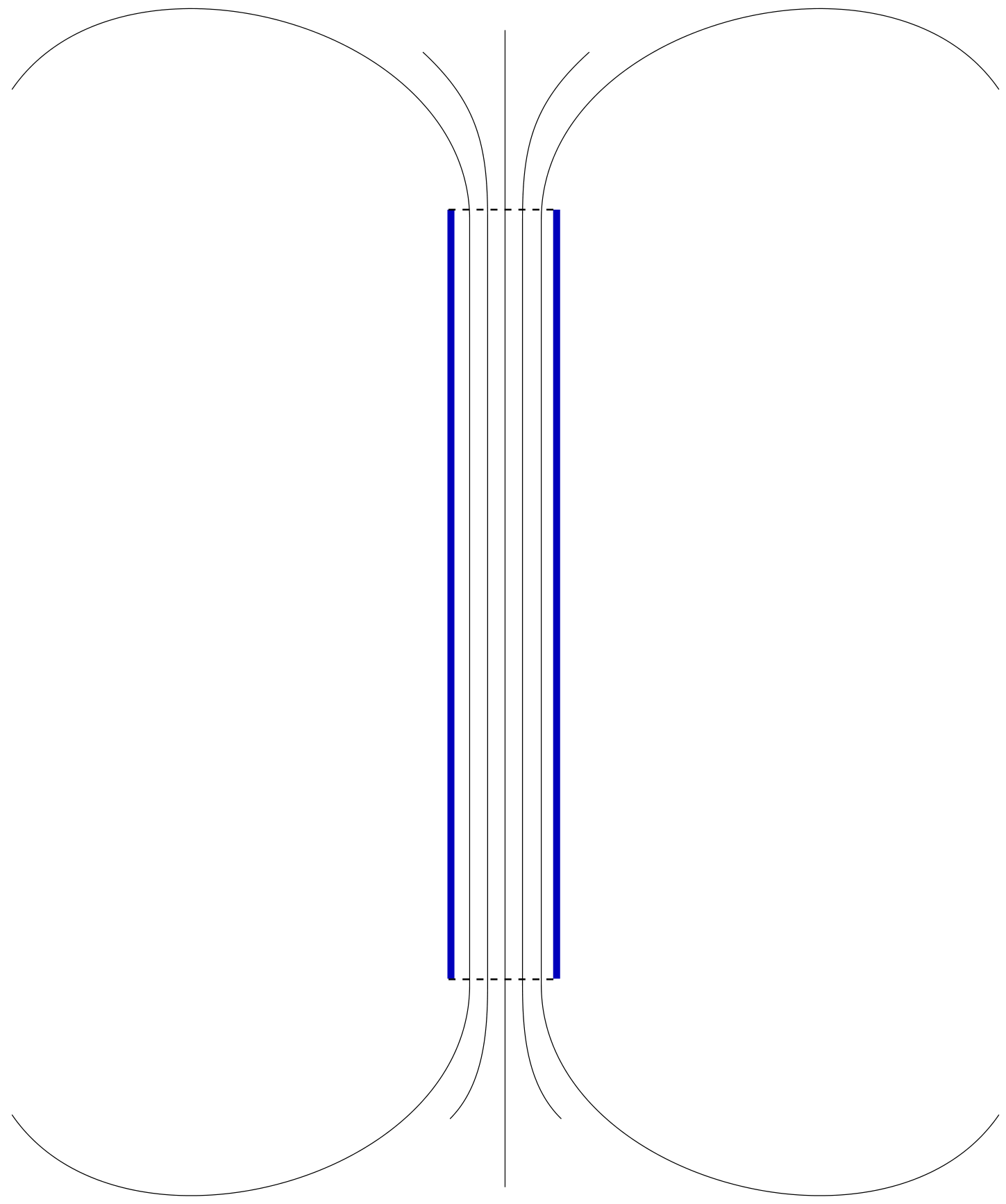
i. (0.8 pts) Sketch here five magnetic field lines.
ii. (1.2 pts)
iii. (2.5 pts)
Оригинал в Архива: th.pdf · официални решения: th_sol.pdf