IPhO 2012, Теория — Задача 3. Protostar formation
The 43rd International Physics Olympiad — Theoretical Competition. Tartu, Estonia — Tuesday, July 17th 2012 · 17 юли 2012 г. · 9 т.
Cover — general instructions
- The examination lasts for 5 hours. There are 3 problems worth a total of 30 points. Please note that the point values of the three theoretical problems are not equal.
- You must not open the envelope with the problems before the sound signal indicating the beginning of competition (three short signals).
- You are not allowed to leave your working place without permission. If you need any assistance (broken calculator, need to visit a restroom, etc), please raise the corresponding flag (“HELP” or “TOILET” with a long handle at your seat) above your seat box walls and keep it raised until an organizer arrives.
- Your answers must be expressed in terms of those quantities, which are highlighted in the problem text, and can contain also fundamental constants, if needed. So, if it is written that “the box height is and the width - ” then can be used in the answer, and cannot be used (unless it is highlighted somewhere else, see below). Those quantities which are highlighted in the text of a subquestion can be used only in the answer to that subquestion; the quantities which are highlighted in the introductory text of the Problem (or a Part of a Problem), i.e. outside the scope of any subquestion, can be used for all the answers of that Problem (or of that Problem Part).
- Use only the front side of the sheets of paper.
- For each problem, there are dedicated Solution Sheets (see header for the number and pictogramme). Write your solutions onto the appropriate Solution Sheets. For each Problem, the Solution Sheets are numbered; use the sheets according to the enumeration. Always mark which Problem Part and Question you are dealing with. Copy the final answers into the appropriate boxes of the Answer Sheets. There are also Draft papers; use these for writing things which you don’t want to be graded. If you have written something what you don’t want to be graded onto the Solution Sheets (such as initial and incorrect solutions), cross these out.
- If you need more paper for a certain problem, please raise the flag “HELP” and tell an organizer the problem number; you are given two Solution sheets (you can do this more than once).
- You should use as little text as possible: try to explain your solution mainly with equations, numbers, symbols and diagrams.
- The first single sound signal tells you that there are 30 min of solving time left; the second double sound signal means that 5 min is left; the third triple sound signal marks the end of solving time. After the third sound signal you must stop writing immediately. Put all the papers into the envelope at your desk. You are not allowed to take any sheet of paper out of the room. If you have finished solving before the final sound signal, please raise your flag.
Условие
Let us model the formation of a star as follows. A spherical cloud of sparse interstellar gas, initially at rest, starts to collapse due to its own gravity. The initial radius of the ball is and the mass is . The temperature of the surroundings (much sparser than the gas) and the initial temperature of the gas is uniformly . The gas may be assumed to be ideal. The average molar mass of the gas is and its adiabatic index is . Assume that , where is the gas constant and is the gravitational constant.
i During much of the collapse, the gas is so transparent that any heat generated is immediately radiated away, i.e. the ball stays in thermodynamic equilibrium with its surroundings. What is the number of times, , by which the pressure increases when the radius is halved to ? Assume that the gas density remains uniform. [0,8 т.]
ii Estimate the time needed for the radius to shrink from to . Neglect the change of the gravity field at the position of a falling gas particle. [1 т.]
iii Assuming that the pressure remains negligible, find the time needed for the ball to collapse from down to a much smaller radius, using Kepler’s Laws. [2,5 т.]
iv At some radius , the gas becomes dense enough to be opaque to the heat radiation. Calculate the amount of heat radiated away during the collapse from the radius down to . [1,7 т.]
v For radii smaller than you may neglect heat loss due to radiation. Determine how the temperature of the ball depends on its radius for . [1 т.]
vi Eventually we cannot neglect the effect of the pressure on the dynamics of the gas and the collapse stops at (with ). However, the radiation loss can still be neglected and the temperature is not yet high enough to ignite nuclear fusion. The pressure of such a protostar is not uniform anymore, but rough estimates with inaccurate numerical prefactors can still be done. Estimate the final radius and the respective temperature . [2 т.]
Отговори
- i 8
- ii
- iii
- iv
- v
- vi
Решение
i. (0.8 pts)
ii. (1 pt) During the period considered the pressure is negligible. Therefore the gas is in free fall. By Gauss’ theorem and symmetry, the gravitational field at any point in the ball is equivalent to the one generated when all the mass closer to the center is compressed into the center. Moreover, while the ball has not yet shrunk much, the field strength on its surface does not change much either. The acceleration of the outermost layer stays approximately constant. Thus,
where
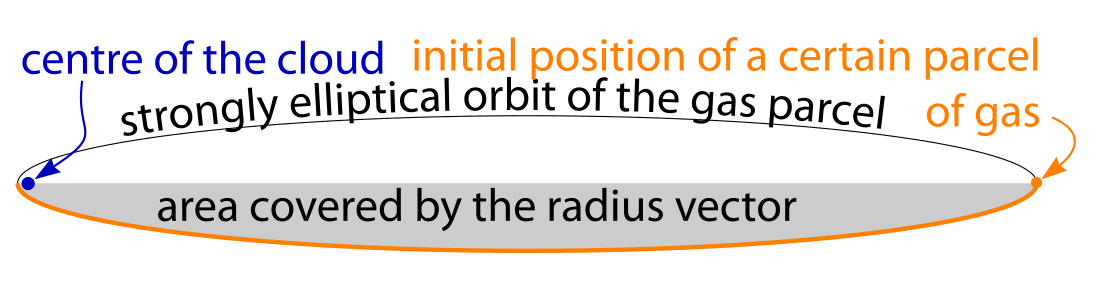
iii. (2.5 pts) Gravitationally the outer layer of the ball is influenced by the rest just as the rest were compressed into a point mass. Therefore we have Keplerian motion: the fall of any part of the outer layer consists in a halfperiod of an ultra-elliptical orbit. The ellipse is degenerate into a line; its foci are at the ends of the line; one focus is at the center of the ball (by Kepler’s 1st law) and the other one is at , see figure (instead of a degenerate ellipse, a strongly elliptical ellipse is depicted). The period of the orbit is determined by the longer semiaxis of the ellipse (by Kepler’s 3rd law). The longer semiaxis is and we are interested in half a period. Thus, the answer is equal to the halfperiod of a circular orbit of radius :
Alternatively, one may write the energy conservation law (that in turn is obtainable from Newton’s II law ) with , separate the variables () and write the integral . This integral is probably not calculable during the limitted time given during the Olympiad, but a possible approach can be sketched as follows. Substituting and , one gets
Here (after shifting the variable) one can use and , finally getting the same answer as by Kepler’s laws.
iv. (1.7 pts) By Clapeyron–Mendeleyev law,
Work done by gravity to compress the ball is
The temperature stays constant, so the internal energy does not change; hence, according to the 1st law of thermodynamics, the compression work is the heat radiated.
v. (1 pt) The collapse continues adiabatically.
vi. (2 pts) During the collapse, the gravitational energy is converted into heat. Since , The released gravitational energy can be estimated as (exact calculation by integration adds a prefactor ); the terminal heat energy is estimated as (the approximation follows from the result of the previous question, when combined with ). So, . For the temperature , we can use the result of the previous question, . Since initial full energy was approximately zero, , we obtain
Therefore,
Alternatively, one can obtain the result by approximately equating the hydrostatic pressure to the gas pressure ; the result will be exactly the same as given above.
Answer sheet (official answers) — Problem T3. Protostar formation (9 points)
i. (0.8 pts)
ii. (1 pt)
iii. (2.5 pts)
iv. (1.7 pts)
v. (1 pt)
vi. (2 pts)
Оригинал в Архива: th.pdf · официални решения: th_sol.pdf